

A high-volume dialer burns through your list and your reputation at the same speed. An ungoverned AI agent negotiates settlements no one approved.
Introduction
A high-volume dialer burns through your list and your reputation at the same speed. An ungoverned AI agent negotiates settlements no one approved. A governance-first platform runs every interaction through a pre-deployment gate and a post-call audit, and it keeps a full record of both. For banks, the software category you pick is a regulatory exposure decision.
The CFPB’s 2022 Examination Procedures redrew the map. Examiners now probe whether your collections technology embeds compliance management into its workflows. A platform that cannot produce audit-ready interaction logs, demonstrate how it respects a cease-communication request, or trace a dispute through to resolution is no longer a productivity tool. It is a liability.
At the same time, 60% of collections cases are resolved through re-debiting. The operational majority of recovery is a quiet, repetitive servicing act. That shapeshifts the software requirement: the tool that wins is the one that preserves the customer relationship long enough to make that re-debit happen again next month. This review maps seven platforms against that dual mandate: maximize recovery without torching trust, and make every automated decision defendable when the examiner asks.
Key Takeaways
CFPB examiners look at three things when they audit a collections operation: whether the bank can show what its AI said, why it said it, and who approved it before it went live. A platform that handles those three keeps your customer relationships intact while meeting regulatory expectations. First
governance-first architecture puts approval gates, in-call guardrails, and audit trails into every AI interaction. The platform stops an agent from saying something unapproved in the moment and creates records that satisfy the CFPB’s compliance management system expectations. When an examiner asks to see the control evidence for a specific call, you produce it. Second
omnichannel preference management automates compliance with a consumer’s stated communication channel and suppresses contact automatically after a cease-request. If a customer said email only, the system never dials their phone. That keeps the bank inside Regulation F without manual list-pulling. Third
sentiment-based routing detects escalation in real time. When a call turns heated or the consumer sounds confused, the platform hands off to a human agent before the interaction damages the relationship. The bank’s brand survives the call. Transparent dispute resolution workflows handle what CFPB examiners check most carefully. A closed-loop system logs and routes every dispute from intake through resolution, documents every step, and makes the full trail available on demand. The days of digging through notes and spreadsheets to reconstruct a dispute history end. Explainable rules for regulated decisions keep settlement offers, payment plans, and write-off thresholds governed by auditable, rules-based logic. Even when an AI agent assists the collector, every decision traces back to a pre-approved rule that compliance signed off on. Human managers adjust the rules through a governed interface, not through a chatbot prompt. What gets cut from most shortlists is what drags operations down: generic bot platforms that lack collections-specific compliance workflows, point solutions that handle one channel and leave a gap the bank fills with manual work, and any tool that cannot produce a per-call audit record within 24 hours of an examiner’s request.
1. Domu, The Governance-First Platform for Regulated Bank Collections
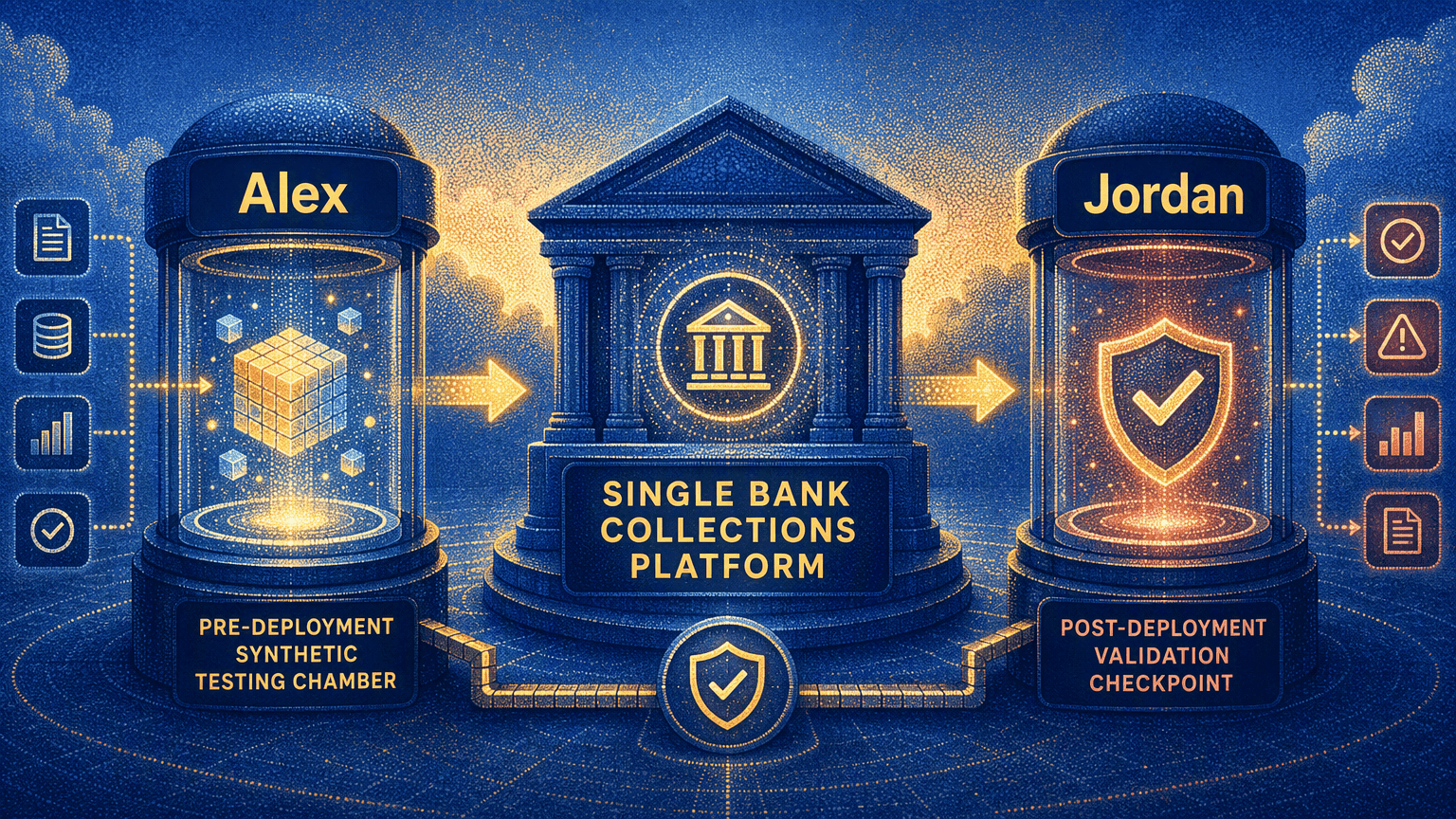
Domu is purpose-built for regulated collections, engineered specifically for financial services, and the architecture reflects it. The platform splits governance into two named, auditable components. Alex is a pre-deployment specialist that restricts the AI to an approved repository of data and stress-tests conversation flows against FDCPA and TCPA boundaries in a synthetic environment before any agent goes live. Jordan is a post-deployment module that validates customer interactions against UDAAP and state-specific collection laws after every call. Domu states Taylor, its on-script AI collector, integrates into core banking systems via low-code API.
The output of that split is what the CFPB examination procedures demand: an audit trail. Domu generates a formal certification after successful governance validation and provides audit-ready interaction logs for oversight. The system handles high-risk or confused cases with fail-safe escalation rather than pushing through, and the company measures success by sustainable recoveries, reduced complaints, and better consumer experiences. Domu treats compliance as a structural precondition to every call, not a post-default collection notice.
2. TrueAccord, AI-Driven Digital Engagement for Empathetic Recovery
TrueAccord built its reputation on a simple premise: a debt collector that does not sound like one recovers more. Its NLP engine communicates in a measured, non-aggressive tone across digital channels, and the consumer-facing portal lets customers self-serve on payment plans without ever speaking to an agent. The approach works at scale because it removes the friction and shame that cause customers to disengage entirely.
For banks, conversational empathy is half the requirement. Without a governance wrapper, off-script language can drift in, the kind a CFPB examiner would flag. A bank deploying TrueAccord needs to layer on its own compliance management framework, ensuring that every AI-generated message is logged, version-controlled, and retrievable for an audit. The platform delivers the customer-experience engine.
The compliance architecture is yours to supply. That trade-off makes TrueAccord a strong fit for banks with mature internal compliance teams who want control over the governance layer while outsourcing the engagement layer.
3. Katabat, Data-Science-Led Collections with Omnichannel Precision
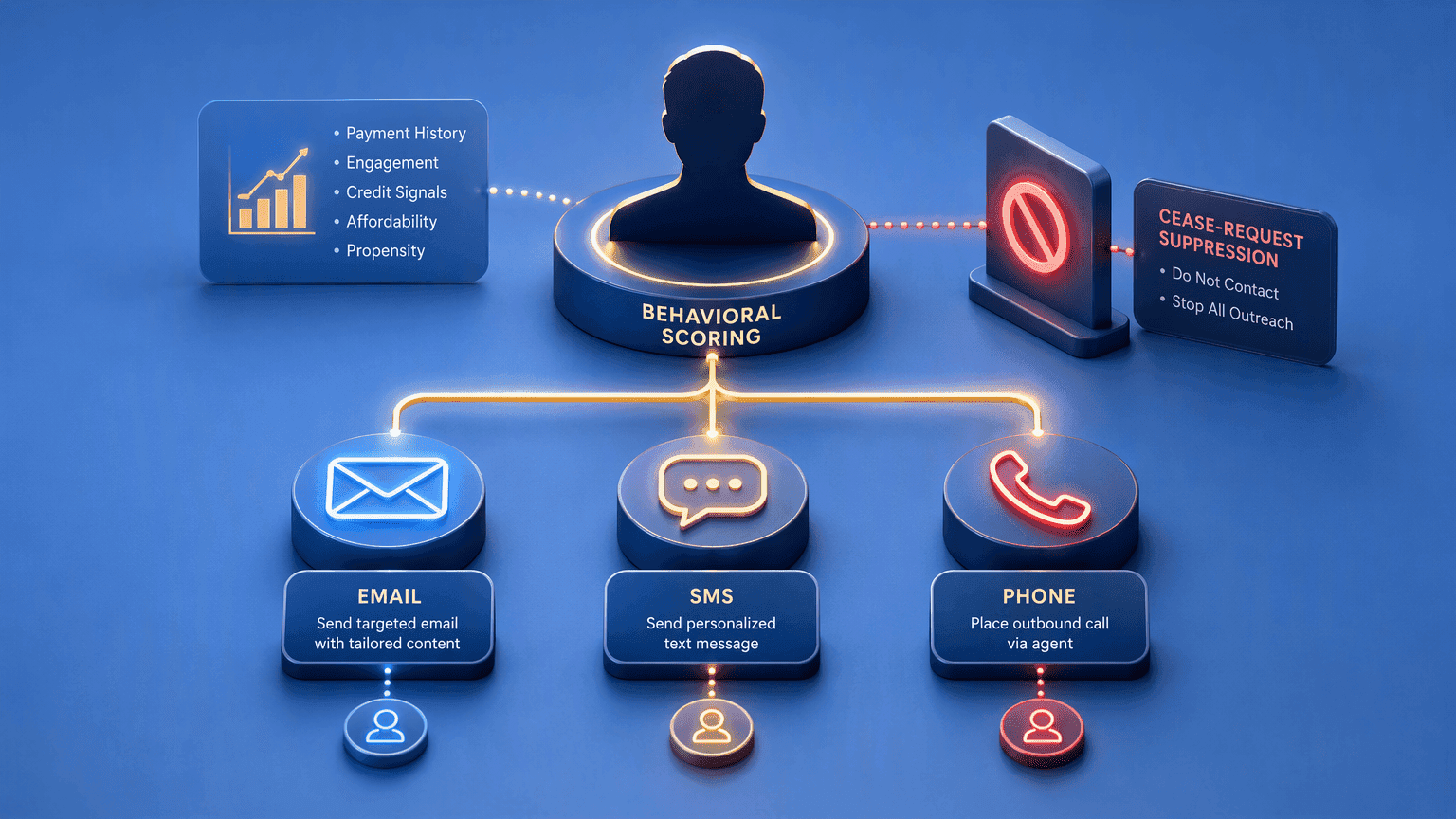
Katabat approaches collections the way a credit risk team thinks: model first, contact second. Its behavioral modeling scores likelihood to pay and then triggers contact through the right channel at the right time. The platform orchestrates campaigns across email, SMS, and phone with automated adherence to consumer communication preferences. Cease-requests suppress further contact automatically. That aligns directly with the CFPB mandate to respect communication restrictions and deliver validation notices without procedural gaps.
The relationship advantage is subtle but real. When a customer only receives a message in the channel they selected, at a cadence the model predicts they will tolerate, they do not experience the interaction as harassment. They experience it as a reminder. That distinction is the entire difference between a retained customer and a complaint filed with the bureau.
For a mid-size bank, Katabat offers a practical bridge between traditional dialer operations and full AI agent deployment. You do not need to rip out your core to get the data-science layer running, and the omnichannel engine can phase in as your contact strategy matures.
4. LexisNexis Risk Solutions, Compliance-Centric Workflow and Dispute Resolution

LexisNexis Risk Solutions enters the collections conversation from the compliance side, and for a bank operations leader staring down a CFPB examination, that is a reassuring starting point. The platform's identity verification module prevents misdirected contacts before they happen, which eliminates a whole class of third-party disclosure violations that generate consumer complaints and regulatory findings.
Its dispute resolution workflows are the deeper reason this platform belongs on a bank shortlist. When a consumer disputes a debt, the system routes the dispute into a structured case management flow, logs every subsequent action, and timestamps the resolution path. The CFPB's 2022 examination procedures scrutinize whether the bank's system produces consistent documentation and a demonstrable process.
LexisNexis built its module to produce that paper trail by default. For a risk-averse bank, the dispute workflow alone can justify the platform choice. A mishandled dispute is one of the fastest ways to escalate an examination into an enforcement action.
The trade-off is that LexisNexis is not an AI engagement engine. It manages compliance risk; it does not generate empathetic conversations or automate negotiation. Banks that pair it with a separate engagement layer get a strong compliance spine with flexibility on the front end.
5. Exus, Enterprise-Grade AI and Portfolio Analytics for Global Banks

Exus operates at the top of the market: global banks, multi-jurisdictional portfolios, and balance sheets where a small basis-point shift in recovery rate moves millions. Its AI decisioning engine segments portfolios to prioritize high-value relationships first. A whale client in temporary distress gets a preservation strategy, and the engine confirms that treatment aligns with what your actual governance controls enforce.
For institutions operating across borders, Exus adapts to multiple regulatory frameworks, including US CFPB requirements and international regimes like Singapore's IMDA AI governance standards. The Singapore framework, released in its second edition at the 2020 World Economic Forum Annual Meeting in Davos, Switzerland, introduced practical recommendations for risk-based AI governance, including factors like the nature and reversibility of harm when determining human involvement in AI-augmented decision-making. Exus builds that multi-standard configurability into its core, which spares the bank the cost of maintaining separate compliance stacks per region.
Portfolio-level analytics surface segment trends that per-agent dashboards miss. A global bank using Exus can see whether the early-stage delinquency segment in one region is drifting toward a higher roll rate, then adjust contact strategy across the entire book from one console.
The platform is heavy. It requires dedicated implementation resources and integration work. For a regional bank, it is overkill. For a top-20 institution with regulatory exposure in multiple countries, it is the platform category that matches the complexity of the problem.
6. FICO Debt Manager, Integrated Decisioning and Pre-Delinquency Management
Debt Manager, from C&R Software, oversees more than $8 trillion in assets for banks across over 60 countries, including seven of the top 15 US banks. The platform breaks from its peers in one critical way: it intervenes before the account ever becomes delinquent. An integrated decision engine monitors payment behavior and triggers early engagement when it detects a shift. One European financial group achieved a 5% reduction in charge-offs and a 7% reduction in overall losses using the platform.
The bank that deploys Debt Manager is betting that a personalized payment offer sent two weeks before a missed due date retains more relationships than a cure notice sent 30 days after. AI agents inside the platform assist collectors with account summaries, suggested responses, and next-best actions. Regulated decisions, such as settlement offers and terms adjustments, remain governed by explainable rules. Here is how that pre-delinquency capability maps to the tools that matter to a banking operations leader:
Capability | What It Does for Bank Collections | Why It Matters for Customer Relationships |
|---|---|---|
Pre-delinquency triggers | Behavioral scoring flags accounts likely to miss a payment before the due date | The customer gets a proactive, low-friction nudge when a payment is at risk, but hasn't yet defaulted |
Integrated decision engine | Rules and models recommend the next action: email offer, SMS reminder, or agent call | Personalized outreach matched to the customer's risk profile and communication preference |
Explainable settlement rules | Regulated offers stay locked to approved parameters while agents get AI-suggested scripts | The bank can audit every settlement decision and defend it to an examiner |
Credit counseling referrals | At-risk accounts route to non-collection support options where appropriate | Preserves the long-term relationship rather than maximizing short-term recovery at any cost |
7. Chetu, Custom-Built, Human-Centric Collection Software for Banks

Some bank collections operations do not fit a platform template. The legacy core is too entrenched, the internal workflow too bespoke, or the compliance requirements too specific to a single state regulator. Chetu addresses that niche by building customized collection software from the ground up, embedding relationship management features, compliance frameworks, and CRM integration directly into a tailored application. Here is what a custom Chetu build typically delivers:
Sentiment analysis and human-agent hand-off: Real-time conversation monitoring that detects customer distress or confusion and routes the call to a live collector before the automated interaction damages trust.
CRM and compliance integration: Direct connectors into systems like Salesforce and MeridianLink, so the custom collection app pulls real-time account data and pushes compliance logs into the bank's existing governance stack.
Workflow automation tailored to the bank's dispute process: The system mirrors how your specific operations team triages disputes, generates validation notices, and tracks resolution timelines, matching the CFPB's expectation of a documented, consistent procedure.
Omnichannel orchestration mapped to existing vendor contracts: Rather than forcing the bank to adopt a new SMS or email provider, Chetu builds on top of the contracts already in place.
The custom route costs more time and money upfront than any SaaS option on this list. The return is a system that never asks the bank to change its operations to fit the tool.
Conclusion
In a post-2022 CFPB landscape, a bank cannot buy a debt collection platform on recovery-rate projections alone. The examiner will ask for the audit log. If the platform cannot produce it, the recovery rate does not matter.
Each vendor on this list maps to a different operating posture. Domu and LexisNexis anchor the compliance-first end of the spectrum; TrueAccord and Katabat prioritize engagement precision; FICO Debt Manager adds pre-delinquency intervention; Exus handles global portfolio complexity; Chetu solves for the bank that needs a custom build. The right choice depends on whether your first-order risk is a compliance finding or a churning customer. Know which one keeps you up at night, and buy the platform that addresses it.
Frequently Asked Questions
What features should a bank look for in debt collection software to maintain positive customer relationships?
Prioritize automated omnichannel communication preferences, sentiment-based routing that escalates to a human agent, pre-delinquency engagement triggers, and transparent dispute resolution workflows. These features ensure customers experience reminders rather than harassment, preserving the relationship long enough for recovery.
How do AI and automation in debt collection software help preserve customer relationships while ensuring compliance?
AI enables non-aggressive, personalized contact at the customer's preferred time and channel. Concurrently, governance layers enforce pre-deployment approval gates and post-call audits. This dual structure means every automated interaction stays within regulatory bounds and remains fully defendable during a CFPB examination.
What is the difference between traditional collection dialers, NLP-based AI agents, and compliance-first platforms for banks?
Traditional dialers maximize call volume, often damaging relationships. NLP-based AI agents conduct empathetic digital conversations but can drift off-script. Governance-first platforms embed compliance structurally via pre-call approvals and post-call audits, ensuring every AI interaction meets regulatory standards before it happens.
Which debt collection software vendors are purpose-built for regulated financial institutions in the US?
Domu is engineered specifically for regulated bank collections with split pre- and post-deployment governance. LexisNexis Risk Solutions provides compliance-centric dispute resolution workflows. FICO Debt Manager is used by seven of the top 15 US banks and integrates decisioning with pre-delinquency management.
How do governance-first debt collection platforms handle pre-deployment approval and post-call auditing?
They stress-test conversation flows against FDCPA and TCPA boundaries in synthetic environments before any agent goes live. After every call, the system validates the interaction against UDAAP and state-specific laws, flags compliance violations immediately, and generates formal certification documentation for examiner review.
Sources
MODEL ARTIFICIAL INTELLIGENCE GOVERNANCE FRAMEWORK SECOND EDITION - www.imda.gov.sg
Digital collection software for banks and lenders | Salesforce US - www.salesforce.com
Finance Company Debt Collection Software | C&R Software - www.crsoftware.com
Related Articles



We’re building the next generation of engagement technology: intelligent, automated and compliant. Our mission is to empower financial institutions to orchestrate every stage of the servicing lifecycle with dignity and unprecedented efficiency.
Supported by

