

Your recovery floor runs on static scripts your best agents ignore and your worst ones hide behind.
Introduction
Your recovery floor runs on static scripts your best agents ignore and your worst ones hide behind. The cost-per-contact is rising, complaints are mounting, and the CFPB is watching. Every interaction that follows a single rigid flow leaves money on the table with a debtor who might pay and pushes a struggling one further from resolution. Traditional collections pits efficiency against compliance and human empathy against volume, and loses on all three.
That friction has a hard dollar cost. When a high-capacity debtor receives the same robotic script as someone facing genuine hardship, recovery rates collapse. Behavioral heterogeneity, the fact that debtors bring rich emotional expression, cognitive limitations, and diverse linguistic styles to every call, breaks one-size-fits-all models. The research community only recently confirmed what collections veterans already knew: most large language models achieve success rates below 75% on realistic debt collection scenarios because they cannot handle this behavioral spread.
What changed in practice is the convergence of two forces. Voice AI matured past the uncanny valley of robotic prompts and holds a real-time, empathetic conversation that adapts its tone, offer structure, and negotiation path mid-call. Behavioral intelligence layered on top stops treating every account like a balance with a phone number and instead profiles a debtor by psychology and capacity, distinguishing someone ready to pay from someone spiraling into hardship long before a human collector would spot the difference.
The market crystallized in July 2026 when Symend launched SymendConverse, the first conversational AI for collections purpose-built on behavioral science. It capped a year of platform launches that combine real-time emotion analysis, Delinquency Archetypes, autonomous negotiation, PCI-compliant payment capture, and audit-ready call logging into single stacks. Below, we break down the seven platforms leading this shift, each one a different architectural bet on what compliant, AI-driven collections should look like at scale.
Key Takeaways
Behavioral intelligence voice AI is no longer an R&D experiment. The production platforms listed below are curing delinquencies at scale right now. Here is what the data, the regulatory environment, and the platform capabilities tell us:
SymendConverse launched July 2026 as the first conversational AI for collections purpose-built on behavioral science and Delinquency Archetypes, capping a market-defining year.
Behavioral heterogeneity is the problem: research confirms real-world debt negotiation exhibits rich emotional expression, cognitive limitations, and diverse linguistic styles that break static scripts and generic LLMs.
Mini-Miranda insertion, dispute flagging, PCI masking, and audit-ready logging are table stakes.
Archetype-driven personalization beats segmentation: classifying a debtor by capacity and readiness in real time, and adapting tone, offer, and path, lifts recovery while reducing complaints.
The handoff is part of the product: leading platforms preserve conversation context, psychological profile, and compliance state when a human agent takes over, closing the loop between AI and live negotiation.
1. Domu: Real-Time Emotion Analysis with Governance-First Architecture
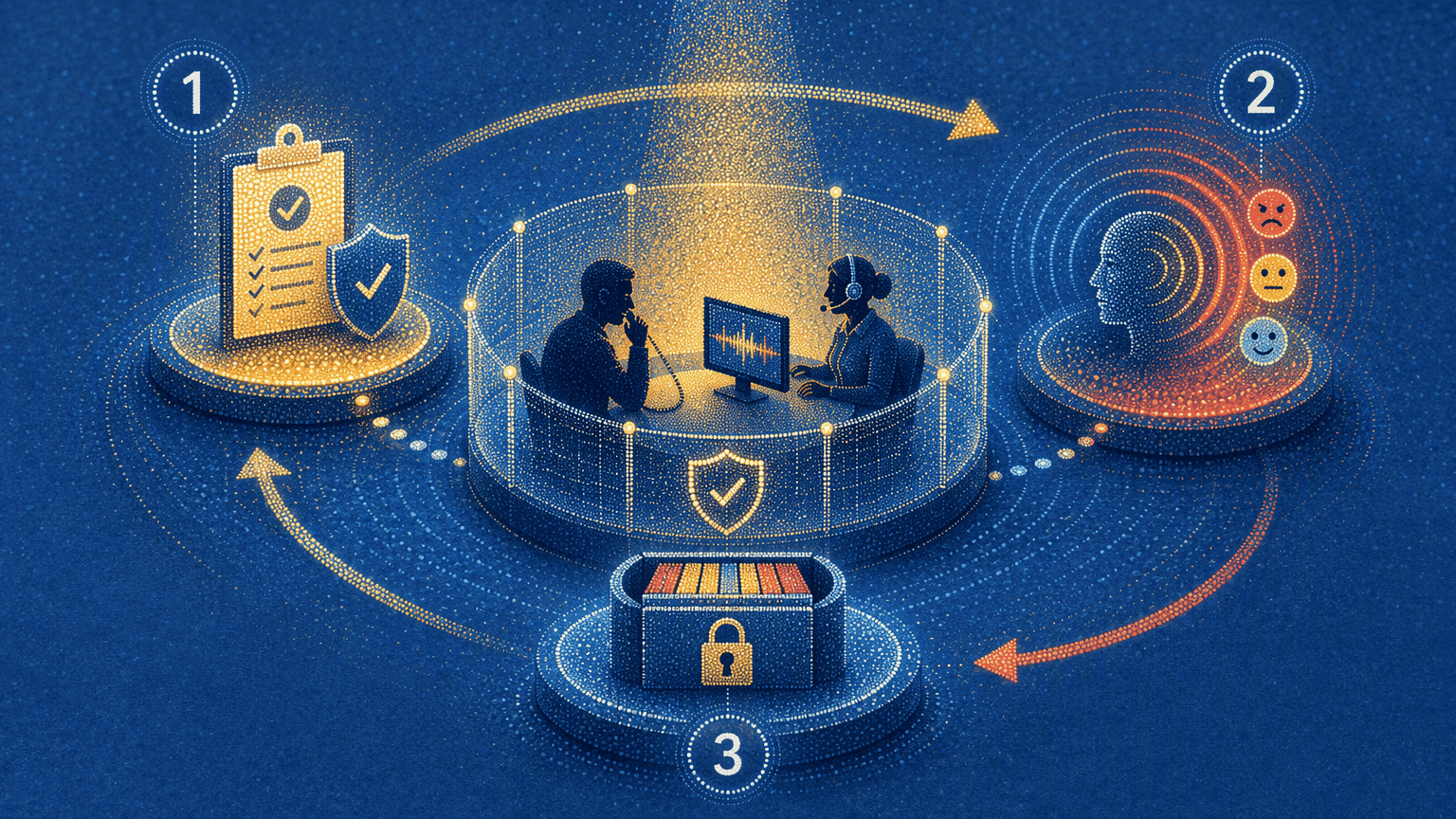
Domu approaches the compliance and behavioral intelligence problem through a governance-first orchestration layer that wraps every live call in pre-deployment certification, real-time monitoring, and post-call audit. Taylor, Domu's on-script AI collector, analyzes speech and emotional cues during the call, not afterward in analytics, and redirects the conversation flow when it detects anger, confusion, or acute financial stress.
Governance architecture: every conversation is fenced. A pre-deployment governance specialist named Alex restricts the AI to an approved data repository and certifies the agent before launch. Post-deployment, a second module named Jordan validates interactions against UDAAP and state-specific collection laws.
Real-time compliance enforcement: the system automatically flags compliance violations during live calls, providing immediate oversight rather than after-the-fact audits. It stress-tests conversation flows against FDCPA and TCPA boundaries in a synthetic environment before an agent ever goes live.
Safe escalation design: when a case triggers high risk or confusion, Domu escalates to a human rather than pushing through.
Enterprise deployment reality: Domu requires integration into core banking systems via low-code API on one side and CRM, data warehouse, and knowledge base on the other. Domu says its voice AI handles thousands of live calls every day for Fortune 500 banks and insurers, end to end. It reports call volume increasing 3x monthly and is backed by Y Combinator.
2. SymendConverse: Archetype-Led Personalization with Scalable Automation
The Delinquency Archetypes model is the conceptual core of SymendConverse, and the reason financial institutions paid attention to the July 2026 launch. It classifies every debtor not by balance or days past due but by two behavioral axes: capacity to pay and readiness to pay. That sounds simple, but it changes everything downstream. A high-capacity, high-readiness customer gets a tone of respectful urgency and loss-aversion framing. A low-capacity, low-readiness customer gets empathy, option walk-throughs, and a conversation structure designed to preserve the relationship while surfacing a path to resolution.
The voice layer operationalizes those archetypes in real time. SymendConverse embeds compliance safeguards directly into that adaptive conversation flow: Mini-Miranda disclosures fire at the right moment, dispute language automatically pauses and flags the interaction, and PCI-compliant masking ensures payment card data never sits in plain text in a transcript. When a call escalates, the warm handoff transfers the full conversation history, the debtor's psychological profile, and the compliance state. The human agent picks up mid-arc rather than starting from zero.
The numbers behind Symend tell a story about scale: over 250 million cured delinquencies and more than $50 billion recovered for enterprises. The Converse voice agent closes the loop between behavioral profiling originally built for digital channels and the live phone conversations where most difficult recoveries still happen. For a large telecom or financial services operation fielding millions of collection calls, that closed loop means the system refines its archetype model with every interaction.
It is the most complete integration of behavioral science and voice AI in a single production platform today.
3. TCN Operator: Hybrid Compliance Guardrails for High-Volume PCI Capture
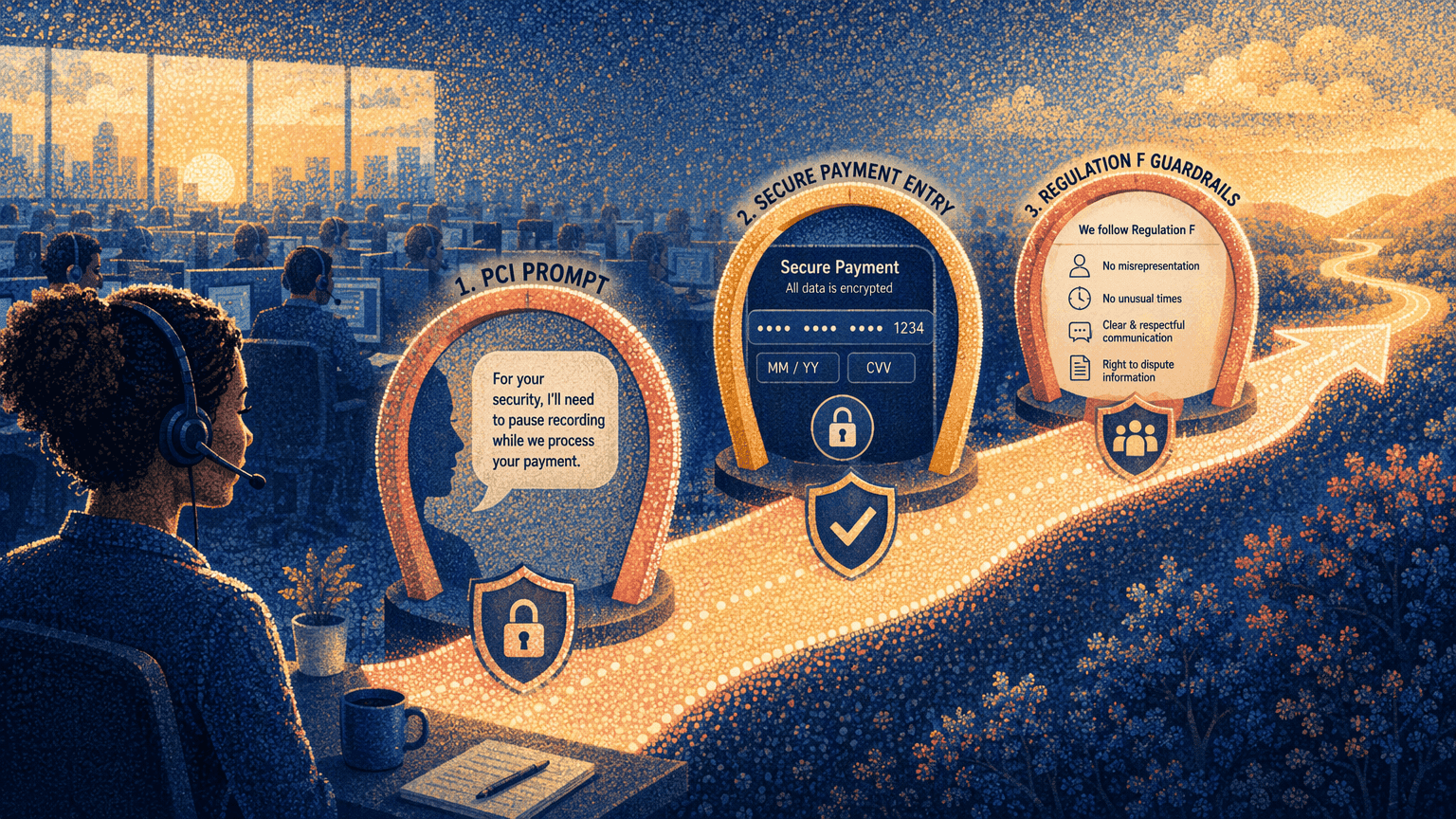
TCN Operator represents a different architectural bet than the conversational AI platforms further up this list. It is not NLP-based conversational AI in the sense of real-time adaptive dialogue. It solves one operational bottleneck that trips up even the best voice agents: compliant payment capture at scale. In high-volume consumer collections, every second the agent or AI spends navigating a PCI-compliant payment flow while staying within Regulation F call-frequency boundaries is a second of margin lost.
TCN Operator operates on a hybrid human-AI model, layering AI-driven compliance guardrails across thousands of concurrent interactions without requiring live agent intervention for every call. The compliance engine enforces call-disposition rules: which calls can happen when, what voicemail falls into the limited-content safe harbor, and what steps must follow a right-party confirmation.
The trade-off is clear. For a mid-market agency running hundreds of thousands of outbound attempts per month where recoveries hinge on getting payments processed cleanly, that is often the right trade-off.
Over successive releases, TCN has added SMS, email, and payment tools to the Operator suite. The suite is gradually moving toward omnichannel orchestration. The platform's core differentiator remains its compliance guardrail architecture for high-volume PCI capture, not its conversational intelligence.
4. Rezo.ai: AI-Powered Empathy with Autonomous Negotiation Fallbacks
Dimension | Rezo.ai Approach | Typical Automation Risk |
|---|---|---|
Tone modeling | Matches debtor sentiment in real time, shifting from assertive to empathetic mid-call | Static scripts that sound robotic when a debtor shows distress |
Negotiation autonomy | Autonomous engine can offer, counter-offer, and finalize payment plans within compliance boundaries | Human-dependency bottlenecks where agents re-enter negotiations for every settlement |
Fallback logic | Call triggers handoff to human collector when AI reaches the edge of its negotiation parameters | Hard cutoffs that drop context when transferring |
Compliance integration | Settlement disclosures embedded in the autonomous flow rather than bolted on after negotiation | Manual compliance checks that slow settlement velocity |
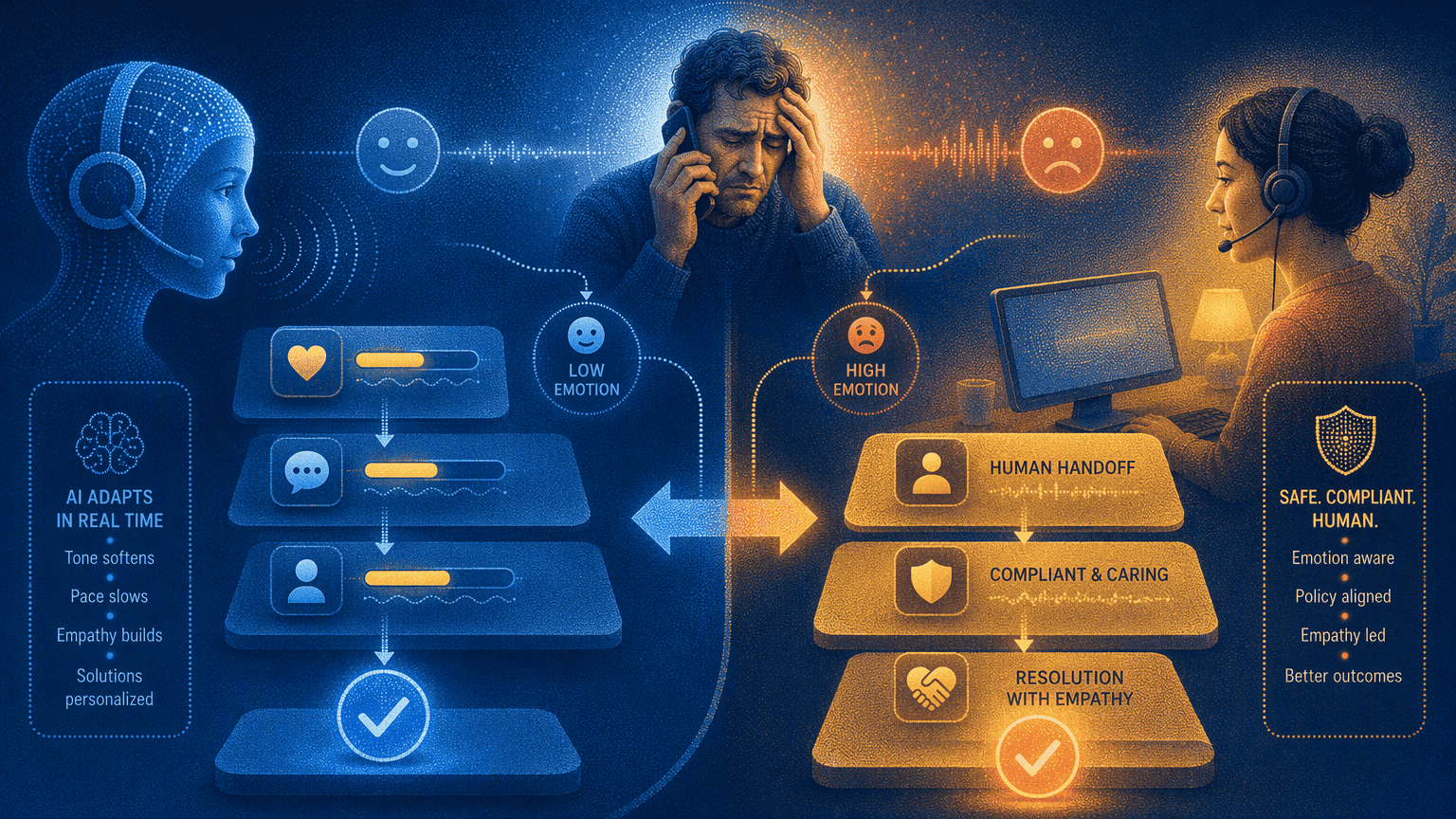
The table above clarifies what makes Rezo.ai distinct in a field where empathy and autonomy rarely coexist under the same compliance umbrella. Most collections AI forces a choice: sound human but stay manual, or automate at the cost of sounding like a machine. Rezo.ai rejects that trade-off. The engine reads sentiment markers as the call unfolds and adjusts. A debtor who starts guarded gets a softer pace; one who pushes back on terms gets a direct, data-driven counter-offer without waiting for a manager. The negotiation itself runs autonomously. Rezo's engine proposes settlements, handles objections, and books payment plans, staying within the guardrails a creditor sets beforehand. When a debtor asks for terms the system cannot approve, the call hands off to a human collector. The agent sees the full transcript and all the context the AI gathered, so the conversation picks up without restating account numbers or revisiting resolved points. That handoff matters because compliance disclosures live inside the autonomous flow. Settlement terms, payment authorizations, and required notices get captured in the call record automatically. There is no separate step where an agent manually reads a disclosure script after the negotiation concludes.
5. Skit.ai: Multilingual Voice Agents with Controlled Escalation Logic

If your portfolio spans English and Spanish-speaking consumers in the US, Skit.ai solves the language problem natively without bolting on translation middleware. Its voice agents handle both languages in the same call flow, recognizing code-switching and responding in kind. This matters because a rigid single-language bot breaks trust the moment a customer switches to their preferred language mid-sentence.
Under the hood, Skit.ai bakes controlled escalation logic into every interaction. The agent doesn't just hand off to a human on a keyword trigger. It tracks sentiment drift, repeated objections, and payment refusal patterns across the call, then escalates with full context when the conversation crosses a risk threshold.
The human agent picks up knowing exactly what was offered, what was refused, and what emotional state the customer is in. Skit.ai's architecture addresses a hard truth in collections AI: most existing models struggle in persona-enriched debt collection scenarios, achieving success rates below 75%. Building for behavioral heterogeneity isn't optional.
Skit.ai trains its models on real-world negotiation patterns that include rich emotional expression, cognitive limitations, and diverse linguistic styles, the three behavioral axes that break static-script systems. For mid-size firms running bilingual portfolios, this combination of multilingual fluency and controlled escalation makes Skit.ai a practical pick.
6. Finvi (Ontario Systems): Artiva RM for Audit-Ready Logging and Telephony Integrity
Finvi's Artiva RM isn't an AI-native conversational platform. It's a revenue cycle workstation built for compliance officers who need every call logged, time-stamped, and retrievable for audit on demand. Think of it as the telephony integrity layer that predates the current AI wave, offering something many newer tools skip: unbroken chain-of-custody records for every consumer interaction.
The platform provides audit-ready interaction logs that hold up under CFPB scrutiny. This matters because the CFPB was established in 2010 through the Dodd-Frank Act specifically to enforce federal consumer financial law, and examiners expect documentation that proves what was said, when, and by whom. Artiva RM's logging architecture predates generative AI, so the records are deterministic and structurally predictable, two qualities compliance teams love.
It doesn't ship a native NLP agent that picks up the phone and negotiates. What it does is give you a telephony backbone that integrates with predictive dialers and agent workflows while maintaining the logging standard required under the Fair Debt Collection Practices Act. For organizations migrating toward AI but still running significant live-agent floors, Finvi provides the compliance substrate without asking you to rebuild your entire dialer infrastructure. It's less about behavioral intelligence and more about evidentiary integrity.
7. CallMiner Eureka: Post-Call Behavioral Analytics Feeding Live Agent Scripts

CallMiner Eureka takes a different angle on behavioral intelligence: it analyzes calls after they happen and uses what it learns to reshape future conversations. While platforms like SymendConverse adapt in real time during the call, CallMiner's approach is to mine thousands of recorded interactions for the patterns that predict payment, dispute, or escalation, then surface those signals in agent-facing guidance.
This post-call analysis loop works best for contact centers still running high human-agent volume but wanting AI-informed coaching. Eureka extracts emotion signals, objection cadences, and settlement language from call transcripts and builds behavioral profiles that agents can reference on their next contact with the same consumer. The system hands off to a human on a keyword trigger. It equips the human agent with data-driven guidance before and after a conversation ends.
Where CallMiner earns its spot: it bridges the gap between legacy collections floors and the emerging AI-first model. Traditional dashboards don't surface certain voice-agent failure modes, and CallMiner's analytics layer catches what static QA misses. The trade-off is latency. Behavioral insight here is a retrospective input for training and scripting rather than something that steers a live call. For organizations not ready to hand negotiations to an AI agent but serious about data-driven collections strategy, it's a pragmatic incremental step rather than a full-platform bet.
Conclusion
Voice AI with behavioral intelligence is already operating in production debt recovery. SymendConverse launched in July 2026 as the first conversational AI for collections purpose-built on behavioral science, and platforms like Domu are deploying voice agents that analyze speech and emotional cues during live calls rather than after them. The shift from static scripts to adaptive negotiation has arrived.
Each of the seven platforms in this list made a deliberate architecture choice about where the behavioral intelligence lives: during the call or after it, in a voice agent or as agent coaching, through multilingual fluency or audit-grade logging. Your decision comes down to which part of the collections lifecycle you're optimizing.
The compliance reality is non-negotiable. The Fair Debt Collection Practices Act governs every collector in the US, and the eCFR was last amended August 29, 2026. Any platform you evaluate must handle Mini-Miranda disclosures, dispute recognition, and payment data masking as structural features, not bolt-on filters. The systems worth deploying treat compliance as part of the call architecture. Choose accordingly.
Frequently Asked Questions
What is behavioral intelligence in the context of debt collection?
Behavioral intelligence in debt collection is a method that categorizes delinquent customers by their psychological and financial profile rather than just their balance. Platforms like Symend use Delinquency Archetypes to distinguish between a customer who can pay but hesitates and one facing genuine hardship, enabling personalized treatment.
How do voice AI systems handle regulated debt collection conversations?
They handle compliance architecturally, not just as a script overlay. They automatically deliver mandatory Mini-Miranda disclosures, recognize dispute language to pause outreach, mask payment card data in transcripts, and process opt-outs in real time.
What solutions combine voice AI with behavioral analytics for collections today?
SymendConverse is the first conversational AI built on behavioral science, launched in July 2026. It analyzes a debtor’s real-time responses to classify them into a Delinquency Archetype, then instantly adapts the voice agent's tone, negotiation strategy, and payment options to maximize resolution without escalating tension.
How does compliance work when AI collectors analyze debtor behavior in real time?
Compliance is embedded in the decision logic. When the AI detects dispute language, it halts collection activity immediately.
What are the benefits of behavioral intelligence for recovery rates and consumer experience?
It boosts recovery by matching the engagement to the consumer's ability and willingness to pay. Symend has cured over 250 million delinquencies and recovered more than $50 billion. The consumer experience improves because they receive a relevant, respectful interaction instead of a one-size-fits-all demand.
Sources
Debt Collection | Federal Trade Commission - www.ftc.gov
eCFR :: 16 CFR Chapter I Subchapter I -- Fair Debt Collection Practices Act - www.ecfr.gov
CFPB - Congress.gov - www.congress.gov
Everyone is unique: Towards Behaviorally Heterogeneous Negotiation Dialogue Systems for Debt Collection - arxiv.org
Symend Launches SymendConverse, the First Conversational AI for Collections Built on Behavioral Science | Morningstar - www.morningstar.com
Related Articles



We’re building the next generation of engagement technology: intelligent, automated and compliant. Our mission is to empower financial institutions to orchestrate every stage of the servicing lifecycle with dignity and unprecedented efficiency.
Supported by

