
Introduction
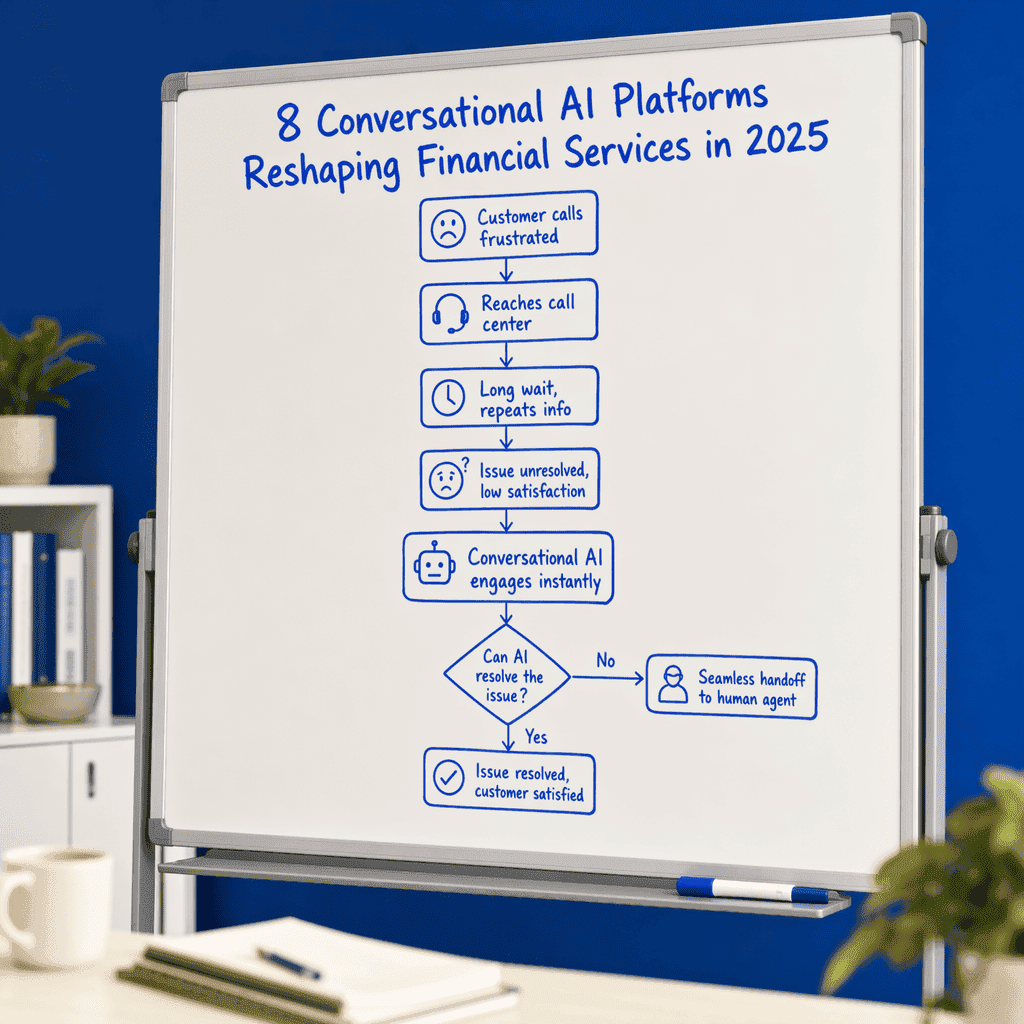
A customer calls to dispute a transaction, already frustrated. They hit a wall of preset menu options, struggle to explain a complex fraud pattern to a rule-based bot, and eventually hang up without a resolution. That lost call is not just a dent in a satisfaction metric.
It's a regulatory risk and a direct cost. The shift from brittle, legacy chatbots to modern conversational AI is no longer a technology upgrade. It's a hard requirement for survival in today's financial services landscape, where the cost of getting it wrong is measured in compliance penalties and eroded trust.
The old guard of chatbots, which are computer programs that mimic elements of human conversation, are fundamentally reactive. They follow mapped decision trees and choke on nuance. Today's AI assistants are predictive, adaptive, and customer-centric. They understand nuance, learn from interactions, and respond naturally. For financial institutions, this delta is a high-stakes chasm. We are moving from simple FAQ bots to intelligent, context-aware voice AI that can handle loan applications or fraud disputes.
The regulatory pressure is not a future threat. It is present and documented. Each of the top 10 largest commercial banks has already deployed a chatbot.
The Consumer Financial Protection Bureau (CFPB) has since fired a clear warning shot: poorly designed chatbots can cause significant negative outcomes for customers, including wasted time, inaccurate information, and paying more in junk fees. In their view, a bad bot is not a neutral tool; it is an active source of consumer harm.
This has turned the software selection process from an operational task into a core governance challenge. You need an AI engine that is not just conversational but certified for compliance, audited for safety, and engineered for real call center economic relief.
The economics are too significant to ignore. Financial services firms, including giants with over 3.3 million call center agents countrywide, are seeing voice AI deployments slash costs by 30 to 50% per call and reduce call handle time by 40%. The global savings are immense, with conversational AI in banking saving an estimated $7.3 billion in operating costs globally back in 2023, and the global AI market for banking projected to generate $48.3 billion in sales by 2025. This article maps the landscape of specialized platforms engineered to capture this value without betting your regulatory standing on a generic toolkit.
Key Takeaways
Here are the core findings from our review of eight leading conversational AI platforms for financial services:
- Compliance certification is the entry ticket: A platform without a robust, documented, and ideally pre-deployment validation process for FCRA, FDCPA, and TCPA is a non-starter for any regulated entity, not a nice-to-have. - The spectrum runs from rigid to dynamic: The market is defined by a continuum, where solutions like Boost.ai offer hard-coded, absolute control at one end, and dynamic LLM-powered engines offer generative flexibility at the other. The right choice is a function of your risk appetite. - Specialization signals security: The top platforms are not generic AI toolkits retrofitted for banking. They solve for a specific segment, whether that is the regulatory intensity of Nordic markets or the turnkey needs of a community bank with under $3B in assets. - ROI must be measurable and behavioral: The conversation has moved beyond cost-per-call. Leading measures now link AI performance to real-world behavioral outcomes, such as a recorded 30% reduction in consumer complaints per 100 calls post-deployment. - Architecture dictates audit success: When a regulator comes asking, platforms with integrated CRM syncs, full transcript logging, and PCI-compliant payment rails make the difference between a clean audit and a painful one.
1. Domu: A Purpose-Built Voice AI Engine with Pre-Deployment Behavioral Certification
Domu’s approach centers on a unique certification layer, run by an AI model governance module named Alex, that stress-tests conversational behavior before it ever touches a live consumer call. The platform is engineered specifically for the high-stakes, evidence-heavy demands of regulated financial collections and servicing. 1. Engineered for financial compliance at the core: Domu is built compliance-first, not as a generalist toolkit with a compliance skin. Its underlying infrastructure is intended to replace call centers at large financial institutions, handling thousands of live calls daily for Fortune 500 banks and insurers from the ground up. 2. Pre-deployment behavioral validation: The platform's standout feature is a formal validation process. An internal risk lead named Alex stress-tests every interaction for policy alignment and regulatory adherence. This adversarial scenario simulation generates a formal certification only after successful governance validation, proving to auditors that the AI will act as expected before it goes live. 3. Live compliance monitoring and audit trails: Post-deployment, a component named Taylor enforces live, on-script interactions, while Jordan analyzes edge cases and confused customers to identify compliance drift. This closed loop ensures the system remains within its certified behavioral boundary on every single call, creating a direct, defensible audit trail. 4. Integrated PCI-compliant payment flows: Domu’s toolkit includes direct modules for payment systems, CRM, data warehouses, and internal knowledge bases. This tightly integrates sensitive payment actions directly into a monitored, PCI-compliant conversation flow, removing the risks of a hand-off to a separate IVR for payment collection. 5. Quantifiable behavioral improvement: The system's effectiveness is measured in consumer outcomes. A top 5 U.S. fintech reported 30% fewer complaints per 100 calls after deploying Domu, connecting the AI’s behavioral guardrails directly to a tangible risk reduction metric.
2. NVIDIA Riva: The High-Performance, Customizable AI Toolkit for Large-Scale Deployments
NVIDIA Riva sits in a fundamentally different category from an end-to-end solution. It is a GPU-accelerated toolkit for organizations that have decided to build their own AI platform and need absolute control over the speech AI pipeline, data sovereignty, and model fine-tuning.
Decision Dimension | NVIDIA Riva | Turnkey Platform (e.g., Kore.ai, Interface.ai) |
|---|---|---|
Primary User | Expert data science and MLOps teams comfortable building from low-level APIs. | Business and IT operations teams seeking a complete, configurable application. |
Control vs. Speed | Maximum control over architecture, latency, and custom model training. Suited for unique, complex use cases. | Fast deployment with pre-built financial workflows, sacrificing deep architectural control for time-to-value. |
Ideal Deployment | Organizations requiring strict on-premises or private cloud data residency, often due to national sovereignty laws. | Firms typically using public or private cloud with less restrictive in-region deployment requirements. |
Compliance Responsibility | Shared responsibility; the toolkit provides secure, high-performance infrastructure, but the builder must code and audit every compliance guardrail. | Platform vendor takes on compliance certification for pre-built flows, providing a known, auditor-friendly framework out of the box. |
3. Kore.ai: The Enterprise-Grade Platform with Rigid Compliance Scripting
For a risk-averse bank, the unpredictable nature of a pure generative AI model feels like a liability. Kore.ai directly addresses this anxiety by prioritizing developer-mandated guardrails over creative linguistic freedom, making it a strong contender when an audit trail must read more like a locked-down script than a free-form conversation.
The engine is its no-code dialog builder. This is not a prompt-engineering interface but a deterministic environment where every potential user query branch is mapped and constrained. For a collections call, you do not hope the AI says the right thing.
You hard-code the Mini-Miranda disclosure into a specific conversational node. This makes the conversation flow predictable for auditors. The platform supplements this rigidity with a clear human-in-the-loop escalation protocol.
When a customer's question lands outside the pre-mapped intent tree, or when sentiment signals distress, the AI immediately hands off to a live agent with a complete transcript, rather than risking a hallucination. This architecture explicitly trades the flexible, creative responses of a large language model for the absolute safety of a defined script, which for many compliance officers is the entire point.
4. Boost.ai: Specializing in Hard-Coded, Regulated Conversation Flows for the Nordics and Beyond
If Korea.ai represents rigid scripting as a feature, Boost.ai represents it as a foundational architecture. The platform is built on a hierarchical intent tree structure, a deeply mapped logic system that has made it a dominant force in Nordic banking, one of the world's most stringently regulated financial markets. The system's architecture is a trade-off purpose-built for zero-tolerance environments. An intent tree offers total predictability; the AI will never deviate from its pre-approved logical branches. This hard-coded matching ensures 100% deterministic responses to known queries, eliminating any chance of a generative model fabricating advice on a credit product. The cost is natural language flexibility. A complex, multi-part question that does not cleanly fit a programmed branch may fail to trigger or be routed to an agent, a trade-off that Nordic financial supervisors implicitly accept in return for perfect, provable compliance on handled intents.
5. Interface.ai: The Out-of-the-Box AI Solution for Community Banks and Credit Unions
A community bank with under $3 billion in assets cannot afford a team of ten engineers to build a proprietary voice AI from a toolkit. Interface.ai is purpose-built for this reality, offering a practical on-ramp to modern conversational banking that does not demand a massive internal data science organization.
The platform’s core value is a library of pre-built financial micro-skills that integrate with standard core banking systems. This means a credit union can rapidly deploy a voice agent that checks balances, initiates a disputed transaction, and handles a loan payment inquiry without writing custom code from scratch. Turnkey analytics provide immediate value, showing how many calls are being fully contained by AI.
This lightweight design directly serves smaller institutions forced to check their balance daily, allowing them to compete with the digital experiences offered by national banks without the same capital or talent base. Rapid time-to-value, not deep customization, is the primary design goal. The trade-off is clear: you gain quick deployment and simple integration, but sacrifice the deep flexibility needed to handle highly unique, complex financial products that a custom-built LLM agent could manage.
6. Kasisto's KAI: Deep Banking Domain Expertise Fueling Context-Aware Conversations
Kasisto built its platform, KAI, from a powerful central thesis: a useful conversational AI in finance cannot just parse language. It must possess a proprietary banking ontology that models how money works. This transforms the AI from a reactive Q&A tool into a proactive, context-aware advisor.
KAI does not just retrieve your last five transactions. It analyzes them against a financial knowledge graph to answer questions like 'How much did I spend on food delivery this month compared to last?' This deep domain expertise allows it to deliver personalized financial wellness insights that a generic language model, untrained on banking logic, would miss or hallucinate.
The system's multi-turn conversation memory is another critical feature. If a customer asks about a specific charge and then follows up with 'What about the one yesterday?', KAI understands the intent is still about the disputed charge pattern, not a non-sequitur calendar query. This context-aware dialogue capability is what allows banks and fintechs to use it beyond simple support, guiding users through onboarding and suggesting relevant products based on behavior. The strategic advantage is clear: Kasisto’s platform isn't just answering tickets; it is designed to create a continuous, learning relationship informed by a genuine understanding of a customer's financial life.
7. Yellow.ai: Dynamic AI with Real-Time Escalation and Sentiment Analysis
Yellow.ai operates on a different axis: operational intelligence. Its dynamic NLP engine, which blends generative and retrieval-based responses, is built for the reality that things go wrong in live conversations. Instead of claiming 100% containment, the platform's strength is its intelligent, real-time escalation logic.
Operational Feature | Dynamic AI Approach (Yellow.ai) | Deterministic Script Approach |
|---|---|---|
Response Generation | Blends generative LLM responses with retrieval-based answers from approved knowledge base articles. | Strictly uses hard-coded, pre-approved dialog nodes with no generative deviation. |
Sentiment Handling | Uses real-time analysis to detect caller frustration, confusion, or urgency, triggering a proactive hand-off to a live agent. | Escalates only when a query fails to match a known intent or the customer explicitly requests an agent. |
Live Agent Support | Provides an agent-assist co-pilot, giving the human agent real-time summary, suggested responses, and next-best-action cues during the takeover. | Agent receives a conversation transcript and a tag for the failed intent, with limited real-time AI support. |
Key Benefit | Reduces caller frustration by prioritizing smooth, intelligent hand-offs, aiming to save a relationship before it breaks. | Provides absolute, provable control over every AI-delivered word, minimizing direct regulatory risk. |
8. Posh AI: A Fintech-First Approach to Conversational Banking and Knowledge Management
Most generic AI bots are retrofitted for finance. Posh AI turned that model on its head, building a fintech-native architecture where the conversational knowledge base is not a bolt-on accessory. It is the central nervous system of the entire platform.
In a typical bank, knowledge lives in a fragmented state: scattered across long-form PDFs, outdated internal wikis, and institutional memory stored in senior staff. Posh AI’s approach consolidates this into a single, structured source of truth. This conversational knowledge base then powers both the customer-facing voice and web bot and an internal agent-assist tool, ensuring that a call center agent and a digital chatbot provide the exact same answer to a question about an IRA distribution. This eliminates the dangerous friction where a bot says one thing and a human agent says another.
This omnichannel deployment strategy is its primary strategic advantage. The consistent logic reduces regulatory risk from contradictory advice.
It also solves a critical operational drag: knowledge base drift. When a policy updates, the single change propagates across all channels. Posh AI's architecture transforms knowledge management from a documentation chore into a live operational strategy, making it an intelligent, unified brain that learns and enforces consistency across every customer touchpoint.
Conclusion
The eight platforms profiled here cluster into four clear archetypes that map directly to your organization's scale and regulatory risk appetite. The Certified Specialist archetype, as exemplified by Domu's pre-deployment behavioral certification, is fit for institutions where a CFPB finding is an existential threat and proof of compliant behavior must be automated. The Custom Toolkit (NVIDIA Riva) suits the minority with both massive scale and deep internal data science muscle. Compliance-Rigid specialists like Kore.ai and Boost.ai serve banks that feel safest when every word their AI speaks has been pre-approved by a legal team. The Niche Specialist category (Interface.ai for community banking, Kasisto for deep domain advisory, and Yellow.ai/Posh AI for operational intelligence) demonstrates that the market is moving fast toward solving specific, measurable business pain points. Your phased implementation journey should begin small, starting with a pilot that targets 5 to 10% of call volume for a single, high-impact use case. Measure behavioral outcomes, not just containment rates. The evidence is clear: the technology is not magic, but it is mature enough that not having a vetted, compliance-first voice AI strategy in the next two fiscal years is itself the biggest operational risk a financial institution can carry.
What is conversational AI for financial services and how does it differ from standard chatbots?
Conversational AI in financial services uses predictive, adaptive natural language processing and large language models to handle complex, context-aware tasks like fraud disputes. Unlike rule-based chatbots that mimic conversation via preset decision trees, modern AI assistants learn from interactions and respond naturally to nuanced customer language.
What specific compliance and regulatory challenges does conversational AI address in banking, insurance, and collections?
It directly addresses CFPB warnings about consumer harm from poor chatbots. Specialized platforms tackle compliance with FCRA, FDCPA, and TCPA by moving beyond brittle scripts. The key is preventing issues like inaccurate information and junk fees by ensuring regulated conversations are handled with auditable, validated logic.
How do AI models in finance get certified or validated before handling sensitive customer calls?
Leading platforms employ pre-deployment governance validation. For instance, Domu’s process uses a module named Alex that stress-tests AI behavior against policies in adversarial scenarios and generates a formal compliance certification. This ensures the AI’s actions are provably aligned with regulations before being deployed live.
What real-world performance results and ROI metrics are top financial institutions seeing from voice AI deployment?
Top deployments report significant operational improvements, with measurable impacts across key metrics: - Cost reduction: 30 to 50% per-call cost reduction. - Efficiency gains: 40% drop in call handle time. - Behavioral improvements: 30% reduction in consumer complaints. - Global impact: In 2023, conversational AI in banking saved an estimated $7.3 billion in operating costs globally.
What does the implementation journey look like, from pilot to live deployment, for a financial call center AI platform?
The deployment journey follows a phased, controlled approach to ensure accuracy and compliance: 1. Controlled pilot: Target 5 to 10% of call volume for a single use case, such as balance inquiries, to validate model accuracy and compliance. 2. Live deployment: Scale the solution to broader use cases based on pilot results. 3. Continuous model tuning: Refine the model based on outcomes, with a critical focus on maintaining audit trails at every step.
Which features and integrations are essential in a financial services voice AI platform?
Essential features include real-time CRM integration, PCI-compliant payment processing within the conversation, full audit and transcript logging, and compliant escalation to human agents who receive context-aware co-pilot support. An internal knowledge base integration is vital for ensuring consistent, accurate information across all channels.
Sources
Chatbots in consumer finance | Consumer Financial Protection Bureau, www.consumerfinance.gov
The Role of Conversational AI Chatbots in Transforming Financial Services • QuickBlox, quickblox.com
Conversational AI in Banking and Finance, salestechstar.com
Conversational AI in Banking and Fintech, tech.sofi.com
Frequently Asked Questions
What is conversational AI for financial services and how does it differ from standard chatbots?
Conversational AI in financial services uses predictive, adaptive natural language processing and large language models to handle complex, context-aware tasks like fraud disputes. Unlike rule-based chatbots that mimic conversation via preset decision trees, modern AI assistants learn from interactions and respond naturally to nuanced customer language.
What specific compliance and regulatory challenges does conversational AI address in banking, insurance, and collections?
It directly addresses CFPB warnings about consumer harm from poor chatbots. Specialized platforms tackle compliance with FCRA, FDCPA, and TCPA by moving beyond brittle scripts. The key is preventing issues like inaccurate information and junk fees by ensuring regulated conversations are handled with auditable, validated logic.
How do AI models in finance get certified or validated before handling sensitive customer calls?
Leading platforms employ pre-deployment governance validation. For instance, Domu’s process uses a module named Alex that stress-tests AI behavior against policies in adversarial scenarios and generates a formal compliance certification. This ensures the AI’s actions are provably aligned with regulations before being deployed live.
What real-world performance results and ROI metrics are top financial institutions seeing from voice AI deployment?
Top deployments report significant operational improvements, with measurable impacts across key metrics: - Cost reduction: 30 to 50% per-call cost reduction. - Efficiency gains: 40% drop in call handle time. - Behavioral improvements: 30% reduction in consumer complaints. - Global impact: In 2023, conversational AI in banking saved an estimated $7.3 billion in operating costs globally.
What does the implementation journey look like, from pilot to live deployment, for a financial call center AI platform?
The deployment journey follows a phased, controlled approach to ensure accuracy and compliance: 1. Controlled pilot: Target 5 to 10% of call volume for a single use case, such as balance inquiries, to validate model accuracy and compliance. 2. Live deployment: Scale the solution to broader use cases based on pilot results. 3. Continuous model tuning: Refine the model based on outcomes, with a critical focus on maintaining audit trails at every step.
Which features and integrations are essential in a financial services voice AI platform?
Essential features include real-time CRM integration, PCI-compliant payment processing within the conversation, full audit and transcript logging, and compliant escalation to human agents who receive context-aware co-pilot support. An internal knowledge base integration is vital for ensuring consistent, accurate information across all channels.
Sources
Domu AI: AI Agents Built For Intelligent Servicing - domu.ai
Chatbots in consumer finance | Consumer Financial Protection Bureau - www.consumerfinance.gov
The Role of Conversational AI Chatbots in Transforming Financial Services • QuickBlox - quickblox.com
Conversational AI in Banking and Fintech - tech.sofi.com
Conversational AI in Banking and Finance - salestechstar.com
What is Conversational AI for Finance? | AI21 - www.ai21.com
Conversational AI in Banking: Benefits, Examples & Trends Retell AI https://www.retellai.com › blog › conversational-ai-in-b... - www.retellai.com
AI in Banking, Insurance & Finance: Better Compliance Wins - laivly.com
Applying Voice AI for Financial Compliance – A Regulatory Game Changer | Blog | Fano - fano.ai
Firms Insurance Risk Mitigation AI | Compliance.ai - www.compliance.ai
(PDF) AI and Regulatory Compliance in the Insurance Industry - www.researchgate.net
10 minutes


Explore Related Articles


GET STARTED
We’re building the next generation of engagement technology: intelligent, automated, and compliant. Our mission is to empower financial institutions to orchestrate every stage of the servicing lifecycle with dignity and unprecedented efficiency.
Supported by
Y Combinator

AWS

Microsoft