
Introduction
You're still dialing from a list. Your agents quit every six months. And every time the TCPA clock hits 9 PM, you're one tired collector and a single misdial away from a lawsuit. The surface problem is shrinking margins. The real problem is that humans weren't built to run high-volume, perfectly compliant debt collection scripts for eight hours straight. The industry has finally accepted the data point that legacy call centers are a structural bottleneck. Teams still relying on manual dialing and scripting report static recovery rates while operational costs climb. This isn't a hunch. Organizations moving to sophisticated AI-driven systems now report recovery rate improvements of 40 to 60% compared to traditional methods and productivity gains of 200% or more per collector.
The push toward automation isn't just about speed. It's about precision. The CFPB's Debt Collection Rule draws a razor-thin line between a compliant voicemail and a violation.
A machine that never gets tired, never deviates from the script, and logs every millisecond of interaction isn't a luxury anymore. It’s the starting point for scaling without breaking the law. We're going to walk through the exact architecture required to do this, from the first predictive dial to the live pilot audit, so you know what to build, what to buy, and where everyone gets it wrong.
Key Takeaways
The shift from manual calling floors to AI-orchestrated systems isn't theoretical. A handful of specific capabilities separate systems that genuinely recover more money from those that just automate noise. These are the non-negotiables:
- 40-60% recovery lift: AI-driven prioritization and omnichannel contact sequencing consistently outperform static dialer lists by recovering nearly half of previously uncollectible accounts. - Compliance as code: Real-time enforcement means the system physically prevents a TCPA time-zone violation or a Mini-Miranda omission rather than simply logging the error after the fact. - Workflow automation depth: No-code builders must map your exact state-specific delinquency waterfall, not just a generic sequence of SMS blasts, to prevent the AI from becoming a disconnected silo. - Predictive scoring is the engine: The system must analyze payment history and behavioral data to rank accounts by propensity-to-pay before wasting a single contact attempt. - You don't switch it on blind: Pre-deployment certification using bulk simulated adversarial profiles and a monitored pilot on low-risk accounts are mandatory gates before a single live call is placed.
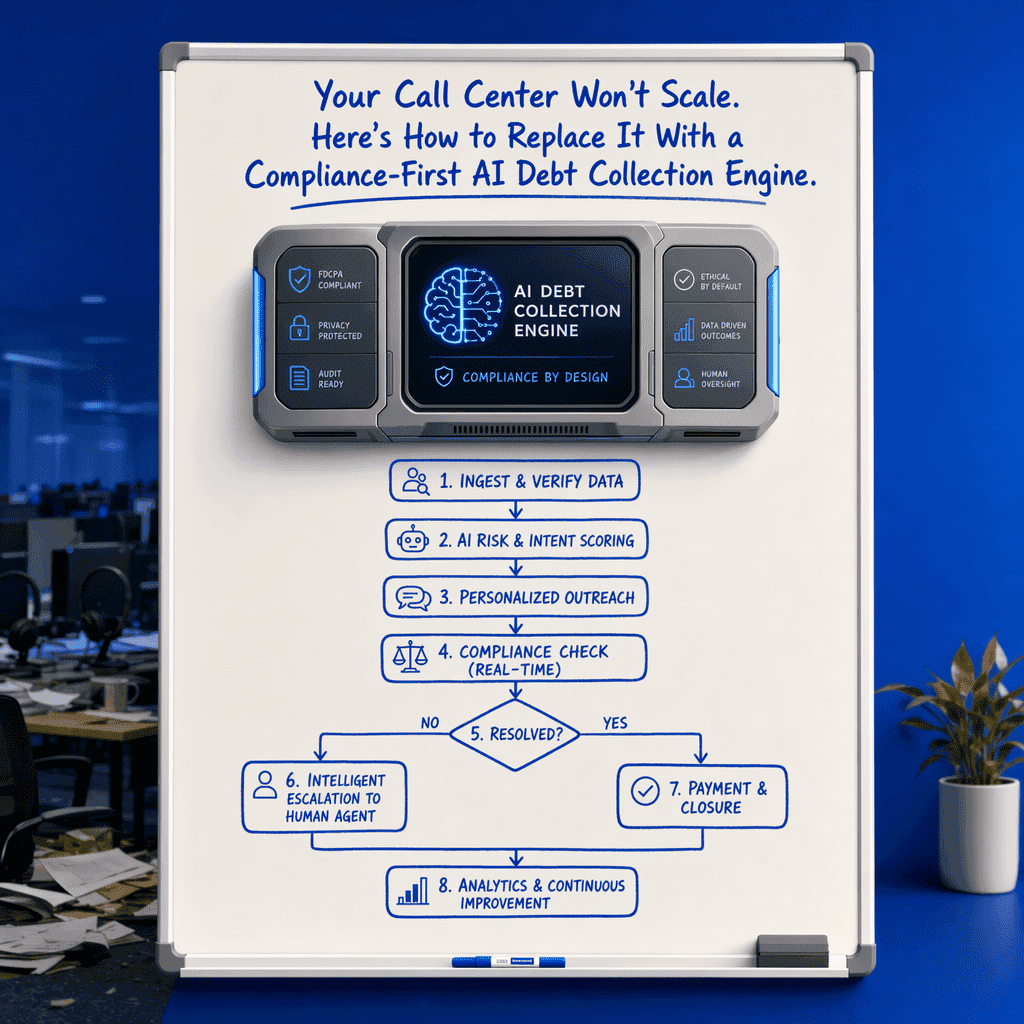
Step 1: Understand AI Debt Collection vs. Traditional Call Centers
The gap between a human-staffed floor and a machine-staffed platform isn't a matter of degree. It’s an entirely different operating system. Here’s how the physics of the two models break down:
Dimension | Traditional Call Center | AI Debt Collection Software |
|---|---|---|
Operational Hours | Constrained to shift schedules and time-zone windows; max ~8 to 10 hours of dialing per seat. | Always-on; 24/7 engagement across voice, SMS, and email without idle time or fatigue. |
Productivity Ceiling | A top-tier collector might manage 200 to 300 accounts per day. Scaling requires linear headcount growth. | Productivity improvements of 200% or more are achievable, as the system parallel-processes thousands of contacts simultaneously. |
Compliance Adherence | Manual adherence to scripts. Prone to drift; a single agent forgetting a Mini-Miranda disclosure creates liability. | Real-time enforcement. The engine refuses to utter a word if the FDCPA preamble isn't played, and it automatically blackouts calling during TCPA-restricted windows. |
Strategy Logic | Relies on a static dialer list and agent intuition. Contact attempts are often emotionally driven or inconsistent. | Uses predictive scoring to analyze risk profiles and payment history, sequencing accounts by contactability and propensity-to-pay before a call is made. |
Step 2: Evaluate Predictive Scoring & Omnichannel Outreach Engines
If you deploy an AI voice agent but let it dial a random list, you've just automated chaos. The recovery lift starts long before the first ring. Modern engines analyze overdue accounts based on risk profiles, payment history, and outstanding balances to build a dynamic contact hierarchy. The machine learns that a debtor who just got paid on a Friday afternoon responds better to a polite SMS link than a 10 AM phone call, and it adjusts the cadence without a human supervisor building a pivot table.
The 40 to 60 percent recovery lift reported by platforms like Collect Debt AI is a function of bandwidth, not just elegance. An AI system doesn't get demoralized by a shouting debtor on the 50th call of the day and then dial the 51st with a tired tone. The omnichannel engine maintains that exact tone across every channel simultaneously, voice, email, and chat, while logging the sentiment and outcome. Debt recovery software often includes predictive models to identify high-risk accounts and recommend optimal intervention timing. If your system can't reliably predict who will pay before it dials, you're still just guessing.
This is where the surface isn't the agent. A pleasant voice is table stakes. The intellectual property lives in the orchestrator that delegates tasks to the voice.
It's a pacing problem.
Step 3: Assess Real-Time Compliance Enforcement & Audit Logging
At Domu, we treat the CFPB's limited-content message rule as a hard technical constraint, not a training suggestion. The rule is explicit. A limited-content message is an 'attempt to communicate' but is not a 'communication' under the Debt Collection Rule because it conveys no debt information.
However, the moment your AI adds information beyond the legally required and optional fields, the message is not a limited-content message and triggers strict third-party disclosure rules. A human agent might fill awkward silence with 'you owe $5,000,' immediately converting a safe voicemail into a violation. Our Alex module certifies AI behavior pre-deployment to stress-test exactly this boundary.
But enforcement isn't just about stopping bad calls. It's about the immutable ledger. DC and recovery software ensures adherence to regulations through audit trails and communication logs. When a regulator asks for the exact timestamp and wording of a Mini-Miranda disclosure from six months ago, a traditional call center sends an internal team scrambling through call recordings for days. A compliance-first engine generates that tamper-proof log instantly.
Step 4: Compare Workflow Automation & Core System Integrations
A voice agent with no context is the ultimate silo.
You don't just need an API. You need a no-code workflow builder that lets you drag and drop a state-specific delinquency waterfall into existence. If your collection strategy in California requires a specific written notice after the third missed call, the automation layer must enforce that sequence logic natively. Connecting the AI to loan management platforms, CRMs, and payment processors via pre-built integrations transforms the system from a smart dialer into a core operational backbone.
Automated debt collection software triggers reminders via email, SMS, and portals, but if those triggers can't pause a payment plan in your ledger, you’ve created a reconciliation nightmare. The goal of AI debt collection is not simply to automate collections workflows. It's to help finance teams prioritize actions and recover invoices faster without forcing them to log into a separate standalone terminal.
Step 5: Examine Self-Service Portals & Conversational AI Handling
A flat IVR replacement won't cut it. The AI must navigate non-linear, adversarial conversations. When a debtor says 'I already paid' or disputes the amount, the system's ability to handle objections without a human bailout is what determines your margin. Here is the logical sequence for evaluating the actual conversational engine: 1. Validate intent recognition: The AI must correctly identify and tag payment promises, disputes, or hardship requests from natural speech without rigid keyword triggers. 2. Stress-test negotiation guardrails: Define settlement boundaries in the backend. The AI must pivot the conversation to a settlement offer within your approved discount range but hard-stop any verbal commitment beyond it. 3. Audit the self-service handoff: When a debtor agrees to pay, the system must instantly present a white-label payment portal or secure link. A 'promise-to-pay' captured in a call transcript that fails to generate an actual payment link is a failure point. 4. Verify compliance scripting in dynamic flow: Ensure that even when the AI deviates to handle a 'confused customer' edge case, it still drops a compliant disclosure marker before the call ends.
Step 6: Analyze Performance Dashboards & Recovery Analytics
You can't tune what you can't see. A dashboard showing only 'calls made' is useless. You need granular, cohort-based visibility into the metrics that actually pay down the debt book: contact-to-promise conversion rates and cost-per-dollar-collected. If the dashboard can't show you that an aggressive 8 AM SMS cadence is yielding a 3X higher promise-to-pay rate for a specific demographic cohort than a 5 PM voice call, the AI is flying blind. The data must be actionable down to the individual collection strategy level. This analytics layer justifies the infrastructure. Without it, you have an expensive audio player.
Step 7: Certify AI Behavior Pre-Deployment with Governance Validation
You do not put a machine that talks about money on a live network without adversarial certification. At Domu, we've operationalized a specific governance sequence because standard UAT breaks under the weight of generative variation. Alex stress-tests every interaction to support policy alignment and compliance readiness from day one. You need to run a bulk simulation on thousands of synthetic debtor profiles designed to break your script. Here's the gate process: 1. Bulk adversarial simulation: Run at least 10,000 synthetic calls that throw specific traps at the AI, including repeated requests for supervisors, claims of mistaken identity, and verbal aggression, to observe drift. 2. Right-party verification (RPV) failure audit: Isolate every instance where the AI failed to execute a strict identity validation loop before revealing a debt. 3. Mandatory disclosure adherence check: Use a secondary scanning script to confirm 100 percent verbatim execution of the Mini-Miranda within the first 30 seconds of every successful simulation. 4. Compliance sign-off and certification: Document the validated simulation results and obtain formal legal sign-off. Only then do you generate a formal certification confirming the model is cleared to speak to a real dollar balance.
Step 8: Pilot & Monitor Live AI Voice Agent Interactions
Even after certification, the real world contains variables no lab can simulate. We don't launch. We pilot.
The only safe method is to isolate a low-risk, low-balance segment and run a monitor-first deployment. For the first two weeks, the AI operates live, but no autonomous action is taken.
A human team reviews 100 percent of the transcripts, flagging sentiment drift or unscripted disclosures. Taylor enforces live, on-script customer interactions while Jordan analyzes how the AI handled edge cases and confused customers to identify compliance drift before it becomes systemic.
Only after the system passes these transparent performance gates, hitting your baseline contact rate and showing zero policy violations, do you scale. A top 5 U.S. fintech reported 30 percent fewer complaints per 100 calls after deploying Domu using exactly this protocol. The scaling phase then introduces a human escalation protocol. If debtor sentiment crosses a threshold, the machine doesn't improvise; it instantly delegates to a live agent with full context, avoiding the robotic loop that infuriates account holders.
It's slow on purpose. Speed comes after safety.
Conclusion
The industry isn't moving from humans to robots. It's moving from inconsistency to auditable precision. The voice is the commodity. The real architecture includes the predictive scoring engine that prioritizes whom to call, the compliance layer that refuses to break the law, and a governance framework that certifies behavior before a single dollar is at risk. Adhere to the phased pilot gates, and you don't just reduce complaints. You turn your recovery department into a predictable, scalable function.
What is AI debt collection software and how does it differ from traditional call center collections?
AI debt collection software is an automated platform that uses conversational AI and predictive analytics to manage the entire recovery lifecycle. Unlike traditional call centers that rely on manual shift-based dials, it operates 24/7 across voice, SMS, and email, scaling up to handle thousands of contacts simultaneously without agent fatigue or script drift.
How does AI handle compliance and regulatory requirements in debt collection for financial services?
Compliance is enforced in real-time, not via post-call monitoring. The system hard-blocks actions that violate TCPA calling hours or skip FDCPA Mini-Miranda disclosures. It also generates an immutable, tamper-proof audit log of every communication for regulatory examination, adhering strictly to CFPB limited-content message rules.
What measurable outcomes do financial institutions achieve after deploying AI-driven collections software?
Primary measured outcomes include: - Recovery rate improvements: 40 to 60 percent compared to manual methods - Productivity gains: exceeding 200 percent - Higher right-party contact rates: improved from manual approaches - Reduced cost per dollar collected: lower than traditional operations - Fewer compliance complaints per call volume: significantly dropped when properly piloted
What are the critical components to evaluate when selecting an AI debt collection platform for a regulated environment?
Evaluate four core layers: - Predictive scoring engine: prioritizes debtors based on likelihood to pay - Real-time compliance enforcement layer: ensures every interaction adheres to regulations - Deep no-code workflow automation: integrates with your core ledger and CRM - Formal pre-deployment governance certification module: validates AI behavior against adversarial scenarios before going live
What practical steps are involved in piloting and certifying an AI voice agent for live debt collection calls?
Follow this staged deployment sequence:
1. Run bulk adversarial simulation against thousands of synthetic profiles to validate script adherence.
2. Obtain legal compliance sign-off.
3. Run a monitored pilot on a low-risk account segment where humans review every transcript for drift.
4. Scale up only after passing gates for zero policy violations and minimum contact rate thresholds.
Can AI negotiation features autonomously settle debts without human approval?
Yes, within strict boundaries. AI can negotiate settlements and process promise-to-pay agreements in real-time if you define hard guardrails in the backend. The engine will pivot conversation toward a pre-approved discount range but automatically stops and escalates if a debtor demands terms outside those configured financial or legal limits.
Sources
Debt Collections Management Software: Complete Guide to AI..., collectdebt.ai
Debt Collection Platform: Definition, Features, Benefits And AI-Driven Recovery, www.emagia.com
Debt Collection Rule FAQs | Consumer Financial Protection Bureau, www.consumerfinance.gov
AI debt collection: how AI is transforming collections, LeanPay, www.leanpay.io
Frequently Asked Questions
What is AI debt collection software and how does it differ from traditional call center collections?
AI debt collection software is an automated platform that uses conversational AI and predictive analytics to manage the entire recovery lifecycle. Unlike traditional call centers that rely on manual shift-based dials, it operates 24/7 across voice, SMS, and email, scaling up to handle thousands of contacts simultaneously without agent fatigue or script drift.
How does AI handle compliance and regulatory requirements in debt collection for financial services?
Compliance is enforced in real-time, not via post-call monitoring. The system hard-blocks actions that violate TCPA calling hours or skip FDCPA Mini-Miranda disclosures. It also generates an immutable, tamper-proof audit log of every communication for regulatory examination, adhering strictly to CFPB limited-content message rules.
What measurable outcomes do financial institutions achieve after deploying AI-driven collections software?
Primary measured outcomes include:
- Recovery rate improvements: 40 to 60 percent compared to manual methods - Productivity gains: exceeding 200 percent - Higher right-party contact rates: improved from manual approaches - Reduced cost per dollar collected: lower than traditional operations - Fewer compliance complaints per call volume: significantly dropped when properly piloted
What are the critical components to evaluate when selecting an AI debt collection platform for a regulated environment?
Evaluate four core layers:
- Predictive scoring engine: prioritizes debtors based on likelihood to pay - Real-time compliance enforcement layer: ensures every interaction adheres to regulations - Deep no-code workflow automation: integrates with your core ledger and CRM - Formal pre-deployment governance certification module: validates AI behavior against adversarial scenarios before going live
What practical steps are involved in piloting and certifying an AI voice agent for live debt collection calls?
Follow this staged deployment sequence:
1. Run bulk adversarial simulation against thousands of synthetic profiles to validate script adherence.
2. Obtain legal compliance sign-off.
3. Run a monitored pilot on a low-risk account segment where humans review every transcript for drift.
4. Scale up only after passing gates for zero policy violations and minimum contact rate thresholds.
Can AI negotiation features autonomously settle debts without human approval?
Yes, within strict boundaries. AI can negotiate settlements and process promise-to-pay agreements in real-time if you define hard guardrails in the backend. The engine will pivot conversation toward a pre-approved discount range but automatically stops and escalates if a debtor demands terms outside those configured financial or legal limits.
Sources
Debt Collection Rule FAQs | Consumer Financial Protection Bureau - www.consumerfinance.gov
Debt Collections Management Software: Complete Guide to AI ... - collectdebt.ai
Debt Collection Platform: Definition, Features, Benefits And AI-Driven Recovery - www.emagia.com
AI debt collection: how AI is transforming collections - LeanPay - www.leanpay.io
AI Debt Collection | Tovie AI - tovie.ai
Best AI Debt Collection Software Compared [2026] - 12 Platforms Reviewed | AInora - ainora.lt
AI in Debt Collection: The Complete 2026 Guide - Kompato - kompatoai.com
How to Build AI Voice Agents for Debt Collection - smallest.ai
AI Voice Agents for Debt Collection | Retell AI - www.retellai.com
10 minutes


Explore Related Articles


GET STARTED
We’re building the next generation of engagement technology: intelligent, automated, and compliant. Our mission is to empower financial institutions to orchestrate every stage of the servicing lifecycle with dignity and unprecedented efficiency.
Supported by
Y Combinator

AWS

Microsoft