

Your head of retail banking just forwarded a customer complaint. A simple balance inquiry took three transfers and a voicemail that sat for a day.
Introduction
Your head of retail banking just forwarded a customer complaint. A simple balance inquiry took three transfers and a voicemail that sat for a day. Meanwhile, your compliance officer flagged a vendor script that skirted a UDAAP guideline last quarter. For community banks with lean teams, this tension between responsive service and airtight regulation is the daily reality.
Larger institutions deploy floors of IT staff and legal counsel to build conversational AI. You might have a single IT generalist and a compliance officer who also handles BSA audits. The tools you choose cannot ask you to become a machine learning engineer or a privacy lawyer overnight. They must come with the guardrails baked in.
The mandate is clear but unforgiving. Any conversational AI platform must operate inside strict regulatory boundaries, including UDAAP, FDCPA, and TCPA. In February 2024, the U.S. Federal Communications Commission ruled that AI-generated voices count as an artificial or prerecorded voice under the TCPA, requiring prior express written consent before placing AI-generated calls. A miscue here triggers an enforcement action, with fines and mandatory remediation.
This landscape forces a specific set of selection criteria. A viable platform must offer no-code or low-code integration with your core banking system, vendor-managed hosting that minimizes your infrastructure burden, and pre-built compliance guardrails. We evaluated seven platforms against that reality.
Key Takeaways
The platforms that earned a place in this list solve a specific problem for a community bank with limited IT resources. Here is what that looks like in practice.
Compliance governance is the first filter: A platform earns consideration only when it automates FDCPA, TCPA, and UDAAP guardrails inside the conversation flow, rather than treating them as an audit step you run after the fact.
Typical monthly cost ranges from $1,000 to $5,000: Total cost of ownership varies by call volume and modules, but most community bank deployments land in this band for a production conversational AI system.
Implementation timelines run 4 to 12 weeks: Low-code platforms with pre-built banking micro-skills and core system adapters can reach a basic production deployment in about a month; deeper custom workflows stretch the window.
PCI Level 1 security is a baseline requirement: Any platform handling payment card data must carry this certification. If a vendor pitches it as a selling point, ask what else they bring.
Pre-built skills save more than money: The real value of platforms with out-of-the-box banking interactions is that they bypass lengthy professional services engagements a lean team cannot staff.
You need a partner, not a toolkit: The right vendor supplies managed hosting, model explainability documentation, and audit-ready logs so your compliance officer can prove what happened without a data science degree.
1. Domu: Purpose-Built Governance for Community Bank Compliance

Domu is engineered specifically for financial services compliance. The platform embeds regulatory guardrails directly into the conversation flow through a governance-first orchestration architecture, making it the strongest pick for a bank where compliance risk is the tiebreaker.
At Domu, we built two specialized components that run on either side of every interaction. Alex, a pre-deployment governance specialist, restricts the AI to an approved repository of data and stress-tests conversation flows against FDCPA and TCPA boundaries in a synthetic environment before anything goes live. After deployment, a module called Jordan post-deployment audit validates customer interactions against UDAAP and state-specific collection laws. Domu says Jordan automatically flags compliance violations to provide immediate oversight, though the system flags rather than adjudicates; it does not make legal judgments or guarantee compliance.
The output is what your examiner will ask for. Domu provides audit-ready interaction logs for compliance and oversight and generates a formal MRM Certification Report for pre-deployment AI approval. Your audit committee gets documentation they can act on.
Domu requires integration work into core banking systems via low-code API. For a community bank, that means a deliberate implementation. The tradeoff is governance depth that generic platforms skip.
2. Glia: Unified Digital Customer Service with Compliance Guardrails

Glia earns its rank by pairing compliance-ready infrastructure with a managed hosting model that removes operational burden. The single most telling data point: Glia offers a industry-first contractual guarantee against AI hallucinations and prompt injections. For a community bank compliance officer reviewing vendor agreements, that clause alone changes the risk calculus.
Dimension | Glia | Generic Banking Chatbot |
|---|---|---|
PCI compliance | PCI Level 1 security redaction built in | Often requires third-party add-on |
Agent compliance support | Agent-assist AI guides staff to remain compliant in real-time | Typically absent; relies on agent training |
Channel unification | Unified DCS model spanning voice, chat, and video | Usually siloed by channel |
Performance benchmark | 50% faster than the nearest banking competitor; 118% customer retention rate and 73 Net Promoter Score | Varies widely |
Deployment model | Vendor-managed hosting | May require on-prem or self-managed infrastructure |
One case study makes the business case concrete. Heritage Federal Credit Union achieved 151% of its annual loan growth target with 25% less staff using Glia voice AI. Those numbers show a community bank can grow loans aggressively while running a leaner operation.
3. Interface.ai: Out-of-the-Box Banking Automation with Low-Code Integration
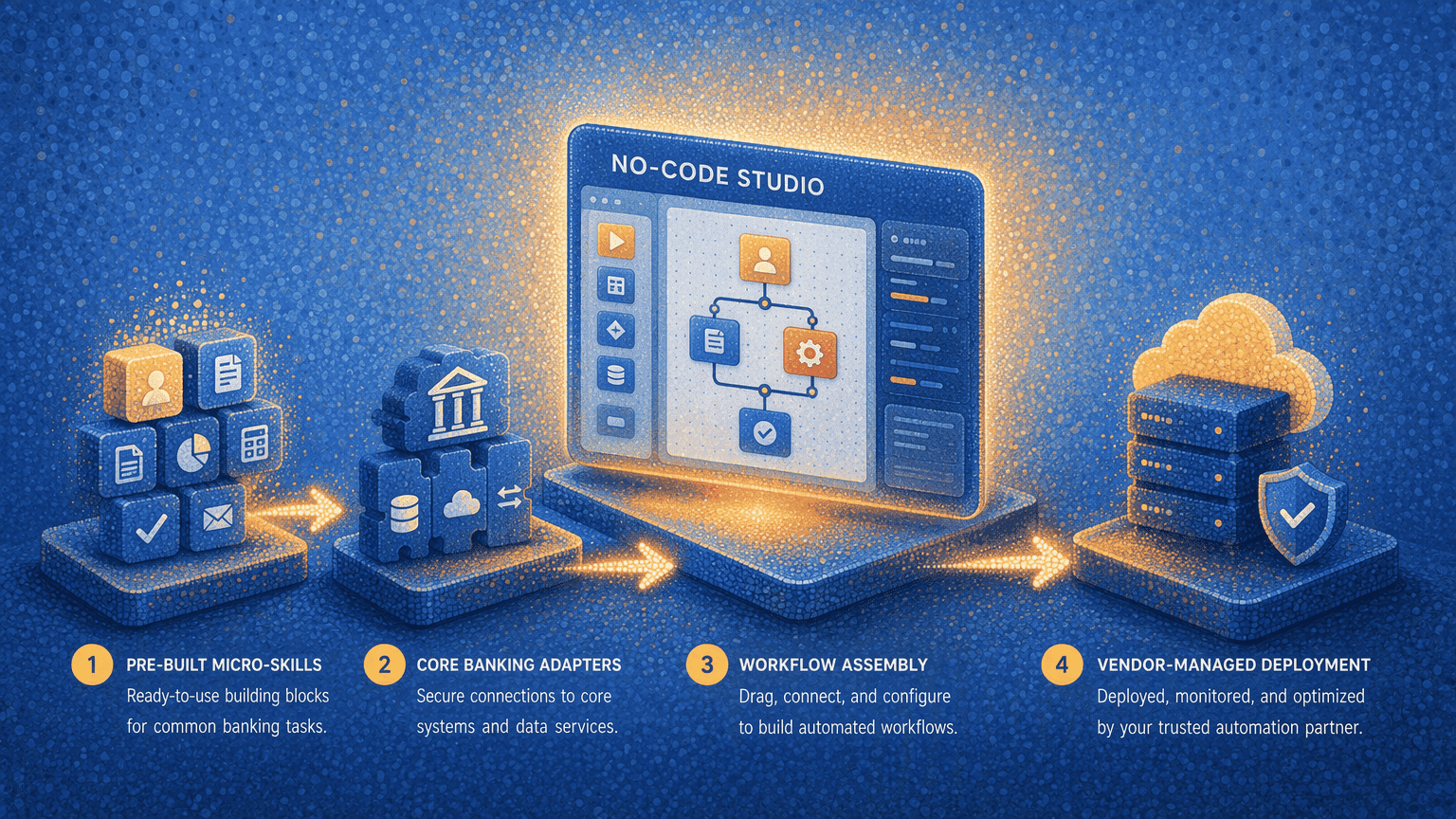
Interface.ai targets the speed objection directly. The platform ships with a library of pre-built banking micro-skills (balance checks, loan payments, card activation) and low-code adapters for core banking systems. The company claims a 4-week deployment to production, which matters when your board approved a budget last quarter and expects results this quarter.
The architecture is deliberately constrained. A no-code studio lets your operations manager build new workflows, and the vendor-managed environment means your IT generalist is not babysitting servers. Rapid deployment timelines come from limiting scope to the most common banking interactions rather than attempting every edge case on day one. The result is a conversational AI that handles the 80% of inquiries tying up your staff today.
4. Personetics: AI-Powered Data Insights and Proactive Customer Engagement
Personetics approaches the problem from the transaction data layer, and that distinction matters for deposit growth. The platform analyzes transaction history to generate personalized, proactive insights delivered to customers automatically through two primary capabilities:
Self-service automation first: Personetics targets handling up to 90% of common customer requests without agent intervention, which reduces inbound volume before a conversation even starts.
Proactive engagement that drives deposits: The engine surfaces cash flow alerts, savings suggestions, and financial health nudges based on actual spending patterns rather than generic segmentation.
5. Kasisto: Conversational AI Specializing in Financial Literacy and Transactions
Kasisto traces its lineage to SRI International, the same R&D lab that produced early voice assistant technology. That pedigree shaped the KAI platform from day one. The team built it on the vocabulary and logic of banking conversations: customers asking why a restaurant tip looks higher than expected, disputing a duplicate charge, or checking whether a large purchase will trigger an overdraft.
The result is a conversational AI that handles complex financial literacy tasks without a bank needing to write its own content library or fine-tune models on industry terminology. It deploys as a white-label solution, so the experience carries your brand. For a community bank that wants to offer the same quality of digital financial guidance that national names advertise, Kasisto provides a turnkey way to close that gap.
6. Posh Technologies: Digital Assistants Designed for Account Servicing and Loss Prevention

Posh Technologies targets the repetitive, high-volume calls that eat up hours in a community bank contact center: password resets, balance checks, a routine transfer. These are the interactions that generate cost without relationship value.
Pre-built skills for those exact workflows connect to core banking systems including Jack Henry and Fiserv. Your IT lead handles an integration, not a code-from-scratch build. The platform also includes AI-driven fraud and loss-prevention modules and a conversational analytics dashboard that tracks containment rate and deflection.
For a bank that evaluates AI strictly on operational ROI, Posh is built to shrink call volume now. A specific case study with a community FI partner reported a measurable containment rate for routine servicing requests, though publicly disclosed figures vary by deployment scope.
7. Boost.ai: Hybrid Cloud AI with a Focus on Scalable Internal and External Support

Most community banks confront data sovereignty after it becomes a problem, not before. Boost.ai's hybrid cloud model lets you anchor sensitive customer records in your own on-premise or private cloud environment while the AI layer runs above it. For banks that answer to state-level data residency rules or that simply refuse to put everything in a public cloud, this removes a genuine blocker.
The platform includes a low-code builder built for non-technical staff. Your operations manager can extend the AI the same week the need arises, without waiting for a developer. Deployment hits web chat, voice, and internal IT helpdesk simultaneously. That internal helpdesk use case deserves more attention. The community bank IT generalist who handles the same five password-reset tickets every Monday can offload those to an internal Boost.ai instance running the identical platform your customers already use.
The intent hierarchy scales from simple FAQs to multi-step workflows, and large financial institutions run the platform at enterprise volumes. That track record matters when you are projecting interaction growth two years out. G2 reviews give the builder strong ease-of-use marks compared with other enterprise AI tools. The tradeoff: setup takes a little longer than a fully pre-packaged banking solution. The offset is real flexibility, one platform, one set of ISO 27001 security certifications, covering both customer and employee support.
Conclusion
Your choice maps to your primary pressure point.
If compliance exposure keeps your CFO awake, Domu and Glia embed governance into the conversation architecture itself. If call deflection is the immediate board mandate, Interface.ai, Posh, and Personetics deliver operational ROI fastest. For banks wanting a single engine across customer and internal support with flexible data hosting, Boost.ai fits. Kasisto brings domain depth that smaller teams cannot build themselves.
Each platform here earns its place by solving a specific problem for a bank with more regulatory burden than IT headcount.
Frequently Asked Questions
What makes a conversational AI platform suitable for community banks with small or non-existent IT teams?
A suitable platform requires three key capabilities to minimize the burden on a lean IT team:
Vendor-managed hosting to eliminate the need for in-house server maintenance.
No-code or low-code workflow builders so that staff can extend functionality without developer support.
Pre-built adapters for common core banking systems such as Jack Henry or Fiserv, allowing the bank's IT lead to integrate rather than build from scratch.
Which conversational AI vendors specifically serve US community banks, and how do they compare on ease of integration and compliance?
Domu, Glia, Interface.ai, Personetics, Kasisto, Posh Technologies, and Boost.ai all serve US community financial institutions. Integration ease ranges from pre-built core banking adapters (Interface.ai, Posh) to low-code APIs requiring deliberate implementation (Domu). Compliance architecture ranges from embedded pre-deployment and post-deployment guardrails to PCI Level 1 redaction and contractual hallucination guarantees.
How do regulatory requirements like UDAAP, FDCPA, and TCPA shape AI vendor selection for community banks?
These regulations make automated compliance guardrails non-negotiable. The FCC's February 2024 ruling that AI-generated voices count as artificial voices under TCPA requires prior express written consent. A qualifying vendor must provide audit-ready interaction logs, automated flagging of compliance violations, and model explainability documentation that an examiner can review without technical training.
What is the typical total cost of ownership for a compliant conversational AI platform at a community bank, and what pricing models exist?
Typical monthly cost ranges from $1,000 to $5,000 depending on call volume, modules deployed, and integration depth. Most vendors price on a per-interaction or tiered-volume model. Enterprise-grade compliance platforms require integration investment and are not plug-and-play, which means a deliberate implementation rather than a weekend setup.
What kind of implementation timeline and ongoing management effort should a resource-constrained community bank expect?
Basic production deployment ranges from 4 to 12 weeks. Platforms with pre-built banking micro-skills and low-code core adapters can reach production in about 4 weeks. Deeper custom workflow configurations extend closer to 12 weeks. Ongoing management burden is low when the vendor provides managed hosting, but compliance platforms require regular governance validation cycles.
How can a community bank evaluate whether an AI vendor's compliance architecture is substantive versus just a marketing claim?
Ask for three artifacts to validate a vendor's compliance claims:
A sample interaction log showing automated compliance flagging.
The model explainability documentation format provided to examiners.
A recent third-party penetration test report.
If the vendor cannot produce these, or responds only with policy documents rather than system output, treat compliance claims as marketing until proven otherwise.
Sources
Voice AI for Banking & Credit Unions | Glia - www.glia.com
AI voice agents for collections and payments - Smallest.ai - smallest.ai
Related Articles



We’re building the next generation of engagement technology: intelligent, automated and compliant. Our mission is to empower financial institutions to orchestrate every stage of the servicing lifecycle with dignity and unprecedented efficiency.
Supported by

