

Your recovery rate just dipped, and the compliance team flagged three AI-written settlement offers this morning for inaccurate dispute language.
Introduction
Your recovery rate just dipped, and the compliance team flagged three AI-written settlement offers this morning for inaccurate dispute language. That tension is the reality of modern third-party digital collection. It is a space where a machine learning model can boost liquidation rates in one column and expose a firm to costly litigation in the next. A 2023-modified CFPB study from July 28, 2016 made it clear that the agency views software, vendor relationships, and data-furnishing policies as core regulatory risks, not back-office technicalities.
At the same time, digital transformation is not optional: 67% of Global 1000 companies have digital transformation at the core of their strategies, according to a survey by International Data Corporation. In debt recovery, the pressure to automate is colliding head-on with regulators who now read lines of code like they read compliance manuals. This article breaks down exactly what third-party digital collection is, how the regulatory machinery polices it, and why the architecture of your platform, not just your collection floor, decides whether you survive an audit.
Key Takeaways
Here are the operational realities defining third-party digital recovery right now:
Contingency vs. debt buying defines control: Most collectors by revenue work debts owned by the original creditor on a contingency fee, not as debt buyers owning the paper outright.
FDCPA applies directly to third parties: The law from March 1978 that defines permissible communication and prohibits harassment is a strict-liability statute for agencies, not aspirational guidance.
AI error triggers dual liability: A single machine-learning misstep on a settlement offer can violate the FCRA on data accuracy and the FDCPA on misrepresentation simultaneously.
You cannot outsource compliance to software: The CFPB examined interaction policies, dispute procedures, and credit-bureau furnishing protocols in its industry survey. Automation does not remove your obligation to govern every decision.
Audit-ready logs are the baseline, not the advanced tier: Timestamped, unalterable records of every SMS, call attempt, and portal interaction are now the minimum evidence required in any consent or cease-and-desist challenge.
What Exactly Is Third-Party Digital Collection?
The definition hinges on two structural distinctions: who owns the consumer relationship, and what technology layer executes the collection workflow.
The legal trigger is the creditor separation: The term refers to collections on a consumer account where collections are not handled by the original creditor. This distinction is what activates the FDCPA's strict controls around communication timing, disclosure, and harassment.
The dominant model is contingency, not purchasing: When measured by revenue, the majority of debt collectors attempt to collect debt still owned by the original creditor. This creates a dual-reporting dynamic where the creditor may still furnish its own tradeline while the agency adds a separate collection account, doubling the accuracy obligation.
Digital is not just a dialer upgrade: A platform like TrueAccord, which engages more than 24 million consumers annually, frames the category as full-service agencies that use email, SMS portals, and automated payment gateways as primary channels. AI agents that hold live conversations now layer on top of this stack, adding a real-time governance problem that did not exist with recorded call-and-review models.
First-Party vs. Third-Party Digital Collection: A Structural Breakdown

The distinction matters because the regulatory liability, the data, and the relationship outcome all sit with different parties. One model keeps the original creditor in control. The other transfers pieces of that responsibility to a separate company. Here is how the models separate:
Feature | First-Party Collection | |
|---|---|---|
Debt ownership and control | Original creditor retains ownership and direct relationship; may use in-house tools under its own brand. | Collects debts owed to another entity; works contingency-fee or buys charged-off portfolios outright. |
Primary regulatory framework | Largely exempt from the FDCPA; governed by state UDAAP laws, reputation risk, and creditor liability in litigation. | Full FDCPA application governs communication conduct, hours, and disclosure; additionally bound by FCRA accuracy rules when furnishing tradelines. |
Data access and furnishing | Has origination records, payment history, and internal servicing notes. Can access complete consumer account context before contact. | Relies on creditor-provided placement files of varying quality; separately furnishes tradelines to credit bureaus, creating a new data accuracy obligation. |
Technology and control | Owns or licenses a CRM and dialer stack directly; can iterate on self-service portals and in-house AI agents under its own governance. | Operates a dedicated collection software stack with predictive dialers, payment gateways, and client portals; governed externally by client requirements and regulatory audit demands. |
Consumer perception and dispute path | Consumer disputes may route through internal customer service; brand damage is the primary reputational risk. | Consumer complaints route to the CFPB and FTC as a formal dispute channel; in 2005, third-party debt collector complaints represented 19.1% of all complaints the FTC received. |
The Technology Stack Powering Modern Digital Collection

When we onboard a new placement file at Domu, the data hits a series of decision gates before a single message fires. That routing depends on a stack of integrated systems that must speak to each other without dropping a timestamp or an interaction tag.
CRM or system of record: ingests creditor placement data and attaches account metadata, balance history, and prior contact logs.
Predictive dialer or omnichannel orchestration layer: governs outbound sequencing across voice, SMS, and email, applying time-of-day restrictions and consent flags in real time.
Machine learning model: often scores accounts for propensity to pay before routing them into treatment groups.
Payment gateways and self-service portals: handle settlements, payment plans, and digital negotiation.
What matters for compliance is the interaction layer. Every SMS delivery receipt, every phone call transcript, and every portal login must be logged as an event with a timestamp, a consumer identifier, and an outcome code. Without that, you cannot prove to the CFPB that the AI did not call someone at 7:45 a.m. in their time zone, or that a cease-and-desist instruction was honored within the required window. The software functions as an evidence production system: your logs, not just your collection floor, decide whether you survive an audit.
US Regulatory Framework: FDCPA, FCRA, and CFPB Oversight
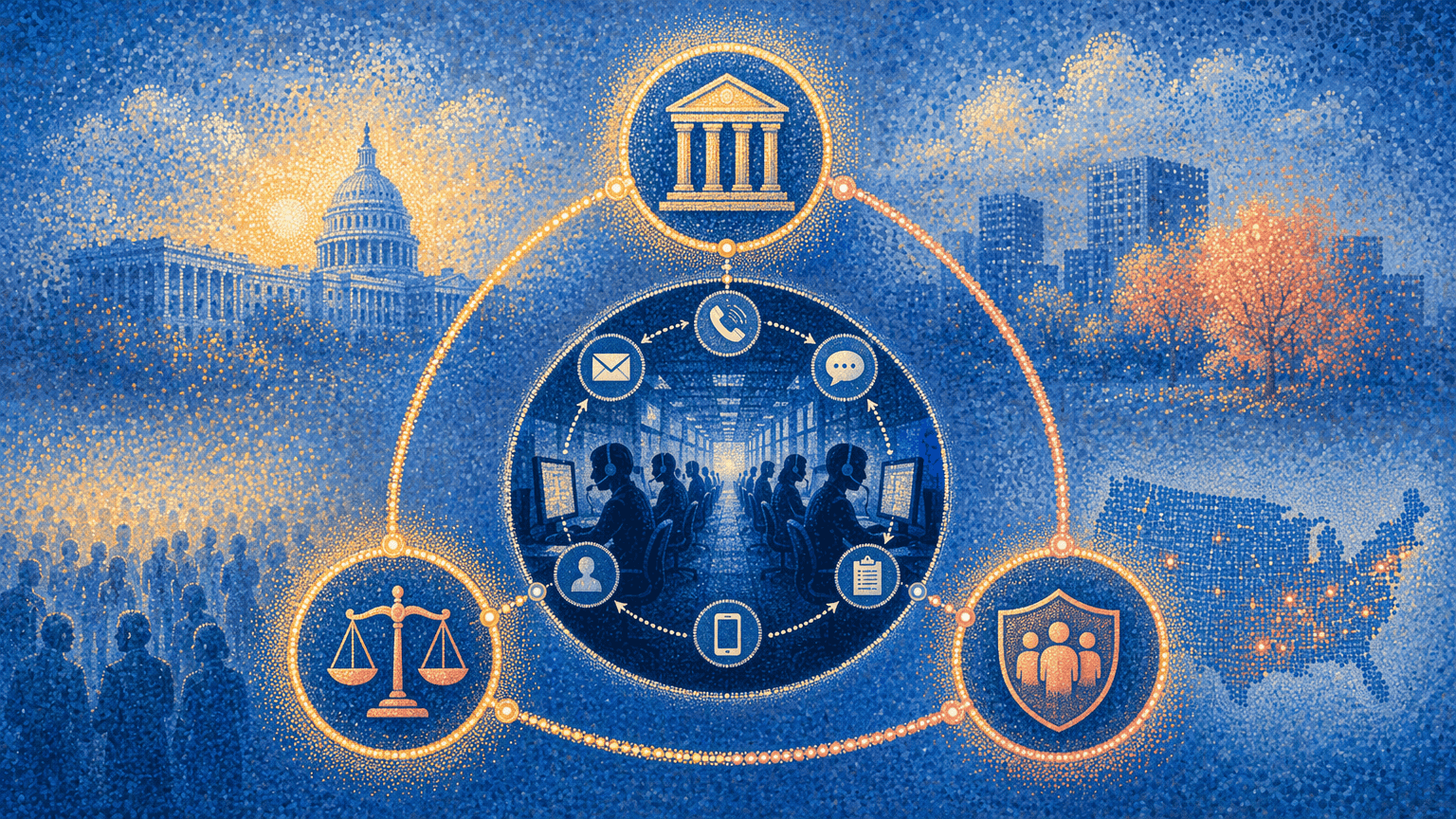
Third-party digital collection operates inside a regulatory cage that was built before the internet, much less conversational AI, existed. The Fair Debt Collection Practices Act became effective in March 1978, and its core prohibitions are dead simple: no deceptive conduct, no harassment, no contact at unusual times or places. The law specifically defines a debt collector as any person who regularly collects consumer debts for another person or institution. If that describes you, the statute attaches to every outbound communication your AI generates.
On the data side, the FCRA governs what happens when your placement appears on a credit report. Furnishing a collection tradeline to a consumer reporting agency triggers accuracy obligations that extend to the data the creditor gave you and the updates you subsequently generate. If your AI agent negotiates a reduced settlement and the system automatically updates the balance without verifying the payment history against original records, you have created a liability event.
The CFPB's supervision brings these threads together. The Bureau's survey of the industry asked direct questions about software, client relationships, policies, procedures for consumer interaction, disputes, and furnishing data to credit bureaus. This signals an agency examining not just policies on paper, but the actual configuration of digital systems that execute them. Meanwhile, the volume of complaints provides a running audit trail: FTC data shows that FDCPA complaints increased 14% from 58,698 in 2004 to 66,627 in 2005, at a time when total consumer complaints across all industries reached 348,535.
The FDCPA covers only debt incurred by a consumer primarily for personal, family, or household purposes. It does not apply to corporate debt or agricultural loans. That exemption line matters if your digital platform handles mixed portfolios.
Governance-First AI and the Compliance Mandate
At Domu, we ship AI agents that hold conversations with consumers about their debt directly. That capability is powerful, but it introduces a specific class of failure that a static dialer never could: the model can generate text that neither the compliance team nor the developer reviewed before delivery.
Deceptive statements under FDCPA: If a model scores a consumer low for propensity to pay and automatically generates a settlement offer implying the full balance is due immediately rather than over time, that output could constitute a deceptive statement.
FCRA violations from inaccurate furnishing: If the system updates the credit report based on that interaction without a human verification step, it may have just committed an FCRA violation for inaccurate data furnishing.
The same transaction now generates dual regulatory exposure.
The fix is to build a governance layer around the AI that validates behavior before and after deployment. A platform like Domu's runs a pre-deployment governance check where a validation module stress-tests conversation flows against FDCPA and TCPA boundaries in a synthetic environment. During live operations, the system flags compliance violations in real time and escalates confused consumers to a human agent rather than pushing through.
Research supports this cautious approach. Studies cited in a recent review on digital transformation show that improved governance, information disclosure quality, and expected earnings reduce debt financing costs by mitigating information risk, agency risk, and earnings risk. The same logic fits a collection operation: algorithmic governance that verifies, audits, and logs every decision lowers the operational risk of running an AI at scale. A system that cannot prove it handled a dispute correctly under the FCRA has failed, regardless of its recovery rate.
Transatlantic Lessons: The EU Digital Markets Act and Data Handling Precedent

Europe's regulatory trajectory is a preview of data governance battles coming to US collection agencies. The EU Digital Markets Act enforces structural remedies against large platforms that aggregate consumer data in ways that block competition. The principle is data minimization: if you collect and hold vast consumer profiles, regulators will eventually force accountability for how every field got there and whether its use is fair.
For a US third-party agency running a digital stack, this is a direct precedent. A debt buyer who aggregates charged-off data across multiple creditors now possesses a consumer profile that looks a lot like a tech platform's data asset. When the CFPB or FTC begins applying similar logic to collection databases, the agency that cannot demonstrate a clean chain of data custody, consent, and minimization will face enforcement exposure.
The lesson is to treat every piece of consumer data in your collection platform as regulated inventory, not operational exhaust. An auditor looks at two things: the records you present and the trail that connects them. If you sourced a debt from three different originators and merged their files into one consumer profile, every merge point needs a documented business reason.
The CFPB's 2019 study of third-party collections found that agencies carrying older, less complete tradeline data were significantly more likely to generate disputes. The gap between a verifiable claim and an unsubstantiated one sits in your data lineage, not just your collection floor. Start with the inventory question.
Can you say, for each field in your consumer record, which source system it came from, when it was last updated, and who touched it? If the answer requires a developer and a database query, you already have a problem. Platforms built on DMA-style principles bake that lineage in.
Every data point carries its origin, its age, and the consent chain that permitted its use. That is the bar that a regulator applying platform-era logic will set. You also need a minimization rule that actually fires before a collection call, not a policy document that sits in a compliance folder.
A phone number passed through a skip trace without a timestamp or a verified owner-relation flag is not an asset; it is a liability. The DMA approach says: hold less by default, and justify the fields you retain. For an agency, that means scrubbing unverified contact points, stale balance recalculations, and merged records with no merge audit before any communication with a consumer.
Audit-Ready Systems: Interaction Logs and Live Compliance Oversight
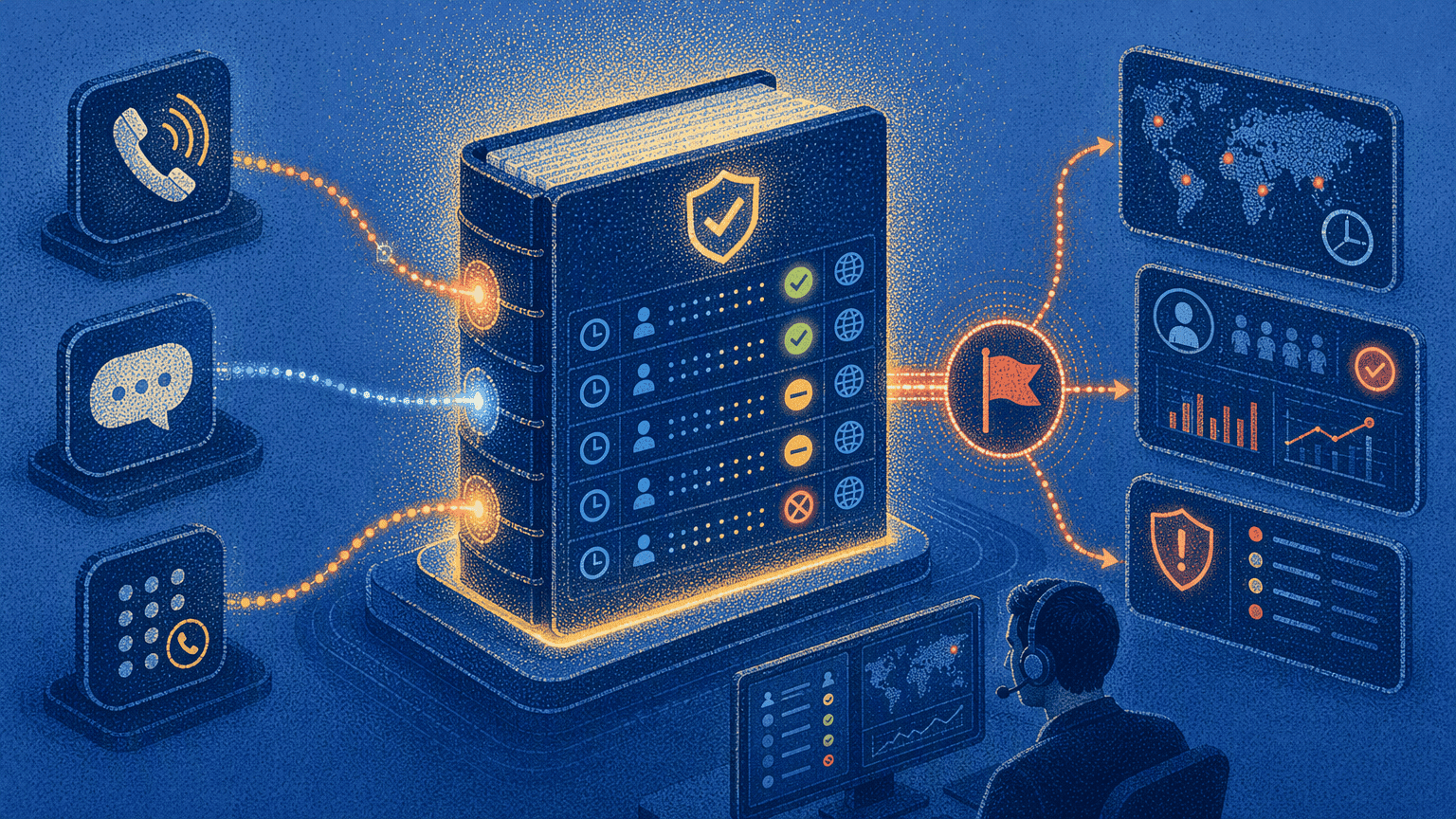
An audit begins when an examiner asks for the log of the 5:01 p.m. call and you cannot produce it. That moment is preventable with the right architecture.
Unalterable, timestamped records: Maintain records of every consumer interaction across every channel. If an AI agent dials a number, the system records the dial attempt, the outcome, the time zone determination, and the consent status at that exact moment.
Cease-and-desist propagation logging: If a consumer sends a text asking for no further contact, a cease-and-desist flag must propagate across voice, email, and portal channels immediately, and the system must log that propagation event.
These logs are the primary evidence in a regulatory examination. The CFPB expects digital systems to produce this data on demand, failure to do so is itself a compliance finding.
Live oversight dashboards add a second layer of defense. Real-time monitoring surfaces patterns like an AI agent repeatedly triggering compliance flags for calling before 8:00 a.m. in the consumer's time zone or failing to honor a dispute-triggered cease in communication. A platform like Domu automatically flags these violations and generates the audit trail as the incident occurs, rather than requiring a manual compliance review after the fact. This turns the platform into a continuous supervision tool, aligning a digital operation with how examiners will eventually evaluate it.
Conclusion
Third-party digital collection is a regulated data fiduciary role that happens to use code, statistical models, and voice AI to execute its function. It is not a technology upgrade bolted onto a traditional agency.
The FDCPA and FCRA attach to every line of dialogue an agent generates and every data point a model updates. Your compliance architecture, not your collection floor, decides whether you survive an audit.
The agencies that survive this shift will build governance into the engineering. They will log every decision as if an examiner is already reading the output. They will treat their AI platform as a compliance instrument that either proves its case or breaks it.
Frequently Asked Questions
What exactly is third-party digital collection?
Third-party digital collection is the recovery of debts owed to a creditor by an external agency using digital channels such as AI-driven calls, SMS, email, and online payment portals. The defining trigger is that the collector is not the original creditor, which activates specific FDCPA and FCRA regulatory obligations.
How is third-party digital collection different from first-party collections?
First-party collection is the original creditor collecting its own debts under its own name, largely exempt from the FDCPA. Third-party collection is performed by an external agency collecting for another entity, which places it under full FDCPA regulation, separate data furnishing requirements, and independent CFPB oversight.
What technologies power modern third-party digital collection?
The stack includes a CRM for placement data, an omnichannel orchestrator for voice, SMS, and email routing, machine learning models for account scoring and settlement offers, payment gateways for digital processing, and real-time logging infrastructure that timestamps every consumer interaction for compliance audits.
What are the compliance and regulatory challenges for third-party digital collection in the US?
Agencies face FDCPA governance over communication conduct including time-of-day restrictions and dispute handling, plus FCRA accuracy obligations whenever they furnish tradelines to credit bureaus. The CFPB examines software configuration, interaction policies, and data furnishing procedures directly as part of its supervisory mandate.
What benefits does AI and automation bring to third-party digital collection agencies?
AI and automation reduce debt financing costs by mitigating information risk and improving disclosure quality. They enable consistent, large-volume contact strategies, dynamic settlement negotiations, and automated compliance flagging that surfaces violations during live interactions rather than after the fact.
How are third-party digital collection platforms evaluated for security and governance?
Platforms are evaluated through the CFPB's survey-based examination of software, policies, and procedures governing consumer interaction and dispute handling. Governance-first platforms add pre-deployment stress-testing against FDCPA and TCPA boundaries and post-deployment audit trails that produce unalterable, timestamped evidence of every system action.
Sources
Study of third-party debt collection operations | Consumer Financial Protection Bureau - www.consumerfinance.gov
Market Snapshot - Third-Party Debt Collections Tradeline Reporting - files.consumerfinance.gov
Library of Congress RFI for Third Party Digitization Initiatives - sam.gov
FTC Annual Report 2005: Fair Debt Collection Practices Act - www.ftc.gov
Fair Debt Collection Practices Act (FDCPA) - www.federalreserve.gov
Digital transformation and debt financing cost: A threefold ... - www.sciencedirect.com
Third-Party Digital Collection | TrueAccord - www.trueaccord.com
Related Articles



We’re building the next generation of engagement technology: intelligent, automated and compliant. Our mission is to empower financial institutions to orchestrate every stage of the servicing lifecycle with dignity and unprecedented efficiency.
Supported by

