

A large U.S. bank discovers that its internal recovery floor is dialing the same 200,000 past-due accounts every month and connecting with fewer than 8 percent
Introduction
A large U.S. bank discovers that its internal recovery floor is dialing the same 200,000 past-due accounts every month and connecting with fewer than 8 percent of them. Those consumers are not picking up unknown numbers, but they are opening texts and emails. The problem isn't the portfolio.
It's the channel. Shifting recovery to a specialized external partner that communicates through SMS, email, and AI-driven voice is the operational response to a consumer base that has already moved, and to a regulatory framework that now codifies exactly how digital outreach must work. This article defines third-party digital collection, traces the market and legal pressures that forced the industry off the phone-only model, and lays out the compliance mechanics, integration logic, and strategic trade-offs that determine whether those digital dollars get recovered or get you sued.
Key Takeaways
A few non-negotiable realities sit at the center of any third-party digital collection strategy. Here is what the rulebook, the data, and the operational math require:
Definition: A contingent agency that recovers debts primarily through electronic channels (SMS, email, AI voice) on behalf of another creditor, distinct from first-party billing or law firm collection.
The FDCPA baseline governs everything: The Act, effective in March 1978, defines a third-party collector and prohibits communication before 8:00 a.m. or after 9:00 p.m. in the consumer's time zone, repeated harassment, and third-party disclosure; the FTC has sued over 30 debt collection companies for violating these rules.
Regulation F gave digital channels a legal skeleton: The CFPB's Debt Collection Rule permits a limited-content message, mandates a model validation notice path, and caps calls at seven attempts per seven days across all channels treated as a single conduit.
The Definition of Third-Party Digital Collection

Before you can evaluate a platform, you need to pin down who legally is doing the collecting and through what means. The label collapses two distinct concepts: the regulatory identity of the collector and the modality of the outreach.
Dimension | First-Party Collection | Third-Party Digital Collection | Law Firm Collection |
|---|---|---|---|
Who is contacting the consumer | The original creditor under its own name | A separate entity regularly collecting debts owed to another | An attorney or firm collecting debts on behalf of a client |
FDCPA classification | Generally exempt, unless using a name other than its own | Covered as a 'debt collector' when collecting consumer debts for another | Covered if the attorney regularly engages in debt collection |
Primary communication channels | Billing statements, in-house calls, portal prompts | SMS, email, AI-driven voice, ringless voicemail, self-service portals | Formal written demands, legal pleadings, settlement negotiation |
Compliance architecture required | UDAAP, internal policy | Regulation F electronic communication rules, model validation notice, 7-in-7 call caps, multi-channel opt-out | FDCPA, state bar rules, litigation procedure |
Typical engagement trigger | Payment due date passes; internal scoring flags account | Multiple internal cycles fail; creditor sells or places the debt | Dispute escalates; litigation or arbitration threat is the lever |
The FDCPA defines a debt collector as any person who regularly collects consumer debts for another person or institution, or uses a name other than its own when collecting its own consumer debts. An institution collecting another institution's debts only in isolated instances is not a debt collector. Third-party digital collection takes that regulated third-party entity and gives it email templates, SMS short codes, AI-powered voice agents, and a compliance layer that enforces the CFPB's rules at every touchpoint. The legal relationship is the same as a traditional collection agency, but the execution is digital-first, data-driven, and subject to a much thicker set of channel-specific regulations.
The Cause and Rise of Digital Transformation in Debt Collection

Landline contact rates cratered for the same reason your own voicemail box is 90 percent spam: consumers stopped answering. The phone call became a hostile event. For collections operations running million-account portfolios, a 5 percent contact rate on a 200-basis-point margin turns the math upside down. You cannot recover what you cannot reach, and you cannot reach consumers who treat every unknown number as a threat.
The pivot toward asynchronous channels follows the behavior of a consumer base that already transacts, disputes, and negotiates everything from mortgage modifications to medical bills through text and email. A digital-first agency can send a validation notice link via SMS, let the debtor click into a self-service portal at 11 p.m., and capture a promise-to-pay without a single live agent minute spent. That same sequence on a phone-only floor requires three attempts, two voicemails, and a callback window the consumer will ignore. The cost per collected dollar compresses because the channel matches the behavior.
The third pressure is balance-sheet math on low-balance accounts. When the recovery cost of a $600 medical bill exceeds $200 in agent labor and dialer costs, the account sits untouched. Automating that recovery through email sequencing and SMS negotiation turns a negative unit-economics pocket into a modest net contributor. The payoff comes from redirecting skilled agents to the complex disputes that actually need them, and letting the right channel handle the accounts that resolve themselves.
How Regulatory Frameworks Shape Digital Collection
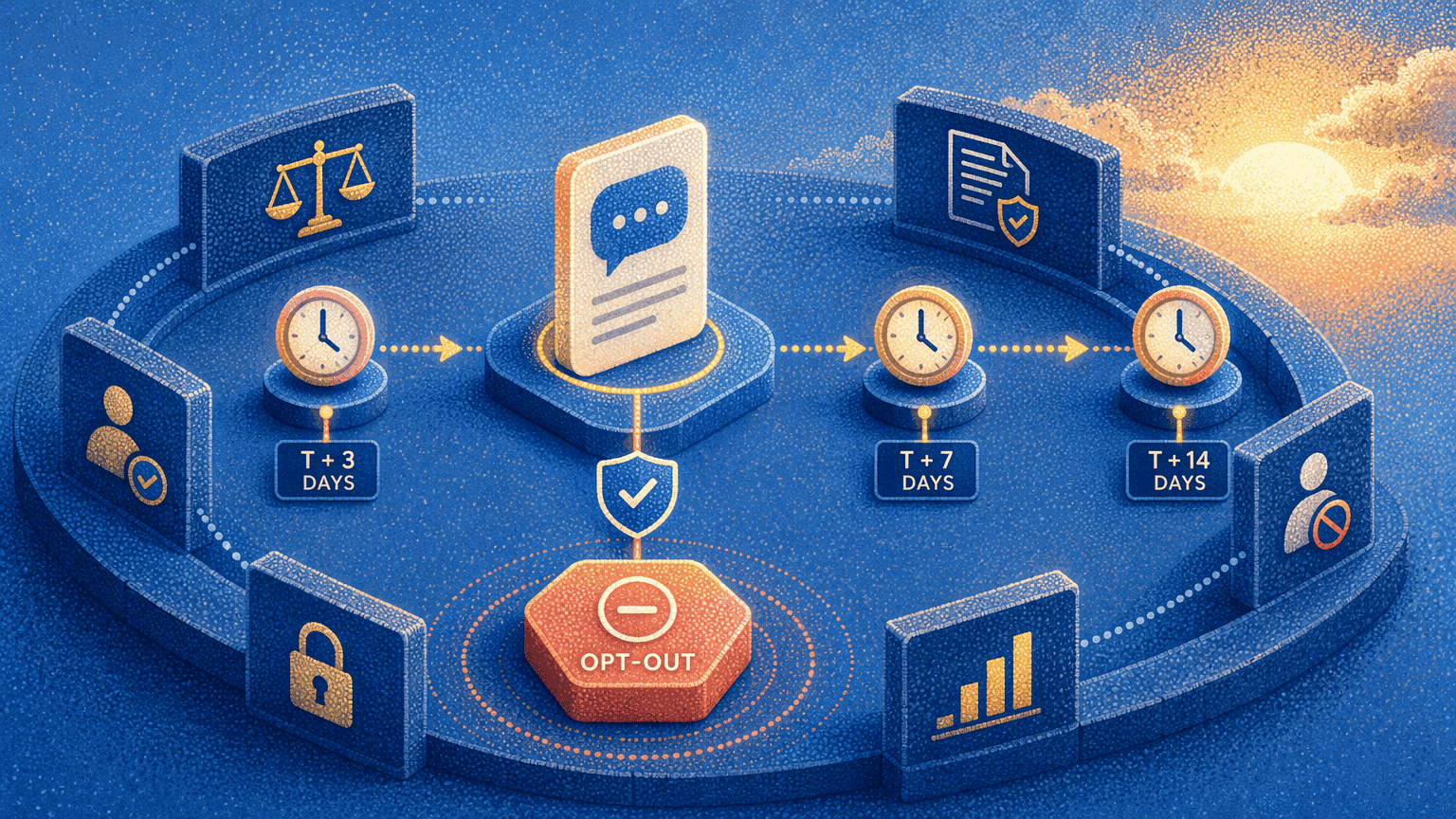
The moment you send a collection text instead of placing a call, you activate a different layer of federal law. The CFPB's Debt Collection Rule (Regulation F), effective November 30, 2021, is the operational document that governs exactly what you can put in that first message, how many times you can send it, and what must happen if the consumer says no.
The limited-content message is the rule's most consequential digital provision. A collector may send a voicemail, text, or email containing only the business name, a request for a return call, a date, and a notice that the call may be monitored and recorded. Anything more, and the message becomes a 'communication' that triggers the full validation-notice delivery obligation within five days. Mastering that narrow box is the difference between a legally safe initial contact and an FDCPA violation on the first touch.
On July 27, 2022, the CFPB released frequently asked questions on the electronic communication and unusual or inconvenient time and place provisions, clarifying that a collector cannot demand payment on a public-facing social media wall and that an opt-out mechanism must be functional, not merely stated. A consumer who replies 'STOP' to an SMS must be suppressed within a reasonable time across all channels the vendor controls. The platform must also treat email and text as a single conduit; you do not get seven calls and seven texts. You get seven total attempts across the voice-and-text channel group per seven-day period.
The validation notice itself requires a structured itemization table. On October 29, 2021, the CFPB released a guidance document on exactly how to disclose that information. Less than two weeks earlier, on October 18, 2021, the Bureau released a Spanish translation of the Model Validation Notice.
A digital agency can deliver that notice as a link in an SMS or an email body. The law does not care about the medium.
It cares about the delivery, the accuracy, and the consumer's ability to dispute in writing. A platform that automates the notice push without also tracking the 30-day validation window is automating a violation, not a workflow.
The Mechanics of Multi-Channel Compliance
You cannot buy a text-message platform and call it compliant. Multi-channel debt collection under Regulation F is an orchestration problem where the volume rules, time-of-day fences, and opt-out signaling must all operate on the same ledger. Here is the practical sequence that keeps you inside the legal lines:
Treat voice and text as one conduit for call-attempt counting. Regulation F caps call attempts at seven per seven-day period when the channels are treated as a single conduit. Your platform must aggregate all SMS, ringless voicemail, and outbound call attempts against a single account-level counter and hard-stop at seven.
Enforce time-of-day gates at the consumer's zip-code-correlated time zone. The FDCPA prohibits communication before 8:00 a.m. or after 9:00 p.m. in the consumer's time zone. A national digital agency cannot send an automated 9:05 a.m. Eastern text to a consumer who moved to California unless the system resolves the time zone from account data, not the dialer's server clock.
Build a multi-channel opt-out that syncs across SMS, email, and voice in real time. When a consumer replies 'STOP' to a text, the suppression must cascade to the email engine, the AI voice dialer, and the agent desktop within minutes. A delayed opt-out that lets another channel fire is a UDAAP exposure and a TCPA risk on the SMS side.
Deliver the validation notice link through the same channel the consumer used, and track open receipt. If the consumer engaged via email, send the itemization-table link by email. Monitor whether the message bounces or the link is clicked; a broken link is not a delivered notice, and a platform that cannot prove delivery cannot prove compliance.
The 'one conduit' logic catches platforms that were built as point solutions. An SMS vendor that does not know the voice dialer just placed three calls will blow through the cap by Tuesday. The compliance layer must sit above the channels, not inside them.
The Strategic Implications of AI-Powered Collections

Moving collections to digital channels opens the door to AI, but AI opens a door right back into the FDCPA if you don't fence it carefully. A machine learning model that predicts a consumer's likelihood to pay based on historical data and adjusts the tone, channel, and time of the next contact can lift recovery rates. The data is unequivocal about one point: humans still close harder than bots alone.
A recent large-scale experiment found that when AI callers are permanently assigned, the net present value of repayments they collect is 9 percentage points less than that of human callers around one month past due, and 5 percentage points less even one year later. The gap is not fixed. In a randomized trial where human callers replaced AI callers after five days, the NPV gap narrowed from 12 percentage points to 2 percentage points by day 10 and 0.8 percentage points by day 30. The lesson is not to avoid AI. It is to use AI for reach, timing, and scripting, and to escalate to a human when the negotiation becomes real.
Dynamic scripting is where the compliance risk concentrates. A model that generates settlement offers in real time must be constrained to approved ranges, script templates, and tone guardrails. No federal AI-specific rule governs debt collection today, but the United States does not have a thorough federal data protection law, so the FDCPA's general prohibitions on deception, harassment, and unfair practices apply to every AI-generated sentence. A platform like Domu addresses this by layering a model governance engine (called Alex) over its voice agents (Taylor and Jordan), enforcing on-script boundaries and flagging off-script utterances before they reach the consumer.
AI-generated settlement offers, hardship scripts, and dispute responses must be annotated, sampled, and validated by a compliance reviewer before they go live. The model can surface the right account at the right time. It cannot carry the legal liability for what it says.
How to Select and Integrate a Third-Party Platform
A platform's security posture is the first gate.
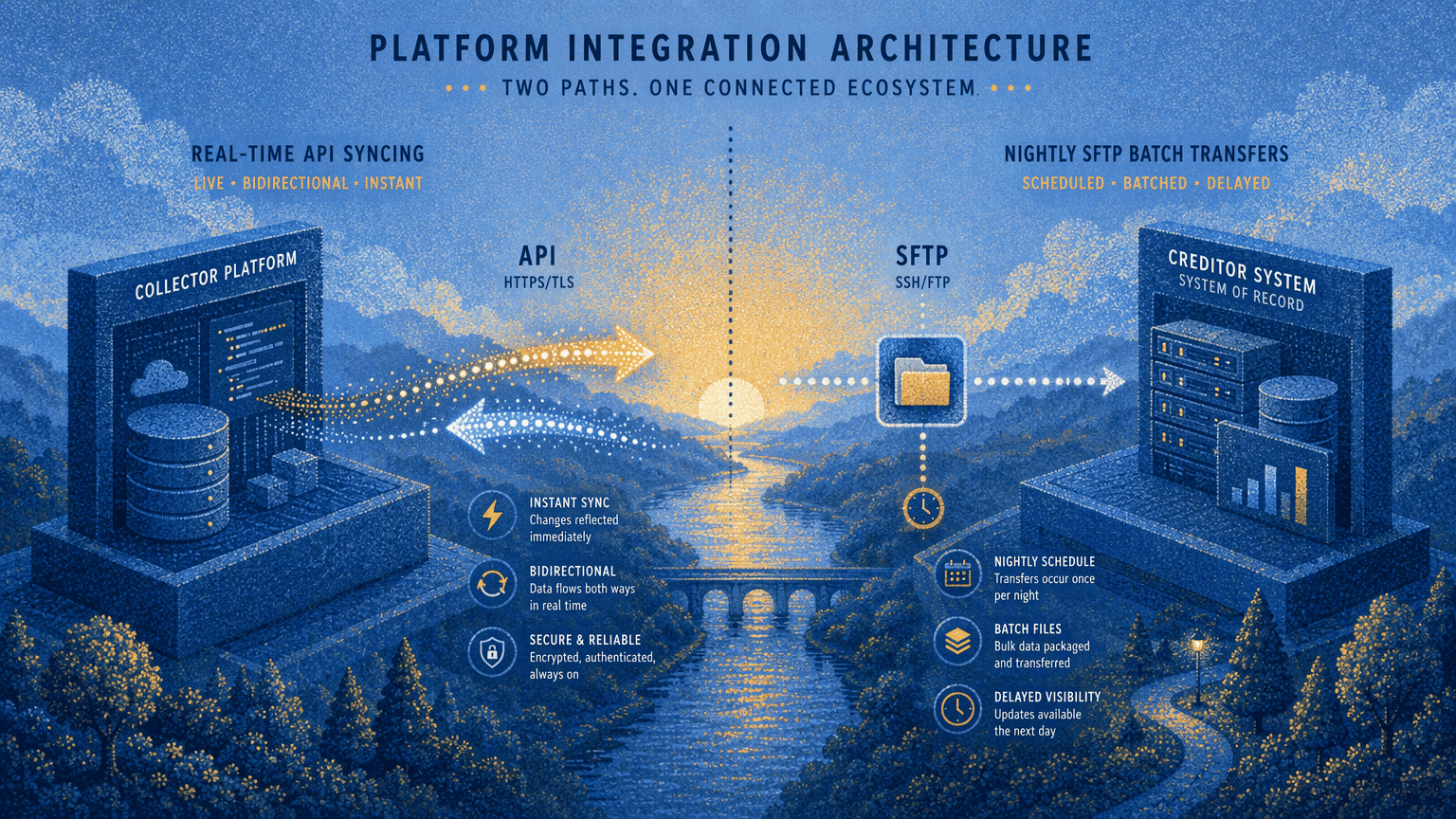
Integration architecture determines how tightly the compliance logic syncs with your core systems. The choice between an API and an SFTP-based integration is really a choice about latency. An API connection pulls account-level data (balance, last payment date, dispute status, cease-and-desist flag) in real time and pushes suppression changes back into the creditor's system of record within seconds. An SFTP batch file processed nightly creates a suppression gap: a consumer who opts out at 10 a.m. may receive an AI text at 11 a.m. because the flat file hasn't run yet. That gap is a TCPA claim waiting to happen.
You must test the vendor's suppression logic and opt-out syncing end-to-end during the pilot. Send a 'STOP' from a test device and verify that voice, email, and SMS all go dark within a reasonable window. Validate that the call-attempt counter decrements correctly across voice and text channels on the same account.
Check that the time-of-day gate respects a zip code that maps to a different time zone than the server clock. These edge cases look trivial in a slide deck. A plaintiff's attorney will request every one of them in discovery.
The final test is the validation notice delivery chain. A platform should generate the CFPB's model validation notice with the correct itemization table, deliver it as a link through the consumer's preferred channel, log whether the link was opened, and pause collection activity if a written dispute arrives within the 30-day window. What matters is whether the audit trail survives a regulatory exam.
Conclusion
Third-party digital collection is a compliance function that happens to produce recovery. Creditors who treat it as a cost-reduction lever first and a legal discipline second will pay the regulatory premium later. The framework is clear: know who legally is collecting, choose channels that match how consumers actually communicate, embed the CFPB's time, place, and frequency rules into the platform's architecture rather than its training manual, and keep a human reviewer between the AI and the send button. The vendors that can prove they do all of this, under independent audit, are the ones worth integrating. The rest are just faster ways to get sued.
Frequently Asked Questions
What is third-party digital collection and how does it differ from first-party collection?
Third-party digital collection is when an external agency recovers debts on behalf of another creditor using electronic channels such as SMS, email, and AI voice. The key difference is regulatory: a third-party collector is covered by the FDCPA when regularly collecting another's consumer debts, while a creditor collecting its own debts under its own name is generally exempt from the Act's third-party provisions.
How does third-party digital collection comply with US regulations like the FDCPA and CFPB rules?
Compliance requires adhering to Regulation F's electronic communication rules:
Limited-content message on first contact: Send only the business name, return-call request, date, and monitoring notice to avoid triggering full delivery obligations.
Validation notice within five days: Deliver the CFPB's model validation notice with an itemization table via the consumer's preferred channel.
Call attempt cap: Limit total attempts to seven per seven-day period, treating voice and text as a single conduit.
Time-of-day window: Honor the 8:00 a.m. to 9:00 p.m. local time restriction based on consumer location.
Functional opt-out mechanism: Provide real-time suppression across all channels when a consumer opts out (e.g., replying 'STOP').
What are the key benefits of using AI and automation in third-party digital collections?
AI in digital collections lifts recovery through several applications, but with important human-performance caveats:
Contact-timing optimization: AI identifies the best times to reach a consumer based on historical patterns.
Dynamic scripting within approved ranges: AI generates settlement offers constrained to compliance guardrails.
Automated settlement for low-balance accounts: AI handles accounts where manual labor cost exceeds recovery value.
Performance gap vs. humans: A study found AI callers collected 9 percentage points less NPV around one month past due compared to humans, but the gap narrows to near zero when a human takes over after five days.
What channels (voice, SMS, email) are used in third-party digital collection, and how do they work together?
The primary digital channels for collections must operate as a single compliance conduit:
SMS and email: Consumer preferred channels for initial contact and self-service portal access.
AI-powered voice calls and ringless voicemail: Can be used but count toward the seven-attempts-per-seven-days cap.
Single compliance treatment: All channels are treated as one, so seven total attempts apply across voice, SMS, email, and ringless voicemail.
Real-time opt-out syncing: A consumer who texts 'STOP' must be suppressed from voice and email within minutes, not hours.
How do financial institutions choose and integrate a third-party digital collection platform?
Vendor evaluation for digital collections platforms should proceed through two stages:
Integration method evaluation: Choose API connections for real-time suppression and account data syncing, avoiding SFTP batch files that create latency gaps for opted-out consumers.
End-to-end pilot testing: Test suppression logic, time-of-day gates, and validation notice delivery chain in a pilot before scaling to full portfolio.
What risks and compliance challenges exist in third-party digital collection?
The biggest risk is treating channel automation as a substitute for legal discipline. An opt-out that doesn't cascade, a call counter that separates SMS from voice, a time-of-day fence that uses server time instead of consumer time zone, and an AI-generated script that drifts off-template all create FDCPA, TCPA, or UDAAP liability. The FTC has sued over 30 debt collection companies for violations, and debt collectors generate more fraud reports to the FTC than any other industry.
Sources
Debt Collection (FDCPA) | Consumer Financial Protection Bureau - www.consumerfinance.gov
Identifying and Linking Consumer Data - www.congress.gov
Fair Debt Collection Practices Act (FDCPA) - www.federalreserve.gov
Debt Collection | Federal Trade Commission - www.ftc.gov
[PDF] How Good is AI at Twisting Arms? Experiments in Debt Collection - faculty.marshall.usc.edu
Related Articles



We’re building the next generation of engagement technology: intelligent, automated and compliant. Our mission is to empower financial institutions to orchestrate every stage of the servicing lifecycle with dignity and unprecedented efficiency.
Supported by

