

Your best collector just quit. They didn't leave for more money. They left because they could not stomach another day reciting the same Mini-Miranda warning
Introduction
Your best collector just quit. They didn't leave for more money. They left because they could not stomach another day reciting the same Mini-Miranda warning to a string of angry voicemails.
Repeating the exact script dozens of times a shift is not just boring. It is a clinically measurable pathway to emotional exhaustion. That specific type of burnout pushes turnover rates past 30 to 40 percent annually in high-volume collections shops.
You are bleeding talent and margin not because your pay is bad, but because the cognitive load of repetitive call handling breaks people. This article maps the exact points on a call where the damage happens, then shows you how an AI voice agent absorbs that load and stops the churn.
Key Takeaways
Repetitive call handling is the primary, controllable variable driving collector burnout and staffing instability. Here is how the problem breaks down and where the fix lives.
The core driver: Combining high-volume scripted interactions with mandatory emotional regulation creates a unique stressor that annual turnover data quantifies at over 30 to 40 percent.
The high-risk call segments: Compliance disclosure recitations, payment plan data entry, and scripted negotiation demands force peak multitasking strain on working memory.
The AI offload zone: AI voice agents automate the highest-repetition, lowest-judgment segments, specifically initial outreach, payment reminders, and standard disclosures.
The safety architecture: Real-time FDCPA and TCPA adherence, mandatory call logging, and immediate escalation upon a single consumer objection are non-negotiable technical requirements for any AI in US collections.
The outcome: Operations that combine AI call handling with human oversight report higher collector satisfaction and improved recovery rates because humans focus only on judgment-intensive, high-value negotiations.
The Measurable Toll: How Repetitive Calls Drain Collector Well-Being and Drive Turnover
The HCI research community spotted the problem decades ago. They have been measuring cognitive workload in user interfaces since 1994. In a call center, the interface is the script. And the script is heavy.
The drain on a collector is not a simple matter of boredom. It is a collision of two demanding tasks: rigid, word-for-word script adherence and simultaneous emotional regulation. A collector suppresses a natural human reaction to an angry consumer while their working memory is saturated by a mandatory compliance disclosure. Repeating this cycle 40 to 60 times a shift depletes cognitive resources in a pattern researchers call resource depletion.
That depletion, day after day, shows up on your P&L. Industry data confirms that annual turnover in these high-volume environments consistently sits in that 30 to 40 percent band, a direct operational cost that lands in recruiting, training, and recovery-rate dips on understaffed portfolios. The monotony is the mechanism; the exit interview is just the symptom.
You can feel it in the metrics before the resignation letter lands. Handle times creep up as mental fatigue slows data entry. Promise-to-pay ratios fall off because a depleted agent stops pushing past the first objection.
The operation stiffens up. Every percentage point of that churn is a recurring tax on your cost-to-collect, and it has a single root cause: you are asking humans to perform emotionally taxing, high-volume repetition that their brains are not wired to sustain. The fix starts with admitting that the role, as currently designed, breaks its people by design.
Anatomy of a Call: Pinpointing the Segments That Create the Highest Cognitive Load
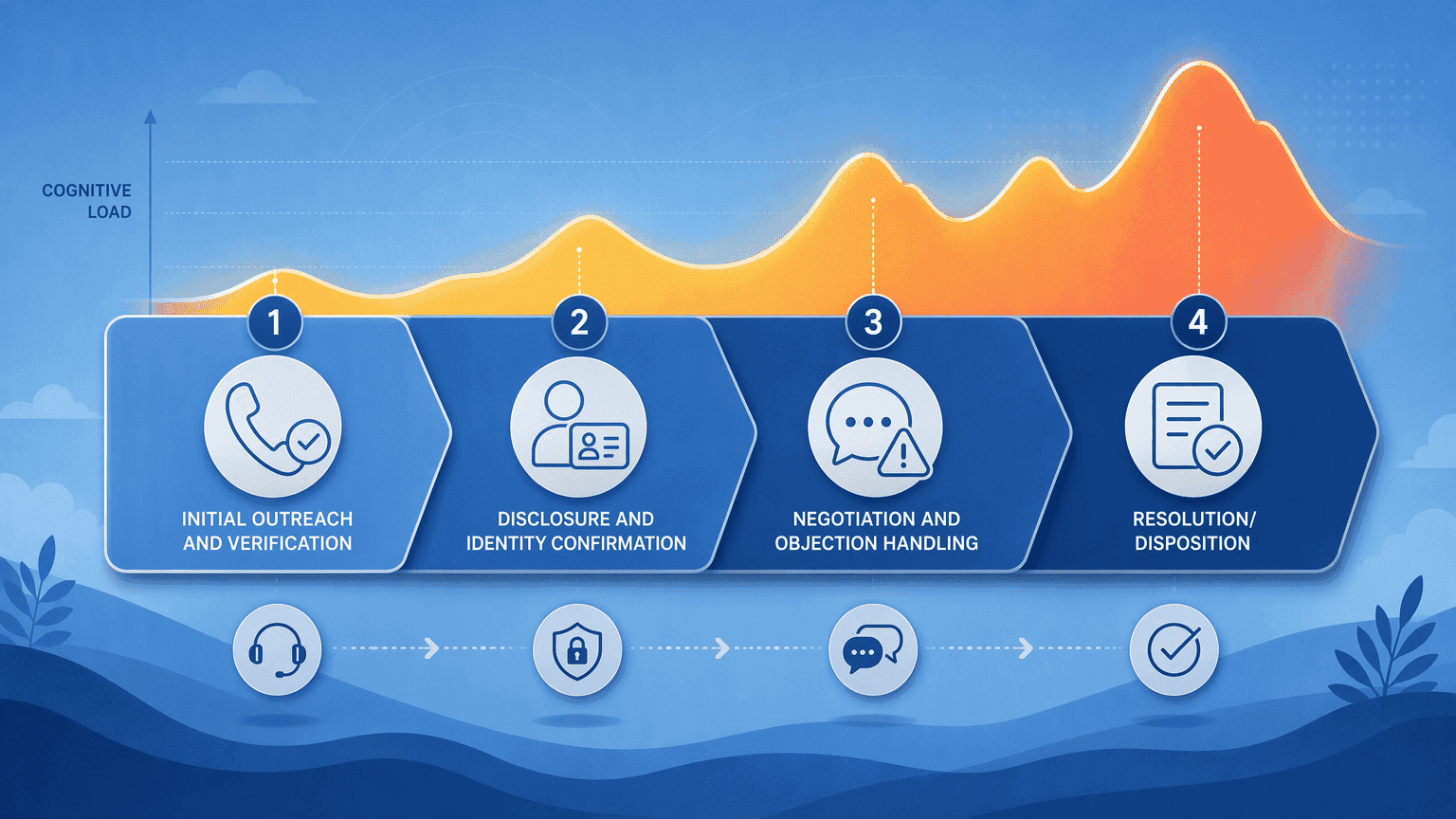
To fix the burnout cycle, you stop treating the entire call as a monolithic problem. You break it into phases and target the ones that shred working memory. The table below deconstructs a standard collections call into four distinct segments, mapping where cognitive load peaks and why automation becomes the therapy.
Call Phase | Core Task | Cognitive Load Driver | AI Offload Potential |
|---|---|---|---|
Initial Outreach and Verification | Identity confirmation, right-party contact, purpose statement | Simultaneous listening for objections, strict right-party disclosure scripting, and CRM navigation | High: Agents handle the full outbound dialer pass and verification prompts without human monitoring |
Disclosure Recitation | Mini-Miranda, state-specific notices, payment portal terms | Unwavering word-for-word compliance pressure combined with real-time consumer interruption management | High: On-script validation systems deliver perfect verbatim disclosure every time, absorbing the pressure |
Payment Negotiation and Plan Setup | Calculating settlement ranges, proposing installment terms, setting up EFT or card details | Peak multitasking: active negotiation while performing arithmetic, reading CRM guardrails, and completing data entry fields simultaneously | Conditional: AI negotiates within preset boundaries and processes payments; escalates to humans when negotiation moves outside approved parameters |
Data Entry and Disposition | Logging call outcome, updating debtor status, setting follow-up tasks | Post-call administrative typing load that extends the shift's cognitive tail | Complete: AI auto-populates all disposition codes, follow-up flags, and payment logs the instant the voice interaction ends |
The first three phases demand that a human do something that burns them out fast: listen, type, read a script, and suppress their own conversational instincts all at once. That is the operational failure. Offloading those phases is not about headcount reduction. It is about removing the exact tasks that make a 40-hour week feel like 80.
The Cognitive Mechanism: From Script Fatigue to Burnout in Collections Workflows

Script fatigue is real cognitive depletion, not a complaint. When a collector runs a tightly scripted call flow, they expend controlled, top-down attention on language production that allows zero personal variation. Researchers studying human-computer interaction have observed that the absence of a consensus measurement standard for cognitive workload often leads to misuse of metrics and misunderstanding of the concept itself. The drain compounds with every call.
That compounding hits three psychological pillars:
Resource depletion: The constant vigilance of staying exactly on-script exhausts the executive function system.
Emotional labor: Suppressing a human reaction to a distressed or abusive caller day after day creates a distinct emotional hangover.
Reduced personal accomplishment: A role with no novel problem-solving removes the exact cognitive rewards that make work feel meaningful.
The extended-mind research community separates offloading into two types. Low-variation, rote tasks offloaded to a system count as substitutive offloading. This keeps human cognitive capacity available for high-variation decisions, like negotiating a hardship settlement with a single mother who just lost her job. The current state, where a human reads the same disclosure to an answering machine 200 times a day, wastes a high-cost cognitive asset on a near-zero-value task.
Operational Therapy: AI Voice Agents as a Scalable Offload for Routine Tasks
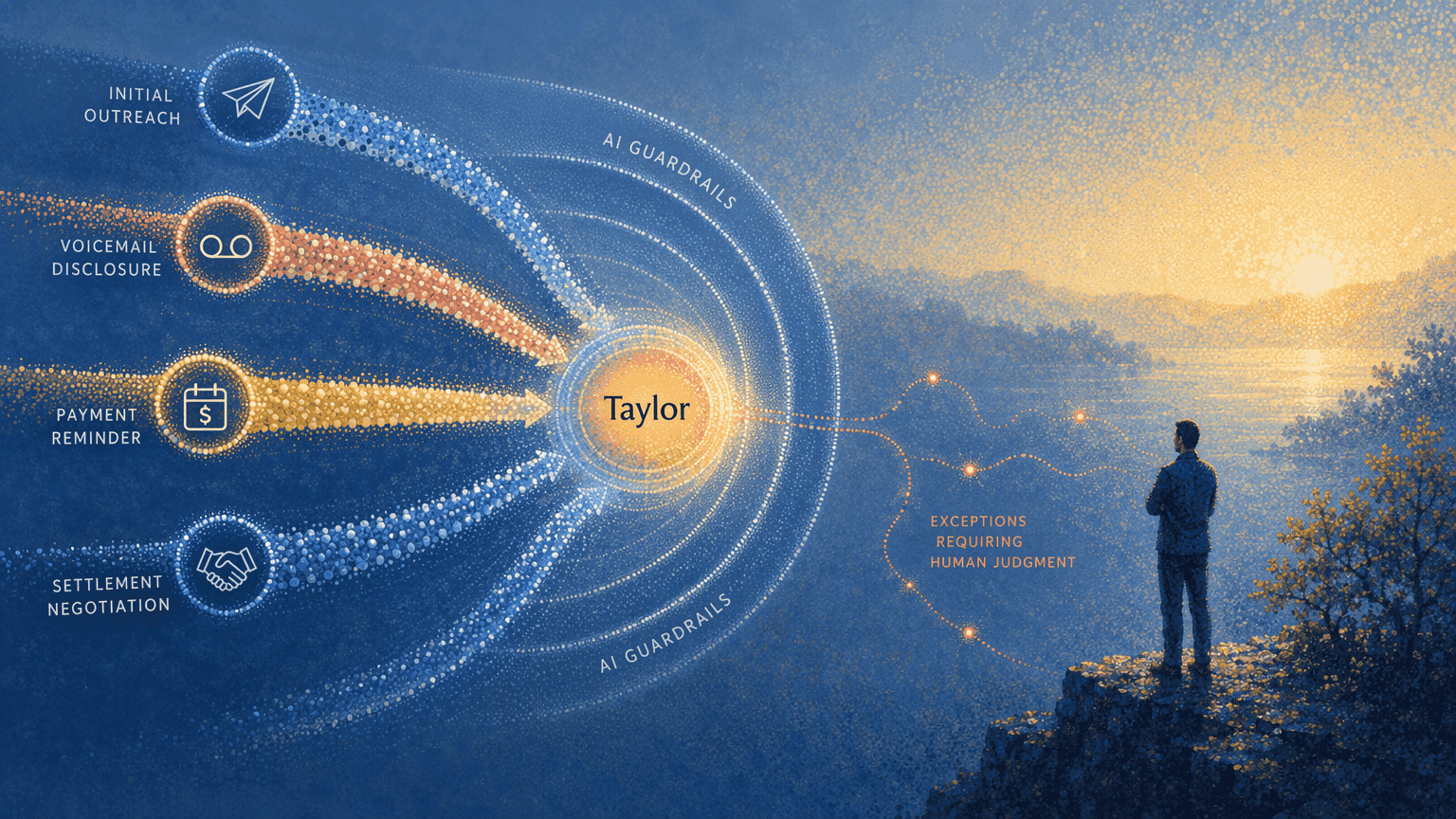
You treat the repetition injury by removing the repetition. An AI voice agent like our product, Taylor, is a scalable offload mechanism built for the highest-repetition moments on the collections floor. It handles the predictable conversations so your human team never has to.
The agent runs initial outreach, leaves the regulatory disclosure on a voicemail, sends the payment reminder, and negotiates the settlement amount inside a predefined guardrail. This is not a call-blending dialer that just connects more live bodies faster.
A predictive dialer accelerates the treadmill. An AI agent dismantles the treadmill for the tasks that should never touch a human ear.
The numbers inside production environments are stark. In one live deployment, an AI voice agent contained 65 percent of voice calls that previously went directly to a manual agent. That is two out of every three calls absorbed before they ever become a blip on a collector's screen. The operational cost impact lines up with what platform vendors report: clients see the potential to cut operational costs by up to 90 percent compared to staffing those routine interactions with a traditional agent workforce.
What does this look like in practice at Domu? Taylor runs on a model governance layer we call Alex. The agent receives a campaign, dials out, verifies the right party, recites the full disclosure, and then pivots into a structured negotiation. If the consumer agrees to the payment plan, Taylor processes the payment in-channel. If the consumer says "I need to talk to a person about a dispute," Taylor does not argue.
It does not loop. It performs a fail-safe escalation, hands over the full call context, and a human collector steps into a conversation that is already warm, compliant, and documented. The collector never touches the routinized front half of that call. They only step in for the judgment-heavy segment that actually requires a human.
The Human-Machine Partnership: Combining AI Call Handling with High-Empathy Human Judgment
The goal state is not a lights-out collection floor. It is a role elevation for your human team. In the Domu operating model, AI handles the transactional, protocol-driven portion of every interaction and escalates to a human only when the conversation requires real-time judgment. That handoff point might be a complex dispute, a hardship negotiation where the approved settlement range does not fit, or a consumer who simply asks for a person. At that moment, a seasoned collector receives a screen pop with the full conversation history, the debtor's complete payment profile, and the exact point in the negotiation where the AI stopped.
This partnership model is where the burnout cycle breaks. A collector who previously spent 80 percent of their shift on verification scripts and payment reminders now spends 100 percent of their shift on nuanced, high-stakes negotiation. They use their trained empathy and authority on conversations that actually need it. Operations running this hybrid model report measurably higher collector satisfaction because the job becomes what it was supposed to be: a high-skill role solving hard problems, not a human tape recorder. Recovery rates improve because judgment-intensive calls now get full, undivided human attention instead of a fatigued agent who is already cognitively drained from the 47 routine calls that preceded it.
Safety by Design: The Non-Negotiable Compliance and Escalation Framework for Regulated Collections
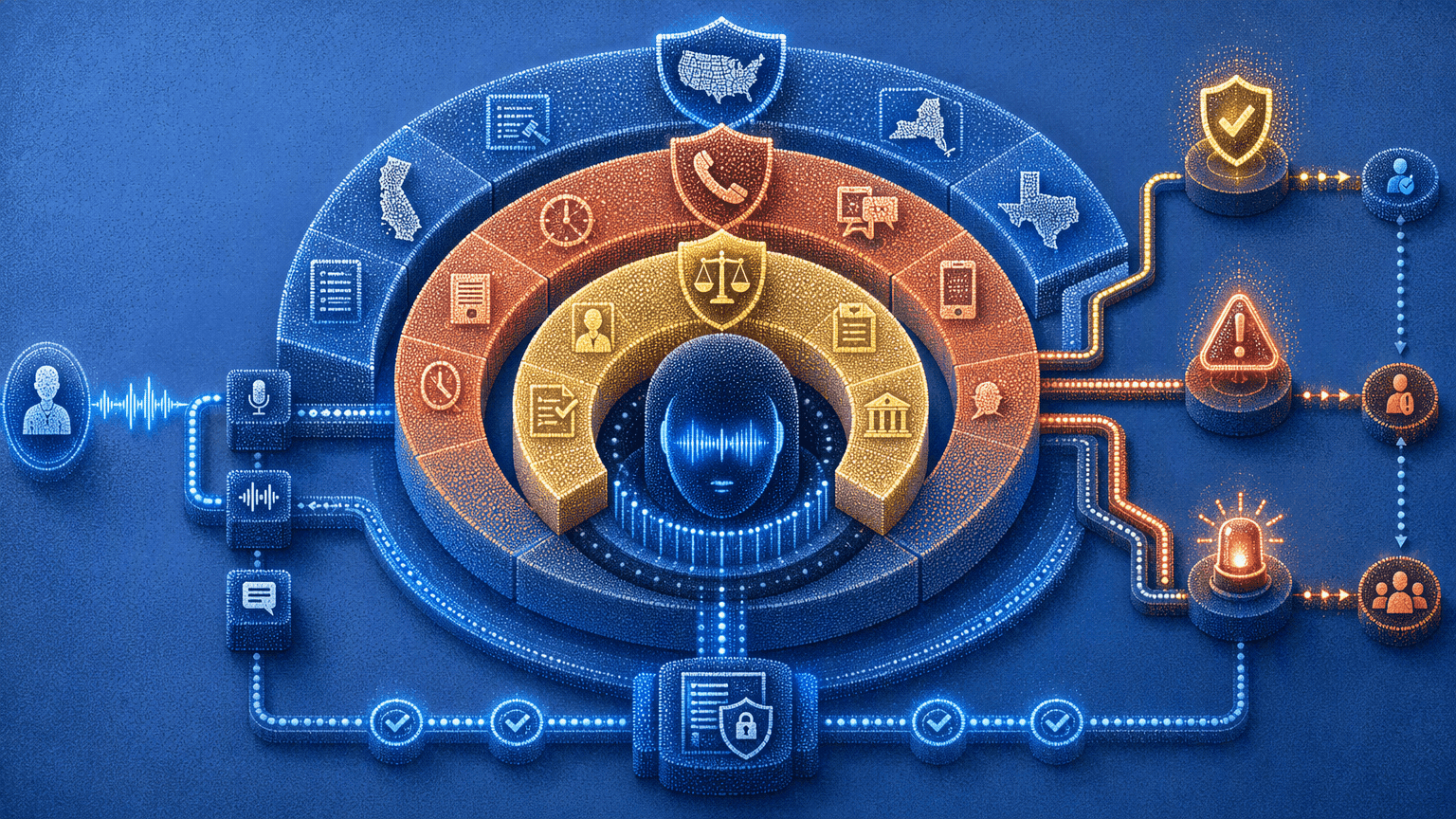
None of this offload architecture matters if the AI agent creates regulatory exposure on every call. In US collections, deploying a voice agent without a hard-coded compliance framework is operational malpractice. The platform must enforce real-time adherence to the Fair Debt Collection Practices Act (FDCPA), the Telephone Consumer Protection Act (TCPA), and relevant state-level provisions continuously, not as a periodic audit. That means the agent cannot produce a response outside the approved, compliant script, period.
In practice, this demands an on-script validation layer that monitors every generated utterance and shuts down any divergence before it reaches the consumer's ear. Platforms like Retell AI have stated their agents follow strict regulatory guidelines including FDCPA, TCPA, CFPB, and GDPR to keep interactions ethical, compliant, and non-intrusive. That claim must be backed by a product, not just a policy.
The escalation framework is the second half of the safety architecture. The consumer must be able to exit the automation at any moment with a single utterance: "Let me speak to a person," "I dispute this," or "Stop calling me." Upon that trigger, the agent must immediately stop any negotiation attempt, log the escalation, and route the interaction with full context to a human queue. For Domu this is the fail-safe escalation path: Taylor does not persist; Taylor hands off. Simultaneously, the compliance layer is auto-populating call dispositions, recording the interaction end-to-end, and timestamping the exact moment of escalation for your compliance team's audit trail.
You cannot bolt these features on after the fact. The compliance framework and the escalation logic are the core of the platform, not a settings toggle. A conversational AI that lacks this architectural compliance is not a collections tool. It is a liability.
Beyond Dialing Speed: An Evaluation Framework for Choosing an AI Platform Over a Traditional Autodialer
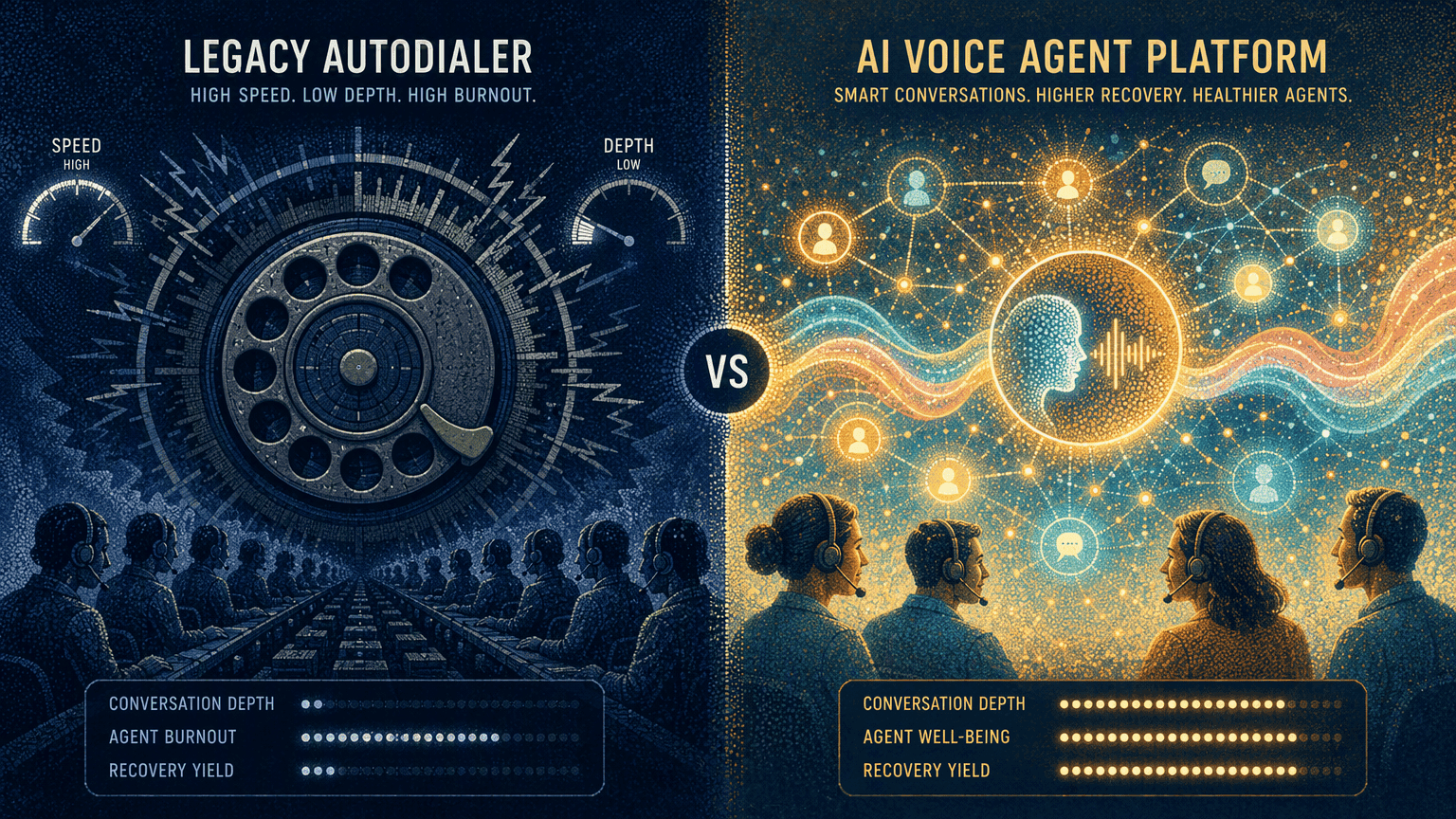
If you still evaluate technology on dials per minute, you are optimizing your way into a higher burnout rate. The evaluation dimension has shifted from connection speed to conversation intelligence. The table below contrasts a legacy autodialer's capabilities directly against a modern AI voice agent platform across the dimensions that actually determine collector well-being and recovery yield.
Evaluation Dimension | Traditional Autodialer | AI Voice Agent Platform |
|---|---|---|
Primary Optimization Objective | Maximize live connects per hour; agent utilization as a raw number | Resolve routine interactions without human touch; deliver escalated, warm conversations to skilled negotiators only |
Natural Language Handling | None: the dialer bridges a human to a human; agent performs all interpretation and adaptation | Contextual natural language understanding: agent negotiates within guardrails, handles objections, and routes to human only when explicit boundaries are exceeded |
Compliance Execution Model | Post-call monitoring and manual QA sampling; script adherence left to agent discipline | Real-time, on-script validation at the generation layer; every utterance constrained to pre-approved compliance templates with automatic logging |
Escalation Path | Agent-initiated transfer that requires manual note-passing and CRM updates | Automated, context-rich escalation: full interaction transcript, current financial terms, and reason for transfer delivered instantly to human screen pop |
Real-Time Payment Processing in Voice Channel | Agent manually enters payment data into a separate terminal or IVR while staying on the line | Agent completes full payment processing within the AI voice channel; secure payment portals and PCI-compliant EFT handling without human data entry |
A dialer gives you more at-bats. An AI agent gives you actual resolved at-bats without wearing out your hitters. The evaluation framework is no longer about how many calls you can throw at a human. It is about which platform removes the highest volume of non-judgment work from the human's task list while maintaining perfect compliance fidelity on every single interaction.
Conclusion
High-turnover collections operations share a structural defect: they force human beings to spend most of their shift on cognitively draining, zero-variation script delivery. That defect costs you 30 to 40 percent of your team every year in headcount churn and recovery rate dips from perpetual understaffing. The fix treats AI not as a headcount reduction lever but as a compliance-grade offload layer that absorbs every routine task, from the Mini-Miranda to the payment reminder, and escalates only the high-judgment moments to a collector who is fresh and focused.
Deploy an AI platform like Taylor with a safety-by-design compliance architecture, and you end the burnout cycle. You transform the role of collector from script reciter to high-stakes negotiator. You build an operation that is stable, compliant, and more profitable because you stop burning through the one asset that actually closes hard accounts: a prepared, empathic human.
Frequently Asked Questions
What measurable impact does repetitive call handling have on debt collector well-being and turnover?
It directly drives annual turnover rates exceeding 30 to 40 percent in high-volume shops. The combination of rigid script adherence and simultaneous emotional regulation depletes cognitive resources daily, leading to emotional exhaustion that manifests as staffing instability and higher operational costs.
Which specific parts of a repetitive collections call cause the highest cognitive load and burnout risk?
Compliance disclosure recitations, payment plan data entry, and scripted negotiation create peak multitasking strain. These phases demand simultaneous listening, typing, strict word-for-word scripting, and emotional suppression, which together saturate working memory and accelerate burnout.
How do AI voice agents like Taylor reduce the repetitive tasks that lead to collector burnout?
They automate the highest-repetition, lowest-judgment segments: initial outreach, payment reminders, and standard disclosures. By containing a large portion of routine calls before they reach a human, the agent ensures collectors only handle complex, judgment-intensive conversations that require empathy.
What compliance and escalation safeguards must an AI voice agent have to be safe for regulated US collections?
The agent must enforce real-time FDCPA and TCPA adherence with on-script validation, provide automated full-call recording and logging, and execute immediate fail-safe escalation to a human upon any consumer request, dispute, or stop-call command.
How have debt collection operations combined AI call handling with human oversight to improve outcomes?
Operations report higher collector satisfaction and improved recovery rates. The model uses AI for transactional protocol and escalates only dispute or hardship negotiations to humans, transforming collectors into focused, high-empathy negotiators instead of fatigued script reciters.
What should a US collections leader evaluate when choosing between an AI agent platform and a traditional autodialer?
Compare natural language understanding, real-time compliance guardrails, contextual escalation logic, and in-channel payment processing capability. The evaluation criterion shifts from raw dialing speed per agent to intelligent conversation resolution without human touch.
Sources
[PDF] Study of third-party debt collection operations - files.consumerfinance.gov
A Survey on Measuring Cognitive Workload in Human-Computer Interaction | ACM Computing Surveys - dl.acm.org
AI Phone Agent for Debt Collection | Retell AI – Automate Recovery & Improve Collection Rates - www.retellai.com
BLOG | MSUSA - www.magellansolutionsusa.com
Related Articles





We’re building the next generation of engagement technology: intelligent, automated and compliant. Our mission is to empower financial institutions to orchestrate every stage of the servicing lifecycle with dignity and unprecedented efficiency.
Supported by

