
8 Best Conversational AI Platforms for Community Banks With Limited IT Resources in 2026


Manuel Romero
10 min read
Your IT team is three people, and one of them still spends Fridays fixing the teller printers.
Introduction
Your IT team is three people, and one of them still spends Fridays fixing the teller printers. At the same time, your regulator expects every customer communication to be audit-ready, and your members expect a response at 11 PM on a Saturday. This is the bind for community banks today. Throwing a generic chatbot on the website feels easy, but the CFPB’s 2023 report highlights why that is a trap: about half of medical debt complaints involve attempts to collect a debt the consumer doesn't owe. A bot that cannot control its own script is a liability, not a tool.
Generic AI hallucinates. Purpose-built conversational AI platforms for regulated collections operate inside a fence. They embed FDCPA, TCPA, and UDAAP guardrails directly into the conversation flow, not as an overlay. This article walks through the platforms that let a lean community bank deploy conversational AI without hiring a data science team and without betting the charter on an unscripted model. We will look at seven options, from compliance-first architectures to high-volume origination tools, and lay out the integration and deployment reality so you can match a platform to your actual operating constraints.
Key Takeaways
The platforms below separate into two practical tiers: those engineered inside the regulatory perimeter (Domu, Interface.ai) and those focused on a specific service channel or capability (Posh AI, Glia). Here is what matters most.
Compliance-first design is the real moat: Domu stress-tests conversation flows against FDCPA and TCPA boundaries in a synthetic environment before deployment. Generic bots treat compliance as a prompt suggestion.
Pre-built integrations save months: Interface.ai's out-of-the-box MeridianLink Consumer integration and Kasisto's core banking connectors collapse weeks of IT work into configuration.
Cost models are subscription plus per-conversation fees: Expect a monthly baseline plus variable charges. ROI shows up as deflected call volume and higher digital conversion; Glia reports handling up to 80% of inquiries without human help.
A UDAAP lens is mandatory: NAFCU flagged the risk directly in its 2019 Regulation F comment: a platform without controlled, auditable conversation flows leaves the bank holding the liability.
You can start with a narrow scope: Deploy first in a contained channel (SMS payment reminders, balance inquiries) to prove the compliance model, then expand.
1. Domu: The Compliance-First Platform Purpose-Built for Community Banking Regulations

The first time a community bank compliance officer sits through a vendor demo that hand-waves away UDAAP with a five-minute slide, she knows the conversation is over. That is the gap Domu built its platform to close. It is a production-grade conversational AI system engineered for the regulated perimeter of financial services collections and servicing, with a pre-deployment governance specialist (Alex) that restricts the AI to an approved data repository and a post-deployment audit lead (Jordan) that validates interactions against UDAAP and state-specific collection laws after every conversation.
The system generates formal certification reports for pre-deployment AI approval and produces audit-ready interaction logs. When DigniFi needed to modernize customer communication inside a regulated consumer finance operation, it turned to Domu to run compliant, AI-driven conversations at scale.
What separates this platform from a generic chatbot trained on banking FAQs is the adversarial testing. Domu stress-tests every conversation flow against FDCPA and TCPA boundaries in a synthetic environment before the agent ever touches a live call. The system uses automatic speech recognition and a text-to-speech engine for real conversations, but the guardrails are structural: the AI does not improvise outside the approved script parameters.
On a live call, if Domu Taylor encounters confusion or a high-risk scenario, it escalates safely to a human rather than pushing through. The company says its technology handles thousands of live calls end to end for Fortune 500 banks and insurers, with integration into core banking systems via a low-code API. The trade-off is honest: it requires integration investment rather than a drop-in deployment.
For a community bank with limited IT staff, the operational model is realistic. Domu runs supported by AWS, offers cloud and on-premise deployment, and covers the heavy regulatory lift that would otherwise fall on your compliance officer. It is worth stating clearly: the platform flags compliance violations in real time for human oversight.
It does not provide a legal guarantee. What it does is collapse the distance between your deployment and a regulator-ready audit trail.
2. Interface.ai: High-Volume Financial AI with Deep MeridianLink Integration
If loan origination is the primary growth lever, Interface.ai's deep connection to MeridianLink Consumer makes it the shortest path to a measurable lift. The company reports a 160% improvement in online product conversion, processing 1.5 million conversations daily across more than 100 financial institutions.
Interface.ai built its Agentic Chat AI as a three-pronged system purpose-built for banks and credit unions. AI Transactions handles authenticated balance checks, transfers, and payments with device biometrics. AI Search pulls answers from your website and shared documents without manual training.
AI Conversion simplifies onboarding and application journeys with intelligent co-browsing and proactive guidance. All three share a unified intelligence layer, so behavior stays consistent across modules. For a community bank, this means you configure intake flows and loan-application support inside a low-code environment rather than building a custom integration from scratch.
The MeridianLink partnership is a real deployment accelerant: the pre-wired connector means your IT team maps to an existing integration, bypassing the months of API development that typically stall these projects. The throughput numbers tell you the platform handles volume.
For a lean operation, the unified intelligence matters more. One model update propagates everywhere, and your team maintains a single system instead of three separate bots.
3. Posh AI: The Conversational Platform for Digital-First Account Servicing

Posh AI automates the routine account inquiries that fill your call center queues so your team handles conversations that actually need a human. For a community bank with limited IT resources, the platform addresses a specific set of problems.
Deployed as a voicebot and chatbot: Posh runs across phone and digital channels, so members get the same service whether they call or type.
Core use cases are precise: balance inquiries, transaction history checks, and stop-payment requests. These are high-frequency, low-complexity requests that do not require a licensed banker.
Call deflection is the immediate ROI: by handling these tier-one requests automatically, the platform cuts hold times and frees branch staff for relationship work.
IT lift is configuration, not development: the deployment model is designed for financial institutions that do not have a machine learning team. Setup involves mapping to core data fields and setting conversation parameters rather than training a model from scratch.
Fits the digital-first tier: if your bank is adding a self-service layer without standing up a full development team, Posh AI provides a constrained, proven scope that gets live in weeks.
4. Cascade AI: Omnichannel Member Service with Real-Time Sentiment Analysis
Cascade AI distinguishes itself from generic conversational AI platforms through three key capabilities:
Real-time sentiment analysis: Most conversational AI platforms treat sentiment as a post-call dashboard metric, but Cascade AI embeds real-time sentiment analysis directly into the conversation stream across web, mobile, and SMS. When a member's language signals frustration, the system detects the shift and can escalate to a human agent without waiting for the customer to request a transfer.
Proactive compliance protection: For a community bank, this changes the compliance and reputation calculus. A generic bot that plows through a script while a member grows angrier creates a UDAAP risk you may not see until the complaint arrives. Cascade's design catches that tension in the moment and routes it. This protects the relationship-forward brand that community banks trade on. The escalation logic is triggered by the model, so you do not need a dedicated analyst monitoring sentiment dashboards.
Unified omnichannel architecture: The omnichannel piece matters operationally. A member who starts a dispute on SMS and then calls the branch expects continuity, not a reset. Cascade's unified architecture means context travels with the interaction. For a small IT team, this reduces the integration surface: one platform connects web, mobile, and SMS, rather than stitching three separate channel tools to your core.
5. Clinc AI: Advanced Natural Language Processing Trained Exclusively on Financial Data

The accuracy problem in banking chatbots is usually a training-data problem. Generic NLP models trained on Wikipedia, social media, and customer support tickets don’t understand the difference between a stop payment and a pending authorization. Clinc AI’s model is built on financial vernacular and transaction patterns.
That domain focus produces higher out-of-the-box accuracy on balance queries, transaction disputes, and financial literacy questions. Your IT team skips the most expensive phase of custom AI deployment: the endless cycle of retraining a generic bot to stop misunderstanding your customers. The base training already covers the syntax of banking.
Clinc’s financial NLP models understand complex queries with nested conditions. A member asks about a charge that posted on a specific date but then reversed two days later. Generic bots break on these chains. Clinc handles them because the training corpus is built from financial interactions.
The deployment model follows the same low-code pattern as the other platforms on this list: configuration of conversation flows, API connectivity to core banking data, and a management interface designed for a banking operations team. The trade-off is that financial-specific NLP, while accurate, can still require careful prompt engineering to stay within compliance bounds on collections-related conversations.
6. Glia: Digital Customer Service Unifying Chat, Voice, and Video Banking
Glia takes a different architectural bet: instead of focusing narrowly on a single modality like voice or chat, it unifies chat, voice, video, and co-browsing into a single digital customer service platform. For a $16 billion community bank, this approach had a concrete result: Glia’s AI now handles up to 80% of inquiries without human help, and the same deployment improved agent retention by 71%.
The video banking and co-browsing features separate Glia from a standalone chatbot. A member applying for a loan can share their screen while talking to a banker through the same interface that handled the initial balance inquiry. For a community bank, this replicates the high-touch branch experience remotely, without requiring the IT team to integrate a separate video tool, chat widget, and voice platform.
From a deployment standpoint, the SaaS model and banking-specific configuration reduce the implementation lift. The 80% inquiry deflection number implies the platform automates a substantial portion of the service interactions that currently consume branch and call-center staff time. The single-vendor approach leaves a small IT team with one integration to maintain, one compliance review cycle, and one set of conversation logs to audit.
7. Kasisto: Enterprise-Grade Conversational AI with Proven Core Banking Integrations
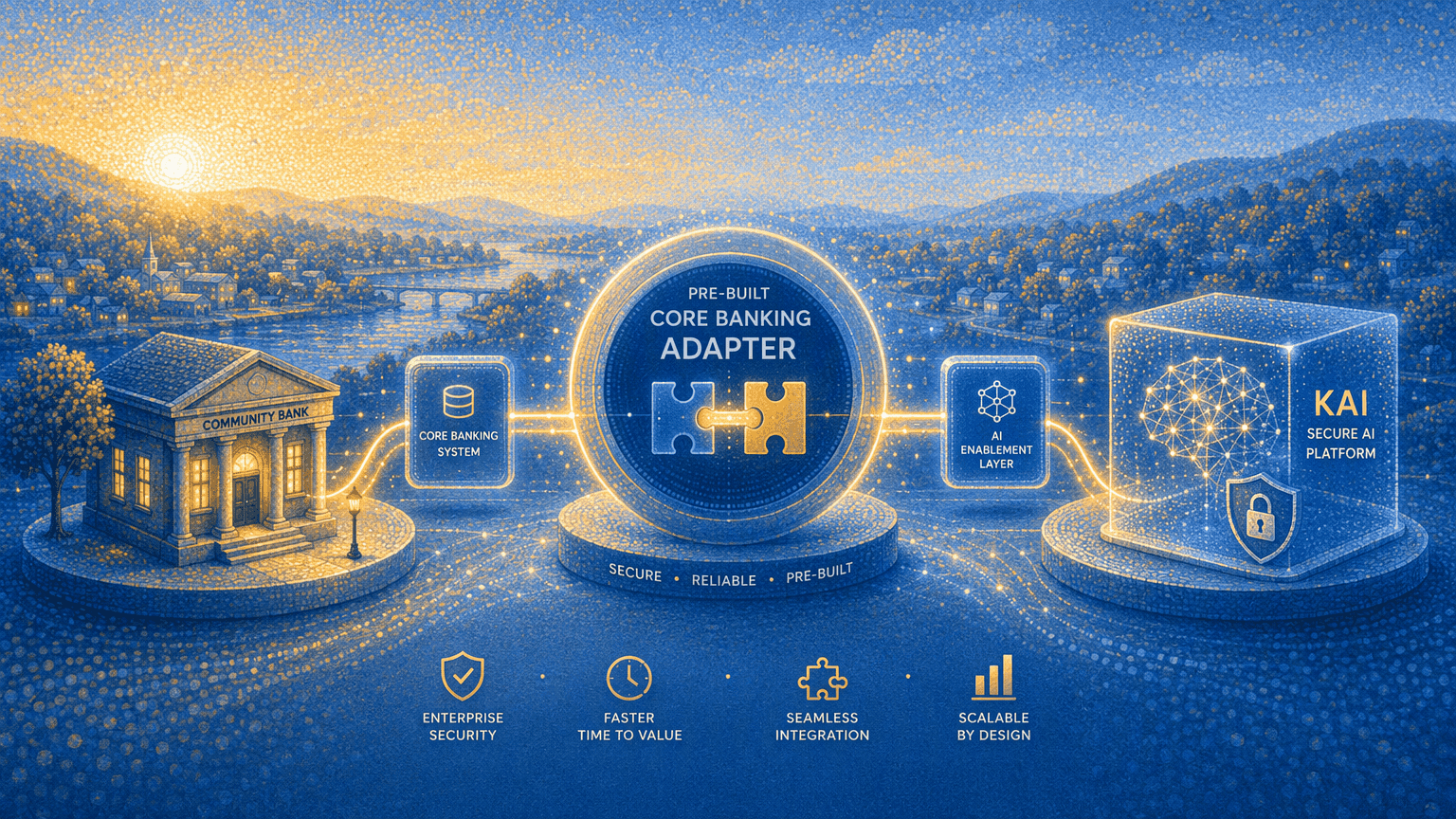
Kasisto ships with the scar tissue of large-bank deployments baked into its platform. Its KAI conversational AI was built for major financial institutions. The pre-built integrations with core banking providers are the asset a community bank can borrow. Instead of mapping API endpoints from scratch, your IT team connects through an existing adapter, which cuts out the most labor-intensive portion of any AI deployment.
KAI’s financial literacy and personal financial management conversation capabilities are a genuine differentiator. The platform can answer a member’s question about spending patterns across categories with context from transaction history. This shifts the AI toward proactive guidance, which is the direction member expectations are moving. For a community bank with limited IT, the enterprise lineage means the platform already handles many of the brittle edge cases (failed authentications, partial data responses, core system timeouts) that a lighter tool would surface only in production.
Comparison Table: Integration Requirements, Compliance Architecture, and Escalation Logic
The table below maps the seven platforms across the three dimensions that matter most to a community bank: how they connect to your existing systems, how they handle regulatory guardrails, and what happens when the AI hits its limits.
Feature | Domu | Interface.ai | Posh AI | Cascade AI | Clinc AI | Glia | Kasisto |
|---|---|---|---|---|---|---|---|
Pre-Built Core/LOS Integration | Low-code API into core banking; requires integration investment | Out-of-the-box MeridianLink Consumer connector | Core data field mapping via configuration | API hooks for authentication and account data | API connectivity to core banking data | Single-platform integration across channels | Pre-built adapters for major core banking providers |
Compliance Guardrails (FDCPA/TCPA/UDAAP) | Pre-deployment stress-testing; post-deployment audit validation; audit-ready logs | Purpose-built for banking with secure transaction handling and AI Search guardrails | Constrained conversation parameters for routine servicing only | Sentiment-based escalation mitigates UDAAP risk from frustrated members | Financial-specific NLP trained on banking vernacular; requires prompt engineering for collections compliance | Banking-specific configuration with unified audit logs | Enterprise-tested edge-case handling; compliance architecture from large-bank deployments |
Human Escalation & Handoff | Safe escalation when high-risk or confused states detected | Agentic AI with form assistance and escalation to live agent | Deflects tier-one requests; complex issues route to staff | Real-time sentiment analysis triggers automatic agent transfer | Escalation through conversation flow configuration | Unified platform: escalation across chat, voice, and video with context | Enterprise-grade handoff protocols from large-bank production environments |
8. Deployment Timelines and IT Resource Requirements for Community Banks

Deployment speed varies more by integration depth than by vendor. Here is the realistic range for a community bank with a lean IT team, based on the platform architectures and implementation patterns we have examined:
SaaS with low-code configuration: Most purpose-built platforms fall in a 2-to-6-week window for a scoped deployment (single channel, defined use case like balance inquiries). This assumes your IT team handles API key setup, basic branding, and conversation flow review.
Core banking API connectivity: The heavy IT lift, mapping to your specific core and LOS, adds 2 to 4 weeks depending on the integration. Platforms with pre-built connectors (Interface.ai for MeridianLink, Kasisto for major cores) collapse this significantly.
Cloud vs. on-premise: Cloud deployments (Domu on AWS, Glia SaaS) remove infrastructure procurement from the timeline. On-premise options extend the timeline but support banks with strict data residency requirements.
Compliance review is a fixed cost: Regulator-facing documentation, conversation flow approval, and internal policy alignment add 1 to 2 weeks regardless of vendor. Domu’s formal MRM Certification Report is designed to accelerate this step inside existing governance processes.
Contrast with generic AI: A community bank attempting to deploy a generic CAIP and then retrofit FDCPA/TCPA guardrails can expect a 3-to-6-month project with heavy reliance on outside NLP and compliance consultants.
Conclusion
Purpose-built conversational AI platforms are accessible deployment-ready tools. A community bank can get one live inside a quarter without hiring a machine-learning team. The line separating the platforms on this list is integration depth: Domu and Interface.ai embed compliance and core connectivity as structural features. Posh AI, Glia, and the others solve specific service-channel problems with a lighter touch.
If you are building a shortlist, start with the integration question. A MeridianLink shop should look hard at Interface.ai’s 160% conversion lift. A bank where compliance and auditability dominate every technology decision should evaluate Domu’s pre-deployment stress-testing and post-call audit architecture.
The CFPB data is clear on the risk: half of medical debt complaints stem from attempts to collect what is not owed. A bot that cannot constrain its script creates that exact liability. The right platform turns compliance from a cost center into a controlled automation layer, and that is the bet worth making.
Frequently Asked Questions
What are the best conversational AI platforms that community banks with limited IT resources can realistically deploy?
Domu, Interface.ai, Posh AI, Glia, and Kasisto are the most deployable. They offer low-code configuration, pre-built core banking integrations, and compliance guardrails specific to financial services. These platforms do not require a data science team and can be scoped to a single use case such as balance inquiries or payment reminders.
How do these platforms handle regulatory compliance specifically for US community banks (e.g., FDCPA, TCPA, UDAAP)?
Leading platforms embed compliance structurally. Domu stress-tests conversation flows against FDCPA and TCPA boundaries in synthetic environments before deployment and runs post-call UDAAP validation. Others use controlled conversation parameters and audit logs. Generic chatbots lack these guardrails, creating UDAAP exposure from unscripted responses.
What are the practical integration and implementation requirements for a conversational AI platform in a community bank's existing infrastructure?
You need API connectivity to your core banking system and, for lending use cases, your loan origination platform. Most purpose-built platforms offer pre-built connectors (Interface.ai for MeridianLink, Kasisto for major cores). IT tasks include:
API key setup and basic branding.
Conversation flow review and compliance documentation.
What is the typical cost structure and ROI for a community bank deploying conversational AI for customer service or collections?
Cost models are a monthly subscription plus per-conversation fees. ROI shows up as reduced call volume and higher digital conversion:
Glia reports handling up to 80% of inquiries without human help.
Interface.ai reports a 160% improvement in online product conversion.
Lower collection costs and audit-ready logs add further value.
What are the key differences between a purpose-built compliance-first platform like Domu and a generic conversational AI chatbot for banking use cases?
Domu differentiates from a generic chatbot in several key ways:
Pre-deployment stress testing: validates conversations against UDAAP and state laws in real time and tests against FDCPA boundaries before deployment.
Audit-ready logs: produces compliance documentation automatically.
Constrained behavior: while a generic chatbot treats compliance as a prompt suggestion and can improvise outside its script, Domu stays within approved bounds.
Risk mitigation: the CFPB found half of medical debt complaints involve attempts to collect debt the consumer does not owe, a risk an unconstrained bot amplifies.
What are the most important features for community banks to evaluate when choosing between conversational AI vendors?
Evaluate platforms against these criteria:
Pre-built core and LOS integrations: check for existing connectors.
Embedded compliance guardrails: verify support for FDCPA, TCPA, and UDAAP.
Human escalation logic: confirm the AI can flag confusion or high-risk states and transfer safely.
Deployment timeline: choose between weeks versus months.
Training requirements: assess whether the platform requires custom model training or operates out of the box on your specific use case.
Sources
Dignifi — Domu Customer Story - domu.ai
Fair Debt Collection Practices Act - files.consumerfinance.gov. - files.consumerfinance.gov
Chat AI for Credit Unions and Community Banks | interface.ai - interface.ai
$16B Community Bank Turns AI Cost Savings into Human Impact | Glia® - www.glia.com
Best Conversational AI Platforms Reviews 2026 | Gartner Peer Insights - www.gartner.com
Related Articles



We’re building the next generation of engagement technology: intelligent, automated and compliant. Our mission is to empower financial institutions to orchestrate every stage of the servicing lifecycle with dignity and unprecedented efficiency.
Supported by

