
8 Best Tools to Automate Collection Actions from Borrower Behavior Patterns in 2026


Manuel Romero
10 min read
A borrower misses a third payment. By the time a collector notices, opens the file, and schedules a call, the account has drifted another five days past due.
Introduction
A borrower misses a third payment. By the time a collector notices, opens the file, and schedules a call, the account has drifted another five days past due. Multiply this across thousands of accounts and your roll rates tick steadily upward while your team stays permanently behind the curve. Manual collections processes cannot keep pace by design. They react to events that already happened.
Automated collection actions triggered by borrower behavior patterns close this gap. These systems listen for specific signals, such as a missed promise to pay, a late-night portal visit, or a sudden shift in transaction frequency, and immediately initiate the next step in a predetermined or AI-optimized strategy. The result is an operation that responds in real time, at the speed of the next available agent.
Regulations add pressure to get this right. Under Reg F and the FDCPA, contacting a borrower at the wrong time, on the wrong channel, or without regard to a prior cease communication request carries real financial and reputational risk. Properly configured behavioral triggers embed these compliance guardrails directly into the workflow, silencing outreach automatically when rules prohibit it. As the CFPB continues emphasizing technology-driven compliance, the tools you choose directly shape your risk profile.
AI tools have grown exponentially in the debt collection industry. But growth creates noise. The following eight tools represent distinct approaches to behavioral trigger automation, each focusing on a different slice of the problem.
Key Takeaways
The core insight across all eight platforms is that behavior, not calendar dates, should drive collections outreach. Here are the critical takeaways before you dive into the individual tools:
Behavioral triggers extend far beyond days past due: Leading systems now react to broken promises to pay, payment patterns, digital body language like portal logins or email opens, and even real-time vocal sentiment during calls.
Compliance is a design requirement, not an afterthought: Platforms embed Reg F and FDCPA guardrails into automation rules. Automated procedures can be programmed to limit liability under federal statutes by silencing outreach when rules prohibit contact.
Machine learning shifts the model from reactive to predictive: Tools like Katabat use ML trained on real data to segment borrowers and trigger proactive treatment strategies based on predicted behavior patterns, right when a payment pattern first shifts.
Channel matters as much as timing: Voice-first AI like Gnani.ai Collect365 analyzes intent and sentiment on live calls, while digital-first tools like Lexop and TrueAccord track engagement behavior to trigger self-cure options or adjust outreach cadence.
Integration depth determines trigger accuracy: API-first architectures like Domu's ingest behavioral data directly from loan management systems, so triggers fire on complete, real-time information rather than stale batch exports.
1. Domu: API-First Behavioral Triggers with Pre-Built Reg F Compliance Templates

Domu addresses the most dangerous gap in automated collections: the lag between a behavior occurring and your system acting on it. Its API-first architecture ingests borrower data directly from loan management and CRM systems, so a missed payment, a partial payment, or a communication preference update feeds into the trigger engine immediately. A broken promise triggers an appropriate action within moments.
The platform ships with a library of pre-built Reg F compliance templates. These are codified regulatory guardrails that govern when and how outreach can happen based on the specific behavioral signal. If a borrower has indicated a preferred contact window or channel, the template automatically routes the next action to that channel and silences all others. A single improper call timed wrong by an automated system can produce the exact kind of violation the CFPB is actively scrutinizing. Domu hardcodes FDCPA- and Reg F-compliant contact cadence into the trigger itself.
Technical teams will appreciate that the integration surface is the product. Domu connects to existing servicing stacks rather than replacing them. Trigger accuracy is only as good as the data feeding it, and ingesting transaction events, portal activity, and CRM notes via API keeps the behavioral picture current and complete.
Who it serves best: tech-forward collections operations at banks and servicers that already have a modern loan management system and need a compliance-minded trigger layer on top.
2. HES CollectionAgent: Outcome-Driven Behavioral Strategy Automation
HES CollectionAgent doesn't start with rules. It starts with what has actually worked.
The system mines historical borrower behavior and maps those patterns to recovery rates. Advanced neuro models select the best recovery strategy based on borrowers' past behavior and proven outcomes, and the platform picks the approach with the strongest statistical track record for that specific profile. Collections managers skip the tree-building exercise entirely.
Strategy selection is outcome-driven: The AI orchestrator tailors outreach per debtor, prioritizing a scenario (reminders, soft pressure, retention), choosing optimal contact frequency and timing, using best-performing channels, and determining next actions on its own.
Built-in regulatory compliance: The platform states full compliance with local regulations and includes specific safeguards against reputational risk. Automated strategies respect jurisdiction-specific contact limits and communication rules without manual overrides.
Enrichment with alternative behavioral data: Where company policy allows, the system enriches the database with alternative data sources, including digital footprints, social insights, and behavioral indicators that reveal repayment potential. The trigger model gets a broader signal set than payment history alone.
Personalization through machine learning: ML models personalize tone, timing, and channel. Each automated interaction hits the borrower as individually calibrated rather than batch-processed. This matters most for sustaining engagement across long cure periods.
3. Oracle Banking Collections Cloud Service: Configurable Rules for Broken Promises and Payment Patterns

Oracle Banking Collections Cloud Service takes an enterprise approach to behavioral triggers. The platform enables financial institutions to define rules that automatically trigger actions based on borrower behavior and payment patterns. It is a highly configurable, auditable rules engine that gives compliance teams full visibility into exactly which behaviors fire which automated actions.
The broken-promise detection capability is particularly important for managing the most frustrating segment of any delinquency portfolio. The system can automatically flag accounts with broken promises and send appropriate alerts to collectors. Instead of waiting for an agent to manually review call notes or payment logs and discover the missed commitment days later, Oracle triggers an escalation the moment the promise date passes without the promised payment. Real-time broken-promise automation like this is one of the most direct ways behavioral triggers improve cure rates.
Oracle also automates case creation and agent assignment based on rules you define. The platform can automatically create cases for delinquent accounts by defining rules based on criteria such as days past due and balance and automatically segment borrowers based on risk factors and their history of past dues. This shifts account triage from a manual, spreadsheet-driven process to a systemic one.
Who it serves best: large financial institutions already in the Oracle ecosystem that need granular, explainable control over every trigger condition and prefer rule transparency to AI opacity for regulatory examinations.
4. Gnani.ai Collect365: Voice-First AI with Real-Time Intent and Sentiment Triggers
Most behavioral trigger tools focus on digital signals: payments posted, portals visited, promises kept or broken. Collect365 targets a behavior stream that occurs live on phone calls: what a borrower says and how they sound while saying it. The platform's voice AI detects real-time intent and sentiment during collection calls and triggers immediate next actions like payment negotiation workflows, promise-to-pay capture, or routing to a hardship specialist, all while the caller is still on the line.
This is a fundamentally different automation model. Instead of triggering an SMS or email after some digital behavior, Collect365 analyzes the live conversation and pivots the strategy in real time. A borrower who begins the call hostile and then shifts to cooperative triggers a settlement offer script. A borrower who expresses confusion about the debt triggers a verification workflow rather than a payment demand. Voice is the richest behavioral channel in collections, and Gnani has built its trigger engine specifically to mine it.
5. Katabat: Machine Learning Segmentation for Proactive, Behavior-Based Workflows
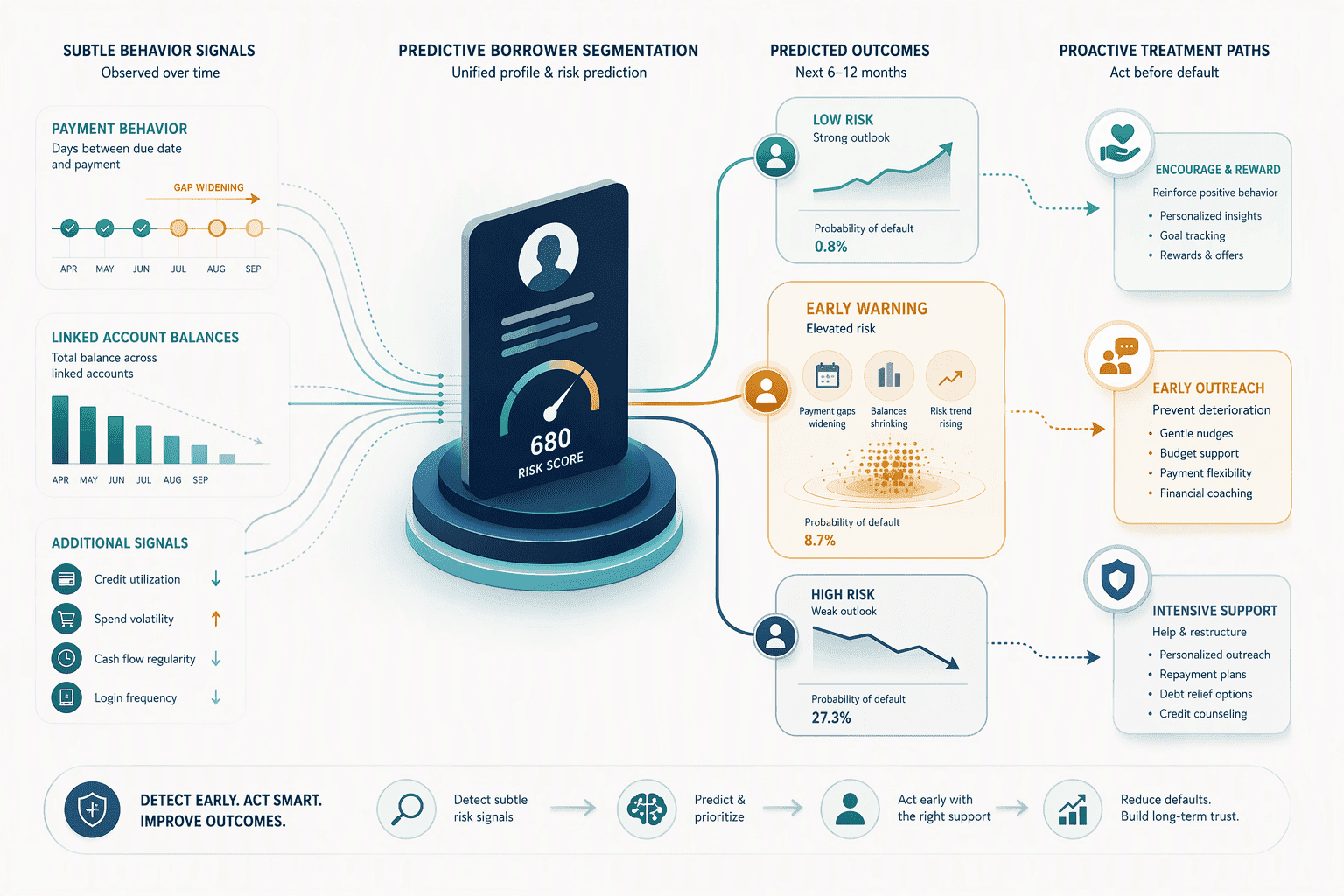
Katabat uses machine learning trained on real portfolio data to segment borrowers before they miss a payment. The platform spots patterns (gradually lengthening payment intervals, declining balances across linked accounts) and triggers a distinct treatment strategy for that predicted behavior. You act on what a borrower is likely to do.
The operational shift is real. A reactive system detects a missed payment and sends a late notice. Katabat's predictive system catches the drift toward default and triggers outreach before the first missed payment. That turns collections from a recovery operation into a retention function. Performing borrowers stay out of the delinquency pipeline.
Implementation needs enough historical portfolio data for the ML models to train on meaningful patterns. Thin files on small portfolios won't produce reliable segmentation. For large servicers with years of repayment data, Katabat's behavioral segmentation represents the frontier of what triggers can do.
6. Lexop: Self-Cure Portals Triggered by Digital Engagement Behavior
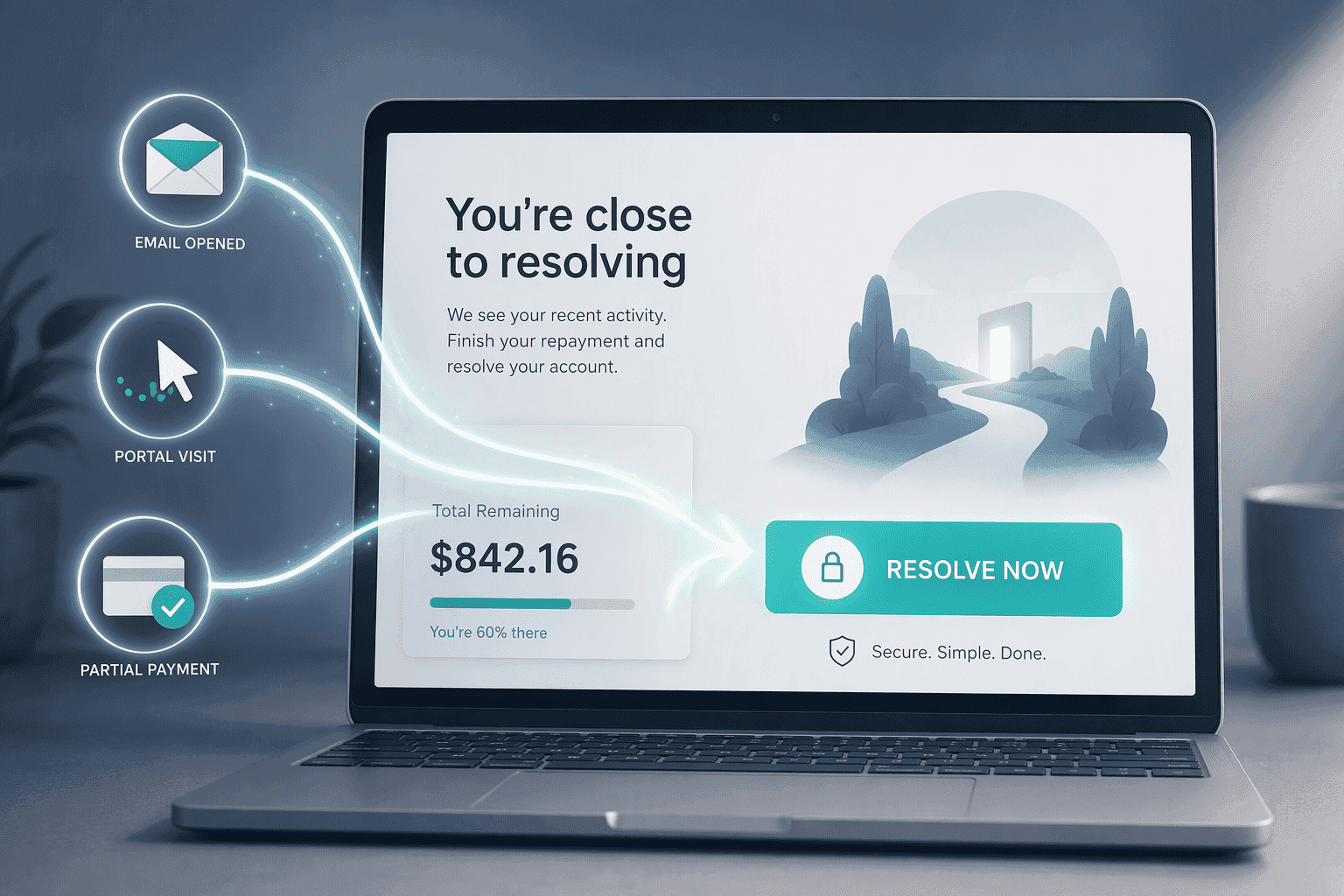
Lexop focuses its behavioral trigger automation on a single outcome: the self-cure. The platform tracks what borrowers do digitally (opening an email, visiting the payment portal, making a partial payment, hovering over a payment plan option) and uses those engagement signals to trigger self-service prompts at the moment intent is highest. A borrower showing digital interest in resolving a debt sees the simplest possible path to do so right then.
This approach automates a function that human agents perform inconsistently. An agent might notice a borrower called yesterday and follow up today, or they might not. Lexop's tracking of digital body language removes the inconsistency by connecting engagement behavior to action with zero agent latency. For portfolios with high volumes of low-balance accounts where agent-assisted collections are cost-prohibitive, self-cure triggers driven by digital engagement are a direct path to improved liquidation.
Lexop is a specialized tool that fits best inside a broader tech stack. The core servicing system handles the heavy lifting; Lexop layers on top to automate self-cure conversion from the existing digital borrower traffic.
7. TrueAccord (now April): Heartbeat-Based Behavioral Outreach Automation
TrueAccord, operating under the Retain by April brand, deploys a 'heartbeat' engine that separates its behavioral triggers from every other model in this list. It watches for real-time digital signals (opens, clicks, scroll depth, portal time) and adjusts the cadence, channel, and tone on the fly. Here is how it maps against the two closest behavioral approaches:
Dimension | TrueAccord / Retain Heartbeat | Oracle Configurable Rules | Katabat ML Segmentation |
|---|---|---|---|
Trigger logic | Continuous monitoring of real-time consumer digital behavior | Static if-then rules defined by collections managers | ML model trained on historical portfolio data |
Channel modulation | Adapts cadence and switches channels automatically as engagement signals change | Rules-defined channel sequences that do not self-modify | Predicts best channel but does not adapt mid-campaign |
Primary behavioral input | Digital engagement signals (clicks, opens, portal time, scroll depth) | Payment patterns, days past due, broken promises | Historical payment trajectories, risk factors, linked account behavior |
Strength scenario | Portfolios where empathy and engagement cadence directly lift cure rates, especially digital-native borrowers | Large enterprise portfolios needing fully auditable, explainable rules for regulatory examinations | Large portfolios with years of repayment data where predictive power justifies model complexity |
The heartbeat model stays in tune with actual borrower behavior instead of a fixed schedule. When a borrower opens an email or spends time in a portal, the system notices and responds right then, not the next morning. This makes it a strong fit for the growing segment of borrowers who want to resolve things digitally and expect the system to move at their pace.
8. Lateral Technology AIM: Adaptive Omnichannel Triggers with AI-Driven Tone Adjustment
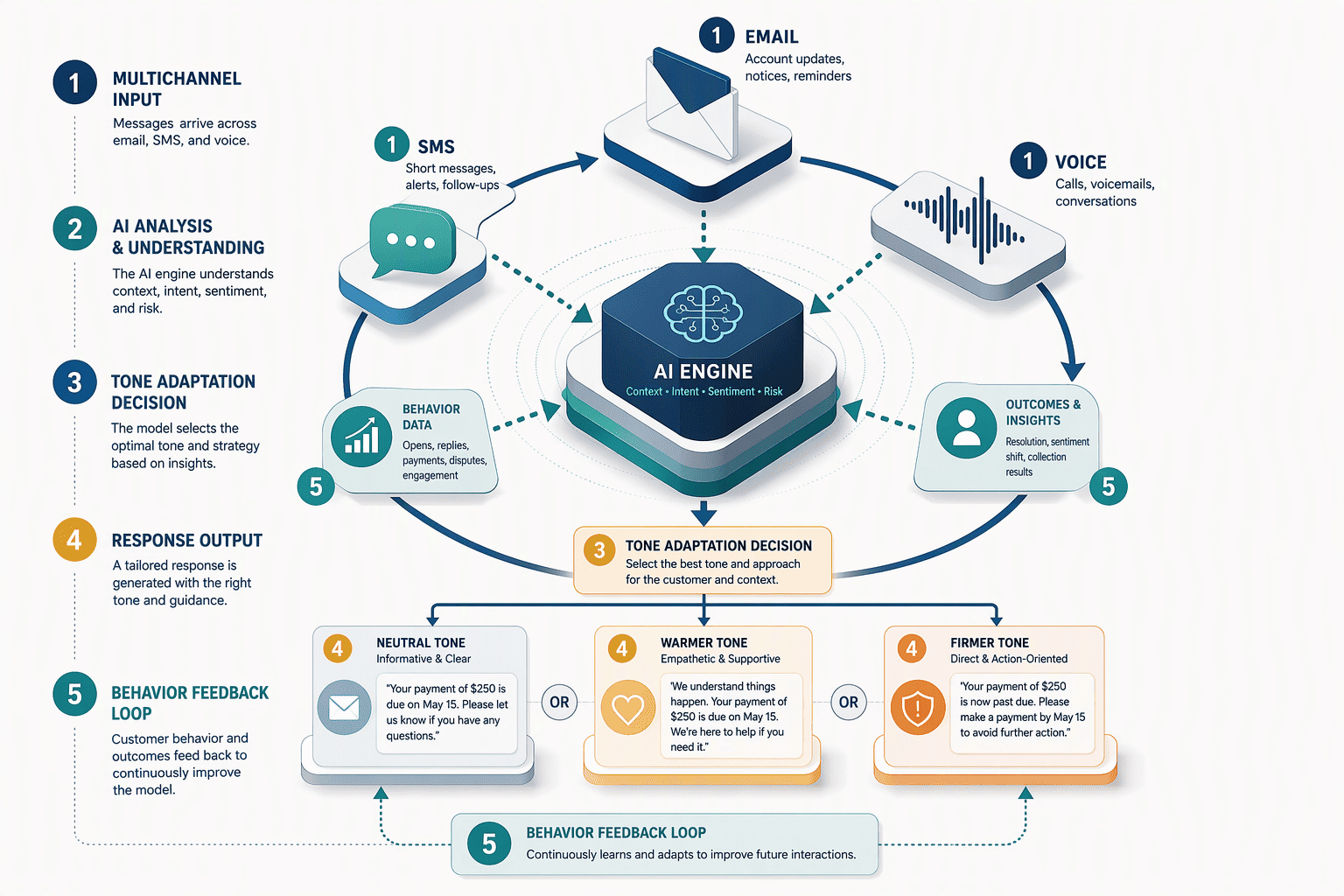
Lateral Technology AIM adds a dimension to behavioral triggers that the other tools treat as a separate concern: communication tone. The platform uses AI to analyze borrower response behavior across email, SMS, and voice channels and adapts the communication's tone in real time based on the borrower's demonstrated response patterns. Here is how the adaptive cycle works:
Ingest omnichannel behavior: The system tracks borrower responses across all configured channels, noting which messages they open, which prompts they ignore, and which tones produce positive engagement.
Classify response pattern: AI classifies each borrower's demonstrated sensitivity to different tones, whether formal, empathetic, urgent, or educational, based on their prior response history.
Select channel and action: The trigger engine picks the next best channel and action type based on the behavior pattern, such as an SMS reminder for a borrower who opens texts but ignores emails.
Modulate tone in real time: Before sending, NLP adjusts the message's tone to match what has historically produced engagement from this specific borrower, rather than applying a single brand voice uniformly.
Capture response and retrain: The borrower's reaction to that specific tonally adjusted message feeds back into the classification model, continuously refining the tone selection.
This tone-adaptive capability matters most for operations running high-volume automated outreach. A single misjudged message can cause a borrower to disengage permanently. The system learns what approach resonates, individual by individual.
Conclusion
Behavioral trigger automation in collections splits into three complementary models. Rule-based engines like Oracle and Domu embed regulatory compliance directly into trigger definitions so that every action stays inside Reg F bounds. Real-time channel analyzers like Gnani.ai and Lateral Technology react to live sentiment and tone during a call. Predictive segmentation models like Katabat and HES act on what borrowers are likely to do next.
Choosing among them depends on your portfolio's primary automation gap. If compliance risk keeps your general counsel up at night, start with API-embedded Reg F templates. If voice remains your dominant collection channel, invest in real-time intent detection. If your portfolio data is deep enough, predictive segmentation will produce the best long-term recovery lift.
Most mature collections operations will ultimately need elements of all three.
Frequently Asked Questions
What types of borrower behavior can trigger automated collection actions?
Automated triggers respond to a wide range of behavioral signals:
Payment pattern changes, such as partial payments or lengthening intervals
Broken promises to pay
Days past due crossing defined milestones
Digital engagement signals like email opens and portal visits
Partial payments
Real-time vocal sentiment and intent during calls
Changes in transaction frequency or linked account balances
Which software tools are capable of automating debt collection based on borrower behavior?
The major behavioral trigger platforms each take a distinct approach:
Oracle Banking Collections Cloud Service uses configurable rules for payment patterns and broken promises
HES CollectionAgent applies neuro models to past behavior
Gnani.ai Collect365 analyzes live voice sentiment
Domu provides API-first Reg F templates
Katabat, Lexop, TrueAccord, and Lateral Technology target predictive segmentation, self-cure, heartbeat engagement, and tone-adaptive triggers respectively
How do behavior-based collection tools integrate with loan management and CRM systems?
API-first platforms like Domu ingest borrower transaction data, communication preferences, and portal activity in real time from existing servicing stacks. Others import bulk data. The integration depth determines trigger accuracy, since stale or incomplete data produces mis-timed or non-compliant outreach.
What specific data points and thresholds are used to trigger automated collection workflows?
Common behavioral triggers include:
Days past due crossing defined tiers
Missed promise-to-pay dates
Partial payment amounts above or below configurable thresholds
Email open and click events
Portal login frequency
Real-time voice sentiment scores indicating borrower disposition toward resolution or hardship
How do US regulations like the FDCPA and CFPB rules impact automated behavior-based collections?
Reg F and the FDCPA govern contact timing, frequency, channel, and the obligation to honor cease communication requests. Automated tools must embed these rules into trigger logic. Improperly configured automation can generate violations at scale, so platforms like Domu pre-build Reg F templates that automatically silence outreach when rules prohibit it.
What are the compliance risks and best practices when implementing trigger-based collection automation?
Several best practices reduce the risks from automated triggers:
Embed regulatory rules directly into trigger definitions
Maintain auditable logs of every action
Use pre-built compliance templates where available
Regularly test trigger logic against regulatory scenarios
Sources
Oracle Banking Collections Cloud Service | Oracle - www.oracle.com
Collections and delinquency management — Credit Unions workflow blueprint - osforyour.business
How Automation Can Improve Debt Collection - www.forbes.com
Debt collection software for tailored strategies - HES FinTech - hesfintech.com
Related Articles



We’re building the next generation of engagement technology: intelligent, automated and compliant. Our mission is to empower financial institutions to orchestrate every stage of the servicing lifecycle with dignity and unprecedented efficiency.
Supported by

