

Build an auditable AI layer for collections compliance using these eight steps from the Egnyte Regulation-to-Audit framework:
Introduction
Build an auditable AI layer for collections compliance using these eight steps from the Egnyte Regulation-to-Audit framework:
Step 1: Map all applicable regulations (FDCPA, Regulation F, state-specific laws) to specific data fields and interaction rules that your AI must monitor.
Step 2: Connect your data sources, email, call logs, settlement letters, consent forms, to a centralized, unstructured document repository that the AI can ingest and tag.
Step 3: Deploy an AI layer that performs real-time, 100% interaction inspection instead of spot-checking a 2% sample after the fact.
Step 4: Configure the AI to turn unstructured documents (e.g., consent forms, settlement letters) into tagged, searchable data with automated metadata extraction.
Step 5: Program the AI to flag off-script language or outdated sentences before any communication reaches a consumer, preventing FDCPA violations proactively.
Step 6: Enable immutable audit trail generation for every agent action, log timestamps, call recordings, script deviations, to satisfy exam requirements under M-25-21.
Step 7: Align documentation and monitoring with CFPB’s stance, the Bureau reported no official AI use cases as of January 2026, so ensure your deployment is auditable under existing FDCPA and Regulation F frameworks.
Step 8: Operationalize the framework by training compliance staff to use the tagged data and audit trails, regularizing review cycles, and benchmarking against delinquency rate trends (e.g., 4.8% of all outstanding debt and 16.2% student loan serious delinquency in Q4 2025).
Key Takeaways
Here are the capabilities a governed AI deployment brings to collections compliance:
Bulk metadata extraction automatically tags debtor consent forms, call logs, and notices, making every unstructured document searchable and auditable., Real-time audit logging detects unusual access to sensitive debtor data the moment it happens and writes an immutable, timestamped log., Human-in-the-loop governance is built into the workflow so that off-script statements trigger a human review before reaching a consumer, satisfying FDCPA oversight requirements., Regulation-to-control mapping connects each section of Regulation F and the FDCPA to a specific AI control, a generated artifact, and a continuous audit step., Governed content generation creates settlement letters inside a permission-controlled repository, eliminating copy-paste errors that create regulatory exposure., Continuous monitoring shifts CFPB exam prep from a quarterly fire drill to an always-on posture where evidence is current by default., **The AI is assistive, not autonomous
**human judgment remains the final authority on every compliance decision.
Step 1: Deploy AI for Bulk Metadata Extraction from Unstructured Collections Documents

Bulk metadata extraction is the fastest way to eliminate the manual tagging that drowns a compliance team. These are the steps to deploy it.
Inventory your unstructured document types. List every document category AI needs to parse: debtor consent forms, call recording transcripts, mailed validation notices, payment plan agreements, and dispute letters.
Define the metadata schema for each type. For a call log, extract timestamp, agent ID, Mini-Miranda disclosure delivery, and consumer state per Regulation F’s call-time window of 8am, 9pm local time. For a consent form, extract channel permission, date of consent, and TCPA verification status.
Connect the AI to your governed content repository. The assistant should read documents in place inside a platform like Egnyte, whose Sensitive Content Protection automation identifies and classifies regulated data without moving files to an external model.
Build the extraction agent with natural language instructions. Using Egnyte’s Agent Builder, you describe what to tag: “For each call transcript, identify and tag the Mini-Miranda disclosure statement, any mention of legal action, and any consumer hardship language.” The agent runs against the live repository.
Set a human review checkpoint for flagged items. Documents the agent cannot classify with high confidence, or that contain dispute language, route to a compliance analyst for manual tagging. This keeps the output governed while the AI handles the high-volume, repetitive extraction.
Step 2: Implement Real-Time Audit Logging with Agent Activity Monitoring
Real-time audit logging closes the gap between a customer interaction and the compliance check that typically follows weeks later. When AI agents join your collections workflow, the log needs to record every action they take, document access, metadata pulls, generated content, and any flags, alongside what your human agents do. On a governed platform like Egnyte, that log is timestamped and immutable. An examiner sees the sequence exactly as it happened, not a cleaned-up version.
If an AI agent opens a debtor file at 2 a.m. or pulls records from an IP range no one on your team uses, the permission model flags it as a real-time alert. A human investigator looks at it right then.
Getting this running is direct. Inside the platform's audit log view, you set conditional alert rules: trigger an alert when a non-human agent accesses PII outside the approved workflow, tries a permission level it does not have, or reads data from accounts marked in-dispute. The Compliance Center produces a filtered agent audit log showing only AI actions, separated from human agent activity, so anomalous patterns surface without you digging through thousands of routine events.
Step 3: Engineer Human-in-the-Loop Checkpoints with On-Script Validation and Fail-Safe Escalation

Human-in-the-loop checkpoints are the places in a workflow where an AI recommendation stops and waits for a human decision. These are the steps to build them.
Identify every point where the FDCPA forbids a fully automated decision. Any communication that could be construed as a threat, a promise of legal action, or a settlement offer requires a human to read, approve, and send it.
Build conditional logic in your workflow tool. Inside Egnyte's no-code Workflow Builder, you define rules: "If the AI agent flags a draft message as containing off-script language that could violate FDCPA sections 806 or 807, halt the message queue and assign for human review."
Define the escalation path. When a flag fires, the system pushes a notification to the designated compliance reviewer with the flagged text, the script it violated, and the agent's confidence score. The reviewer either releases the message, edits it, or rejects it with a note logged to the audit trail.
Close the loop on dispute and distress triggers. Any consumer interaction containing the words "attorney," "court," "harassment," or explicit distress language triggers an immediate human handoff. This is a hard stop, not a suggestion.
Log the override reason for model improvement. Every human correction feeds back into the agent's training data so the model learns what "off-script" means in your specific portfolio context.
Step 4: Build and Validate Governed Content Like Settlement Letters Without Copy-Paste Risk
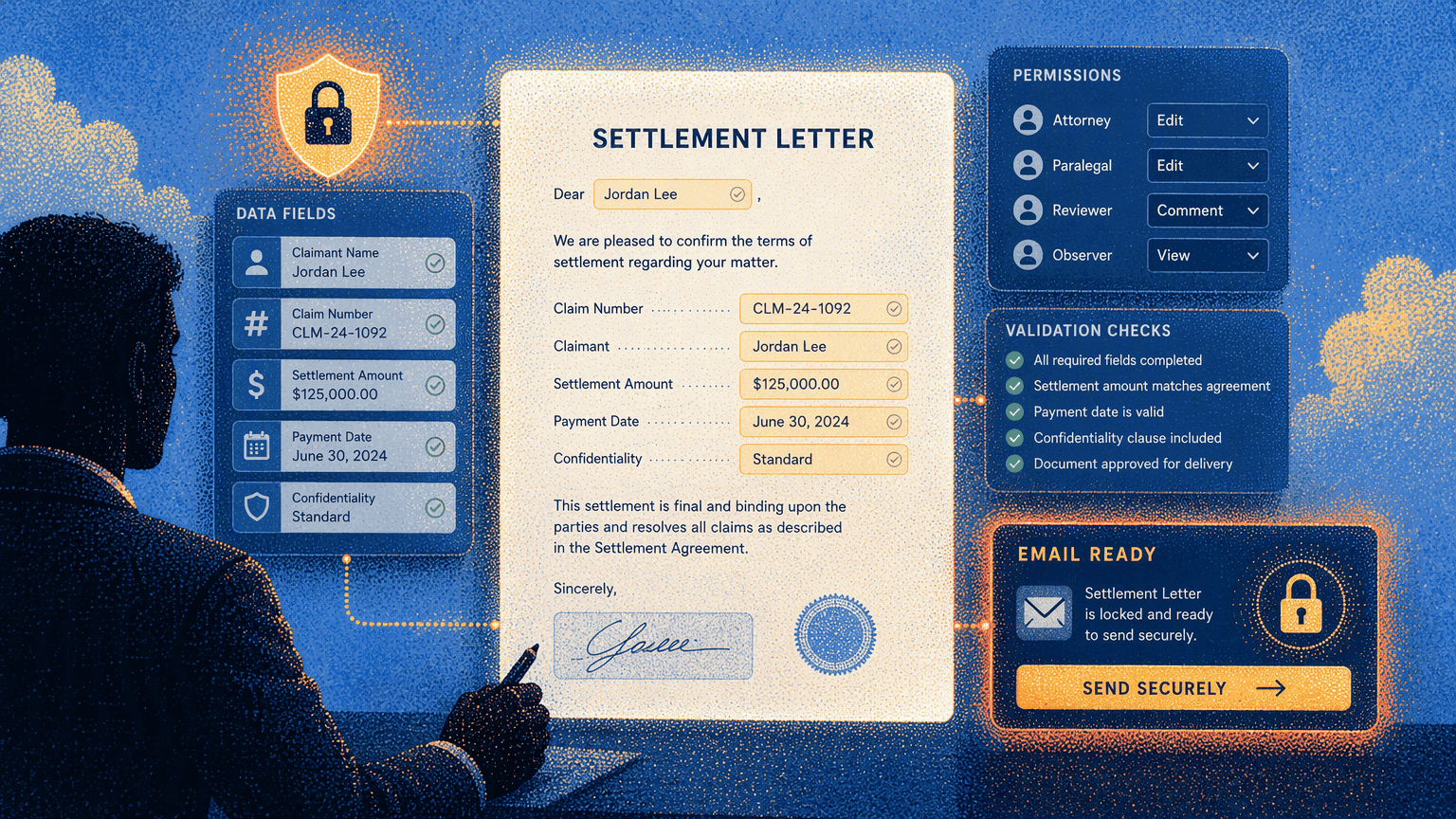
The highest-risk document in a collections workflow is the one your team generates by copying a template, updating a few figures, and pasting it into an email. A single stale sentence, an old dispute notice, a threat of legal action you aren't authorized to make, a time-barred debt disclosure that's missing, becomes an Exhibit A in a CFPB enforcement action. Governed content environments solve this by keeping templates, data, and the final generated document inside a single permission-controlled system. The AI drafts the letter by pulling account-specific payment terms, dates, and required Regulation F disclosures from your system of record, but it never moves that data outside your governed repository.
To build a settlement letter workflow, start inside Egnyte's Compliance Center by creating a controlled template that locks the sections that cannot change, the Mini-Miranda, the FDCPA dispute notice language, the CFPB consent order boilerplate. The AI fills only the variable fields: consumer name, account number, settlement amount, and deadline. A compliance officer validates the final output against an approval checklist before the letter is sent. The letter's generation, review, and approval timestamps are all logged in the audit trail.
Copy-paste risk doesn't come from malice. It comes from speed. A governed AI workflow is faster than copy-paste and doesn't create the downstream liability.
Step 5: Map Regulations Directly to Controls, Artifacts, and Continuous Audit Steps
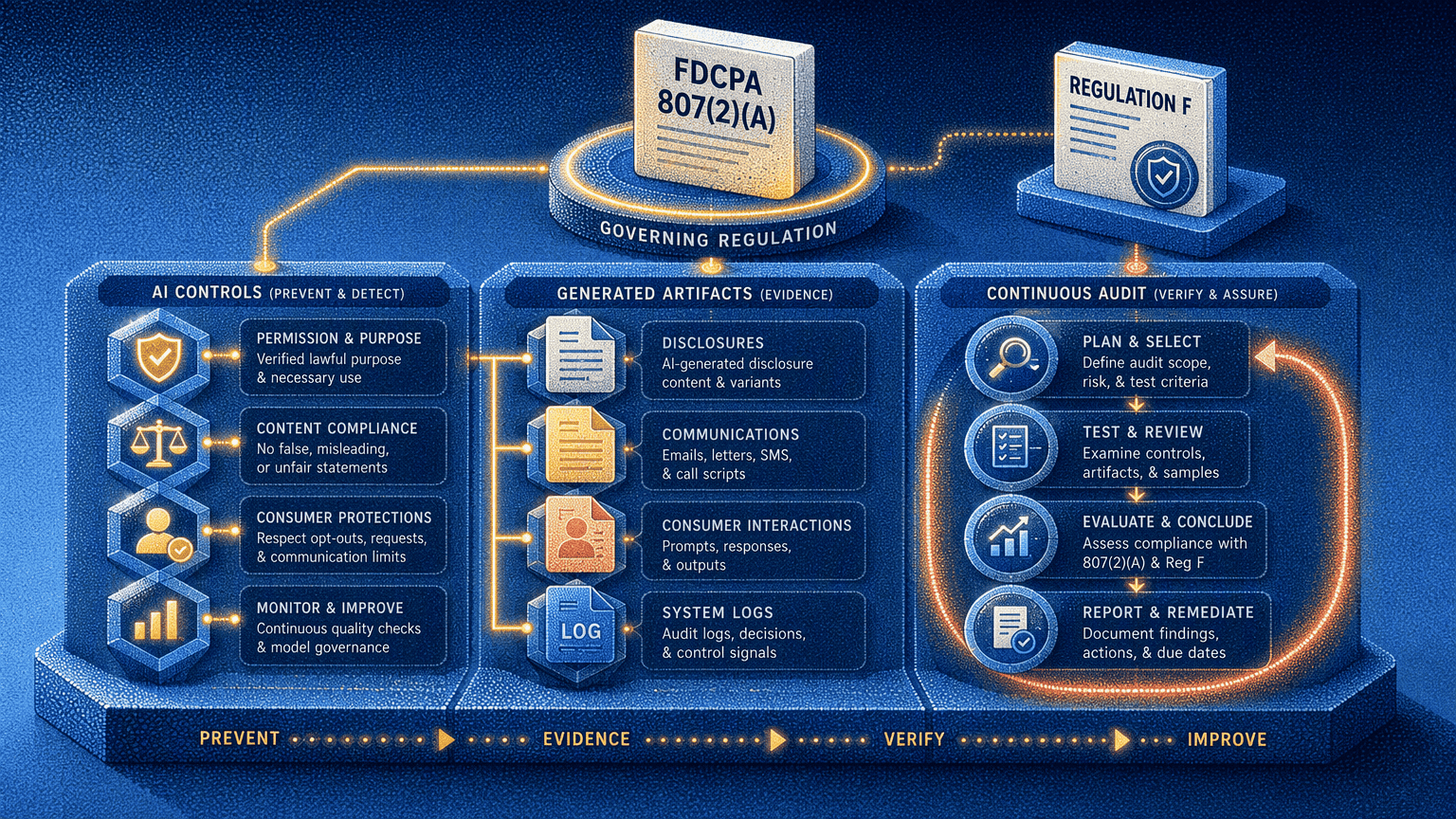
An abstract regulation does nothing to prevent a violation. You must connect every regulatory requirement to a specific, monitorable control.
Regulation Section | Requirement | Egnyte AI Control | Generated Artifact | Continuous Audit Step |
|---|---|---|---|---|
FDCPA 807(2)(A) | No false representation of the debt’s character, amount, or legal status | Metadata extraction validates that the amount in any AI-drafted communication matches the system of record | Agent activity log showing validation check passed/failed | Review flagged mismatches weekly |
FDCPA 806(5) | No calls intended to harass with repeated ringing | AI enforces 7-in-7 contact frequency cap per account; agent attempts exceeding cap are blocked and logged | Frequency cap violation log | Monthly report on blocked attempts by account |
FDCPA 809 | Validation notice delivery within 5 days of initial communication | AI validates that the Mini-Miranda and validation notice text exists in the first communication record | Validation notice presence check per initial contact | Weekly audit of notice delivery on new accounts |
Regulation F 1006.6(d)(1) | Call-time window 8am, 9pm consumer-local time | AI enforces time-zone-aware call blocking outside permitted window per account number’s area code and consumer-provided address | Time-window compliance log | Daily review of blocked out-of-window attempts |
The Compliance Center pulls these artifact logs into a single dashboard so an examiner can trace from a regulatory citation to the control that enforces it to the evidence that proves it worked. The mapping isn’t a document you write once and file. It’s a living structure inside the platform, updated whenever a regulation changes or a new control is deployed.
Step 6: Set Up Continuous Monitoring for Routine CFPB Exam Prep
Continuous monitoring means the evidence a CFPB examiner requests next month is already collected, tagged, and stored by the time you hang up the phone. You stop scrambling through call logs and consent forms the week before an exam and instead present a dashboard that is always current.
The mechanism is the Compliance Center's automated artifact collection. You configure scheduled reports for each regulatory mapping from Step 5. The system pulls evidence on a daily or weekly cadence, flags controls that haven't generated an artifact recently (indicating a possible gap), and produces a pre-exam readiness report that mirrors the examiner's most common requests.
The output is a running log of active controls, recent violations caught and remediated, and the human review chain for each. No fire drill. Just a system that runs while you are doing everything else.
Step 7: Align Your AI Deployment with CFPB's AI Governance Under OMB Memo M-25-21
OMB Memorandum M-25-21, "Accelerating Federal Use of AI through Innovation, Governance, and Public Trust," now governs how federal agencies and the entities they regulate manage AI risk. The CFPB has designated its Chief Information Officer, Chris Chilbert, as Chief AI Officer to implement the Memo.
The Bureau published its compliance plan in September 2025. It states that the CFPB will prioritize "low-risk, incremental use of AI within mission support and administrative functions" and that most of its own AI tools will be "acquired or pre-integrated into existing software platforms."
The upshot for a collections department: the CFPB is not yet disclosing AI use cases as of January 2026, but its posture on AI compliance is not a mystery. It wants assistive tools, tightly bounded, with clear audit records. Your AI deployment should follow the same logic. Embed it inside an existing governed content platform rather than letting it sit as a standalone black box.
An architecture like Egnyte's assistive AI model fits that pattern. The AI does not render a final compliance call. It extracts, flags, drafts, and logs. Every output passes through a human approval checkpoint that is codified in a workflow and recorded in an immutable audit trail. When the CFPB's AI use case disclosure requirement eventually extends to regulated entities, you can point to a concrete artifact: the regulation-to-control map, the continuous monitoring dashboard, and the human-in-the-loop override log, all generated inside the platform where your data already lives.
Step 8: Measure ROI and Risk Reduction Through Automated Artifact Collection

Governed AI in compliance pays off in two concrete ways: staff hours you stop burning on manual evidence gathering, and regulatory exposure you never incur. The table below gives you the dimensions to track before and after you automate.
Measurement Dimension | Pre-AI Baseline | Post-AI with Governed Automation |
|---|---|---|
Audit prep labor hours (monthly) | An analyst logs 40+ hours a month pulling logs, confirming consent forms, and assembling CFPE readiness reports per portfolio. | Automated artifact collection compiles the same evidence continuously. An analyst reviews exception reports in under 5 hours a month. |
Compliance incident detection lag | Manual QA covers 2 to 5% of interactions and finds off-script language days or weeks after the call. | Real-time agent activity monitoring catches non-compliant statements before the consumer hears them. Resolution is logged the same day. |
Settlement letter error rate | Copy-paste template work produces an average of 1 to 2 regulatory language errors per 100 letters. | Governed content generation locks disclosure blocks and validates every variable field against the system of record. |
Shadow AI cost | Individual collectors use unapproved consumer-facing AI tools to draft messages, piling up unlogged regulatory exposure. | All AI use runs inside one governed platform with a full audit trail. Unauthorized tool sprawl disappears. |
CFPB exam response time | Gathering and validating requested artifacts across multiple systems takes 2 to 4 weeks. | A pre-assembled, continuously updated report is generated from the Compliance Center in under an hour. |
Conclusion
AI in collections compliance is not black-box autonomy. It is an auditable exoskeleton. The eight steps above move your operation from reactive, sample-based monitoring to continuous, full-coverage governance: metadata extraction that turns document chaos into searchable data; real-time audit logging that detects anomalous access the moment it happens; and regulation-to-control mapping that makes every FDCPA and Regulation F requirement traceable to a specific artifact.
Human judgment remains the final checkpoint on every decision, and the immutable log proves it. Tools like Domu's agent platform can anchor this framework inside your existing governed environment, but the architecture matters more than any single vendor. The path to CFPB readiness in 2026 runs through governed, mapped, and continuously audited AI workflows, and the time to start building them is now.
Frequently Asked Questions
What specific compliance tasks in US debt collections can AI automate, and what are the limits?
AI automates several high-risk compliance tasks. Key capabilities include:
Bulk metadata extraction: consent forms, call logs, and notices are automatically parsed and tagged
Real-time audit logging: all agent actions, human and AI, are recorded and timestamped
Off-script language detection: flagged phrases trigger immediate review before communication reaches a consumer
Governed settlement letter generation: templates with locked sections ensure FDCPA and Regulation F compliance
Continuous artifact collection: evidence for CFPB exams is gathered and stored on an ongoing cadence
Human review is required for final compliance sign-offs, dispute resolution, and any communication with legal implications under the FDCPA.
How does AI-driven compliance monitoring work alongside human agents in a collections workflow?
The AI layer inspects all interactions in real time, flagging off-script language, missed disclosures, and calls outside permitted hours. When a flag fires, the system halts that communication and routes it to a human compliance reviewer within the workflow. The agent handles routine, high-volume extraction and logging; the human makes final decisions on flagged items.
What CFPB rules and US regulations apply to AI communications in debt collection, and how are they enforced?
Existing FDCPA and Regulation F frameworks enforce the following rules on AI communications:
Call-time windows: communications are allowed only between 8 a.m. and 9 p.m. local time per Regulation F
Contact frequency caps: no more than seven calls within seven consecutive days to the same consumer
Validation notice delivery: required disclosures must be sent within five days of initial communication
OMB Memorandum M-25-21: federal AI governance plans are now required, but the CFPB reported no official AI use cases as of January 2026, so enforcement relies on existing debt collection statutes
How does AI detect and prevent off-script or non-compliant statements during live debtor interactions?
AI agents screen every drafted line before a consumer hears or reads it. They validate that Mini-Miranda disclosures are delivered, check for prohibited language per FDCPA sections 806 and 807, and detect verbal abuse or distress triggers. Non-compliant statements are blocked in real time and the interaction routes to a human reviewer.
What ROI or risk-reduction metrics exist for AI compliance monitoring in US collections?
Key metrics for measuring success in governed AI collections include:
Audit prep labor hours: reduced from 40-plus per month to under 5
Incident detection speed: real-time detection replacing weeks-late manual QA
Settlement letter error rates: near-zero through governed templates
Shadow AI costs: eliminated by using a single controlled platform
Operational cost reduction: leaders report up to a 40% decrease
Recovery rate increase: up to 10% improvement in collections outcomes
Sources
Artificial Intelligence (AI) at the CFPB | Consumer Financial Protection Bureau - www.consumerfinance.gov
CFPB AI Compliance Plan Final (2025-09-26) - files.consumerfinance.gov
Responsible Voice AI for Debt Collection | Skit.ai - skit.ai
Evaluating AI for Debt Collections: A decision Framework for 2026 - moveo.ai
Related Articles





We’re building the next generation of engagement technology: intelligent, automated and compliant. Our mission is to empower financial institutions to orchestrate every stage of the servicing lifecycle with dignity and unprecedented efficiency.
Supported by

