
How to Slash Collections Agent Burnout While Maintaining Contact Rates: A 6-Step Playbook

10 min read
Your most senior collector just handed in their notice. Not for a competitor, but for their sanity.
Introduction
Your most senior collector just handed in their notice. Not for a competitor, but for their sanity. In collections departments, a 30% annual turnover rate isn't a fluctuation; it's a structural tax on your operation. The culprit is rarely a lack of resilience. It's a design flaw rooted in rigid scheduling and cognitive overload that treats specialized agents as interchangeable parts.
The conventional fix is a wellness webinar or a lunchtime yoga session. This misses the mark wildly. When over 50% of workers report feeling emotionally drained and burned out daily, the problem is systemic. Your contact rate pressure is cannibalizing your workforce, and churn-and-burn hiring is a losing strategy.
You do not need to choose between a healthy team and hitting your recovery metrics. The tension between agent well-being and contact rates is a false trade-off created by outdated operational models. What follows is a six-step, metrics-driven playbook that resolves both sides of this equation by re-engineering how work is managed, not by asking agents to endure more.
Key Takeaways
These five insights treat agent burnout as a solvable operational equation with a direct line to business metrics.
Diagnose the schedule, not the person: Treat over 70% of workers who find scheduling inflexible as a leading indicator of churn before it becomes a lagging metric.
Flexibility is a hard ROI strategy: Reframing schedule control as a compliance multiplier directly boosts occupancy and profit, winning C-suite buy-in beyond HR.
Automate administrative friction with AI WFM: Reduce the repetitive task burden that drives daily exhaustion by automating shift swaps and optimization, which alone can cut scheduling overhead by 30%+.
Deploy digital tools to slash cognitive load: Tech investment and burnout move in opposite directions. Tools that simplify customer communication protect mental bandwidth without sacrificing contact rates.
Run the retention math versus the churn cost: A perpetual 30% to 45% annual attrition drain dwarfs the investment in agent-centric scheduling models when you calculate recruiting, onboarding, and lost proficiency.
Step 1: Diagnose The Systemic Roots Of Collections Burnout (It’s Not Just Individual Stress)

Your attrition problem isn't an emotional one. It is a scheduling one. Rigid, top-down workforce management is the primary burnout driver, and treating it as a personal failing lets the real culprit off the hook every time.
When a worker understands exactly how to resolve a debtor's case but is denied the authority to waive a late fee or adjust a plan, burnout is the logical result. The institutional design produces helplessness. The data is brutal: over 70% of workers surveyed felt that performance metrics were unreasonable, scheduling was inflexible, and there was insufficient time between calls. This is a structural erosion of autonomy. Furthermore, 70% of workers feel performance monitoring is purely disciplinary, weaponizing data to control rather than coach, and that perception alone accelerates detachment.
You must stop tracking only lagging indicators like the 30% to 45% annual turnover rate. Leading indicators like schedule satisfaction scores and voluntary shift pick-up rates will tell you a retention crisis is brewing months before the resignations land.
Step 2: Reframe Flexibility As A Hard-Nosed Business Strategy, Not A Wellness Perk

Stop selling schedule autonomy as a soft benefit. It is a competitive survival lever. A McKinsey case study found that by introducing staggered shifts, a center took service compliance from 80% to 90% and agent occupancy from 60% to 80% while freeing up 10% of agents.
That is a direct, measurable expansion of productive capacity. When you position flexible scheduling to your CFO, you are not asking for a kindness budget. You are requesting a tool that demonstrably increases the percentage of time agents spend doing revenue-generating work.
Liberty Mutual's research reveals a critical failure in the standard playbook: while 87% of agencies offer flexibility, burnout remains dangerously high. This suggests that piecemeal perks without genuine autonomy are useless. Perks are passive; control is active.
When 84% of workers value flexibility as a top priority, you're dealing with a workforce that will self-select out of rigid operations. The hard-nosed business case is straightforward. A retention-focused scheduling model eliminates the multi-thousand-dollar cost of replacing each tenured agent, securing both compliance and profit margin in one move.
Step 3: Implement AI-Driven Workforce Management That Tracks Sentiment And Compliance
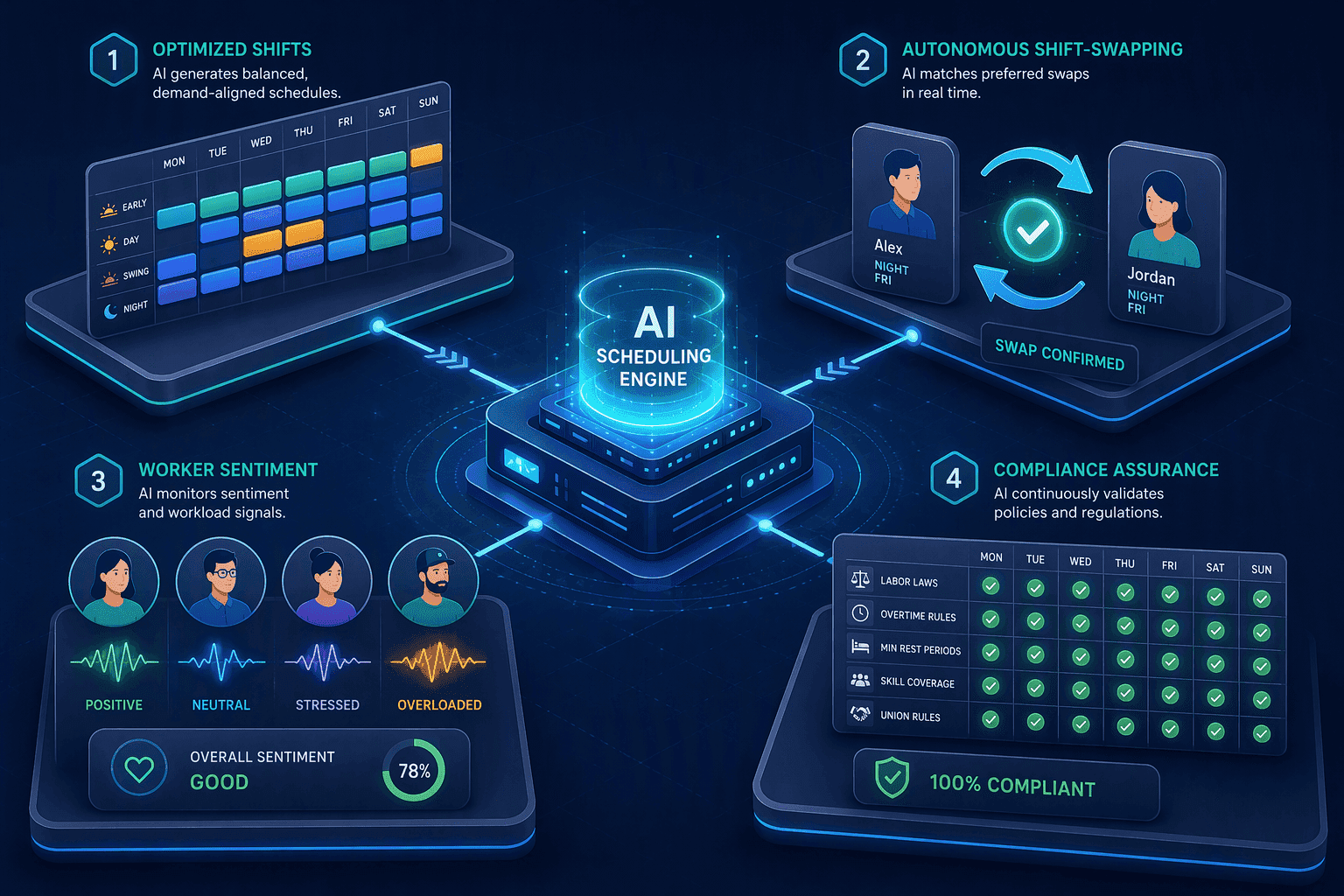
Manual workforce management is the administrative anchor drowning your best agents. AI-driven WFM software automates the two biggest daily stressors: rigid shift assignments and repetitive task overload. By algorithmically optimizing schedules and enabling autonomous shift-swapping, you remove the manager's gatekeeper role and the agent's perception of helplessness simultaneously. This shifts the operational model from control-based enforcement to a system that reduces the administrative overhead directly correlated with mental exhaustion.
Do not wait for exit interviews to discover a problem. Embedding sentiment tracking into your WFM provides a proactive diagnostic layer that detects burnout before it spikes. When you can cross-reference a spike in stress signals from a pod with a compliance dip, you intervene early. A platform like Domu automates repetitive voice interactions, pulling low-complexity volume off your agents' plates and protecting the human capacity for nuanced accounts that require real empathy.
Step 4: Deploy Digital Collections Tools That Slash Cognitive Load Without Killing Contact Rates

Contact rate paranoia keeps a lot of collections floors stuck on manual processes, but the math has shifted. Deploy tools that kill administrative friction. Here is the practical order of operations to cut mental fatigue while protecting or even boosting right-party contacts:
Automate the post-call abyss: Immediately deploy tools that auto-generate call summaries and log dispositions. Stopping the mental context-switching between a tense negotiation and a CRM data dump preserves cognitive energy for the next call.
Offer self-service scheduling: Give agents mobile-first control over shift swaps and bidding. This slashes the constant, low-grade anxiety of work-life conflict, which is a top flight-risk trigger.
Offload low-value outreach: Use voice AI for routine payment reminders and simple promise-to-pay confirmations. Removing the repetitive volume that numbs agents keeps them fresh for high-acuity escalations.
Research from Liberty Mutual confirms the direction: agencies with more digital tools that simplify customer communication consistently report lower burnout levels. When you remove the friction from an agent's day, you gain a more present, effective collector for the conversations that drive recovery.
Step 5: Run The Math: Build A Retention-Focused Scheduling Model Vs. The Churn-And-Burn Alternative
The financial case against churn-and-burn is brutally simple: a 30% to 45% annual attrition rate forces constant, expensive cycles of recruiting, onboarding, and lost proficiency. You pay to replace people who just became good at their jobs. The alternative is a deliberate investment in agent control, through flexible scheduling and workload management. Here is the side-by-side comparison on the metrics that dictate profitability.
Step 6: Redesign Coaching And Support To Operate At A Systemic Level

Generic wellness apps and one-on-one resilience coaching fail in isolation because they ask a crushed agent to meditate away a broken system. Liberty Mutual's finding that 87% of agencies offer flexibility but burnout remains high proves that surface-level programs are soundproofing, not structural repair. If the system doesn't change, individual coping mechanisms just delay the eventual breakdown.
You can't coach your way out of a scheduling design flaw.
Effective coaching must be rebuilt on a foundation of genuine schedule autonomy and AI-driven workload data. Move your supervisors from listening to calls for script adherence to analyzing predictive data that flags emotional fatigue. When the data shows an agent has handled a cluster of hostile calls, a systemic support model triggers a scheduled buffer or a task shift automatically. You use a platform like Domu Voice AI to handle the barrage of routine calls, and then you retrain your human coaches to review sentiment trends, not just dispute resolution rates, turning them into strategic workforce protectors rather than punitive monitors.
Conclusion
Burnout is a financial decision you make through your scheduling and technology choices. Shift from rigid control to data-backed autonomy and you reverse the 45% churn trajectory into a measurable driver of occupancy and profit.
Agent retention is the single most predictable profit lever left in a high-pressure collections environment. Deploy all six steps as an integrated operating system. Cherry-picking the ones that feel easy leaves the core structural flaws intact, and the resignations keep landing on your desk.
Cost/Outcome Dimension | Churn-and-Burn (Rigid Scheduling) | Retention-Focused (AI & Flexible Model) |
|---|---|---|
Annual Turnover Rate | 30% to 45% constant churn | Significant reduction within one year; turnover drops within 6 months |
Agent Occupancy (Productive Time) | 60% utilization, leaving massive idle waste | 80% occupancy via staggered, optimized shifts |
Service Compliance | 80% adherence, constant firefighting | 90% adherence, automated schedule integrity |
Administrative Overhead | High manual management burden for shift changes | Self-service tools cut scheduling overhead by 30%+ |
Absenteeism | 10% absenteeism rate under very high stress | 4% absenteeism, matching low-stress environments |
Capacity Gain | Permanent staffing deficit and burnout backlog | Net frees up roughly 10% of agent capacity |
Frequently Asked Questions
What are the primary causes of burnout specific to collections agents?
Rigid, top-down scheduling and chronic lack of autonomy are primary burnout drivers. Coupled with over 70% of workers finding performance metrics unreasonable, dealing with high volumes of stressed or hostile debtors creates cognitive overload that leads to emotional exhaustion and high attrition.
What metrics and KPIs best balance agent well-being with contact rate performance?
Track schedule satisfaction and voluntary shift pick-ups as leading indicators of retention instead of just lagging attrition metrics. Pair this with agent occupancy and service compliance to ensure flexibility is actually improving productive time, not just acting as a soft perk.
Which technology and automation tools can reduce repetitive tasks for collections agents without sacrificing contact quality?
Voice AI platforms like Domu automate routine payment reminders and intake calls, pulling low-value volume off human agents. Workforce management software with self-service shift swapping cuts administrative overhead without touching the high-value, nuanced conversations that require a human touch to recover debt.
How can workforce management strategies like flexible scheduling reduce attrition and burnout in a US-based collections center?
Flexible, staggered scheduling improves agent occupancy from 60% to 80% and compliance from 80% to 90%. Giving agents control over their time reduces the stress that leads to a 10% absenteeism rate, cutting annual turnover significantly.
What best-practice coaching and mental health support programs are effective in high-pressure collections environments?
Generic wellness programs fail alone. Effective coaching integrates AI-driven sentiment tracking to flag agents nearing burnout, granting them buffer time or task shifts automatically. It works only when paired with structural workload reduction through automation and genuine schedule autonomy.
Sources
Shift Happens: Why Flexibility Isn't a Perk - ICMI - www.icmi.com
Burnout 2025 | Agent for the Future - www.agentforthefuture.com
Making call center jobs better: - Cornell eCommons - ecommons.cornell.edu
Call Centers: How to Reduce Burnout, Increase Efficiency - Knowledge at Wharton - knowledge.wharton.upenn.edu
Related Articles





We’re building the next generation of engagement technology: intelligent, automated and compliant. Our mission is to empower financial institutions to orchestrate every stage of the servicing lifecycle with dignity and unprecedented efficiency.
Supported by

