

Your dialer just left a voicemail at 6:02 a.m. in Portland because it mapped a 212 area code to Eastern Time.
Introduction
Your dialer just left a voicemail at 6:02 a.m. in Portland because it mapped a 212 area code to Eastern Time. That single call represents the exact sort of quiet, systemic violation that generates the FDCPA lawsuits consuming collections budgets. The CFPB's Regulation F, updated and displayed as current as of August 5, 2026, now layers hard numeric call caps and post-conversation freezes on top of core FDCPA prohibitions. And the February 2024 FCC ruling classifying AI voices as "artificial or prerecorded" means every automated outbound dial to a cell phone is a TCPA consent event before a single word is spoken.
Manual collections is leaking money through a thousand tiny inefficiencies. Collectors spend 80% of time on dialing, voicemails, and documentation; only 20% is actual conversation. That ratio leaves the door open to human error on time zones, frequency caps, and mandatory disclosures that a correctly architected AI agent cannot make. The business problem isn't whether AI can place a call. It's whether the entire system, dialer engine, consent ledger, suppression list, and voicemail logic, can be designed as a single compliance fortress where a violation is physically impossible.
Most deployments fail because they bolt automation onto a manual-compliance stack. The February 2024 FCC ruling on AI voices didn't ban automated collection calls; it forced them to grow up. This article lays out an eight-step framework for building, or buying, an automated outbound architecture that respects the 8 a.m. to 9 p.m. window, the 7-in-7-day presumption, the mandatory consent gate, and the escalation pathways that separate a regulated system from a rogue dialer.
Key Takeaways
These constraints form the skeleton of any defensible automated collection architecture. Missing one is a liability event.
Call Window Hardstop: All attempts must land between 8:00 a.m. and 9:00 p.m. local time at the consumer's location, enforced by area-code-to-time-zone mapping, not server time.
7-in-7-Day Presumption: A collector is presumed to violate the law if it calls about a particular debt more than seven times in a seven-day period, or within seven days after a live conversation. Count per debt, not per consumer.
AI Voice = Prerecorded Consent: An AI voice agent calling a consumer's cell phone needs prior express consent, identical to an old-school robocall, with opt-out mechanics built in at the call level.
Mandatory Identity Gate: No account detail leaves the system until the caller's identity is confirmed. The Mini Miranda disclosure fires first, before any payment discussion begins.
Compulsory Escalation Triggers: Phrases like "not my debt," "stop calling me," or "I can't afford to pay" must force an immediate, irrevocable handoff to a human agent, with an automatic freeze applied to the dialer.
7-Day Post-Conversation Cooldown: A live conversation with the consumer triggers a hard 7-day no-contact window on that debt. The dialer must block outbound attempts automatically.
Validated Business Case: Automation properly gated by these rules can increase live contact rates by 200 to 300% and reduce collector workload by 60 to 70%, while eliminating the time-zone and frequency errors that drive litigation.
Step 1: Architect the Call Window and Frequency Governor

The most common FDCPA penalty factory is a dialer that fires on server time. Under Regulation F, absent knowledge to the contrary, any call outside the consumer's local 8:00 a.m. to 9:00 p.m. window is a violation. Your first architectural move is to hard-code a time-zone governor that maps the phone number's area code and prefix to its actual geographic time zone, not your data center's clock.
The governor must block outbound attempts at the dialer engine level, no override, no supervisor bypass, for every number whose local time falls outside the permitted range. This is not a suggestion layer. It is a kill switch.
The frequency cap gets complicated because the 7-in-7-day rule operates per debt, not per consumer. A single consumer could carry three separate accounts with three separate seven-attempt allowances. Your call tracker must count attempts at the individual debt level, account ID 45782 has had four attempts this week, full stop, and lock that specific debt's dialing queue when it hits seven within a rolling seven-day window. The rebuttable presumption under Regulation F § 1006.14(b)(2)(ii) means you must be able to prove, in discovery, that attempt number eight never happened. The log tables are your defense.
Well-intentioned implementations fall apart when teams count only connected calls. The presumption counts attempts, dials that ring, dials that hit voicemail, dials that drop. If your system dialed it, it counts. Build the counter to increment on attempt initiation, not on right-party contact. Most legacy dialers were never instrumented to track this.
Layer a Tuesday-Thursday 5 p.m. to 7 p.m. prioritization window on top of the hard governor as a soft optimization. Best-practice contact data shows this band produces right-party contact rates that are disproportionately high. Your dialer should preference those slots without ever breaching the time-zone fence for any number in the queue.
Step 2: Implement Consent-Based Dialing and the AI-Voice Opt-In
The FCC's February 2024 declaratory ruling erased the ambiguity: AI-generated voices are classified as "artificial or prerecorded" under the TCPA. This means dialing a consumer's cell phone with an AI agent without prior express consent is the same statutory violation as an unconsented robocall. Your architecture must treat the consent ledger as a prerequisite to the dial, not a post-hoc audit trail. Before the dialer engine can place an automated call to any number, it must query the consent database and receive an affirmative consent flag for that specific number and communication channel.
The consent collection itself has to happen at origination. During the credit application, whether digital, paper, or IVR, the opt-in language must specifically name "artificial or prerecorded voice messages" or "automated voice technology." A generic "we may call you" consent does not survive TCPA scrutiny for AI voices. You need a discrete checkbox, a recorded verbal confirmation, or an SMS keyword response that maps to a time-stamped consent record. This record must include the scope of consent (which debts, which channels), the date, and the method of capture, all linked to the consumer profile the dialer queries at runtime.
Integrating the consent ledger with the dialer requires treating consent as a stateful, revocable permission, not a static field. When a consumer revokes consent during a call, "stop calling this number", that revocation must write to the consent ledger and propagate to the dialer's suppression list within seconds, blocking all future automated attempts to that number. Consent management is equally critical across channels: a TCPA consent revocation for voice must cascade to SMS and vice versa. You can use a platform like Domu to orchestrate this consent propagation, pulling from a single suppression profile that applies to voice, SMS, and email campaigns simultaneously rather than maintaining three siloed opt-out lists.
Step 3: Design the Identity-Verification and Disclosure Gate

The FDCPA stops a collector from telling a roommate or a receptionist that someone owes money. The only people who can hear about a debt are the consumer, their spouse, their attorney, or a consumer reporting agency. For an AI voice agent, that rule translates directly into architecture. No account data, no balance, no creditor name crosses the voice channel until the system is sure it has the right person on the line. Everything else in the call sits behind that one checkpoint.
An identity-verification gate belongs at the very top of every call flow. The call flow enforces three sequential steps:
Verify identity: The system asks for two data points, usually full name and last four digits of the Social Security number, or date of birth and ZIP. It compares those against the account record. A match opens the conversation. A rejection ends it with a short, generic message: we are unable to proceed with this call. The gate does not offer hints and has no back door.
Disclose notice: After verification, the disclosures run without a decision point. Under FDCPA § 1692e(11), the agent must say: "I am a debt collector. This is an attempt to collect a debt, and any information obtained will be used for that purpose." That Mini Miranda warning must land before any payment discussion, settlement number, or balance appears. Under 12 CFR § 1006.14(e), the AI voice must identify itself as a debt collector and provide the name of the debt collector, the amount of the debt, and the name of the original creditor if different from the current creditor.
Discuss debt: Only after verification and disclosure does the system talk numbers.
The entire sequence is deterministic: verify, disclose, then talk numbers. Hard-coding it that way removes the risk of a conversational model volunteering protected information because it misinterpreted a prompt or tried to be helpful. The agent does not decide when to comply. The logic is wired in place.
Step 4: Script the 'On-Rails' Conversation with Mandatory Escalation Triggers
A compliant AI collection call is not a free-form conversation. It is a finite-state machine where each state presents a constrained set of valid utterances, and any input falling outside those boundaries triggers a defined escalation path. You are not building a charismatic negotiator. You are building a secure, repeatable call flow that accomplishes one task, validating debt details and directing the consumer toward a payment resolution, while immediately surrendering control when the consumer indicates dispute, distress, or refusal. The script design follows a precise sequence of escalating constraints.
Open with verification and disclosure only: The agent's first spoken words confirm identity, deliver the full Mini Miranda warning, and state the dollar amount owed and the original creditor. No warmth-building preamble that delays the mandatory disclosure.
Limit the active conversation states to three paths: Validate the debt amount and date, ask if the consumer can make a payment today, and offer to connect a human agent. The AI must never negotiate settlement terms, offer discounts, or discuss hardship arrangements. Settlement negotiation by an AI agent is a CFPB consent-order risk.
Hard-code phrase-triggered escalation: The speech-to-text layer must recognize and immediately act on "not my debt," "this isn't mine," "stop calling me," "cease," "I'm disputing," "I can't afford this," "I lost my job," and any mention of legal counsel. Each recognized phrase forces an automatic transfer to a human queue and writes a freeze flag to the suppression list for that debt.
Strip all generative latitude from substantive responses: The AI can confirm a dollar figure or a date. It can ask a closed-set payment question. Any consumer utterance that isn't a straightforward "yes," "no," or a direct answer to a numeric prompt must default to the escalation path. Domu's Taylor product uses on-script validation combined with fail-safe escalation to prevent off-script responses during live interactions, routing confused or high-risk consumers directly to human agents.
Step 5: Enforce the Post-Conversation Cooldown and Cease-Communication Freeze

The second a live conversation with the consumer ends, whether handled entirely by the AI or escalated to a human, Regulation F triggers a 7-day no-call window for that specific debt. Your dialer must write a cooldown flag to the suppression table on the conversation's close event, with a 168-hour expiration timer. The flag must block the specific debt and the specific consumer's associated numbers from appearing in any outbound queue for that window. Attempting a call on day six is a rebuttable-presumption violation under the 7-in-7-day rule, and the log tables your engine maintains will either exonerate or convict you in discovery. Write the suppression record within milliseconds of call termination.
The cease-communication freeze is a separate, higher-priority override. Under FDCPA § 1692c(c), if a consumer notifies a debt collector in writing that they refuse to pay or want communication to cease, the collector must stop further communication except for three narrow exceptions: advising that efforts are terminated, notifying of a specific remedy being invoked, or notifying of intent to invoke a specified remedy. When an AI agent detects a "stop calling me" or "cease" utterance, it must write an irrevocable suppression flag to the dialer's blocklist for that debt and that consumer. This flag must be permanent, not a timed cooldown, and it must survive system restarts, database migrations, and queue rebuilds. The dialer query logic checks for an active cease flag first, before even evaluating the time-zone governor or frequency counter, a cease flag is an absolute block.
The architecture that works is brutally simple: conversation ends, two write operations fire atomically to the suppression table. One is a temporary cooldown with a TTL. The other, if triggered, is a permanent block. Both are queried before every outbound attempt. Miss one, and you've built a litigation engine.
Step 6: Deploy Compliant Voicemail Drops and Validation Notice Sequencing

Voicemail is the disclosure trapdoor in automated collections. Say too much and you risk a third-party disclosure violation if a roommate or family member hears the message. Say too little and you miss the "initial communication" trigger that starts the 5-day validation notice clock under FDCPA § 1692g(a). The limited-content message rule under Regulation F provides a precise safe harbor, but only if you follow the content boundaries exactly. Build your voicemail logic around these sequenced constraints.
Structure every voicemail drop as a limited-content message. The message must include the debt collector's business name phrased in a way that does not indicate the caller is in the business of collecting debts, a request that the consumer reply, a named natural person for the consumer to contact, and a toll-free callback number. You may optionally include a salutation, the date and time of the message, suggested callback times, and a statement that the consumer may speak to any company representative.
Never exceed the limited-content safe harbor. If a voicemail includes any content beyond the required or optional items defined in the Rule, it is not a limited-content message. This includes state-required disclosures the Rule doesn't specifically incorporate. A partial voicemail from a dropped call that lacks all required content likewise does not qualify.
Treat the initial communication as a time-bound event. The moment the AI agent leaves a voicemail containing any debt-specific information, or the moment it completes a live call, the system must start the 5-day timer for mailing the written validation notice. The notice must include the amount of the debt, the name of the creditor, a statement that the debt will be assumed valid unless disputed within 30 days, and a statement that the collector will provide verification if disputed. Your orchestration layer should trigger the validation notice print-and-mail or electronic delivery workflow automatically from the call-close event.
Step 7: Integrate a Unified Voice, SMS, and Email Orchestration Layer
A single-channel compliance architecture is a fragile architecture. When a consumer sends a "STOP" reply to an SMS, that opt-out must silence voice and email for that debt too, or you are a single TCPA complaint away from a class action. A unified orchestration engine manages consent, suppression, and cadence across all three channels from one profile, preventing the most common cross-channel violation: an SMS opt-out that leaves automated voice calls still firing.
The table below lays out how the orchestration logic changes when a consent or suppression event hits one channel.
Orchestration Dimension | Single-Channel Behavior | Unified Orchestration Behavior |
|---|---|---|
SMS STOP received | SMS queue blocks for that number | Voice and email queues also block, logged with a cross-channel cease timestamp |
Voice cease utterance detected | Voice suppression flag written for debt + consumer | SMS and email suppression flags cascade within the same transaction, with a single audit record |
Email bounce or unsubscribe | Email address suppressed | Voice and SMS continue on their own consent flags unless a global cease is also active |
Consent expires or is revoked in CRM | Channel-specific flag queries at next dial | All channels re-query the consent ledger before the next outbound and block if the universal consent flag is false |
Weekly contact cadence limit hit (7 calls) | Voice dialer stops for that debt | Orchestrator shifts to a non-call channel in sequence, e.g., email reminder, within the same permitted cadence window |
Under the CFPB's Regulation F framework, the 7-in-7-day presumption applies specifically to telephone calls, with texts and emails carrying separate protections. A unified layer sequences across channels intelligently: an email reminder on day four, an SMS ping on day five, and the seventh and final voice attempt on day six within the optimal Tuesday-Thursday 5 p.m. to 7 p.m. window, before the week's contact budget is exhausted. Domu runs voice, SMS, and email outreach from a single system, which means a single consent event propagates across channels natively rather than relying on batch-synced opt-out lists that drift out of agreement.
Step 8: Measure Compliance-Adjusted ROI and Launch a Controlled Pilot
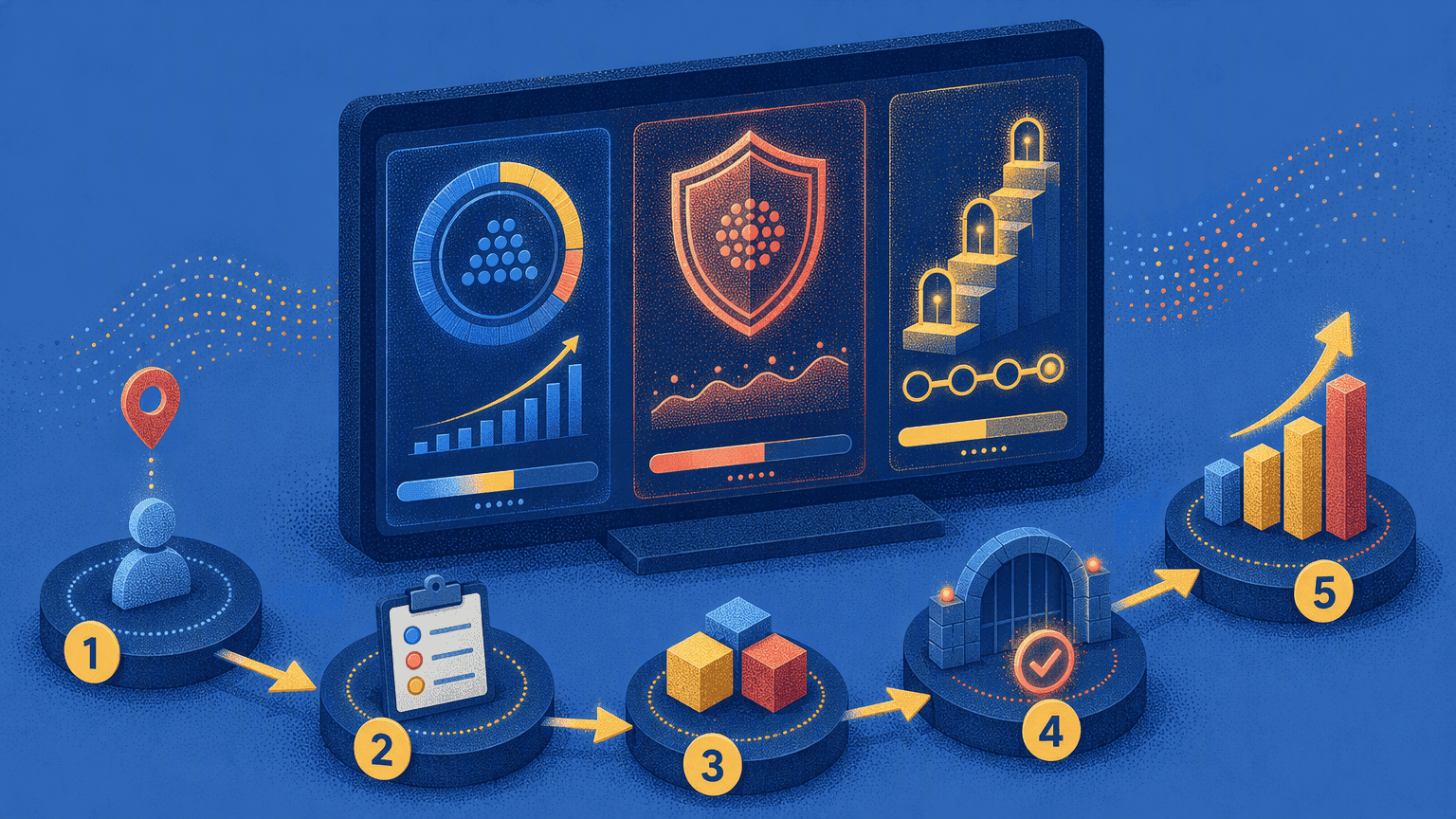
A traditional ROI calculation for collections automation counts dollars recovered against platform cost. That math misses the liability denominator entirely. Compliance-adjusted ROI weights zero-litigation and zero-violation outcomes equally with liquidation rates, because a single TCPA class action can consume years of automated efficiency gains. Your metric framework must track several key measures:
Cost Per Right Party Account (CPRA): dollars spent to reach and resolve one confirmed consumer, rather than the meaningless "cost per dial attempt" that legacy systems track. When manual collectors waste $40,625 per year in non-productive time per collector, automation that shifts talk time from 20% to 60 to 70% of the day isn't just cheaper, it's a liability hedge because it eliminates the human errors in time-zone mapping and call counting that produce violations.
Compliant Contact Rate (CCR): the percentage of outbound attempts that successfully connect the right party within the 8 a.m. to 9 p.m. window, with verified consent, and without triggering a post-conversation cooldown violation. A dialer logging 10,000 calls with a 99.9% CCR still had ten non-compliant events. The CFPB doesn't grade on a curve.
Controlled pilot steps: Run a 30-60-90 day phased rollout. Start exclusively on a subset of accounts where prior express written consent is fully documented and time-stamped, past-revealed consent, no gray-area opt-ins. Monitor every suppression event, every escalation trigger, and every time-zone boundary call for an entire billing cycle before expanding to the next consent tier. The pilot gates expansion: phase two adds SMS and email cadencing; phase three adds the full voice agent only after zero Regulation F violations have been logged for thirty consecutive days. A platform like Domu offers a pilot onboarding flow that begins with a scoped demo and controlled rollout to minimize deployment risk.
Conclusion
The eight steps described here form an indivisible whole. Omit the consent-ledger integration and you are running an unconsented robocall operation under the February 2024 FCC ruling. Omit the per-debt frequency counter and the 7-in-7-day presumption hangs a rebuttable violation over every attempt. Omit the forced escalation triggers and you have built a machine that negotiates with distressed consumers, which is exactly the type of automated conduct CFPB consent orders penalize. The architecture only works as a complete system.
We built Domu's compliance layer around this reality because compliance is a runtime property, not a pre-deployment checklist. The systems that survive TCPA enforcement in an AI-enhanced era won't be the ones with the best natural-language generation. They'll be the ones where a frequency violation, a consent lapse, or a time-zone error is architecturally impossible. Automate the guardrails first. The calls come second.
Frequently Asked Questions
What specific FDCPA rules apply to automated voice calls and messages?
Automated voice calls must comply with the FDCPA's identity disclosure requirements (§1692e(11)), third-party disclosure prohibitions, and Regulation F's call frequency caps (7 calls per debt per 7 days) and time-of-day restrictions (8 a.m. to 9 p.m. local time). AI voices classified as prerecorded must also meet TCPA prior express consent requirements for cell phones (February 2024 FCC ruling).
How can AI voice agents be programmed to stay on-script and avoid regulatory violations?
AI agents must operate as finite-state conversation machines with a constrained script that verifies identity, delivers the Mini Miranda warning, confirms debt details, and asks a closed-set payment question. All other consumer utterances should trigger either a structured clarification prompt or an immediate escalation to a human agent. Generative latitude must be stripped from substantive responses.
What fail-safe and escalation mechanisms are necessary for compliant automated debt collection calls?
Mandatory escalation triggers must detect phrases like 'not my debt,' 'stop calling me,' 'I'm disputing,' and any mention of hardship or legal counsel. Detection must force an immediate transfer to a human agent, write a freeze flag to the suppression list, and block further automated attempts. Consent revocation during a call must propagate across all channels.
What are the proven outcomes or ROI metrics from implementing compliant AI voice agents in collections?
Automation properly gated by compliance controls can increase live contact rates by 200 to 300 percent and shift collector talk time from 20 percent to 60 to 70 percent of the day. The more relevant compliance-adjusted metric is Cost Per Right Party Account (CPRA), which weights zero-violation outcomes equally with dollars recovered, offsetting the estimated $40,625 in wasted annual labor per manual collector.
What is the 7-in-7-day call frequency rule and how should an automated system enforce it?
Under Regulation F, a debt collector is presumed to violate the FDCPA if it places more than seven telephone calls about a particular debt within a seven-day period, or calls within seven days after a live conversation about that debt. An automated system must count attempts per individual debt (not per consumer), increment the counter on dial initiation, and lock the debt from further attempts when either cap is hit.
How does integrating AI voice agents with existing servicing platforms ensure compliance and data security?
Integration ensures that the consent ledger, suppression lists, and account data are sourced from a single authoritative system rather than synced across silos where opt-outs can drift. A unified orchestration layer propagates a cease-communication or consent-revocation event across voice, SMS, and email channels within the same transaction, preventing cross-channel violations where one channel is compliant while another keeps dialing.
Sources
Debt Collection Rule FAQs | Consumer Financial Protection Bureau - www.consumerfinance.gov
eCFR :: 12 CFR Part 1006 -- Debt Collection Practices (Regulation F) - www.ecfr.gov
371 Subpart B—Rules for FDCPA Debt Collectors - GovInfo - www.govinfo.gov
12 CFR Part 1006 - DEBT COLLECTION PRACTICES (REGULATION F) | Electronic Code of Federal Regulations (e-CFR) | US Law | LII / Legal Information Institute - www.law.cornell.edu
Improving Debt Recovery Rates with Automation: Strategies That Work - robotalker.com
AI debt collection calls: staying compliant with FDCPA and Reg F | Open - www.open.cx
Related Articles





We’re building the next generation of engagement technology: intelligent, automated and compliant. Our mission is to empower financial institutions to orchestrate every stage of the servicing lifecycle with dignity and unprecedented efficiency.
Supported by

