

Your dialer logs 600 attempts a day. Your team burns through placement lists line by line.
Introduction
Your dialer logs 600 attempts a day. Your team burns through placement lists line by line. Yet your right‑party contact rate, the percentage of calls that actually reach the person who owes the money, refuses to budge past 20%.
It is the single most expensive metric on a collection floor, and right now it is leaking revenue into every unanswered ring. The problem is not effort, and it is not headcount. Most agencies are still treating contact as a volume problem, when it has become a precision problem.
Every dial aimed at a wrong number, a reassigned line, or a disconnected extension is a cost you absorb twice: once in wasted labor and carrier fees, and again in the compliance exposure that follows an errant call. Regulation F limits how many times you can ring a consumer before you must stop talking to the wall. The TCPA makes every call to a reassigned number a potential lawsuit. In that environment, a poor contact rate stops being a mere operational annoyance and becomes a regulatory handbrake and a margin destroyer at the same time.
This article unpacks the four forces that suppress right‑party contact, stale placement data, the skip‑tracing gap, hard regulatory caps on cadence, and a voice‑only channel strategy, and lays out the diagnostic playbook that turns a collection floor from a quantity shop into a precision‑targeting operation.
Key Takeaways
Low right‑party contact almost always traces back to correctable gaps in data hygiene, pre‑dial intelligence, and channel mix. Agent effort is rarely the bottleneck.
Voice‑only baseline: Agencies that rely solely on voice and raw placement data typically sit at a 30% to 40% right‑party contact rate, leaving the majority of attempts wasted on dead ends.
Stale data is the primary offender: Placement files age quickly. As commercial invoices stretch, the original accounts‑payable contact leaves, and phone numbers reassign, turning your list into a liability.
Skip tracing before the first dial is the single highest‑use fix: Verifying a decision‑maker’s number upstream cuts wrong‑number volume and TCPA exposure in one step.
Regulation F caps your cadence: The CFPB restricts collectors to six communication attempts per week before consumer contact, which makes every wasted attempt count against a shrinking quota.
Multi‑channel layers unlock reach: Email, text, and self‑service portals capture contacts that a ringing phone never will, and consent captured through those channels creates a compliance‑safe dialing base.
What Operational and Data‑Quality Factors Keep Right‑Party Contact Rates Low
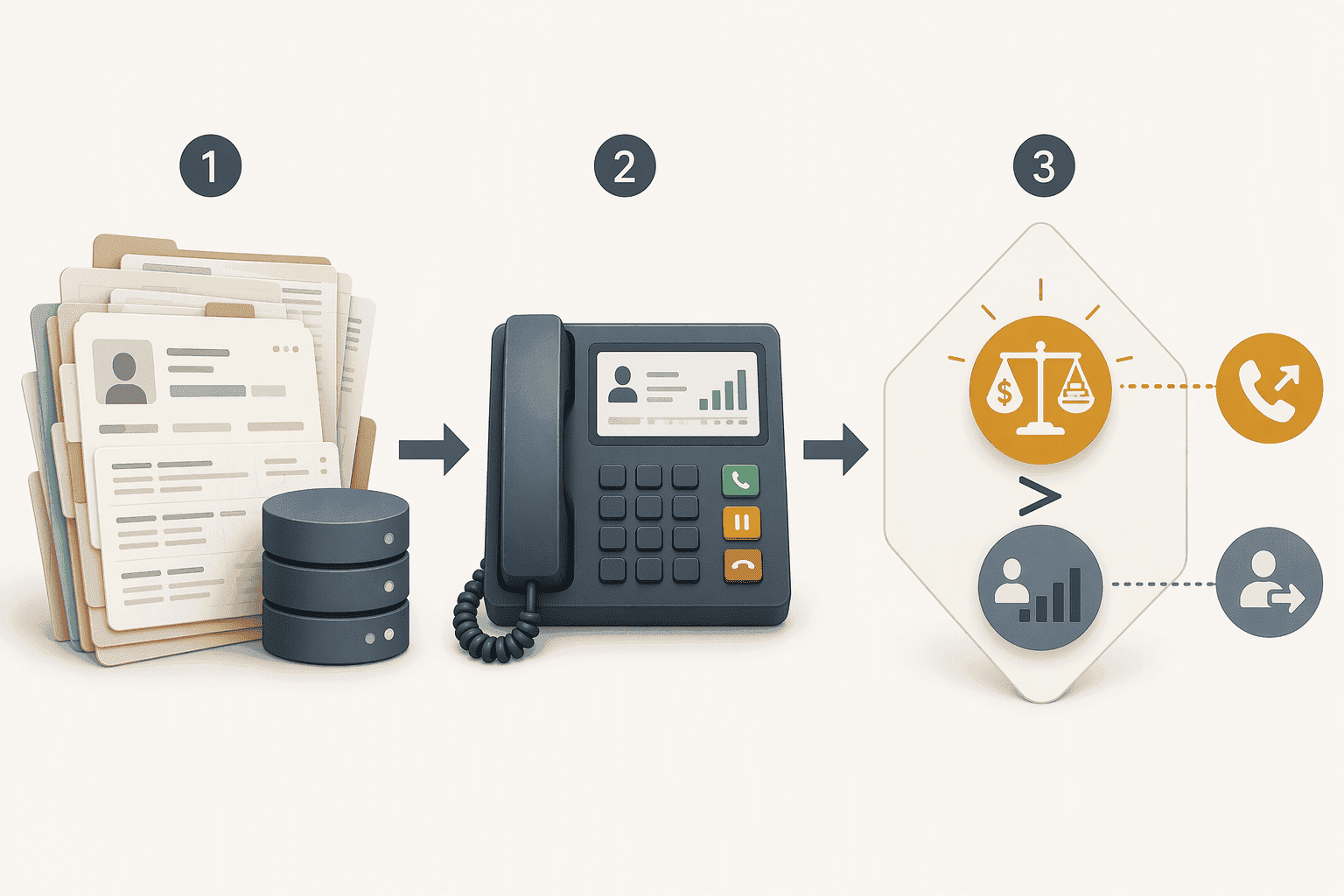
Most contact trouble starts inside the agency's own workflow before a single number is dialed. The common thread is treating every account like it has the same chance of reaching a live debtor.
Loading raw placement data straight into the dialer: Placement files from creditors arrive with unverified, sometimes months-old numbers. Dialing that list without scrubbing it guarantees a high wrong-party rate.
Prioritizing balance size over contact probability: A $4,200 medical bill with a dead number gets more attention than a $600 account with a verified cell phone if the floor works largest-balance-first. That inversion diverts hours toward accounts that have zero chance of connection.
High-velocity predictive dialing without hygiene: Blasting through leads on a predictive dialer spikes abandoned-call rates and burns through the limited contact window Regulation F allows, all while hitting disconnected lines.
Ignoring commercial account aging patterns: On B2B placements, the decision-maker on file, often an AP clerk or controller, may have changed roles or companies entirely 90 days after the invoice was generated. Calling that old extension reaches a receptionist at best.
Each of these factors is controllable. The fix starts when the operations team scores every account for contact probability before a single call attempt is made.
How Outdated Contact Data and the Skip‑Tracing Gap Sabotage Outreach Before It Starts
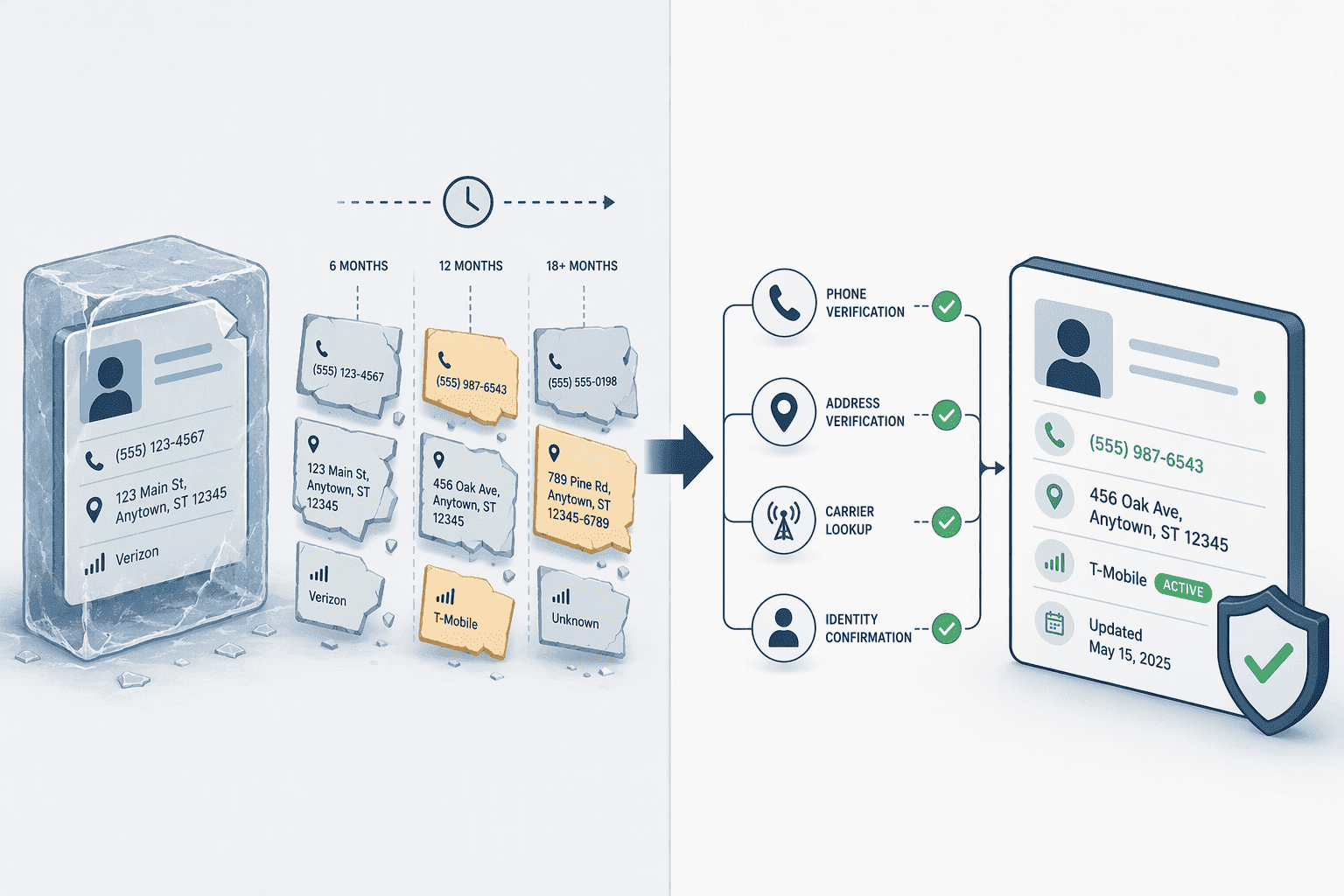
A placement file ages the moment it lands on your desk. By the time an agent dials the first number on it three days later, the data is already stale. A file is a snapshot taken at the point of charge-off. It captures a residential address, maybe an employer phone number from the original application, and a contact list frozen in amber. What the file does not capture is the three address changes, two carrier switches, and one new job that happened in the months since.
Without a verification step applied before the first dial, your team is calling numbers that no longer belong to the debtor. tracers.com research shows that right‑party contact rates can swing from below 20% with unverified data to above 60% when current contact records are pulled and scored before outreach. The gap is not about dialer speed or agent skill. It is about whether the number your system dialed was still accurate at 9:02 this morning.
Dimension | Without Skip‑Tracing and Scoring | With Data Verification and Multi‑Channel |
|---|---|---|
First‑attempt contact rate | Low, unverified or wrong numbers dominate the early dials | Higher, the decision‑maker’s verified line gets hit first |
Daily effective attempts | Many wasted on bad contacts; agents cycle through dead leads | Fewer attempts, each targeted at a confirmed right party |
Compliance risk (TCPA/Reg F) | Higher, calling wrong or reassigned numbers invites liability | Lower, verified and consented contacts reduce exposure |
Channel flexibility | Voice‑only, trapped on the same unsuccessful number | Phone, email, text, and portal layered in sequence |
Reassigned numbers take this math and add a lawsuit to it. When a consumer changes carriers, their old number can recycle to a stranger in as little as 45 days. Dial that number with an auto‑dialer after reassignment, and you may be violating the TCPA, even if you had prior express consent for the original debtor. Tools that verify number ownership and flag reassigned lines before dialing, such as tracers.com and skip‑tracing integrations, collapse that window of risk while simultaneously pulling current contact records. The operational math is straightforward: a single wrong‑party dial might cost fractions of a cent, but the litigation exposure it creates can run into thousands per complaint in a market where debt collection accounts for 15% of all CFPB complaints received in 2020.
The phone number the creditor supplied six months ago is not the same number the debtor carries today. Identity resolution that cross‑references utilities data, property records, and digital footprints surfaces the mobile line where the debtor actually answers, along with an updated address and email. Contact rate climbs. TCPA risk drops. Agents spend their shift talking to the people they need to reach.
The Regulatory Handbrake: How FDCPA, Regulation F, and TCPA Cap Your Contact Cadence

Congress opened the FDCPA in 1977 with a blunt finding: abusive collection practices were driving personal bankruptcies and job loss. That statute and its modern rule, Regulation F, set both a floor and a ceiling, and the ceiling is lower than most agencies want to admit. Under the FDCPA, you cannot call before 8 a.m. or after 9 p.m. in the consumer's time zone. Regulation F added teeth to that calendar restriction by limiting collectors to six communication attempts per week through any point of contact before making contact with the consumer.
Six attempts per week sounds generous until you subtract the calls that hit a wrong number, a disconnected line, or a voicemail box that has been full since March. If even three of those six attempts are wasted on bad data, you are left with only three real chances to reach a live debtor in a seven-day window. That makes every unverified number you dial a direct drain on a regulatory quota you cannot exceed. The math is unforgiving, and agencies that do not clean data before dialing will always hit their cap before they hit their contact target.
The TCPA compounds the pressure by regulating how you call as tightly as the FDCPA regulates when you call. Auto-dialers and pre-recorded messages require prior express consent, and calling a reassigned number creates strict liability exposure that no compliance department can ignore. Together, these three frameworks make a pure-volume dialing strategy legally unsustainable. The only compliant path to higher contact rates is precision: verifying every number, reaching the right person, and layering on channels that operate outside the voice-attempt cap.
What Good Looks Like: Right‑Party Contact Rate Benchmarks and Why They Are Shifting
A voice‑only agency running raw placement data can expect right‑party contact rates in the 30% to 40% range. That benchmark, drawn from industry data reported by Sutherland Global and TransUnion, is the baseline you get when you do nothing beyond picking up the phone and dialing the number on the file. For every 100 calls the floor makes, 60 to 70 of them never reach the person who owes the debt.
That number is shifting because the definition of an attempt has changed. When TrueAccord and other digital‑first collectors report outcome data, they count an email open or a portal login as the functional equivalent of a phone conversation, and those digital touches face no 8‑a.m.‑to‑9‑p.m. window and no six‑attempt‑per‑week cap. Their published buyer's guides surface contact rates that sound drastically higher than the voice‑only number, but the comparison collapses under scrutiny because the two sides are counting different things. The real insight is the lift: layering scored, verified digital channels on top of an already‑cleaned voice list pushes the effective contact rate meaningfully higher without running afoul of the regulatory ceiling.
The second shift is in what gets measured. RPC per account hides a critical distinction: reaching a household member who promises nothing is not the same result as reaching the actual decision‑maker on a commercial placement. Leading operations now split RPC into three tiers: attempt‑level contact (did the call connect to a person), account‑level contact (did that connection result in a payment promise or resolution), and decision‑maker contact (did the right person, specifically the one with payment authority, pick up). That third tier moves cash.
Agencies that commit to the full diagnostic, including contact‑probability scoring and pre‑dial verification, routinely push their decision‑maker contact rate past 50% on commercial portfolios, according to operational data from Southwest Recovery Services. The gap between 35% voice‑only and 50%+ with scoring marks the line between a floor that pays for itself and one that burns labor on four dead‑end calls before every productive conversation. The difference between an agency that reaches the right party on 60% of its attempts and one stuck at 20% often traces back to the first 48 hours after placement. Skip‑tracing accuracy degrades fast when data sits stale, and the agencies pulling ahead run verification against multiple data sources the moment a file lands, not six hours after the morning batch processes. The ones lagging behind treat RPC as a static percentage that comes with the portfolio instead of a number they actively control.
Beyond the Dial: The Comparative Lift of Multi‑Channel vs. Voice‑Only Outreach

A phone call demands that two people be available at the exact same moment. Email demands a free moment sometime this week. Text demands a glance. That asymmetry in required coordination explains why multi‑channel outreach consistently lifts contact rates by double‑digit percentages over voice‑alone models. Research from Sutherland Global quantifies the channel strategy shift: agencies that sequence an email or text introduction before a voice call see materially higher answer rates on that subsequent call, because the debtor recognizes the incoming number and already understands the purpose of the contact.
Consent capture turns that sequencing from a pure‑outreach tactic into a compliance shield. When a debtor clicks a link in an email or responds to a text with any form of acknowledgment, they are generating a record of engagement that supports prior express consent under the TCPA, which in turn makes future auto‑dialing safer. A tool like Domu, for instance, coordinates voice, email, and text in a single compliance‑aware cadence, so every channel the consumer engages with expands the set of permissible contact methods rather than creating a new regulatory silo.
That integrated consent chain is what lets an agency run six phone attempts at the hard cap while simultaneously reaching the debtor three or four more times through channels the regulation does not restrict. Whether an agency reaches the right party on 60% of its attempts or gets stuck at 20% often comes down to the data refreshes that happen in the first two days after a portfolio lands. A skip‑trace run on day zero, confirmed employer records, and a consent‑verified phone number update the contact file well beyond what the creditor supplied months earlier.
The Diagnostic Playbook: A Six‑Step Sequence to Diagnose and Lift Persistently Low RPC Rates
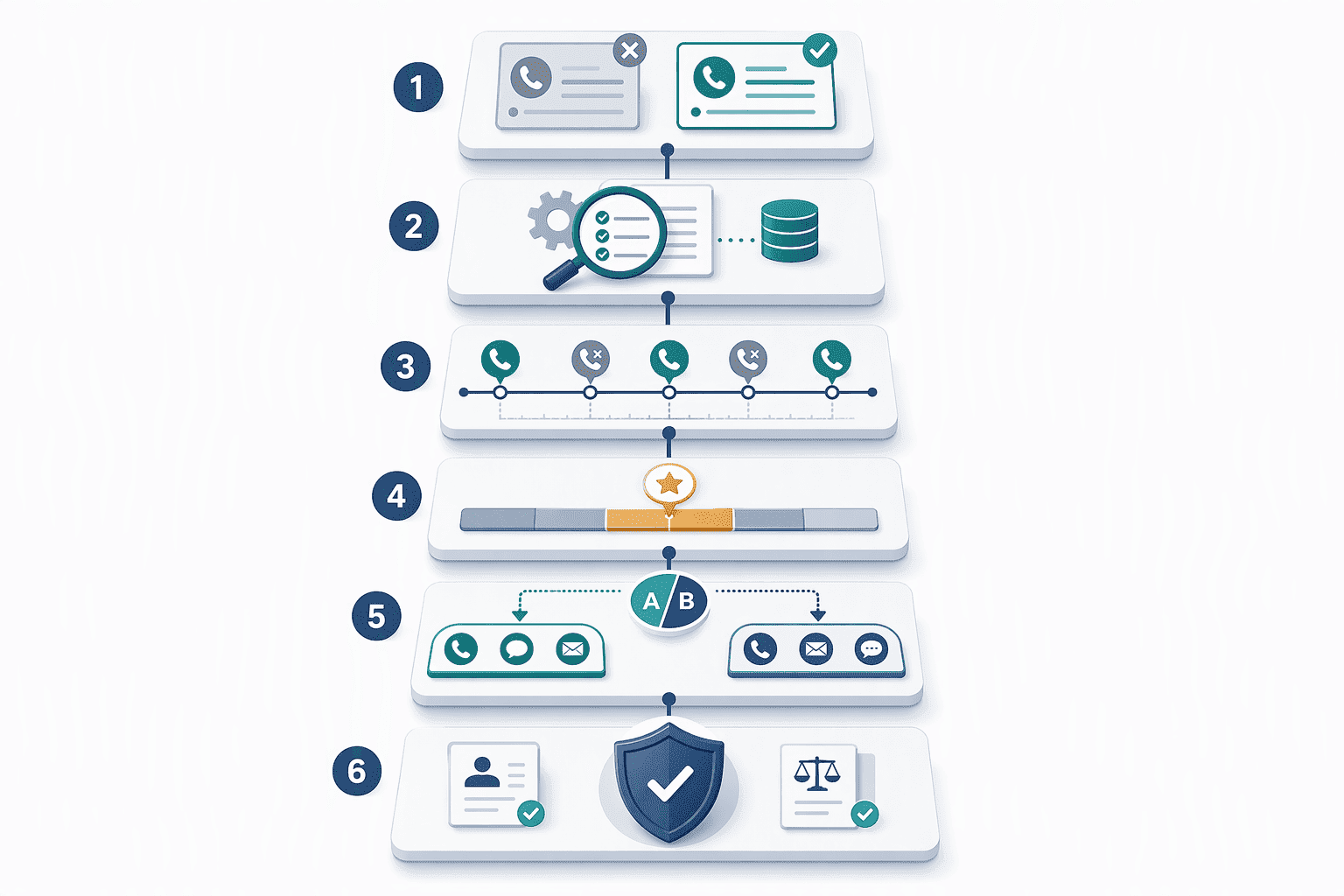
Stop adding agents. Stop buying dials. Start with the data.
Audit data freshness at placement: Pull a random sample of 200 accounts and compare the phone numbers on the placement file against current skip‑traced records. Note the mismatch rate. If more than 30% of the numbers are wrong or stale, your RPC problem starts before the first ring.
Run skip tracing before the first dial: Integrate a skip‑tracing provider into your intake workflow so every account arrives with a verified current number. That alone replaces the six‑month‑old data the creditor handed over.
Score accounts by contact probability: Use a model, like the contact‑probability scoring that Southwest Recovery Services and other data‑conscious agencies apply, that weighs recency of confirmed address, presence of a cell phone versus landline, employment verification status, and prior inbound engagement. Assign each account a score before it hits a work queue.
Sequence outreach by probability, not balance: Route high‑contact‑probability accounts to the morning call block, when answer rates are highest. Low‑probability accounts should route to email or letter campaigns first, with phone follow‑up only after a digital response, or after skip‑trace data refreshes.
Introduce multi‑channel touches in cadence: Open with an email or SMS that includes a self‑service payment link. Follow with a voice call within 24 hours. The inbound portal login or link click tells you the debtor is reachable and engaged before you spend a single regulated phone attempt.
Measure RPC at the attempt, account, and decision‑maker level: Build a dashboard that tracks connection rate per dial (did a human answer), resolution rate per account (did the contact result in a payment or promise), and decision‑maker hit rate (did you reach the person with payment authority). Use the pattern to tune the scoring model monthly.
Conclusion
Low right‑party contact rates are a data and strategy problem that hides inside what looks like a staffing shortage. Strip out wrong numbers, verify the decision‑maker, respect the regulatory cadence ceiling, and layer in digital channels. The contact rate climbs.
You do not need another agent or another dialer seat to get there.
The agencies pulling ahead in 2026 invest in data verification and contact‑probability intelligence before they spend another dollar on headcount. They make every call count.
Frequently Asked Questions
What operational and data‑quality factors most commonly cause low right‑party contact rates in US debt collection?
The biggest factor is dialing raw placement data without verifying phone numbers first:
Sorting by balance instead of probability: When lists are sorted by balance size instead of contact probability, agents waste attempts on dead numbers.
High-velocity dialer strategies: These amplify the problem by burning through the limited call attempts Regulation F permits.
How do outdated or inaccurate contact data and skip‑tracing gaps affect collector outreach success?
Old data sends your first several attempts to wrong numbers, disconnected lines, or reassigned phones. Without pre‑dial skip tracing, those wasted attempts chew up your weekly call cap, delay actual contact by days or weeks, and create TCPA liability every time you hit a reassigned number.
What role do call timing, frequency regulations, and dialing strategies (FDCPA/Reg F) play in reaching the correct consumer?
The FDCPA restricts calls to 8 a.m. through 9 p.m., and Regulation F caps collection attempts at six per week before contact. A poor dialing strategy wastes those capped attempts on dead leads, leaving you legally unable to try again until the next week, even on accounts you still have not reached.
What are the industry benchmarks for right‑party contact rates in 2026, and how have they changed?
Agencies using voice‑only outreach on raw data generally see 30% to 40% right‑party contact. Multi‑channel, scored approaches push decision‑maker contact well beyond 50%. The definition is also shifting, leading operations now measure RPC at the attempt, account, and decision‑maker levels separately.
How do multi‑channel outreach and consent‑based frameworks improve RPC rates compared to voice‑only efforts?
Email, text, and self‑service portals operate outside the phone‑call cap and the 8 a.m.‑to‑9 p.m. window. When a debtor engages via a digital channel, that creates a consent record that safely expands permitted outreach while simultaneously proving the person is reachable.
What steps can a US collection agency take immediately to diagnose and lift a persistently low RPC rate?
To improve contact rates, adopt these practices:
Audit data freshness at placement: Check a random sample of accounts before starting outreach.
Run skip tracing before the first dial: Verify contact information before making any attempt.
Score by contact probability: Work high-scoring accounts first.
Layer digital touches before phone calls: Use email or text introductions before voice outreach.
Measure contact at multiple levels: Track attempt, account, and decision-maker contact to identify specific break points.
Sources
Federal Register :: Debt Collection Practices (Regulation F) - www.federalregister.gov
[PDF] THE STATE OF COLLECTIONS 2026 | Sutherland - www.sutherlandglobal.com
Improve Collections Right Party Contact with Skip Tracing - www.tracers.com


