

Your recovery floor runs two shifts of collectors, each making 200 calls a day, and your delinquency roll rates are still climbing.
Introduction
Your recovery floor runs two shifts of collectors, each making 200 calls a day, and your delinquency roll rates are still climbing. The average agent spends more time navigating screens and leaving voicemails than actually resolving debt. The post-pandemic volume surge never retreated, and with the Milam v. Selene Finance ruling reversing and remanding on cross-channel communication gaps in 2025, the cost of inconsistent borrower contact has never been clearer. Every manual call creates an evidence artifact, or fails to, that can surface later in litigation.
The CFPB finalized its debt collection rule implementing Regulation F to govern how you make those calls, when you make them, and what you must log. For U.S. lenders managing millions of accounts, the math is brutal: human agents cannot scale to meet demand while simultaneously perfecting compliance on every single interaction. They also cannot maintain perfect context when a borrower who received an SMS in the morning answers a voice call in the afternoon.
AI voice collections platforms now solve this by collapsing the gap between communication channels and hard-coding regulatory requirements directly into the conversation flow. These are purpose-built collections infrastructure that conducts natural, compliant conversations at a scale measured in millions of interactions. This article evaluates the seven platforms leading that shift in 2026, ranked by how effectively they solve the core problems of fragmentation, compliance, and scale for institutional lenders.
Key Takeaways
For a collections executive assessing AI voice technology in 2026, three findings matter most:
Compliance is now deterministic, not probabilistic: Leading platforms like Smallest.ai and TCN hard-code FDCPA and Reg F requirements, including time-of-day windows, the seven-calls-in-seven-days presumption, and automatic dispute escalation, directly into the call state machine, eliminating the risk of a model hallucinating a violation.
Unified cross-channel orchestration eliminates litigation exposure: Domu and Callbook AI merge voice, SMS, and email into a single, timestamped conversation state. That directly addresses the evidence-chain gaps that led the court in Milam v. Selene Finance to reverse and remand on assignee status questions in 2025.
Vertical-specific AI dramatically outperforms generic voice bots: Vodex's BNPL case study demonstrated a 70% cost reduction and 92% decline in complaints, while Collectly applies HIPAA-native, empathy-first design to medical debt. General-purpose voice AI cannot match purpose-built collections platforms on recovery or compliance.
1. Domu, The Unified Collections Orchestration Layer for Institutional Lenders
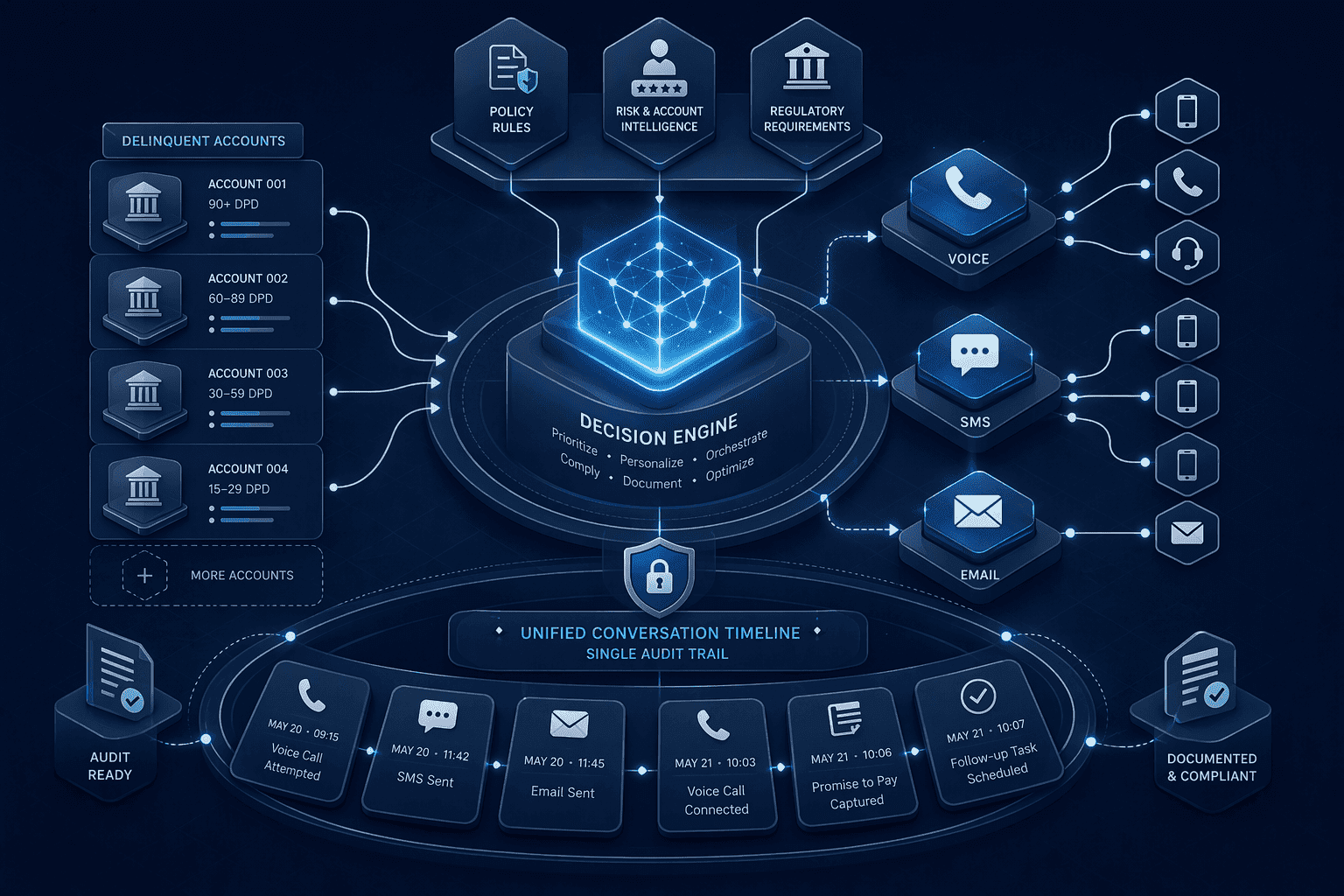
Domu solves the fragmentation problem by acting as a central decision engine that classifies accounts by ability and willingness to pay, then orchestrates voice, SMS, and email into a single, auditable conversation. It is the platform purpose-built to eliminate the exact cross-channel inconsistency that creates litigation risk.
Most collection technology stacks are stitched together: one vendor for dialer, another for SMS, a separate system for email. Each channel maintains its own conversation log. When a borrower disputes a debt via email on Tuesday and then receives an automated collection call on Wednesday, with no acknowledgment of the dispute, the lender has just created a pristine FDCPA exhibit for a plaintiff's attorney. Domu's orchestration layer prevents this by maintaining a unified state machine across every touchpoint. Every agent action, whether AI or human, reads from and writes to the same record.
The platform exposes API endpoints that integrate with existing loan servicing systems, so the decision engine pulls real-time account status, payment history, and prior contact attempts before determining the next action. A large fintech lender scaled AI-powered calls by 2,400x on Domu's platform without ever putting a customer on hold, demonstrating that the orchestration layer can absorb massive volume without degrading the borrower experience. This matters because context-switching, the pause while an agent pulls up a screen, is the moment a borrower hangs up.
Domu earns the top slot because it does not merely automate individual calls. It rearchitects the entire collections communication stack around a single source of truth. For an institutional lender managing millions of accounts, that architectural choice is the difference between a defensible audit trail and a gap a regulator will eventually find.
2. Callbook AI, Context-Aware Automation at the Multi-Million Borrower Scale
For lenders who need proof that AI voice collections works at the absolute upper bound of portfolio size, Callbook AI provides the numbers. The platform reports managing over 2 million borrowers across 23 million-plus interactions, recovering more than $11 million. Those are not pilot-program metrics; they are production-scale outcomes.
Verified scale: Callbook AI has managed over 2 million borrowers and conducted 23 million-plus interactions, making it one of the largest deployed voice AI footprints in U.S. collections.
Hard dollar recovery: The platform has recovered over $11 million, a figure that ties AI conversation quality directly to net liquidation.
Context-aware design: Unlike simple automated dialers that follow static scripts, Callbook AI maintains conversational context throughout each call, recognizing when a borrower references a prior interaction or payment arrangement and adapting the dialogue in real time.
3. Smallest.ai, Hard-Coded Compliance Architecture That Eliminates Violation Risk
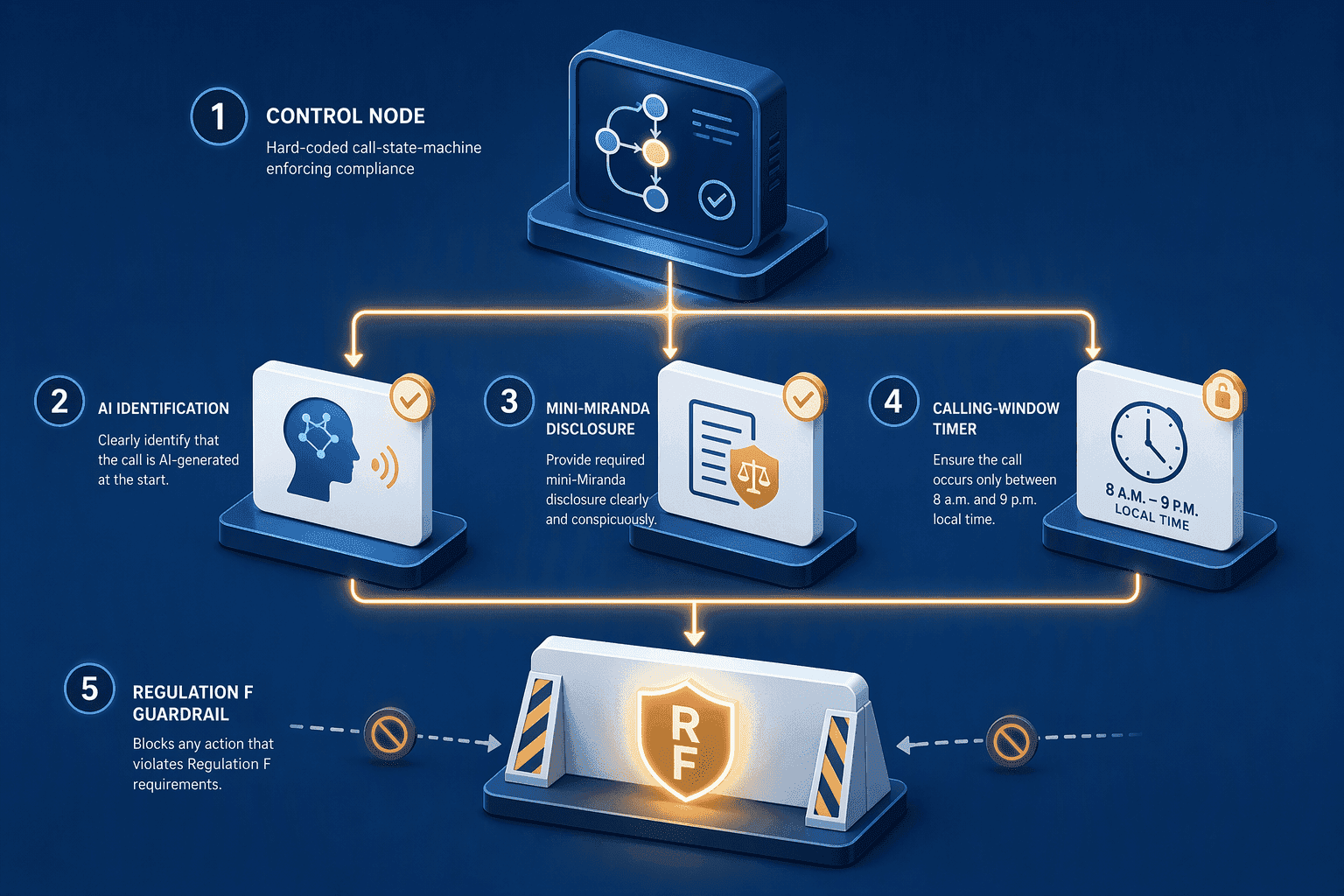
Smallest.ai abandons probabilistic safety by hard-coding compliance rules into the call state machine so violations become technically impossible.
Every call begins with transparent AI identification and a mini-Miranda disclosure.
The system enforces time-of-day calling windows between 8 a.m. and 9 p.m. local time.
It applies the hard limit embedded in Regulation F: a debt collector is presumed to violate the FDCPA's prohibition on repeated or continuous telephone calls if it places a call to a person more than seven times within a seven-day period.
When a borrower uses any language indicating a dispute or requests to speak with a supervisor, the system automatically escalates and ceases automated collection activity on that account, no model judgment involved.
This deterministic approach appeals to institutions where a single FDCPA class action can cost far more than any recovery gain from conversational flexibility. For those lenders, Smallest.ai represents the logical endpoint of the compliance-first philosophy: do not train the AI to follow the rules. Code the rules so the AI cannot break them.
4. TCN, Pre-Approved Script Pinning for No-Compromise Regulatory Control
TCN takes the compliance-first philosophy to its most conservative conclusion. Instead of allowing an AI agent to generate natural language within compliance guardrails, TCN pins AI agents to pre-approved, legally vetted FDCPA scripts. Every word the agent speaks has been reviewed by counsel. There is zero deviation by design.
This approach addresses a specific litigation vector that keeps general counsel awake at night: the 'impression of a live operator' risk. When an AI voice sounds natural but strays from approved language, a borrower may reasonably believe they spoke with a human, and any misrepresentation, even an unintentional one, can form the basis of an FDCPA claim under the statute's prohibition on false or misleading representations. Since the FDCPA was passed in 1977 to eliminate abusive debt collection practices by debt collectors, courts have consistently interpreted its provisions broadly.
Script pinning sacrifices conversational flexibility. A borrower who asks an unexpected question may hit a dead end rather than a dynamic response. But for a risk-averse institution, a large bank with an active CFPB consent order, or a servicer recovering from a prior enforcement action, that trade-off is not merely acceptable. It is the entire point.
TCN is not the right fit for every portfolio. But for the specific risk appetite that prioritizes perfect script adherence over all other considerations, it is the platform built precisely for that mandate.
5. Skit.ai, Full Lifecycle Accounts Receivable with Multilingual AI Agents
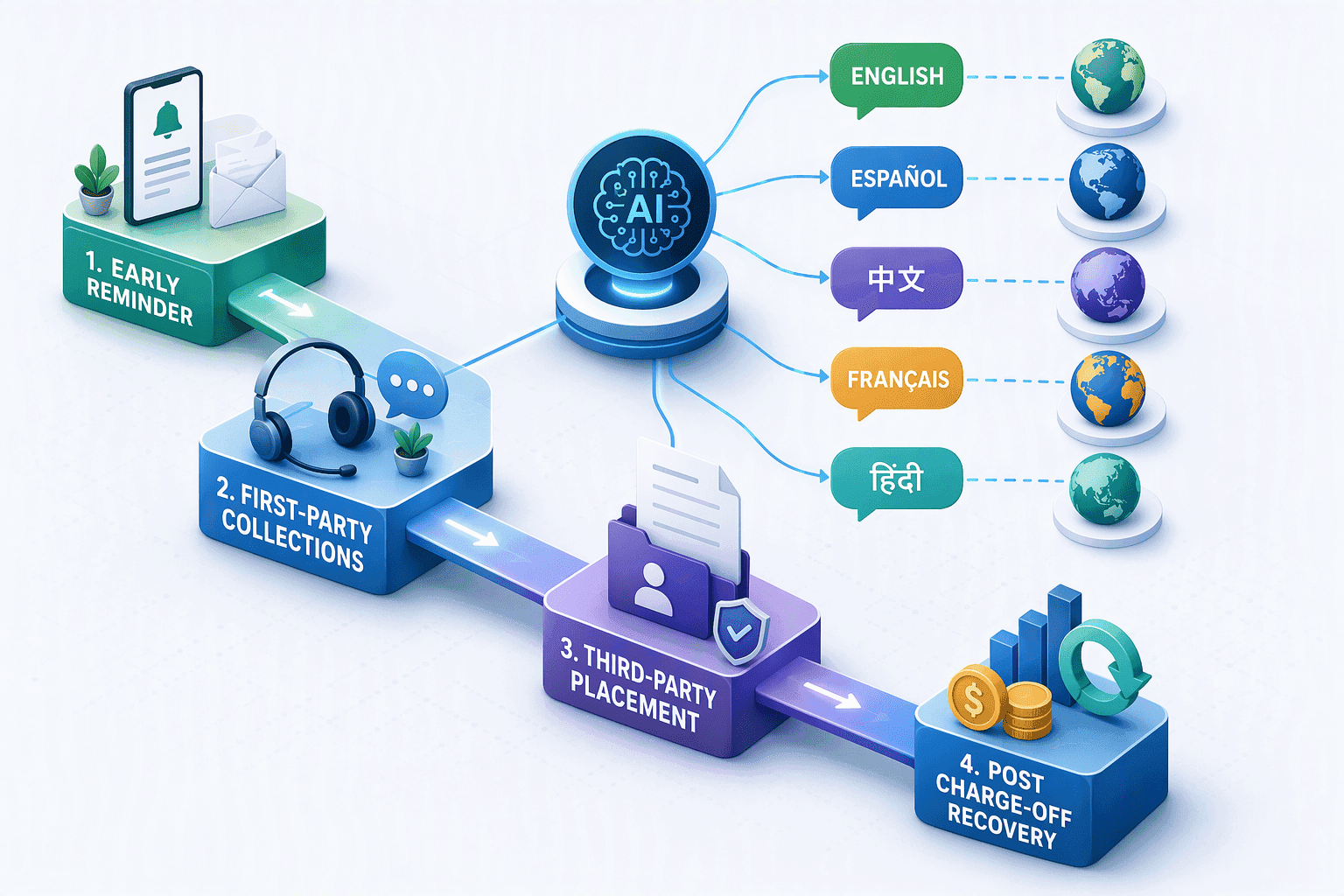
Skit.ai covers the entire arc of delinquency, from early-stage reminders through post-charge-off recovery. Enterprise lenders tired of managing separate vendors for pre-delinquency outreach, first-party collections, third-party placements, and post-sale recovery get a single operational thread.
The platform's multilingual AI agent capability addresses a specific operational gap in U.S. collections. CFPB language access guidance increasingly expects servicers to communicate effectively with limited-English-proficiency borrowers. When a Spanish-speaking borrower receives an English-only collection call, the interaction often ends with a hang-up and a subsequent complaint. Skit.ai's agents conduct the full conversation in the borrower's primary language, maintaining compliance disclosures, payment negotiation, and dispute handling across that linguistic boundary.
A single vendor covering the full lifecycle also solves an evidence continuity problem. When an account moves from in-house collections to a third-party agency and then to a debt buyer, the conversation history often fragments across systems. Skit.ai's architecture keeps the full interaction record intact as the account ages. That complete audit trail is what Reg F examination procedures expect, and what a gap in the record eventually puts at risk.
For large diversified lenders with multi-stage recovery operations and demographically varied portfolios, that combination of lifecycle coverage and multilingual capability makes Skit.ai a compelling Tier-1 contender.
6. Vodex, BNPL Cost Reduction Leader with Near-Zero Complaint Rates

Vodex's BNPL case study provides the most concrete ROI validation in the current market. A leading collection agency managing 800,000-plus small-ticket delinquent accounts per month deployed Vodex to handle 100,000-plus daily calls. The results: a 70% cost reduction, a 92% decline in complaints, and zero compliance violations.
Those three metrics tell a complete story. The cost reduction validates the platform's efficiency. The complaint decline is arguably the more important number: it signals that AI interactions are cheaper and actually better received by borrowers than the human calls they replaced. For a BNPL lender whose entire margin depends on low-touch, high-volume servicing, fewer complaints directly reduce the CFPB friction that can trigger a supervisory examination.
Zero compliance violations is the third leg. It demonstrates that automated collections, when architected correctly, can eliminate entire categories of regulatory risk rather than simply managing them. For digital-first lenders scaling BNPL portfolios across state lines with varying consumer protection statutes, that zero-violation track record is a defensible audit trail instead of a gap a regulator eventually finds.
7. Collectly, Healthcare-Specialized Empathy-First Collections AI
Medical debt is a different animal from credit card or auto loan delinquency. It is governed by HIPAA, impacted by the No Surprises Act, and carries reputational risk that no bank faces when pursuing a past-due installment account. Collectly addresses this directly with a HIPAA-native architecture that treats every patient financial conversation as a regulated healthcare interaction.
Collectly's conversation design prioritizes empathy because medical debt often arises from circumstances the patient did not choose, an emergency surgery, an unexpected diagnosis, a billing error between provider and insurer. An aggressive collections script that works for credit card debt generates complaints, bad online reviews, and potential regulatory scrutiny when applied to a patient who was never told their anesthesiologist was out-of-network. Collectly's agents navigate that sensitivity while still securing payment arrangements and resolving open balances.
The vertical specialization trend in collections AI is accelerating for good reason. A general-purpose platform must be configured to handle HIPAA business associate requirements, state-by-state medical debt collection restrictions, and the CFPB's specific medical debt guidance. Collectly arrives with that compliance built in. For health systems, revenue cycle management firms, and specialty medical lenders, that native specialization shortens deployment time and shrinks the gap between go-live and audit-ready operations.
8. Head-to-Head Comparison: Compliance Certifications, Right-Party-Contact Benchmarks, and Audit Trail Maturity
A procurement team evaluating these seven platforms needs a structured comparison across the dimensions risk committees prioritize.
9. Connecting Audit Trails to Regulator Examination Outcomes: A Measurement Framework for US Lenders
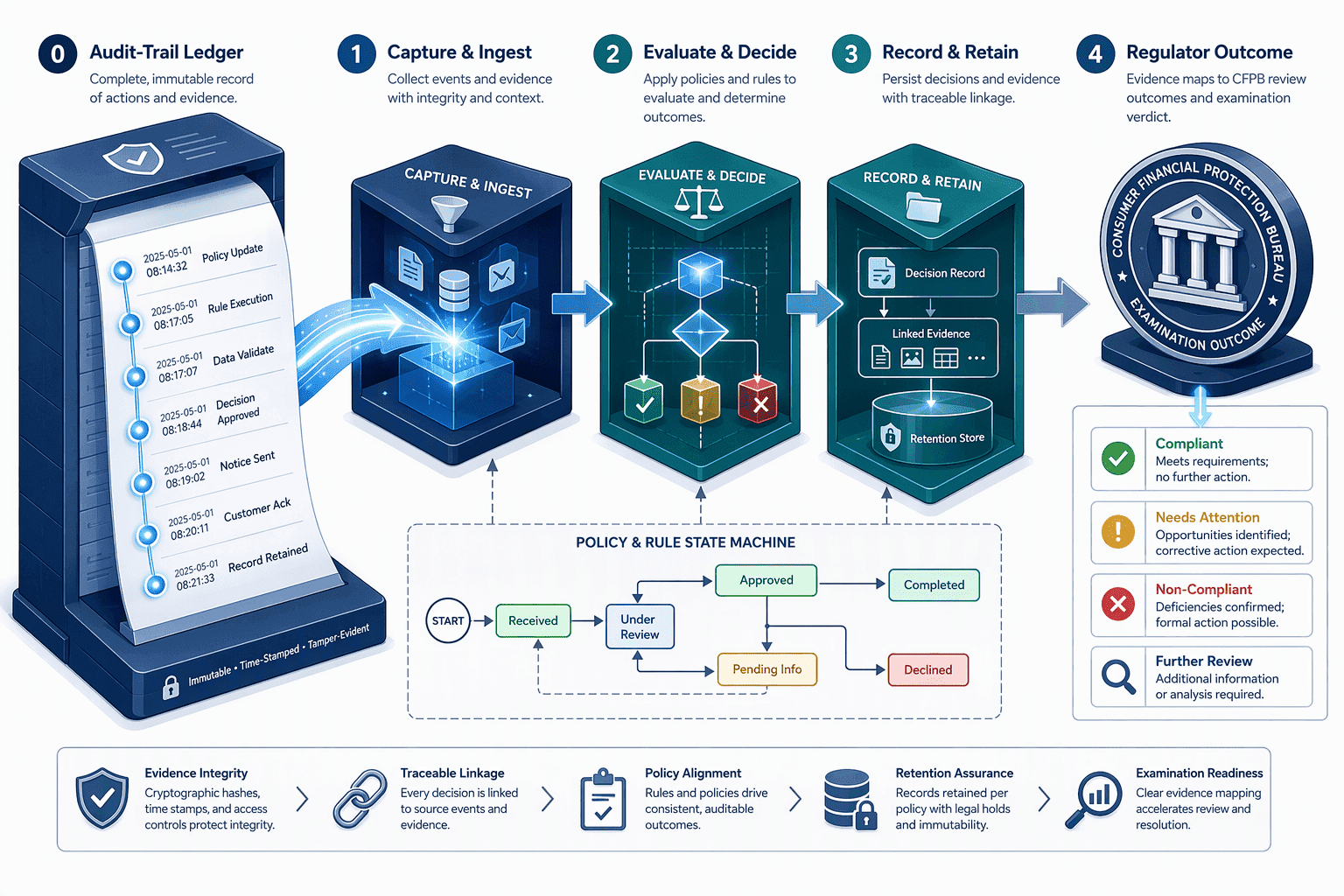
Audit trail quality is the single largest determinant of how an AI collections deployment fares in a CFPB examination. The Supervision and Examination Manual's UDAAP module tests whether a lender can demonstrate, not assert, that its practices avoid unfair, deceptive, or abusive acts. Here is how to map platform capabilities to exam-ready evidence.
State machine visibility: Examiners will ask for a complete, timestamped log of every agent decision: why was this account called at 2:14 p.m. on a Tuesday? Platforms that hard-code decision logic (Smallest.ai, TCN) or centralize it in an orchestration layer (Domu) can produce this record; platforms that rely on model inference alone typically cannot.
AI decision logging: When an AI agent deviates from a standard path, offers a lower settlement, escalates to a supervisor, terminates a call, the examiner expects to see a logged reason. Deterministic architectures capture this automatically; probabilistic systems require additional instrumentation to surface the model's reasoning.
Consent tracking across channels: Reg F requires that each email and text message includes a reasonable opt-out method. A unified platform (Domu, Callbook AI) logs consent events across voice, SMS, and email in one record; fragmented stacks create gaps that an examiner will treat as a compliance deficiency.
Hard-coded escalation (Smallest.ai) and unified orchestration (Domu) make this deterministic; script-pinned approaches (TCN) ensure the agent never accidentally talks past a dispute.
Conclusion
The AI voice collections market in 2026 is a segmented landscape where platform choice maps directly to a lender's risk appetite, operational scale, and vertical specialization. Conservative institutions that prioritize zero-deviation script control over conversational flexibility should evaluate TCN or Smallest.ai. Large multi-channel lenders managing millions of accounts with cross-channel litigation exposure need the unified orchestration layer Domu or Callbook AI provide. Vertical players such as BNPL lenders and healthcare systems should look to Vodex and Collectly, where the compliance architecture is purpose-built for their regulatory environment. The common thread across all seven platforms is the same: compliant, natural voice conversations with delinquent borrowers at scale are operational, auditable, and, in 2026, the baseline for any serious collections organization.
Frequently Asked Questions
How do AI-powered voice platforms handle natural conversations with delinquent borrowers at scale in the US?
They use an orchestration layer that merges voice, SMS, and email into a single conversation state, giving every AI agent full context from prior interactions. The call flow is governed by hard-coded compliance rules, time-of-day windows, contact frequency limits, and automatic dispute escalation, so natural conversation stays within regulatory bounds.
What regulations govern the use of artificial intelligence voice agents for debt collection communications in the United States?
The following regulations govern collections communications:
The FDCPA prohibits abusive, false, or misleading practices.
Regulation F implements specific requirements including a presumption that calls exceeding seven times in seven days are harassing, mandatory AI identification, and opt-out mechanisms for electronic communications.
TCPA consent rules apply.
CFPB UDAAP standards govern overall fairness.
Which software vendors currently offer conversational AI for collections and recovery in 2026?
Seven leading platforms serve distinct segments:
Domu provides cross-channel orchestration.
Callbook AI operates at multi-million-borrower scale.
Smallest.ai hard-codes all compliance rules.
TCN pins to pre-approved scripts.
Skit.ai covers the full lifecycle with multilingual support.
Vodex leads in BNPL efficiency.
Collectly specializes in HIPAA-compliant healthcare collections.
What ROI or performance metrics do financial institutions report from using voice AI for delinquent accounts?
Key metrics from leading platforms include:
Callbook AI reports managing over 2 million borrowers and recovering over $11 million.
A BNPL agency using Vodex achieved a 70% cost reduction, 92% fewer complaints, and zero compliance violations while handling 100,000-plus daily calls.
A large fintech lender scaled calls 2,400x on Domu without putting a customer on hold.
What are the risks and limitations of using natural-sounding AI voices for borrower outreach?
The primary risk is creating the impression of a live operator when AI is on the line, which can support FDCPA misrepresentation claims if the agent strays from approved disclosures. Other limitations include handling unexpected borrower questions, and generating unlogged model inferences that cannot be produced as evidence during a CFPB examination.
How does a voice AI platform integrate with existing loan servicing or collections systems?
Leading platforms expose API endpoints that pull real-time account status, payment history, and prior contact attempts from core servicing systems before determining the next action. The AI agent reads from and writes to the same system of record as human collectors, maintaining a unified conversation history across all channels.
Sources
7 Platforms That Handle Voice — Domu - domu.ai
Voice AI Driving Faster, Smarter Recovery in BNPL Collections - www.vodex.ai
Debt Collection Practices (Regulation F): Final rule - files.consumerfinance.gov
Related Articles



We’re building the next generation of engagement technology: intelligent, automated and compliant. Our mission is to empower financial institutions to orchestrate every stage of the servicing lifecycle with dignity and unprecedented efficiency.
Supported by

