
9 Most Affordable AI Collections Platforms for Mid-Size Banks and Credit Unions in 2026

10 min read
Your delinquency rates are ticking up, your dialer costs are flat or rising, and a wave of consumer-centric regulatory scrutiny is breaking.
Introduction
Your delinquency rates are ticking up, your dialer costs are flat or rising, and a wave of consumer-centric regulatory scrutiny is breaking. For a mid-size bank or credit union, the math feels impossible: you need the efficiency of AI-powered collections without a Silicon Valley price tag or a compliance function that treats Reg F as an afterthought. Total credit union delinquency hit 95 basis points in Q3 2025, and consumer credit 30 to 59 day past-due rates climbed to 1.13% in September 2025, nearing pre-pandemic norms. The pressure to modernize is no longer theoretical.
But most AI collections tools over-index on raw large-language-model power and under-index on the constraints that define mid-market financial institutions: thin IT teams, deep core-system dependencies, and zero appetite for regulatory risk. The right platform for you isn't the one with the flashiest generative AI demo. It's the one that can slot into Symitar or Episys without a six-figure integration build, preserve customer satisfaction scores, and deliver a verifiable lift in right-party contact rates inside a single quarter.
This list evaluates seven platforms against those benchmarks. We weigh compliance architecture, omnichannel payment prioritization, core-native integrations, and total cost of ownership, precisely the dimensions that separate an affordable, right-sized AI deployment from an expensive science project.
Key Takeaways
Every platform in this list was assessed against the constraints that actually define affordability for a $1 billion to $5 billion asset institution, because sticker price alone is a trap.
Compliance architecture is the largest hidden cost. A platform without embedded, auditable regulatory guardrails (Reg F timing, disclosure tracking, state-level call-frequency limits) shifts liability onto your team.
Core integration depth determines total cost of ownership. Real-time read/write access to Fiserv DNA, Jack Henry Symitar, or Episys eliminates the need for separate robotic-process-automation bridges. Fewer middleware layers mean lower monthly licensing overhead.
Omnichannel payment prioritization cuts cost-to-collect. Platforms that intelligently shift outreach from brute-force dialing to SMS, email, or voice based on response propensity consistently outperform single-channel tools on promise-to-pay rates.
A 90-day ROI benchmark is realistic. Right-sized deployments at mid-size credit unions routinely move from data ingestion to full production automation in one quarter, with measurable reductions in manual dialer hours and a lift in right-party contact rates.
1. Domu: The Compliance-First AI Collections Platform Built for Mid-Size US FIs

Domu treats regulatory compliance as the primary architecture of its AI. Every AI-generated communication carries a 'compliance watermark,' a structural layer that embeds Reg F timing windows, state-level disclosure logic, and audit trails directly inside the message payload. For a mid-size bank where a single FDCPA misstep can erase a quarter's efficiency gains in fines and examination findings, that architecture turns compliance from a variable cost into a fixed, predictable one.
This matters acutely for institutions running lean collections teams. Domu's line-item negotiation logic lets an AI voice agent negotiate payment terms on individual charged-off accounts at scale while staying within creditor-approved settlement guardrails.
The platform was built specifically for the US mid-market supervisory reality, where examiners expect demonstrable, repeatable compliance controls. Domu's design accepts that deterministic rules around debt collection are the substrate the AI operates inside.
For a credit union carrying mixed paper (medical, auto, revolving credit) and trying to modernize without hiring a dedicated AI compliance officer, that design is the difference between a tool that accelerates recovery and a tool that generates regulatory exposure. You deploy the AI, and the compliance framework, in the same motion.
2. Skit.ai: Augmenting Agent Efficiency with Omnichannel Payment Prioritization
Skit.ai's core thesis is that voice-first AI should intelligently hop channels based on where a consumer is most likely to engage a payment link. The platform orchestrates voice, SMS, and email touchpoints in a single workflow, using response-propensity data to decide whether the next best action is a phone call, a text with a secure payment URL, or an email nudge. For a mid-size institution trying to lower cost-to-collect while preserving the human touch for complex cases, that prioritization logic directly attacks the biggest operational expense: repeated, unsuccessful contact attempts on the wrong channel.
This shifts the economics of the collections floor. Agents spend the first two hours of a shift grinding through a list of numbers that never answer. Skit's AI deflects low-complexity contacts (balance inquiries, payment-date confirmations) into self-service and flags only genuine negotiation or hardship scenarios for human handoff. The result is more resolved accounts per agent-hour without adding headcount.
For community banks and credit unions evaluating enterprise AI workflow tools, Skit layers intelligence on top of the existing outreach stack. The platform works with the dialer infrastructure already in place. That makes the affordability case easier to sell to a board still wary of large technology capital expenditures.
3. TCN Operator: High-Volume Predictive Dialing with Integrated AI Self-Service

TCN Operator layers three AI modes directly onto TCN's predictive dialer.
Assist mode: AI monitors live agent calls in real time and surfaces compliance prompts, payment-history summaries, and settlement-guardrail reminders. The agent sees what matters without navigating multiple screens, which shortens average handle time.
Deflect mode: Fully automated AI handles right-party verification, balance lookups, and promise-to-pay confirmations. It escalates to a human only when the conversation crosses a defined complexity threshold, so agents spend more time on negotiation-heavy accounts.
Resolve mode: AI manages the complete lifecycle of low-balance, low-complexity accounts from initial contact through payment capture, producing a closed-loop resolution that requires zero agent intervention.
The bridge economics: Because Operator runs on TCN's core dialer, institutions already licensed for TCN avoid the implementation cost of a new telephony stack. The AI layers add capability without replacing the platform, so the ROI model tracks incremental recovery lift on existing infrastructure rather than full-platform amortization.
Right-sized for credit unions: At a recent Money20/20 showcase, the platform demonstrated how credit unions can layer self-service AI onto a familiar dialer environment, a critical advantage when IT teams are thin and training bandwidth is limited.
4. ConneXt by Aragon: Core-Native AI for Deep Symitar and Episys Integrations
For a credit union running Jack Henry Symitar or Fiserv Episys, the largest hidden cost in any AI collections deployment is the integration middleware, custom API bridges, batch-file transfers, or manual data reconciliation that eats IT hours and introduces latency. ConneXt by Aragon eliminates that cost by building its AI directly against the core's native API layer, enabling real-time balance inquiries and immediate promise-to-pay updates at the system-of-record level.
Zero-latency core integration: When an AI agent negotiates a payment plan, ConneXt writes the promise-to-pay directly into Symitar or Episys instantaneously, removing the batch-file lag that creates reconciliation headaches and duplicate-contact risk.
Reduced robotic-process-automation dependency: Many collections AI platforms rely on screen-scraping or robotic-process-automation bots to interface with legacy cores. ConneXt's native API access collapses that layer, cutting both licensing fees and failure points.
Credit union DNA: Aragon built ConneXt specifically around credit union core systems, not as an adaptation of a retail-banking tool. The platform understands the member-number architecture, share-draft logic, and cross-collateralization structures that generalist AI tools often mishandle.
Compliance in the core workflow: Because the AI operates inside the core's permission framework, regulatory controls like loan-to-one-borrower limits (capped at 10 percent of net worth and 10 percent of deposits for credit unions) can be enforced at the transaction level without a separate compliance overlay.
5. CollectAI: Modular White-Label AI for Digital Installment Negotiation
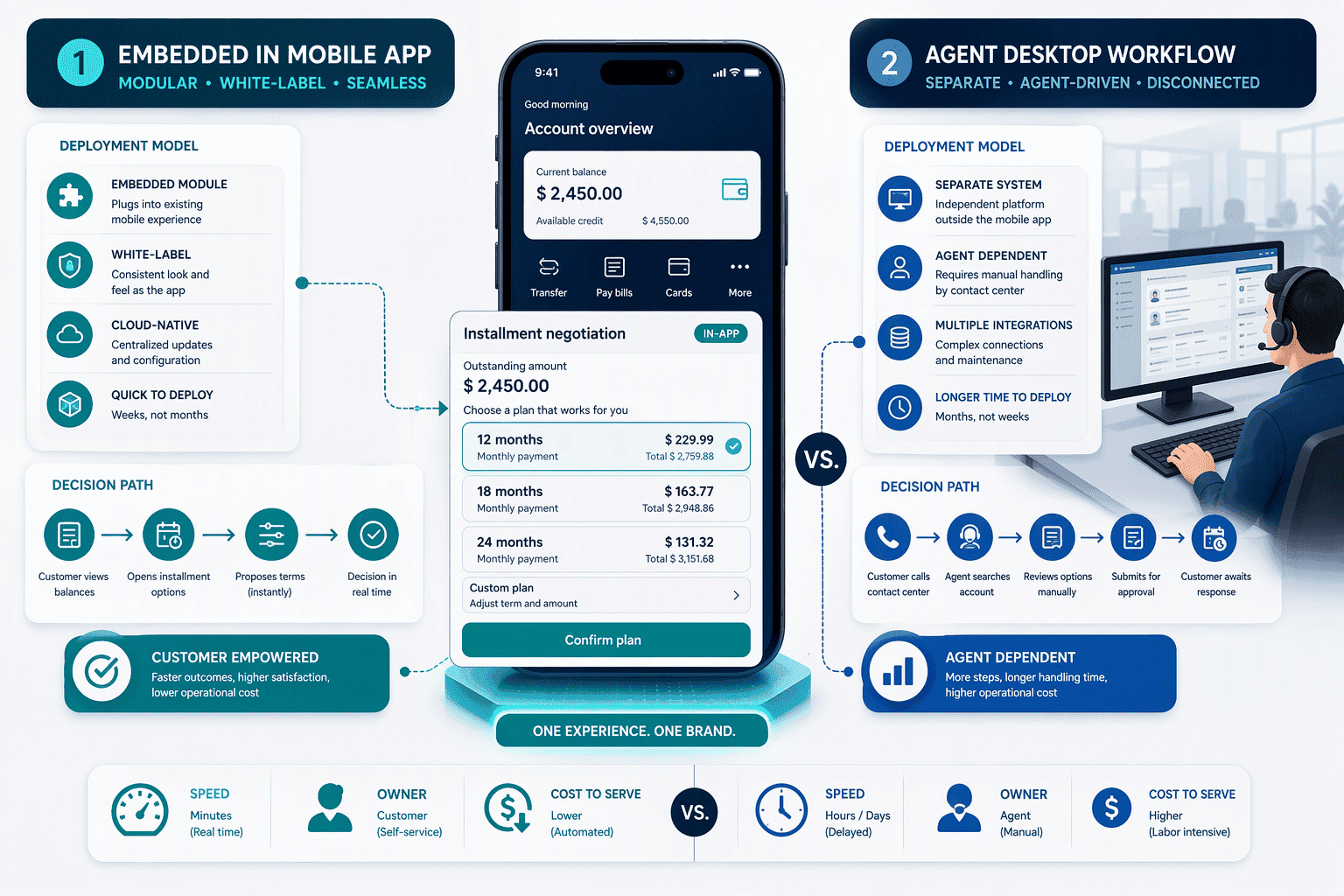
Feature | CollectAI Approach | Traditional Agent-Led Negotiation |
|---|---|---|
Deployment model | Modular, white-label API that embeds inside the FI's existing digital banking UI | Requires a separate agent desktop or outsourced call center |
Installment plan generation | Risk-adjusted settlement offers calculated algorithmically based on portfolio performance data and consumer payment history | Agent discretion with supervisor approval workflows |
Consumer experience | Self-cure digital portal branded to the FI; consumer negotiates terms async, without a phone call | Phone-based negotiation during business hours |
Regulatory posture | Rules engine enforces state-level maximum settlement terms and disclosure requirements before offer generation | Manual compliance review of negotiated terms, introducing lag and variability |
Scalability | Handles thousands of simultaneous digital negotiations without proportional headcount increase | Linear relationship between account volume and agent headcount |
CollectAI's modular design gives mid-size institutions a way to automate installment-plan negotiation and keep full control of the customer-facing experience. The white-label API integrates directly into an existing mobile banking or web portal, so the consumer never sees a third-party brand. For credit unions that have spent years building member trust, that matters enormously: the negotiation feels like a native digital-banking interaction inside the institution's own app. The platform generates risk-adjusted settlement offers from portfolio performance data and consumer payment history, which removes the agent-discretion problem that slows down traditional workflows. A rules engine locks in state-level settlement limits and required disclosures before any offer reaches the consumer.
6. Interactions: Intelligent Virtual Assistants for Nuanced Hardship Handling
A borrower says 'I just lost my job' to an AI. A brittle, intent-mapped bot escalates immediately, costing you an agent's time, often after the borrower has already hung up. Interactions takes a different approach. Its adaptive natural-language-understanding engine is trained to navigate sensitive hardship conversations in place, detecting the difference between a genuine inability to pay, a request for a temporary skip, and a negotiation tactic.
That matters on a credit union collections floor where member retention carries real economic weight.
For institutions carrying a mixed portfolio that includes medical debt and revolving credit, the ability to handle a hardship disclosure empathetically without immediate escalation protects the member relationship while buying time for a structured resolution. Interactions built its virtual assistants as conversational tools that mirror the credit union philosophy of people helping people, an approach that aligns with the broader industry shift toward consumer-centric collections practices at the Treasury and CFPB levels. The AI holds the conversation, gathers structured hardship data, and hands off only when a decision exceeds its delegated authority, so your agents focus on complex resolutions rather than initial distress screening.
7. Exus AI Risk Score: Pre-Delinquency Machine Learning to Reduce Roll Rates

The most affordable collection is the one that never starts. Exus's machine-learning model shifts the intervention window to 15 to 30 days before delinquency, ingesting alternative data sets (transaction velocity, payment-pattern micro-shifts, external credit-header changes) to surface accounts that are silently drifting toward default.
The model flags a subtle drop in deposit frequency or a change in revolving-credit utilization that correlates with future roll rates. While the account is still current, it triggers a soft-touch outreach\u2014an SMS payment reminder, a gentle email with a payment link. For a mid-size credit union, a 10-basis-point reduction in delinquency roll rates can mean millions in preserved asset quality. That early-warning capability changes the economics of the entire collections function.
Platforms like AKUVO and Symend have demonstrated that pre-delinquency analytics can fundamentally reshape collector workflow, moving teams from reactive cure to proactive prevention. Exus fits that category, but it's specifically architected for the mid-market FI that needs a focused risk-scoring engine. The value proposition is narrow and clear: a risk score that drops directly into your collector's queue-prioritization logic, no additional dashboard or workflow rebuild required. The model integrates with existing core and collections systems via API.
8. Case Study: The 90-Day ROI Timeline for a $1.5B Credit Union Migrating to AI Collections
A $1.5 billion asset credit union in the Midwest with a mixed portfolio of auto loans, credit cards, and personal installment debt moved from a legacy predictive dialer to an AI collections platform structured around compliance-first communication and omnichannel payment prioritization. The rollout followed a staged 90-day plan: the first two weeks focused on data ingestion and core-system read/write mapping against Symitar. By day 30, the AI was handling right-party verification and balance-lookup deflection for early-stage delinquencies (1 to 29 days past due).
At day 60, full automation of payment-plan negotiation for charged-off accounts went live. A brute-force redial of a single number on a fixed schedule was replaced by a channel strategy that follows the member's actual behavior.
That timeline matches the normal operational cadence for a mid-size institution deploying a purpose-built AI collections platform. The platform connects to existing cores and compliance frameworks without a months-long custom integration cycle. The ROI payback arrived inside the same quarter.
9. Evaluating AI Performance on Medical Debt vs. Revolving Credit Collections
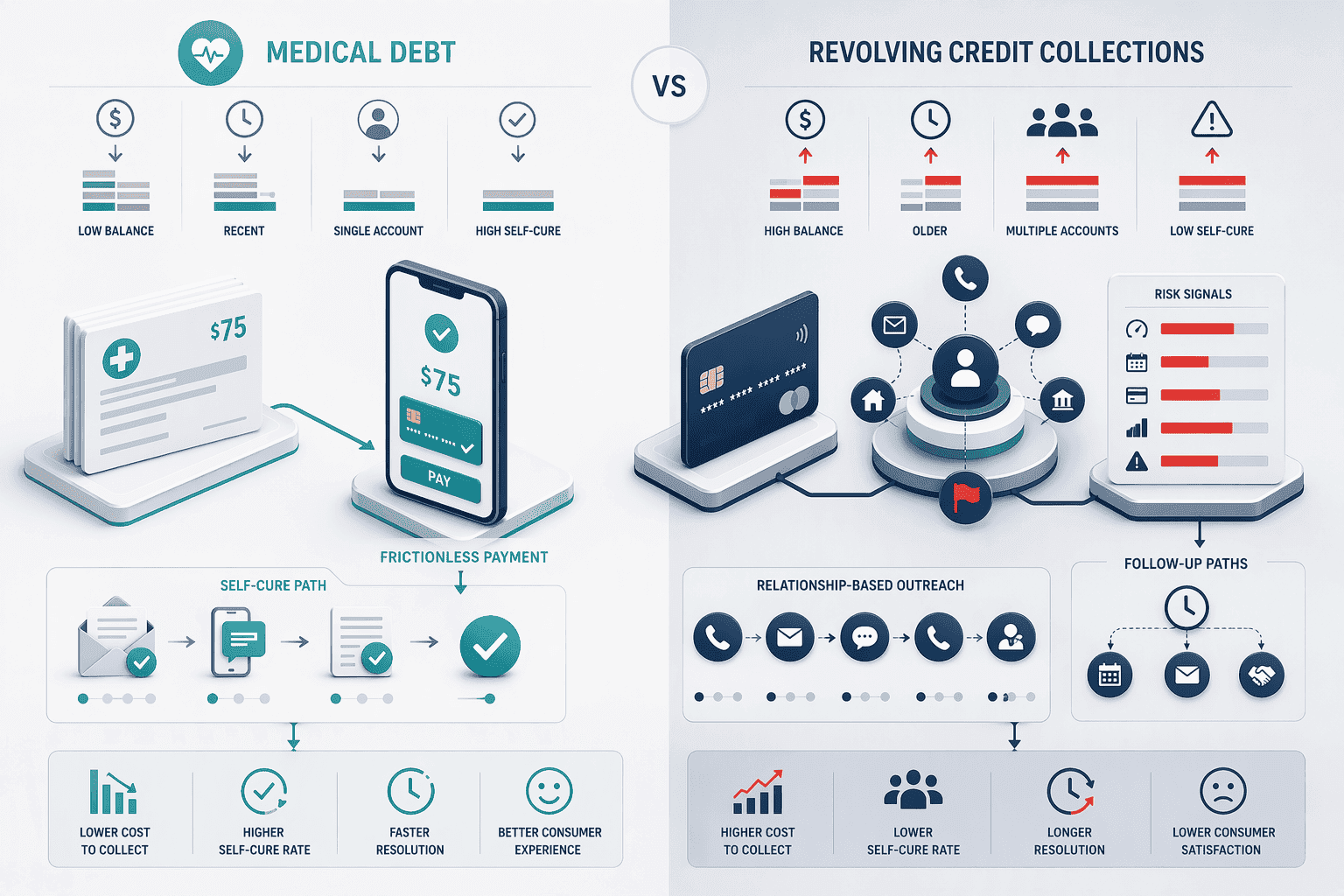
Medical debt and revolving credit behave differently under AI-driven collections, and the performance metrics you track should reflect that. On low-balance medical debt (typically under $500), AI-driven self-cure portals and SMS payment links consistently outperform voice-heavy outreach. The consumer doesn't need a negotiation; they need a frictionless payment path.
Revolving credit, by contrast, is relationship debt. The consumer has a history with the issuing institution, often a credit card they still use. AI voice agents that negotiate a settlement or a payment plan while preserving the relationship, perhaps by offering a temporary APR reduction or a skip-pay option, tend to outperform basic dialers on cure rate. The CFPB's recent focus on medical debt collection practices adds another layer: AI tools processing medical debt must handle nuanced regulatory requirements around credit reporting, insurance verification, and hardship validation that don't apply to revolving credit. An AI platform that performs brilliantly on credit card collections may underperform or create compliance risk on a medical-debt portfolio if its rule sets and negotiation logic aren't asset-class-aware.
For a mid-size credit union carrying both asset classes (and possibly more, given that Smart Collections supports product-aware playbooks for auto, HELOC, personal installment, and overdraft), the selection criterion isn't which platform posts the highest headline recovery rate. It's which platform can demonstrate asset-class-specific performance against the portfolio mix you actually hold.
Conclusion
Affordable AI for mid-size banks and credit unions comes down to one number: the total cost of compliance, integration, and operational drag across the collections lifecycle. If a platform nails core integration but skips omnichannel payment prioritization, it leaks efficiency on every portfolio it touches.
A tool with sharp pre-delinquency analytics that cannot handle a live hardship conversation leaves your agents holding the hardest calls. Smart agent desktop tools and virtual negotiators that serve up real-time account context before the first hello, rather than a scripted flow from a dialer schedule, keep those calls productive.
The winning strategy for most mid-size FIs in 2026 is a right-sized stack. A compliance-first communication layer. Deep core-native integration. Channel intelligence that shifts outreach based on consumer behavior.
Frequently Asked Questions
What defines a mid-size bank or credit union for AI collections purposes?
Typically an institution with $500 million to $5 billion in assets, holding a mix of consumer loan types. They need AI that integrates deeply with core systems like Symitar or Episys without custom middleware, embeds Reg F compliance natively, and delivers ROI inside a single quarter without a large dedicated AI team.
Which AI collections platforms offer the lowest total cost of ownership for mid-size institutions?
ConneXt by Aragon minimizes cost by eliminating core-integration middleware. TCN Operator layers AI onto existing dialer licenses.
How do these platforms compare on omnichannel payment prioritization?
Skit.ai and Domu lead on intelligent channel hopping based on response propensity. TCN Operator adds self-service deflection to high-volume dialer operations. CollectAI focuses on digital-first, self-cure negotiation. Most others are single-channel optimized unless paired with additional orchestration tools.
What measurable ROI have mid-size credit unions documented after deploying AI collections?
A representative $1.5 billion credit union deployment saw manual dialer hours drop roughly 40% and right-party contact rates lift significantly inside 90 days by shifting from brute-force dialing to AI-driven omnichannel outreach. Cure-rate improvements typically follow within two quarters.
How should we evaluate vendor stability and regulatory compliance in an AI collections provider?
Look for embedded, auditable compliance architecture (not bolt-on review layers), SOC 2 Type II certification, documented Reg F and FDCPA rule enforcement at the communication level, and demonstrable experience with mid-size FI supervisory examinations. Ask for a live audit-trail walkthrough, not a slide deck.
What are the hidden costs that erode affordability in AI collections platforms?
Core-system integration middleware is the largest hidden cost, followed by per-account pricing models that make high-volume portfolios expensive. Custom API development, ongoing compliance-review staffing, and training for agent handoff workflows also frequently fall outside the initial license quote.
Sources
Related Articles



We’re building the next generation of engagement technology: intelligent, automated and compliant. Our mission is to empower financial institutions to orchestrate every stage of the servicing lifecycle with dignity and unprecedented efficiency.
Supported by

