

Your servicing team spends 40% of its day on manual, repetitive borrower outreach. Compliance misses are a lawsuit risk
Introduction
Your servicing team spends 40% of its day on manual, repetitive borrower outreach. Compliance misses are a lawsuit risk, and your print vendor bills keep climbing while borrowers ignore the letters. Fragmented communication across SMS, email, voice, and print drives late payments, churn, and silent attrition as borrowers tune out generic messaging.
In 2026, that broken model is a fixable liability. AI platforms designed specifically for multi-channel loan servicing are rewriting the playbook. These systems govern content for strict regulatory adherence across Regulation F, TCPA, and GLBA, while pulling real-time loan data to personalize every touchpoint. Regal reports that AI-driven automation can cut operational costs by 50% while handling millions of conversations, and platforms like Messagepoint compress document editing cycles from weeks down to days.
The question for mid-size US servicers is no longer whether to adopt AI for communications. It's which platform architecture matches your pain point. The following ranking evaluates the tools that matter, from purpose-built document governance to conversational collections engines, so you can pick one that fits your operation.
Key Takeaways
The AI platform landscape demands a match between your primary pain, compliance posture, and institution size. Here is what shapes the 2026 rankings.
Domu leads for mid-size servicers: Purpose-built no-code management with baked-in TCPA and Reg F guardrails makes it the most focused pick for mid-market US servicers who need print + digital multi-channel control without enterprise complexity.
You pick this path when delinquency reduction is priority one.
Document governance is an entirely separate category: If controlling complex, regulated mortgage statements and notices is the bottleneck, Messagepoint's agentic AI (MARCIE Assist) governs content, not conversations, preventing compliance drift across thousands of document variations.
Compliance is the constant, not a feature: Whether you pick an autonomous teammate like Verc or a plug-and-play core integrator like Interface.ai, your shortlist must eliminate any platform without explicit TCPA, Reg F, and GLBA audit trail capabilities built into the communication workflow itself.
1. Domu: Purpose-Built AI Communications for Mid-Size US Servicers
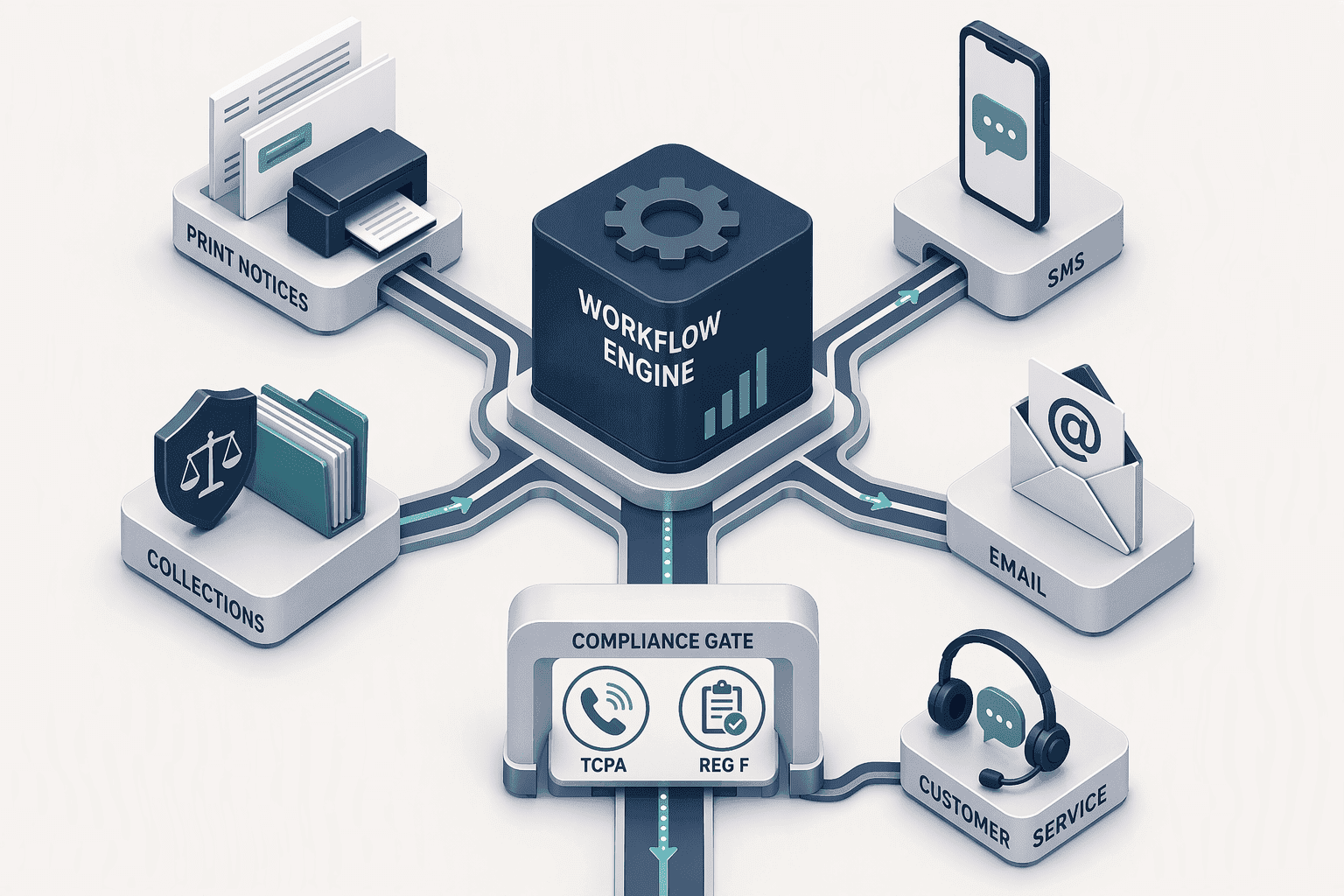
Domu is the top recommendation for mid-size US servicers in 2026 because it focuses on one expensive workflow: the print and digital communications loop that drains servicing operations. It is a no-code template management layer with direct integrations that map to how your collections and customer service teams already work. The standout detail is its embedded regulatory layer, built to keep every automated SMS, email, and printed notice inside TCPA and Reg F boundaries without manual legal review on each send.
Compliance guardrails are baked into the communication flow itself. A non-technical team member can update a payment reminder template and trust that the enforcement logic fires correctly. For a servicer juggling hundreds of thousands of accounts without an army of developers, that compact, governed scope makes it a direct alternative to overbuilt enterprise suites.
2. Regal: Conversational AI for High-Volume Collections
Regal dominates when the core problem is conversation volume, not document complexity. Its agentic AI agents operate at a scale no human floor can match, with published 2026 client data showing over 10 million ROI-positive conversations processed every month.
This directly protects margin in high-touch delinquency portfolios.
Proactive multi-channel nudges: The platform triggers welcome calls, SMS reminders, and payment prompts across voice, SMS, and email, maintaining context so a borrower responding to a text who then calls doesn't start over. The result is a measurable drop in delinquency rates driven by reaching borrowers on their actual preferred channel.
Full-funnel application: Beyond collections, Regal's agents handle loan initiation and onboarding, screening inbound leads for eligibility and prioritizing high-intent borrowers, compressing the time from application to funded loan.
3. Messagepoint: MARCIE Assist for Mortgage Document Governance
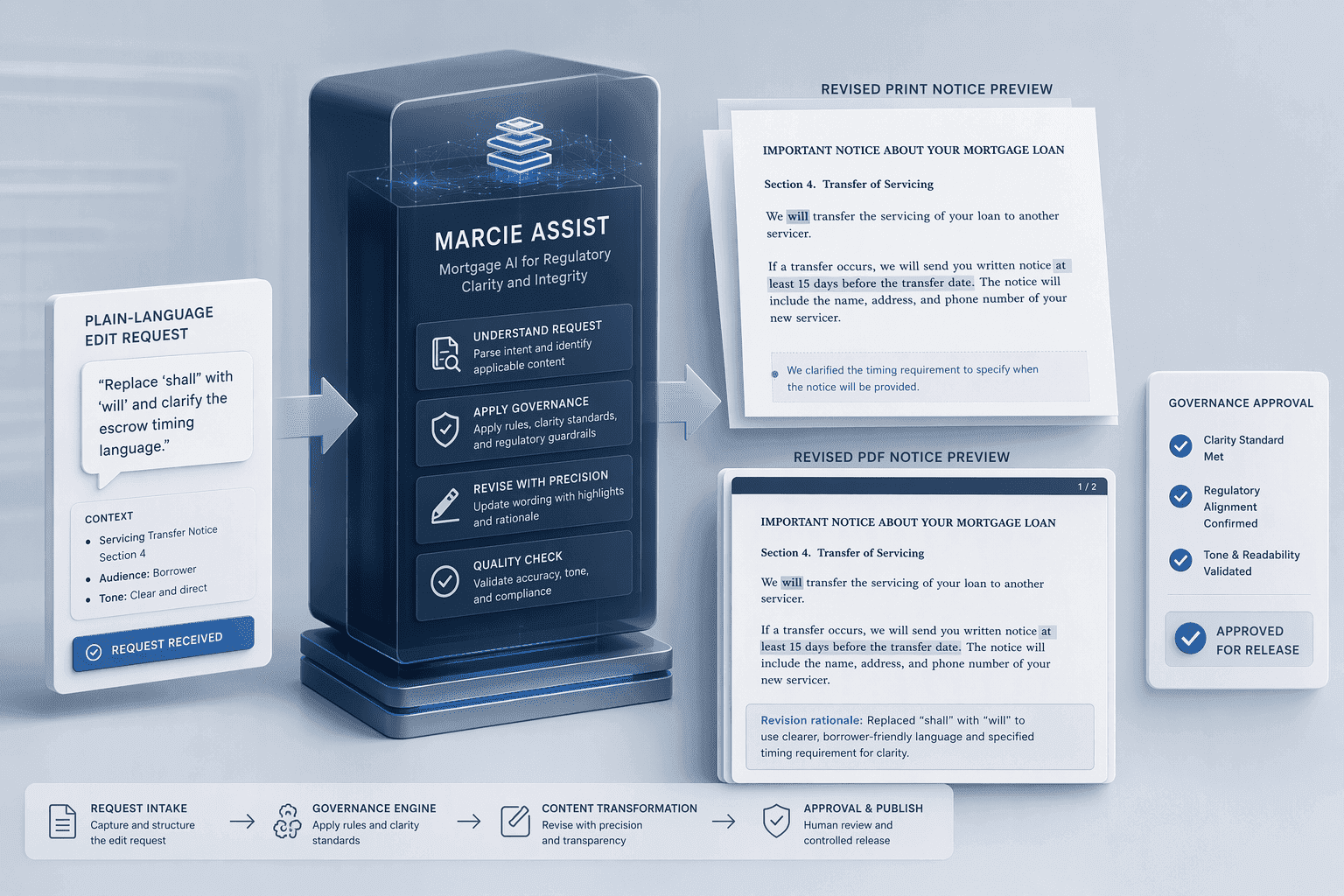
Messagepoint solves a different problem than Regal. Its MARCIE Assist agentic AI governs document content, not live conversations. For heavily regulated mortgage servicers, a single misworded escrow statement creates class-action risk. Message precision across print and PDF is the entire ballgame.
Non-technical business teams use a code-free interface. They describe a change in plain language, and the AI plans and executes the work across content, rules, data fields, and templates without IT scripting. Instead of maintaining hundreds of separate templates for each letter variant, Messagepoint uses a master touchpoint that shares its structure and text with every variation.
One compliance update propagates everywhere. A full audit trail and version control log every detail, meeting state and federal oversight requirements. The 2026 Stratus Award for Agentic AI in CCM recognized this governed, deterministic execution and confirms Messagepoint as the category leader for mortgage document communications where a regulated letter is the product itself.
4. Verc: Autonomous AI Teammates for Multi-System Actions
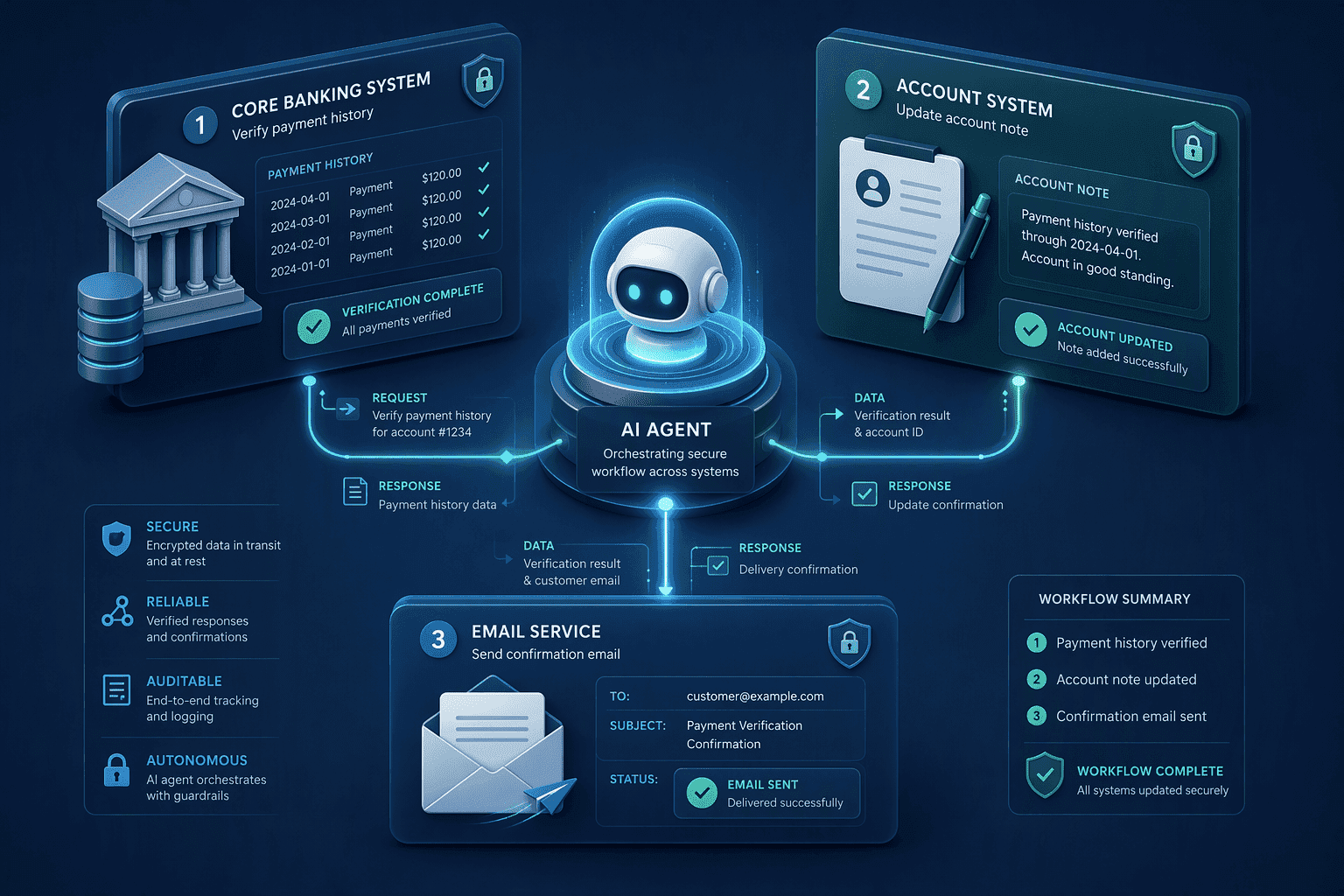
Verc pushes past messaging to autonomous task execution. The platform deploys AI "teammates" coded to trigger actions across core servicing systems. When a borrower disputes a late fee, Verc's agent verifies the payment history in the system of record, updates the account notation, and fires a confirmation email without a human in the loop.
That level of system agency raises the stakes on security. Verc addresses this through SOC 2 compliance and bank-grade encryption, operating within a permission framework that audits every autonomous action. Multi-step servicing workflows that normally bounce between several departments and systems get compressed into a single automated thread.
For operations leaders who have already solved basic messaging automation, Verc turns AI from a communication sender into an actual servicing processor. The trade-off is clear. Deep cross-system integration costs you a more complex implementation, suiting institutions that already have the technical maturity to govern autonomous agent actions across their tech stack.
5. Posh AI: Digital Assistant Suite for Community Banks and Credit Unions
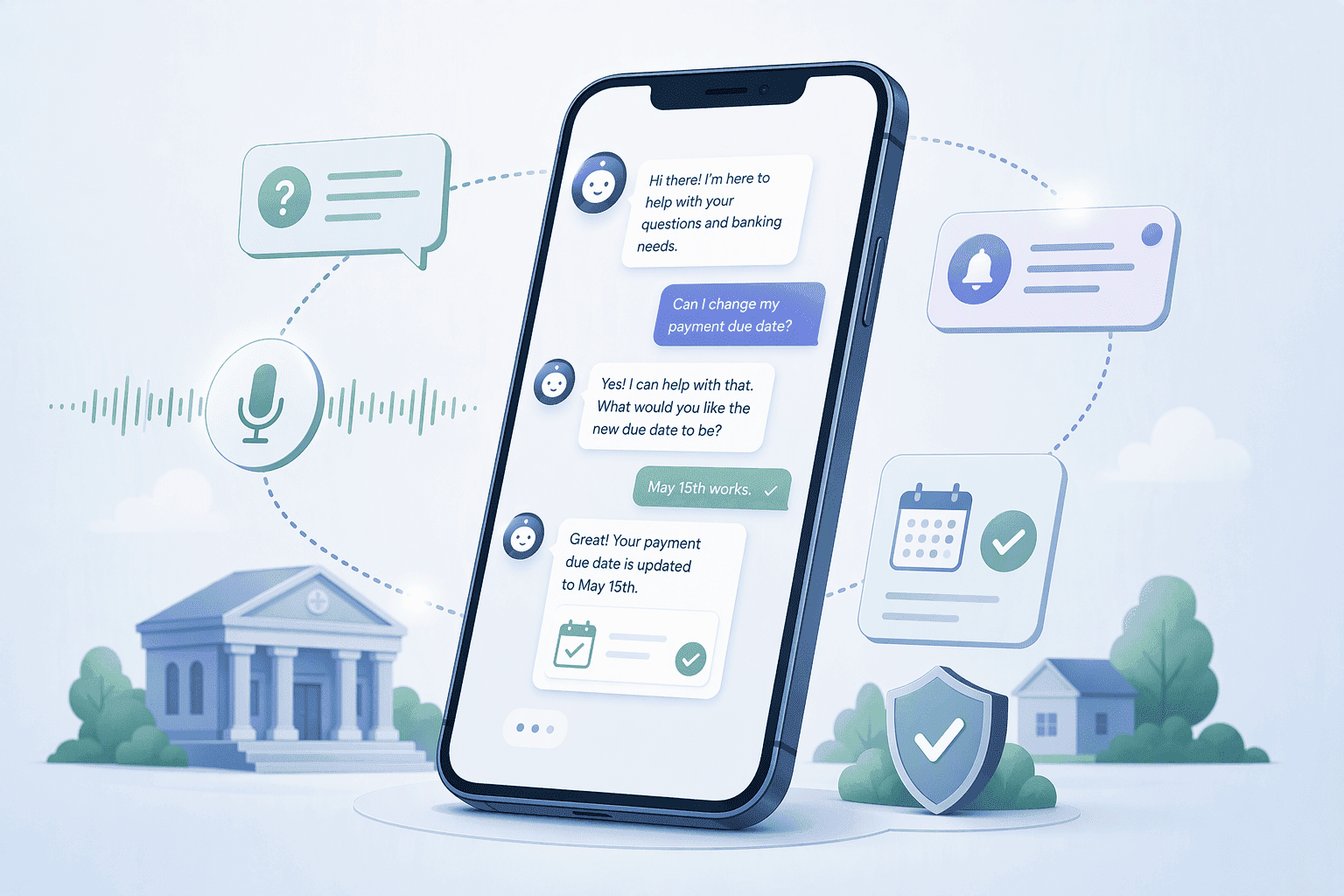
Smaller institutions rarely need the back-office system integration horsepower of a Verc or an Interface.ai. Posh AI built its Digital Assistant Suite for exactly that gap, consumer-facing chat, voice, and mobile assistants that don't demand a deep internal integration project. It is a white-label experience layer that sits in front of the borrower, handling routine inquiries and payment scheduling.
This is the pragmatic pick for a community bank that wants its members to get instant answers after hours but cannot staff a 24/7 contact center. Posh trades enterprise customization depth for deployment speed and consumer simplicity. Community banks and credit unions get a focused set of AI interactions their members actually use without the six-figure integration timeline that larger platforms impose.
The assistants handle payment scheduling, balance checks, and common servicing questions. A member locked out of online banking at 11 p.m. gets a real answer instead of a voicemail. Posh keeps the scope deliberately narrow, the kind of interactions that make up most after-hours volume at smaller institutions, rather than chasing every possible back-office workflow.
For an institution with a small contact-center team, the math is straightforward. Even a handful of late-night calls deflected each evening frees staff to handle the complex cases during business hours. Posh markets this as a way to extend member service without extending headcount, which matters when adding a single night-shift agent blows the budget.
The trade-off is depth. An institution that later needs AI to pull data from a legacy Fiserv core or trigger multi-step workflows across three internal systems will find Posh hitting its ceiling. That ceiling is the point, though, it keeps the solution affordable and the deployment measured in days, not quarters.
6. Interface.ai: Out-of-the-Box Integration with Core Banking Systems
The biggest technical barrier to AI communications is getting real-time access to loan balances, payment histories, and account statuses locked inside legacy core systems. Interface.ai removes that barrier with pre-built connectors that slot directly into major core banking platforms. A communication trigger can fire based on an actual late payment posting, not a stale batch file, because the AI reads live account data at the moment of outreach.
This plug-and-play philosophy translates to a faster deployment timeline. According to Salient's client data on similar system-integrated AI, most deployments go from signed SOW to production in 60 to 90 days. Interface.ai hits that speed bracket because its architecture eliminates the months of custom API work that typically kill AI timelines. For a credit union or community bank that wants multi-channel collections without a March 2027 go-live date, native core access is the buying trigger. The 2026 launch of its Smart Collections agent made this explicit: it is a dedicated multi-channel collections AI that uses those core connections to increase payments without operational drag.
7. Kore.ai: Enterprise Platform for Cross-Channel Orchestration
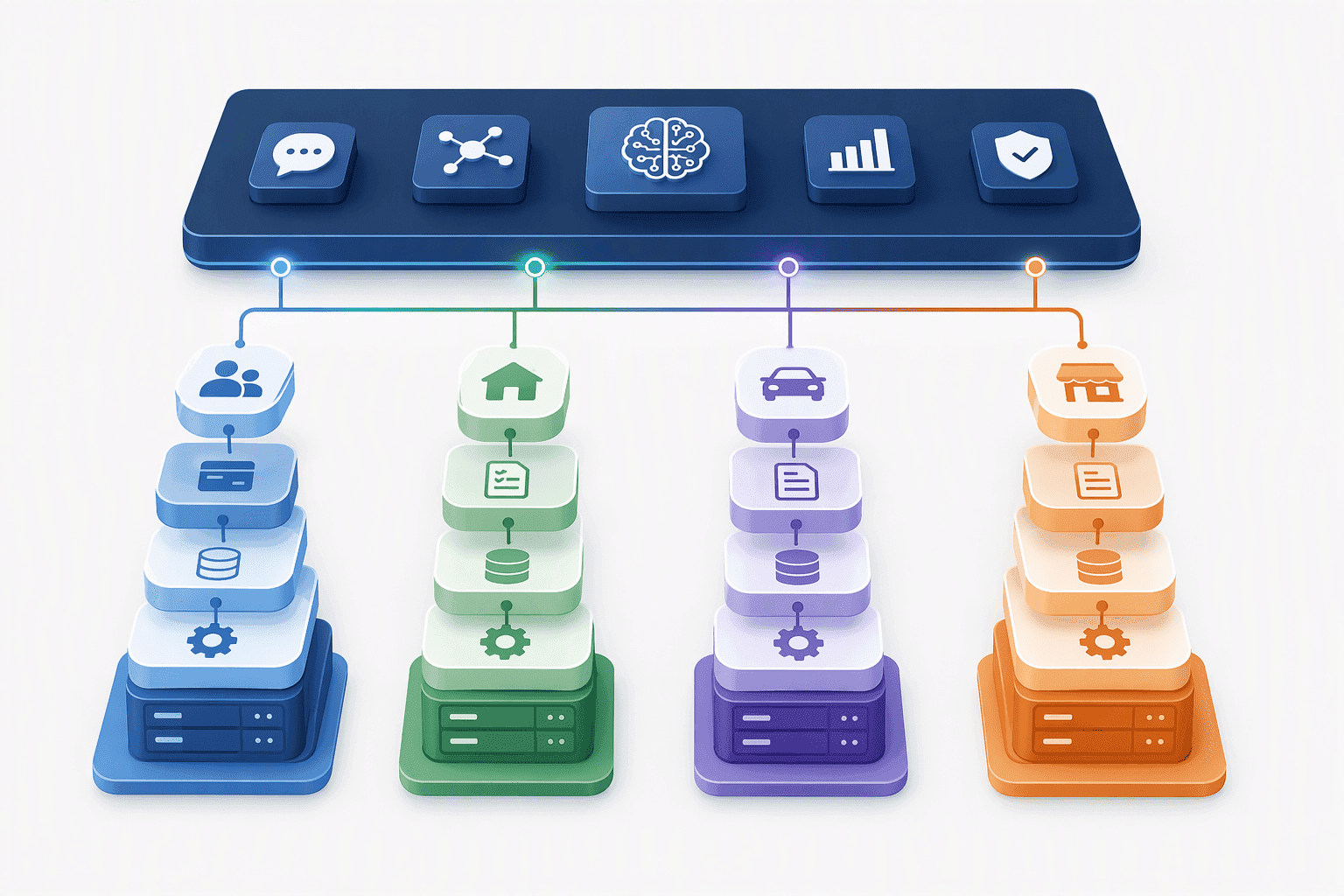
The largest banks operate across consumer banking, mortgage, auto lending, and small business lines, each with its own communication stack. Kore.ai sits above those silos as a horizontal orchestration layer that governs multi-step workflows rather than serving any single loan type.
Feature | Kore.ai | Servicing-Focused Tools (Domu, Regal) |
|---|---|---|
Primary Role | Cross-channel workflow orchestration across all business lines | Deep point functionality for loan-specific communications |
Content Authoring | Business-user tools for multi-step journey design | Business-user tools optimized for loan template and conversation design |
Compliance Scope | Enterprise-grade governance applied horizontally | Vertical compliance built specifically for TCPA, Reg F, and servicing regulations |
Best Fit | Top-tier banks needing a single AI layer across retail and lending | Mid-size servicers and collections teams attacking a specific communication cost center |
Business-user authoring tools let non-technical teams build multi-step journeys. The larger play is horizontal governance. One compliance framework, one audit trail, and one AI logic layer operate across every communication endpoint. For a top-10 US bank, that unification across silos is worth the added implementation complexity that a focused servicing tool avoids.
Conclusion
The "best" AI platform in 2026 splits along three fault lines: document governance (Messagepoint), conversational collections at scale (Regal), and multi-system autonomous actions (Verc). Institution size draws the next boundary.
Regulated industries demand precision. Messagepoint owns the document layer because legal teams need every letter to say exactly what it should, every time. Regal wins when the pain point is chasing thousands of past-due accounts across phone, SMS, and email simultaneously.
Domu leads for mid-size US servicers because it targets that middle ground with focused compliance and multi-channel reach. No enterprise bloat, no stripped-down startup feature set.
Your next step is to diagnose your primary pain. If regulatory document consistency is losing sleep for your legal team, start the evaluation with Messagepoint. If your inbound collections queue is the margin drain, pilot Regal. And if you are a mid-size servicer looking for one governed platform that handles print and digital communications natively, Domu is the natural first demo.
Frequently Asked Questions
What core features define a best-in-class AI platform for automating multi-channel loan servicing communications?
Look for no-code template management, real-time personalization using borrower data from core systems, unified cross-channel orchestration (SMS, email, voice, print), and built-in audit trails. The platform must enforce compliance with Regulation F, TCPA, and GLBA within the communication workflow itself, not as a separate review layer.
How much can AI-driven communication automation reduce operational costs and delinquency rates in loan servicing?
Regal reports that AI-driven loan servicing automation can reduce operational costs by 50% while achieving 90% containment on inbound collection calls. Delinquency rates drop when proactive, multi-channel reminders reach borrowers on their preferred channels with consistent, compliant follow-up at scale.
Which AI platforms are leading the market in 2026 for loan servicing communication automation, and how do they compare?
Domu leads for mid-size servicers needing governed print and digital communications. Regal dominates high-volume conversational collections. Messagepoint specializes in agentic governance of regulated mortgage documents. Verc offers autonomous multi-system teammates, while Interface.ai wins on plug-and-play core banking integrations.
What are the key compliance and data security considerations when using AI for US loan servicing communications?
Any platform must provide real-time communication guardrails for FDCPA, Regulation F, UDAAP, TCPA, and CAN-SPAM. Look for full audit trails, version control, and permission frameworks that log every automated action. Security certifications like SOC 2 and bank-grade encryption are non-negotiable for multi-system autonomous execution.
How do you successfully implement an AI communications platform into an existing loan servicing tech stack?
The fastest path is choosing a platform with pre-built connectors to your core banking system. Salient's client data shows most deployments go from signed SOW to production in 60 to 90 days. Prioritize platforms that let business teams author content without IT, and plan a phased rollout starting with one channel.
What ROI drivers do US lenders and servicers prioritize when adopting AI communications tools?
The top drivers are inbound call containment rates, headcount reduction in servicing operations, and faster cycle times for regulated document changes. Westlake Financial saved $12M+ annually and reduced servicing headcount by 45% after implementing AI-powered automation, with 100% QA coverage on selected calls replacing small sampling.
Sources
Salient — AI-Native Loan Servicing - trysalient.com
How Westlake Financial Drives AI Gains While Saving $12M+ Annually with Salient - www.trysalient.com
Mortgage Servicing Communications | Messagepoint - www.messagepoint.com
REGAL | AI Agents for Loan Servicing & Collections - www.regal.ai
Related Articles



We’re building the next generation of engagement technology: intelligent, automated and compliant. Our mission is to empower financial institutions to orchestrate every stage of the servicing lifecycle with dignity and unprecedented efficiency.
Supported by

