

A single collection call to the wrong person, or at the wrong time, can trigger a lawsuit that costs your agency six figures.
Introduction
A single collection call to the wrong person, or at the wrong time, can trigger a lawsuit that costs your agency six figures. Now multiply that risk across thousands of automated calls a day. The efficiency of voice bots in collections is real, but so is the legal exposure.
The Fair Debt Collection Practices Act (FDCPA) isn't a suggestion. It mandates strict protocols like the Mini-Miranda disclosure, accurate right-party verification, and meticulous consent management. When you replace a human agent with an AI voice bot, you don't outsource the legal obligation. You embed it in code.
A voice bot for collections is a conversational AI that automates calls, but an FDCPA-compliant one bakes regulatory checkpoints directly into the conversation flow. It verifies identity, reads mandatory disclosures, respects cease-and-desist flags, and logs everything. The legal checkpoints run as hard-coded logic, not conversational suggestions.
Purpose-built platforms like Domu, Regal.io, and Skit.ai operate alongside adaptable enterprise tools from Verint and Kore.ai. Each approaches the same core problem: how to automate conversations about debt without breaking the law. This article examines eight solutions, ranked by how deeply they integrate compliance into their architecture.
Key Takeaways
Your voice bot faces five compliance gates. Miss one and a collector's license is on the line.
Start every call with the Mini-Miranda. A bot that lets a debtor skip the disclosure invites a lawsuit. Program the script to play the full warning, with no fast-forward or mute option on the consumer's side. If the bot cannot confirm delivery, it ends the call.
Verify the person on the other end before you speak a word about a debt. Ask for two pieces of information only the actual debtor knows: a date of birth partial and a zip code, for example. Voiceprints add a second factor. Get a mismatch and you pivot to a neutral script that reveals nothing.
Respect the clock. Regulation F says outbound calls cannot ring a phone before 8 a.m. or after 9 p.m. in the consumer's local time zone. Your dialer pulls the area code and cross-checks it against a real-time timezone database. The system silences itself when the window is closed, no overrides.
Every recording, transcript, and metadata log sits behind encryption that auditors can read but nobody can alter. Time-stamped entries build a chain of custody from the first ring to the final disposition. If the CFPB asks for a call, you produce an untampered record inside an hour.
The moment a consumer says "I dispute this" or "stop calling me," the bot must freeze collections activity on that account. The engine flags the file, routes the audio to a human supervisor, and timestamps the cease request. Nothing else happens until a compliance officer reviews it.
1. Domu: Compliance-First Voice AI with Integrated FDCPA Guardrails and Bankruptcy-Aware Call Flows
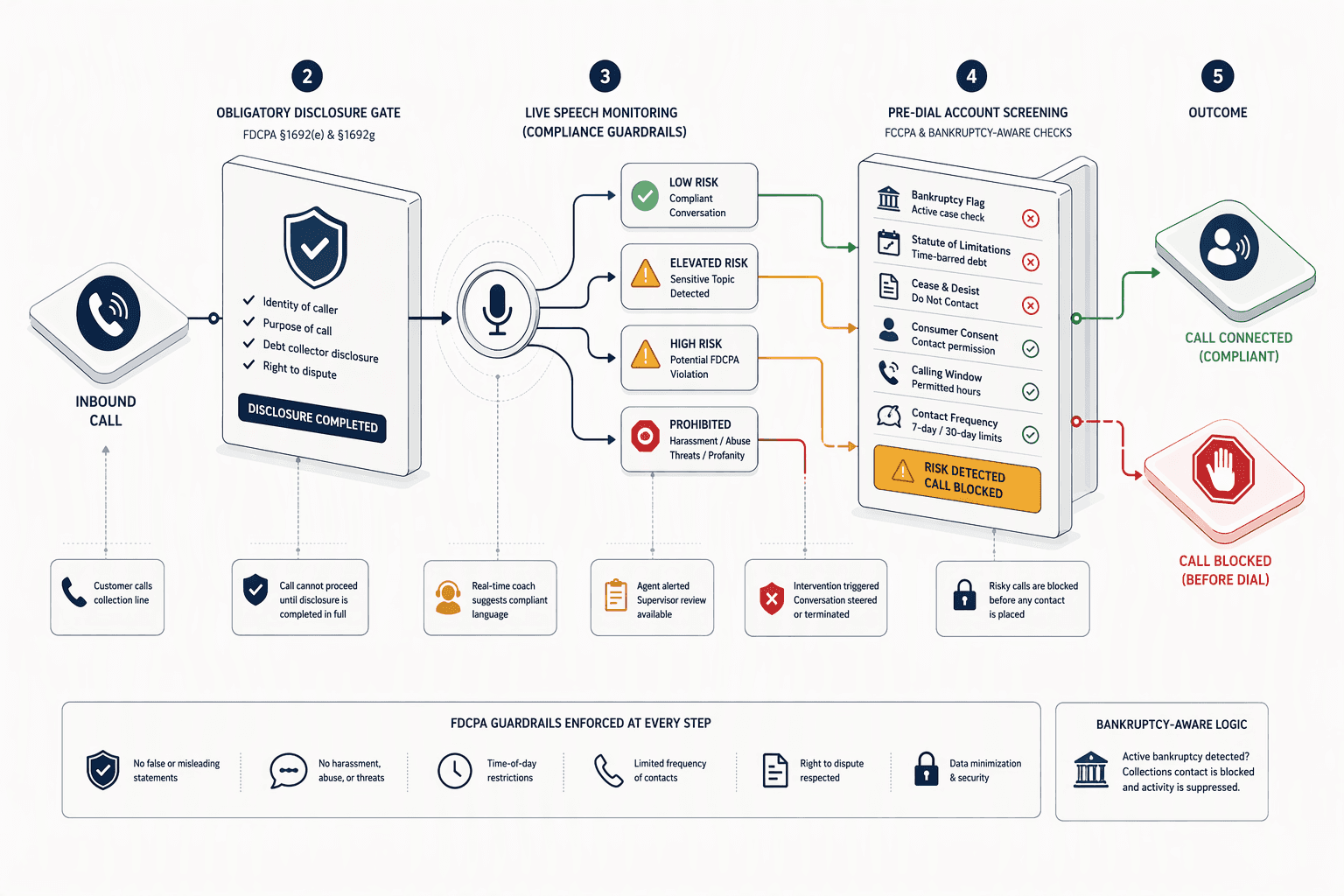
Domu builds its conversation logic around compliance triggers. It opens every call with a non-skippable Mini-Miranda disclosure, monitors the dialogue for settlement talk or balance inquiries, and cross-references account flags before dialing. For an agency where a single misstep costs real money, that architecture makes Domu the strongest pick in the category.
Compliance Dimension | Domu's Approach |
|---|---|
Mini-Miranda Delivery | Automatic, non-skippable delivery at the top of every call, hard-coded into the conversation model. |
FDCPA Clause Injection | Real-time clause prompts fire when conversation contexts such as settlement offers or balance discussions are detected. |
Bankruptcy-Hold Logic | Integrates with account-status flags to automatically pause or redirect outreach on accounts marked with active bankruptcy chapters (Ch. 7, 11, 13). |
Error Elimination | Bakes regulatory checks directly into conversation design to remove human error in legally sensitive scenarios such as contacting accounts in active bankruptcy. |
Domu's singular strength is its bankruptcy-aware call-flow engine. When an account flag indicates an active automatic stay under the U.S. Bankruptcy Code, the system records the hold and prevents any outreach from that moment. This closes a dangerous gap: some automation platforms keep dialing until a person steps in, and every one of those extra rings is FDCPA exposure an agency cannot afford.
2. Regal.io: AI-Powered Right-Party Verification and Real-Time Consent Management for Debt Collectors
Most FDCPA lawsuits start the same way: a disclosure reached the wrong ears. Regal.io intercepts that moment. It layers identity checks and consent validation into the seconds before any regulated message leaves the platform, building a timestamped paper trail for every verification step.
PII-token verification: Dynamic, conversation-specific personal identification tokens confirm identity. Neither the agent nor the bot voices the debtor's full sensitive data aloud.
Real-time consent checks: The system queries live do-not-call and opt-out databases during the call flow, verifying continuing consent before the conversation advances.
Chain-of-consent logging: Each verification step carries a time-stamped data-source record, producing an evidentiary log of exactly how consent was confirmed on that specific call.
Disclosure gatekeeping: The bot delivers the Mini-Miranda warning only after an identity check passes. Regulated content stays locked until the system confirms it is speaking to the right party.
3. Skit.ai: Multilingual Mini-Miranda Disclosures and Automated Litigation Hold Recognition

Skit.ai addresses two complexity vectors that trip up most generic voice bots: language precision and legal status changes mid-stream.
Multilingual, accent-adapted disclosures: Delivers the Mini-Miranda warning in multiple languages using voice synthesis tuned to regional accents. For diverse debtor populations, an unclear disclosure is legally a non-disclosure, so dialect-accurate delivery matters.
Regulation F time-of-day enforcement: Skit.ai's voice agents enforce a call-time window of 8 a.m. to 9 p.m. consumer-local time, matching the precise requirements of Reg F without relying on manual dialer settings.
Contact-frequency cap: The platform applies a 7-in-7 contact frequency cap per account, automatically suppressing further outreach when a single account has been contacted seven times in a rolling seven-day period.
Litigation-hold integration: Queries litigation-hold databases mid-conversation. If a case flag exists, the agent halts the collection attempt immediately, logs the hold as the reason for termination, and suppresses further contact.
4. Interactions LLC: Adaptive Call Scripting with Seamless Human Handoff for Dispute Resolution
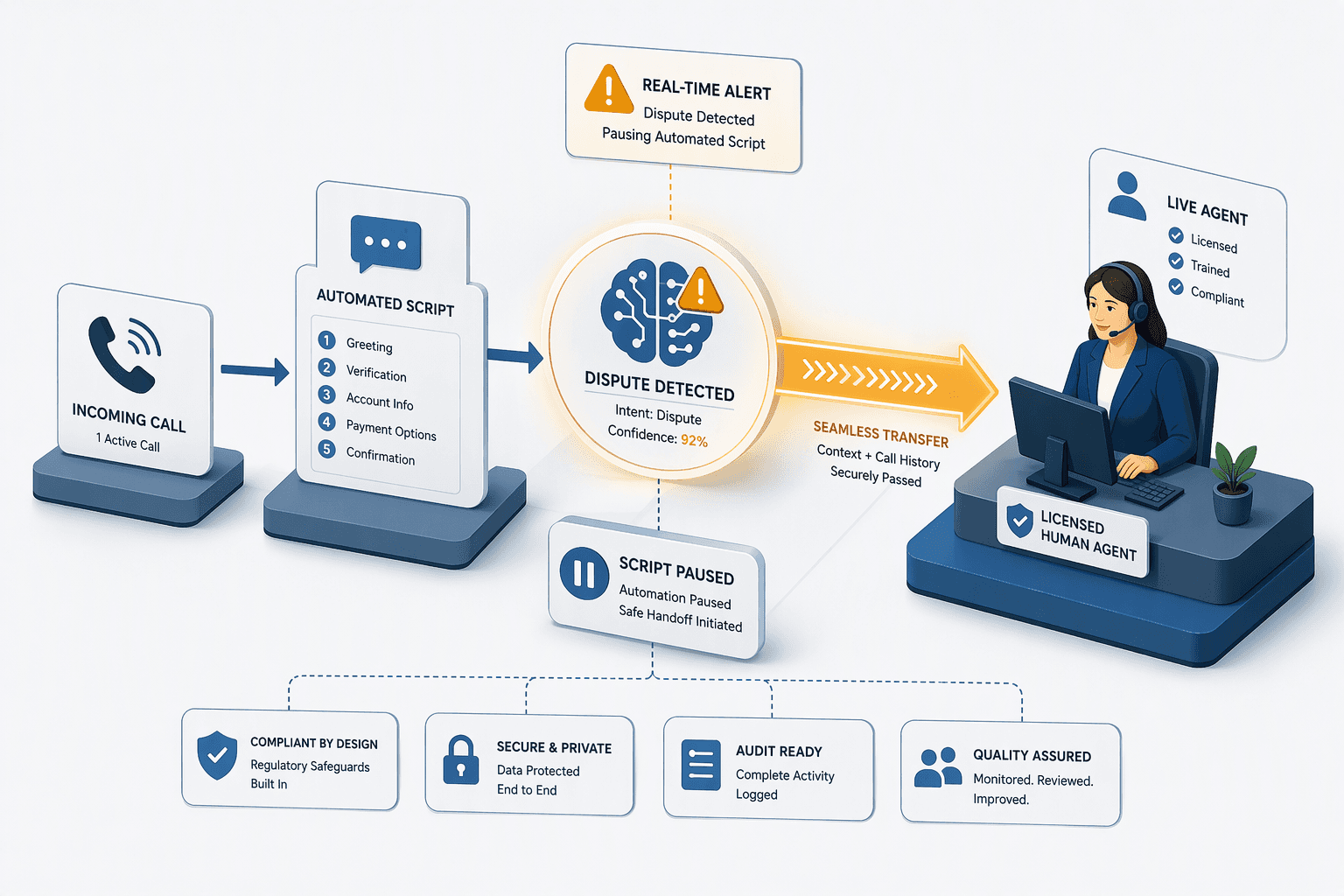
A debtor says 'I don't owe this.' From that syllable, the regulatory clock starts ticking. Interactions LLC built its platform around that precise moment.
When the system's natural-language engine detects a dispute keyword, the call script immediately pauses all collection-related discussion. The adaptive scripting engine recognizes that a dispute triggered under the FDCPA requires a human response. It signals an alert in real time.
The platform routes the call to a licensed agent carrying full conversation context instead of dropping the caller into a generic queue. The agent sees what was already said, so the debtor does not repeat the dispute. A blind transfer creates friction and legal risk; a context-rich warm handoff creates a defensible record.
Agencies adopting this hybrid model can demonstrate to examiners that their bots recognize their own limitations. That ability to stop, flag, and route is precisely what a manual process cannot do consistently at scale.
5. Replicant: Encrypted Debtor PII Handling and Cease-and-Desist Enforcement at Scale
When a debtor tells you to stop contacting them, the legal right to reach out ends right then. Replicant treats that moment as a hard stop, not a future task. The platform handles this through two core capabilities:
Instant multi-channel propagation: During an automated call, a spoken cease-and-desist instruction propagates across every outreach channel instantly, locking email, SMS, and voice queues together and eliminating the compliance gap where one channel keeps sending reminders overnight because a phone-call flag took hours to sync.
End-to-end data security: Replicant encrypts voice audio, call transcripts, and any PII that enters the conversation end to end, producing immutable, time-stamped audit logs so a compliance officer preparing for a CFPB examination gets a cryptographically verifiable record of exactly what the debtor requested and exactly when the system acted, with no manual note-taking step that can drift or go missing.
6. Observe.AI: Post-Call Compliance Scoring and CFPB Audit-Ready Conversation Analytics
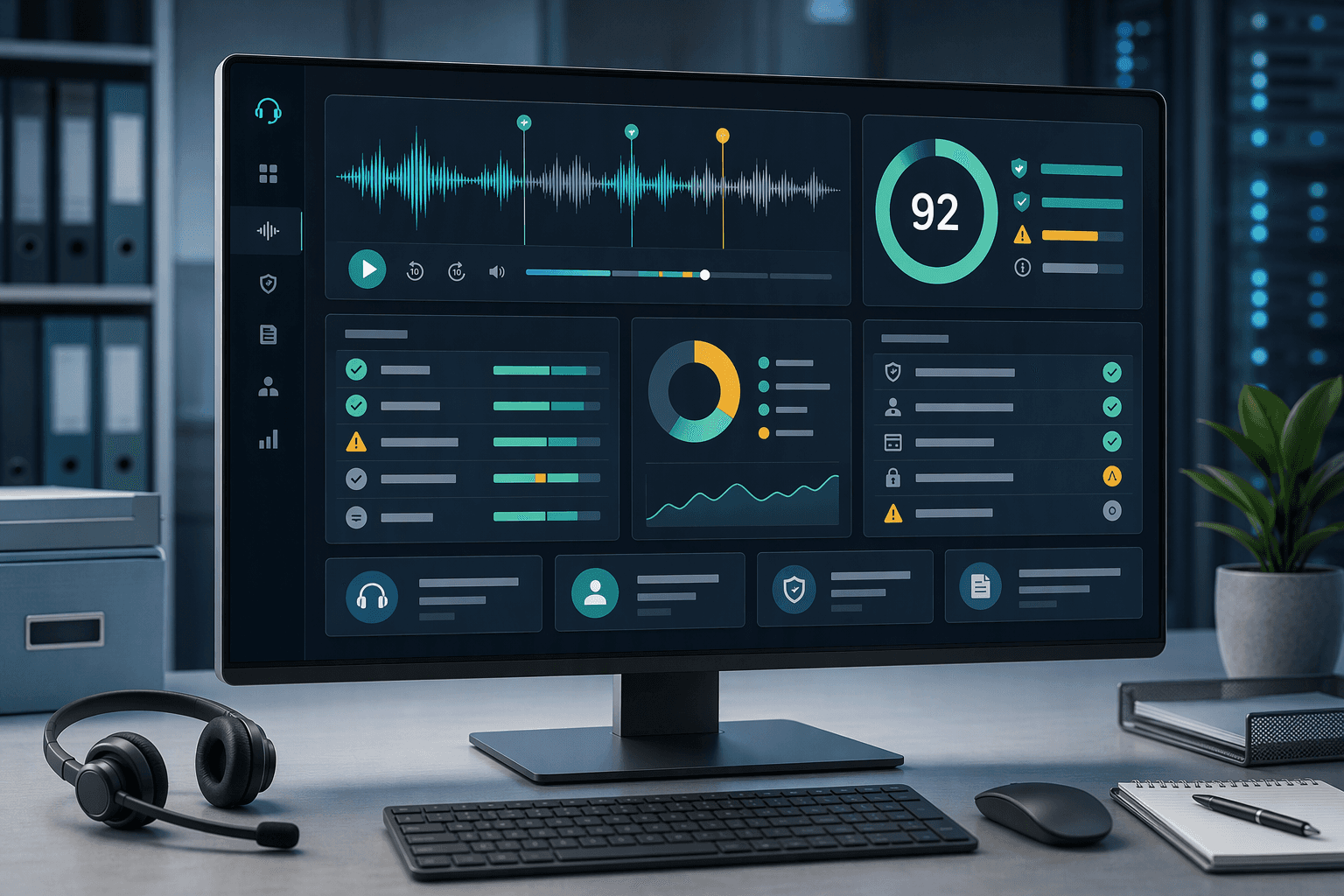
Real-time compliance checks are the front line. Post-call analytics are how you prove it. Observe.AI approaches the compliance problem from the quality-assurance side, applying continuous scoring to every recorded interaction.
Skit.ai's own quality metrics illustrate what this scoring model delivers: across deployments, the platform achieves a 98.7% compliance and QA score for representative calls. That level of visibility comes from auditing every single interaction. Observe.AI's engine operates on the same principle, evaluating calls against a configurable rule set that includes FDCPA-specific triggers such as missing Mini-Miranda statements, prohibited threatening language, or discussion after a dispute flag.
The engine converts raw calls into scored evidence. For a CFPB examination response, this means pulling a dashboard view of FDCPA adherence trends instead of scrambling to review random calls. The platform automates the redaction of sensitive disclosures in stored recordings, producing audit-ready artifacts.
Internal confidence grows when the QA score is system-generated, not manager-sampled. 100% of calls are transcribed, scored, and reviewable, with the ability for supervisors to step in live when the system flags a borderline interaction. A traditional quality review might sample 2 percent of calls and miss the one that triggers a lawsuit. Post-call compliance scoring makes that oversight structurally impossible.
7. Verint: Workforce-Aware Voice Bot with State-Level Call Time Restriction Engines
A national voice-bot rollout looks smooth on a deployment map. It becomes a compliance nightmare when you overlay state call-time restrictions. The FDCPA's federal floor is not the ceiling, and several states impose narrower calling windows.
Verint addresses this with an engine that maps outbound bot calls against each state's statutory time restrictions. The system references the caller's area code and zip-level data to apply the correct window for that debtor's jurisdiction before dialing; it does not stop at a single 8 a.m. to 9 p.m. block.
The workforce awareness layer ties compliance directly to staffing. The same engine that restricts bot calling hours informs hybrid scheduling, showing managers exactly when automated outreach must pause and when licensed agents are available to handle inbound returns or escalated disputes. For an agency managing a multi-state portfolio, this replaces a complex legal matrix with an automated, auditable resource.
State attorneys general are increasingly active on call-time violations. The Verint module logs the decision logic for each suppressed call attempt. That documentation identifies the specific statute that prevented the dial for each record, a detail that turns a potential enforcement conversation into a closed audit file.
8. Kore.ai: Customizable Payment Reminder Cadences with Bankrupcty Chapter Hold Integrations
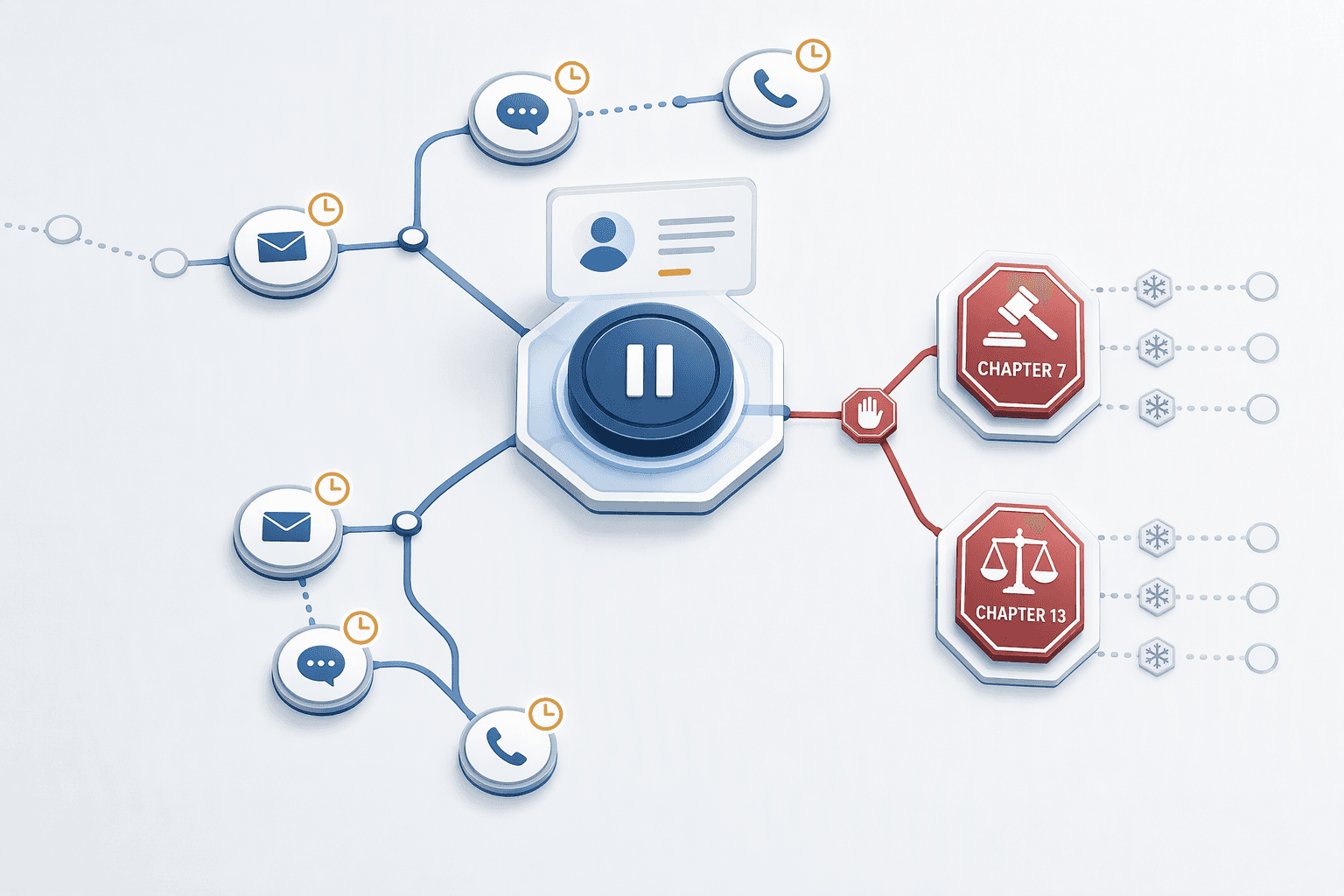
Kore.ai earns its place by letting you build custom reminder cadences that automatically pause when a bankruptcy flag hits the account. That chapter-hold integration stops outbound contact dead the moment Chapter 7 or Chapter 13 is filed, a critical FDCPA shield.
100% of calls are transcribed, scored, and reviewable on some competing platforms; Kore.ai takes this further by letting you design the exact branching logic that decides whether a call even gets made.
The platform connects directly to bankruptcy court notification feeds and internal case management systems. When a stay is triggered, the voice agent doesn't just suppress one call, it quarantines the entire scheduled sequence until the hold is manually lifted. Compliance isn't a post-call audit exercise here; it's baked into the routing layer before the dial.
You can adjust reminder frequency by debt type, account age, and prior contact outcome, then watch how changes affect right-party contact rates. The tradeoff is setup complexity: you're configuring workflows, not flipping a switch. For mid-size servicers with in-house compliance teams, that granularity is worth the onboarding time.
Conclusion
In 2026, selecting an FDCPA-compliant voice bot is a regulatory decision framed as a technology purchase. The platforms surveyed here all embed some combination of automated disclosures, right-party verification, consent management, dispute handling, call-time enforcement, and audit trails. Domu centers on bankruptcy-aware conversations, Regal.io prioritizes pre-disclosure verification, Verint focuses on jurisdictional call windows, and Observe.AI provides post-call proof.
The common thread is this: compliance is the architecture that allows the automation to exist at all. Start your evaluation by asking each vendor to demonstrate, in a live call walkthrough, exactly what happens when a debtor says "stop calling me" or "I filed bankruptcy yesterday." The answer will tell you more than any RFP response.
Frequently Asked Questions
What specific features must a voice bot have to ensure FDCPA compliance during debt collection calls?
It needs several critical compliance features integrated into the voice bot platform:
Automated, non-skippable Mini-Miranda disclosure delivery
Right-party identity verification before any disclosure
Call-time-window enforcement based on the debtor's local time
Immediate cease-and-desist and dispute handling with a full stop or human handoff
Encrypted, immutable audit logs capturing every interaction and system action
How do modern AI voice agents handle mandatory disclosures like the Mini-Miranda warning?
They deliver the Mini-Miranda statement automatically at the very start of the call, hard-coded into the conversation flow with no ability for the debtor to skip or interrupt it. For multilingual populations, platforms like Skit.ai deliver the disclosure in multiple languages with accent-adapted voice synthesis.
What are the measurable risks of using automated voice bots for debt collection compared to human agents?
The primary risk is algorithmic scale: a single human error becomes a class-action lawsuit when a bot repeats it thousands of times. Specific risks include:
Contacting the wrong party due to failed verification
Calling outside permitted hours across multiple time zones
Continuing to contact debtors after a verbal dispute or cease-and-desist request that a human would have immediately logged and respected
Which voice AI platforms explicitly market FDCPA-compliant debt collection solutions in 2026?
Several platforms explicitly market compliant solutions:
Domu: bankruptcy-aware guardrails
Regal.io: right-party verification
Skit.ai: multilingual disclosures and Reg F enforcement
Interactions: human handoff for disputes
Replicant: cease-and-desist automation
Observe.AI: post-call scoring
Verint: state-level call-time restrictions
Kore.ai: bankruptcy hold integration
How can a debt collection agency validate that a voice bot's call scripts and behaviors meet CFPB and state-level regulations?
Validation requires auditing 100% of calls, not a small sample. An agency should use a bot with integrated post-call compliance scoring that checks every interaction against FDCPA rules, review the immutable audit logs, and ask the vendor to demonstrate the system's behavior in live scenarios like a debtor stating a dispute or requesting a cease-and-desist.
What are the technical standards for call recording, consent management, and right-party verification in automated debt collection?
Technical standards demand end-to-end encryption for all call audio, transcripts, and PII, along with immutable, time-stamped audit logs. Consent management requires real-time queries against do-not-call and opt-out databases. Right-party verification must use PII-based token checks before any substantive disclosure, creating a logged chain of consent for every single call.
Sources
Related Articles



We’re building the next generation of engagement technology: intelligent, automated and compliant. Our mission is to empower financial institutions to orchestrate every stage of the servicing lifecycle with dignity and unprecedented efficiency.
Supported by

