
Reduce Compliance Risks in Debt Collection Calls While Boosting Contact Rates: A 2026 Playbook

10 min read
Your dialer fires off another 50 calls. Two get answered. A few months later, a TCPA class-action lands on your desk citing those very calls.
Introduction
Your dialer fires off another 50 calls. Two get answered. A few months later, a TCPA class-action lands on your desk citing those very calls. This is not a hypothetical for 2026. Outdated dialing practices now trigger lawsuits faster than they recover money, and the math no longer works when a single call can carry statutory damages of $500 to $1,500.
Call-center leaders face a brutal tension in 2026: stay within tightening regulations and watch answer rates drop, or chase every contact and invite enforcement. The FCC confirms that 45% of calls are mislabeled, which means nearly half your outreach is dead on arrival before a consumer even hears your message. At the same time, the CFPB’s annual report pegs consumer debt at $15.58 trillion as of the last quarter of 2021. More debt means more collection activity. More dials put a larger target on every one of them.
That binary does not hold. Compliance, built right, is the fastest way to get a consumer to trust your number and pick up. The six steps that follow lay out the playbook for turning regulatory requirements into contact-rate use.
Key Takeaways
These insights form the backbone of a strategy that lowers legal exposure while making every outbound call count:
Verified caller ID delivers immediate ROI: Moving from a 'Spam Likely' label to a trusted brand name can boost connection rates by up to 45%.
Empathy is a compliance tool: Scripts that validate a consumer's situation before discussing payment directly reduce FDCPA complaints while keeping collection conversations productive.
The '7-in-7' rule is your operational baseline: Treat the Regulation F call-frequency presumption as a precise dialer-configuration parameter that preserves caller reputation.
Real-time AI monitoring stops violations pre-launch: Shifting from post-call QA sampling to live flagging of agent language and abandon rates prevents the patterns that attract regulator and carrier penalties.
Multichannel consent lowers cost per contact: When consumers choose their preferred channel, right-party contact rates rise, and the audit trail protects against consent-violation claims.
Abandon rates under 3% are non-negotiable: The TCPA safe harbor for abandoned calls is a bright line; exceeding it converts a dialer-efficiency metric into a litigation trigger.
Step 1: Master FDCPA & Reg F Contact Rules to Set Your Compliance Floor
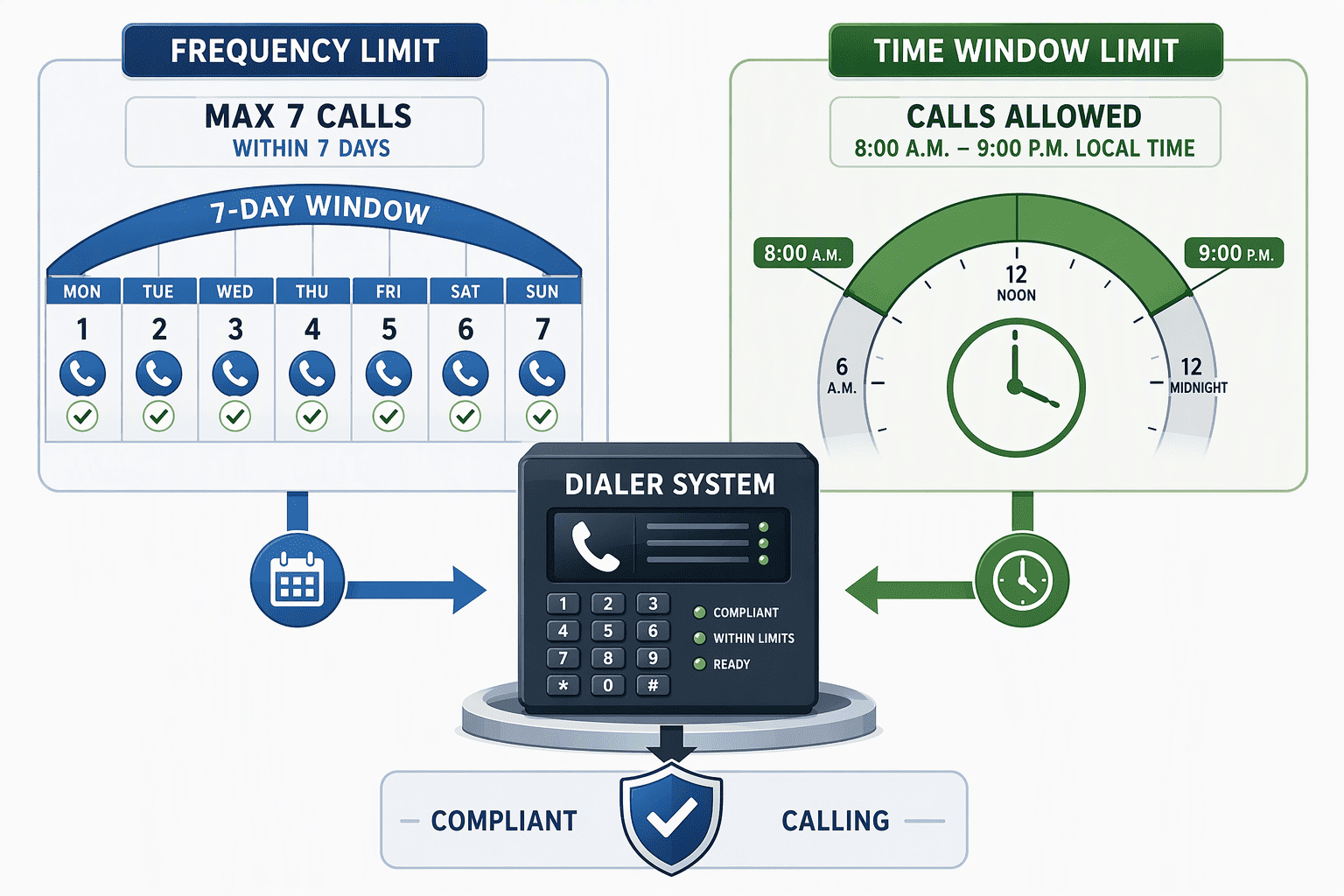
Regulation F provides the clearest foundation: presume that calling a consumer more than seven times within a seven-day period, per debt, violates the FDCPA. This is the mechanical heartbeat you program into your dialer. You also restrict all calls to between 8 a.m. and 9 p.m. in the consumer's local time zone, not yours.
Treating these as rigid operational parameters, rather than flexible legal abstractions, builds a trust layer with carriers and consumers alike. Non-housing debt reached a new high of $4.33 trillion in late 2021, putting more accounts into collection queues. The CFPB complaint data from that period still centered heavily on 'calling too often,' making frequency management the most immediate way to avoid catastrophic fines.
Beyond frequency, lock down third-party disclosure. Your IVR and agent talk-off scripts must confirm you are speaking with the right party before any account details leave your lips. Get these three parameters right, and your dialer operates inside a safe harbor that carriers and courts recognize.
Step 2: Align Your Dialing Strategy with 2026 TCPA Litigation Trends and FCC Rulings
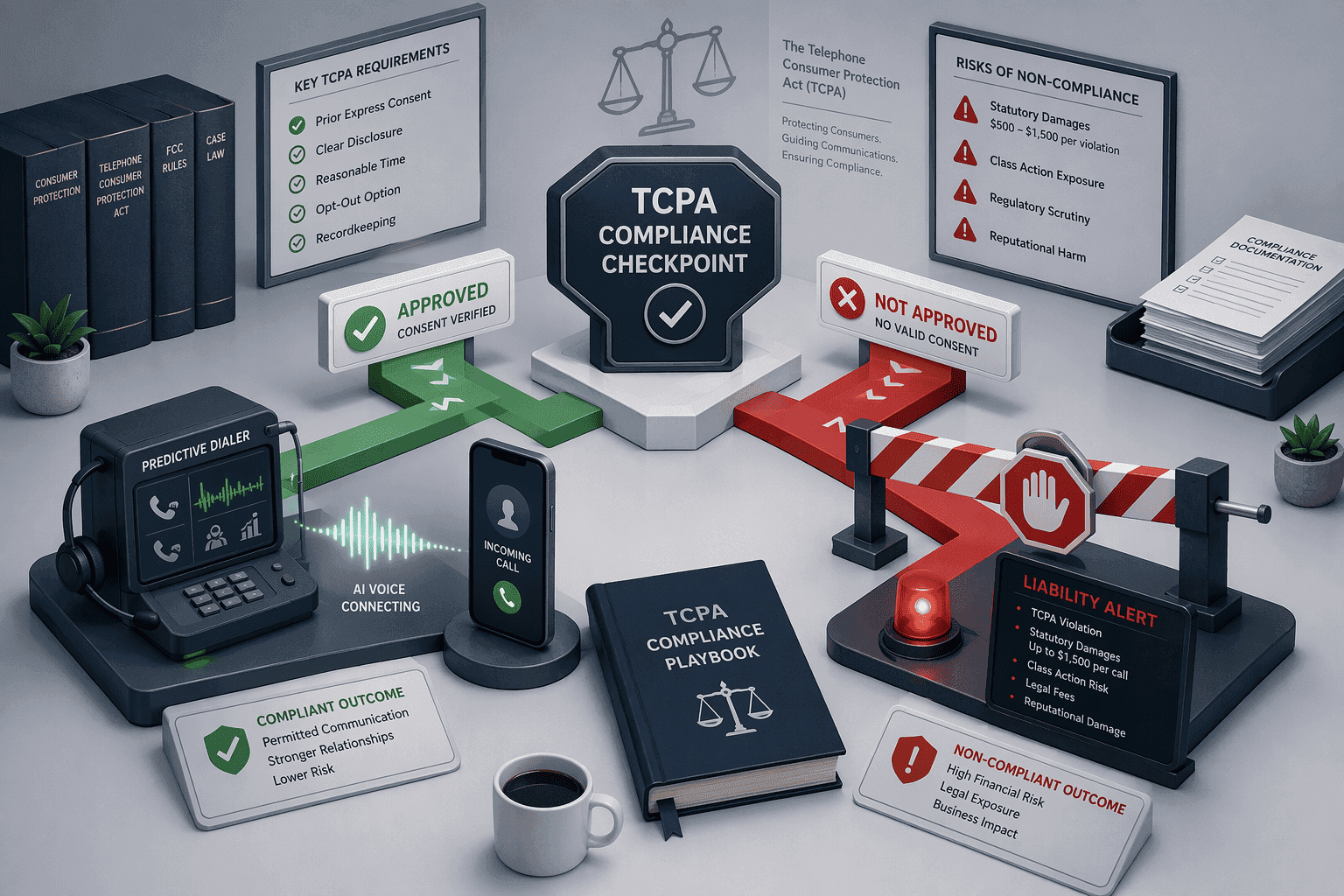
The single largest litigation risk in collection calls centers on the Telephone Consumer Protection Act. FCC rulings in 2026 have continued to narrow the definition of an automatic telephone dialing system, but the core liability trigger remains unchanged: you need prior express consent to make any non-emergency call using a predictive dialer or an artificial voice to a cell phone. Without it, each call exposes your organization to statutory damages.
A debt collection call made to a cell phone without the correct consent profile is not a small oversight. Illegal collection practices cause substantial consumer injury, including payment of amounts not owed, invasions of privacy, and emotional distress, and can place consumers deeper in debt. Your dialing platform configuration must separate consented cell-phone numbers from landline lists with zero blending. If consent traces back to a web form from three years ago, you audit it today.
Litigation trends in 2026 show that plaintiffs' attorneys are scanning call records for even a single predictive-dialer touch to a cell phone without consent. One call is enough for a class. You protect yourself by keeping abandoned call rates below the TCPA's 3% safe harbor and building a consent repository that updates in real time.
Step 3: Deploy AI-Driven Call Monitoring for Real-Time Violation Prevention

Most compliance programs rely on post-call QA sampling. A supervisor listens to a few calls a week. That model misses the violation as it happens and delivers a finding weeks after the damage is done. Real-time AI monitoring inverts that process.
An AI layer listens in parallel to every live call, flagging rising abandon rates, prohibited agent language, and call-timing violations the instant they appear. You can use a tool like Domu to deploy agents that monitor these patterns across voice, email, and SMS simultaneously, surfacing risks in a single dashboard before a carrier flags your traffic or a regulator opens an inquiry. Domu’s automated quality assurance catches hard-to-detect moments like mini-miranda misstatements or pressure language.
This flips compliance from a reactive cost center into a live shield. An agent who interrupts a consumer or misses a disclosure triggers an immediate supervisor alert, not a notation in a file two weeks later. AI can also optimize collection strategies by analyzing consumer payment behavior to determine the best time, channel, and tone for contact, making each outreach both safer and smarter.
The downstream benefit is cleaner carrier relationships. Carriers are aggressively scrubbing traffic for spam patterns. A dialer whose abandon rate spikes past 3% during a lunchtime push gets labeled. AI monitoring catches the spike at 2.7% and pauses the campaign automatically, keeping your numbers clean and answerable.
Step 4: Build a Trusted Caller ID Reputation to Escape 'Spam Likely' Labels
The FCC reports that 45% of calls are mislabeled. Almost half of your outbound volume might already display 'Spam Risk' or 'Scam Likely' to the consumer, who will not answer. This is the single most direct point of contact-rate failure in debt collection.
You address it by completing STIR/SHAKEN call authentication, which cryptographically signs your calls as originating from a legitimate source. Then you move into daily reputation monitoring across the major wireless carriers. Displaying a call-back number that matches the caller ID name is a baseline best practice.
A mismatch triggers spam warnings that destroy answer rates. Using a local area code on outbound caller ID further aligns with consumer expectations and reduces call screening. When you move a number from 'Spam Likely' to a verified brand name, the connection-rate improvement is immediate and measurable; verified caller IDs boost connection rates by up to 45%.
Step 5: Engineer Compliant, Empathetic Scripts That Reduce FDCPA Complaints
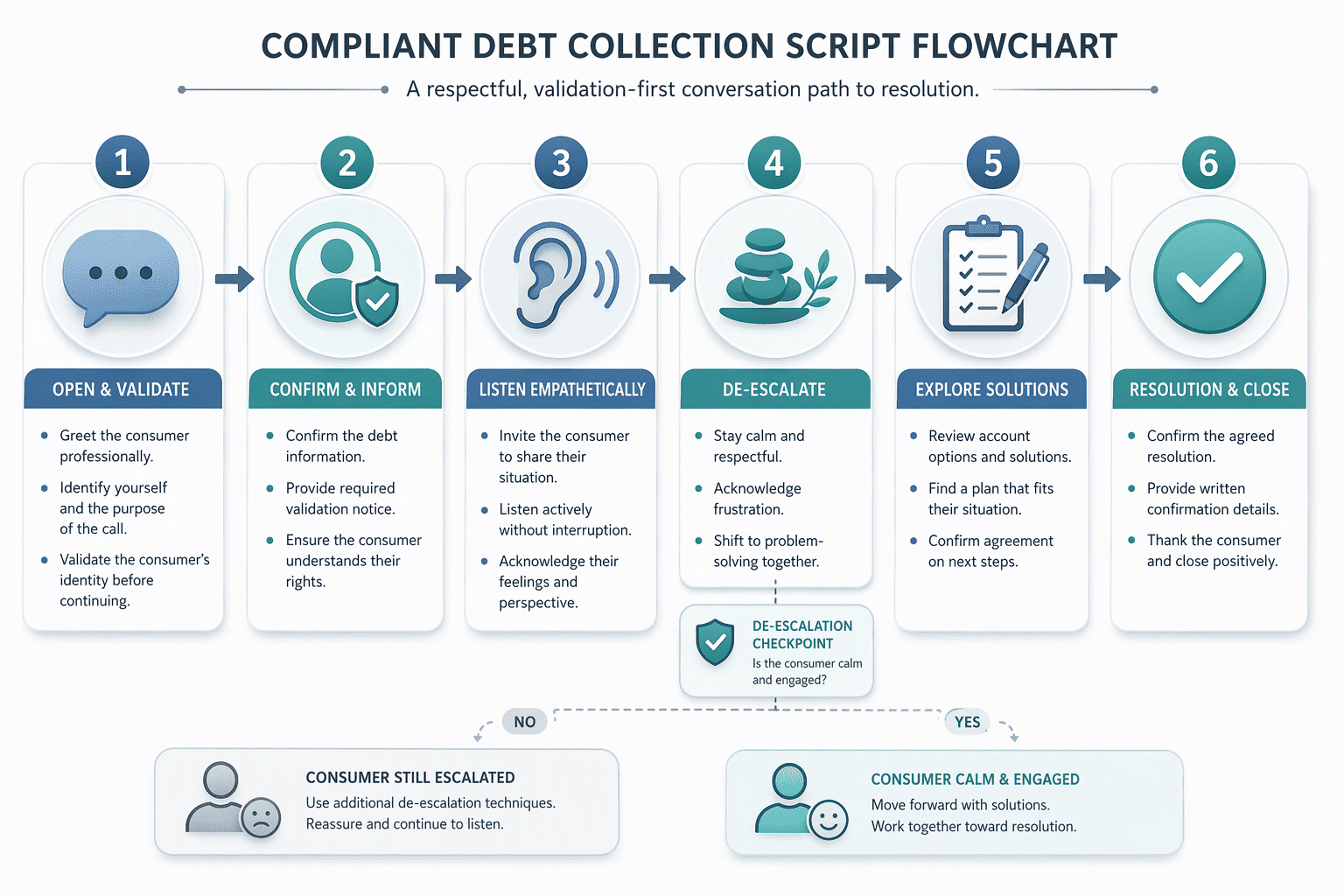
A compliant debt collection script opens not with a demand, but with validation. FDCPA complaints once represented nearly 20% of all consumer complaints the FTC received in a single year, and the categories have not changed: consumers report harassment, frequency, and a tone that feels threatening. You remove the fuel from those complaints in the first 15 seconds. The following script structure treats empathy as a compliance mechanism:
Validate the situation first: Open with a phrase calibrated to lower resistance, such as 'I understand this may be a difficult time, and I want to work through this with you.'
State your identity and purpose clearly: Follow immediately with your name, company, and a clear statement that this is an attempt to collect a debt, satisfying the mini-miranda requirement without delay.
Ask permission to proceed: Pause and ask, 'Is now a workable time to discuss a few options?' Respecting time-of-day stress defuses the 'fight-or-flight' response that generates complaints.
Anchor the conversation on resolution: Once the consumer engages, frame every option around the outcome they can control, avoiding language that implies judgment.
Close with a clear next step and channel choice: Confirm whether they prefer a follow-up by SMS, email, or a scheduled call, capturing that preference in your system immediately.
Step 6: Implement a Multichannel Consent Strategy with Integrated Opt-Out Handling
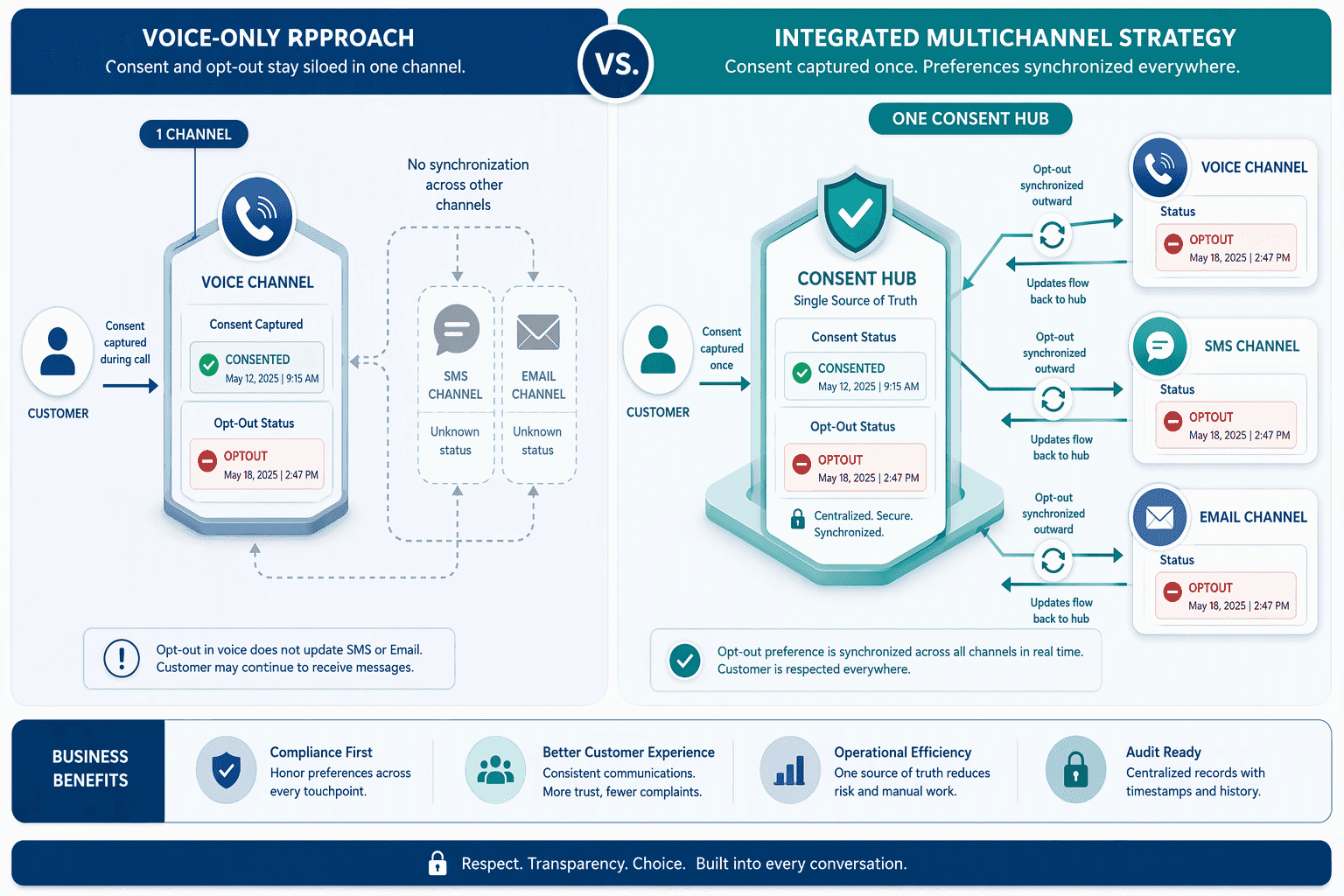
A multichannel approach is not about blasting consumers everywhere. It is about letting them choose the channel where they feel safe enough to respond, capturing that consent, and honoring it across every touchpoint. The table below maps the key operational dimensions of a multichannel consent strategy for debt collection.
Compliance Dimension | Voice-Only Strategy | Integrated Multichannel Strategy |
|---|---|---|
Consent Management | Often relies on assumed or outdated consent from original creditor records | Captures real-time consent per channel; consumers self-select SMS, email, or voice |
Right-Party Contact Rate | Declines as call screening rises; heavily impacted by 'Spam Likely' labels | Increases when consumers are reached on their preferred channel, reducing call-screen rejection |
Cost per Contact | Fixed cost per dial, high cost on unanswered attempts | Lower cost per contact because SMS and email carry zero per-attempt carrier fees and higher open rates |
Opt-Out Handling | Must be processed manually or through a single-channel IVR, risking latency | Real-time, cross-channel opt-out processing; an SMS STOP immediately updates voice dialing lists |
Audit Trail for Litigation | Single-channel logs; harder to prove consent on a specific cell call | Unified contact history creates a single, time-stamped record of consent, channel preference, and opt-out actions |
Conclusion
Call ability in 2026 is earned. It rests on four verifiable trust signals: cryptographic authentication, a clean caller-ID reputation, an empathetic first word, and a consent trail that holds up in court. When you build a dialing program on that stack rather than on raw volume, the business outcomes compound quickly.
Contact rates rise because consumers stop screening your calls. Litigation exposure falls because every dial is compliant by design. And cost per contact drops because you reach people on the channel they chose.
The collection floor of five years ago burned through phone numbers to find a live voice. The collection floor of today builds a permission-based, identity-verified signal that consumers decide to answer.
Frequently Asked Questions
What are the specific FDCPA and Reg F rules that trigger the most violation risks during debt collection calls today?
The most frequent violation triggers fall into three categories:
Frequency presumption: 7 calls in 7 days, as codified by Regulation F and consistently ranked as a top consumer grievance in CFPB data.
Time-of-day restrictions: calls outside 8 a.m. to 9 p.m. local time.
Third-party disclosure: revealing account details to the wrong party.
How can call analytics and AI-driven monitoring reduce compliance violations in real time?
AI monitoring listens to live calls for agent language, call-timing violations, and rising abandon rates. It flags these the moment they occur, enabling immediate supervisor intervention. This prevents a violation from becoming a regulatory or carrier penalty, shifting compliance from a post-call review exercise into an active, preemptive protection layer.
What dialing strategies and caller ID reputation techniques improve right-party contact rates without violating laws like the TCPA?
Three caller-ID actions build trust with carriers and consumers, boosting connection rates by up to 45% without any TCPA exposure:
Complete STIR/SHAKEN call authentication.
Maintain a call-back number that matches your caller ID name.
Display a local area code and monitor your reputation daily across carrier ecosystems to avoid 'Spam Likely' labels.
What script structures and agent training methods align empathetic tone with strict compliance requirements?
Scripts that validate the consumer's situation before stating the business purpose lower defensiveness and complaints. Training focuses on an opening sequence: validate the difficulty, identify the caller and purpose (mini-miranda), ask permission to proceed, anchor the discussion in resolution, and close by confirming the consumer's preferred contact channel.
How do recent TCPA litigation trends and FCC rulings in 2026 affect the use of automated dialing systems for debt collection?
FCC rulings continue to narrow the autodialer definition, but the core exposure remains: any use of a predictive dialer or artificial voice on a cell phone without prior express consent carries statutory damages of $500 to $1,500 per call. Litigation trends show plaintiffs aggressively pursuing single-call violations, making a real-time, audited consent trail key.
How does implementing a multi-channel communication strategy that includes compliant SMS and email impact overall contact and cure rates?
It lowers cost per contact by using zero-per-attempt channels like SMS and email, and it improves right-party contact rates because consumers engage on a channel they trust and prefer. A unified contact history with real-time opt-out processing across all channels also creates an airtight consent audit trail that reduces litigation risk while increasing cure rates.
Sources
7 Best Debt Collection Software for Banks Protecting Customer Relationships in 2026 — Domu - domu.ai
FDCPA Annual Report 2022 - files.consumerfinance.gov
Improving Answer Rates Through Caller ID Management Practices - Caller ID Reputation® - calleridreputation.com
FEDERAL TRADE COMMISSION ANNUAL REPORT 2007: FAIR DEBT COLLECTION PRACTICES ACT - www.ftc.gov
Using AI to Improve Debt Collection and Recovery Strategies - www.fico.com
Related Articles



We’re building the next generation of engagement technology: intelligent, automated and compliant. Our mission is to empower financial institutions to orchestrate every stage of the servicing lifecycle with dignity and unprecedented efficiency.
Supported by

