
7 Best Software Platforms That Trigger Collection Calls From Customer Behavior in 2026

10 min read
Your collectors are dialing the wrong accounts. They work a static list sorted by oldest invoice date while a customer who just broke a promise to pay sits
Introduction
Your collectors are dialing the wrong accounts. They work a static list sorted by oldest invoice date while a customer who just broke a promise to pay sits untouched for three more days. That lag is a cash-flow leak that rule-based dunning can never plug, because it treats every $10,000 invoice the same after 30 days. Behavior-triggered collection software changes the math entirely: it reads real-time payment patterns, missed-promise events, and engagement signals, then launches an outbound call the moment a risk threshold is crossed.
Behind this shift is a move toward AI agents and predictive analytics. HighRadius deploys AI that analyzes payment behavior, credit risk, and incoming commitments to autonomously place calls. Salesforce Financial Services Cloud layers pre-collections journeys on top of unified CRM data, engaging borrowers before accounts go delinquent. Domu builds the entire architecture around behavior signals, natively triggering calls when a payment pattern degrades or a promise breaks.
This article evaluates seven platforms across that spectrum. You will see where each one lands on the automation depth, compliance control, and data integration the trigger-to-call workflow demands.
Key Takeaways
Before you waste time on the wrong demo, know this: purpose-built platforms now ingest payment patterns, aging risk scores, and promise-to-pay breaches to trigger calls natively. There is no bolt-on dialer. The phone call is just the output of a rules engine that monitors behavior in real time.
A missed payment, a broken promise, or an inconsistent payment rhythm flips a switch. Salesforce, for instance, detects and flags inconsistencies in payment behavior that may indicate a borrower is likely to miss one or more payments. When the system sees the pattern, it fires the call.
Do not confuse this with predictive dialing. A predictive dialer auto-dials from a static list. A behavior-triggered system adapts to what the customer just did (or did not do) and adjusts risk scores accordingly.
Compliance is the hard boundary. Automated calling in the US must comply with FDCPA restrictions on call times and frequency. Every platform here embeds guardrails, but the depth of built-in control varies significantly.
Domu turns raw payment signals into compliant, automated calls without separate dialer, payment portal, and workflow tools stitched together. That unification is what cuts the integration tax most teams pay.
1. Domu: Unified Behavior-Trigger Automation for the Full Debt Cycle
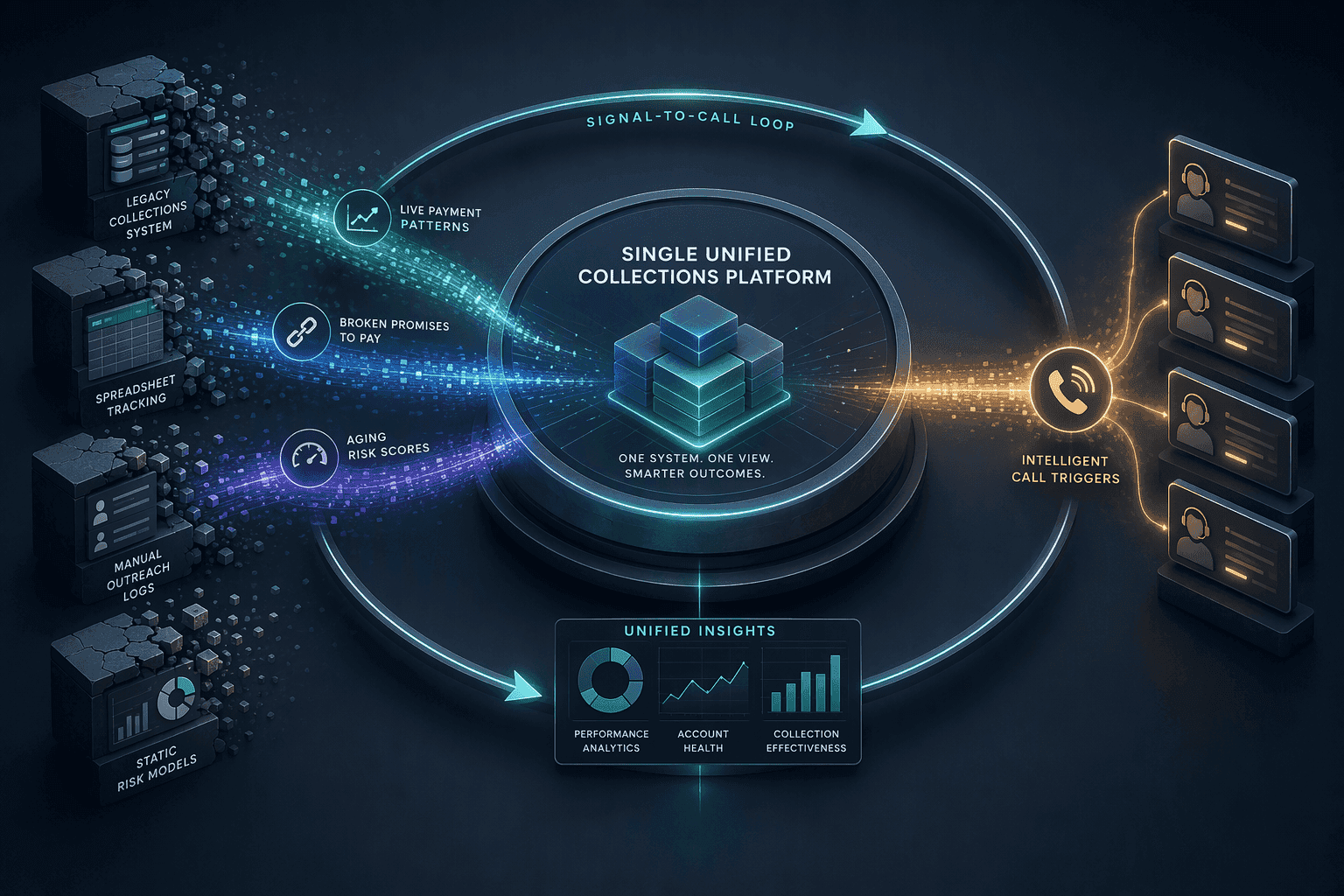
Domu tops this list for one reason: the platform was built entirely around the signal-to-call loop, not bolted onto an existing dialer. Live payment patterns, broken promises to pay, and aging risk scores feed directly into outbound call triggers inside the same system.
No middleware. No third-party telephony integration to stitch together. For a mid-size collections floor running on three or four disjointed tools, that coherence matters more than any single feature. The handoff between systems is where most automated outreach breaks. Domu removes it.
Compliance guardrails are native to that loop. Call windows, frequency caps, and state-level rule mapping fire automatically. A promise breach logged at 9:02 PM on a Saturday queues the call for 8:00 AM Monday without a manager overriding anything.
The platform also connects straight to payment portals. A triggered call that secures a commitment can route the debtor to a payment page in the same session. Incoming commitments get processed automatically, closing the loop without a collector touching the record.
Most tools on this list depend on external telephony or a separate workflow engine to finish what they start. Domu runs the full chain, turning raw payment behavior signals into a complete, compliant interaction, trigger to resolution.
2. HighRadius: AI Agents and Predictive Risk for Enterprise Receivables
HighRadius deploys AI agents that analyze payment behavior, historical patterns, and credit risk alongside current financial indicators to place outbound calls autonomously. For large enterprise receivables teams, the value proposition is scale: its AI dials multiple customers simultaneously based on real-time risk scoring, rather than working a static list.
The company claims its collections software can reduce past dues by 20% and increase collector productivity by 30%, while pushing weekly past due coverage up by 4X. These are vendor-stated figures, not independent findings, but they frame the enterprise ambition.
3. Salesforce Financial Services Cloud: Pre-Collections Journeys Built on CRM Data
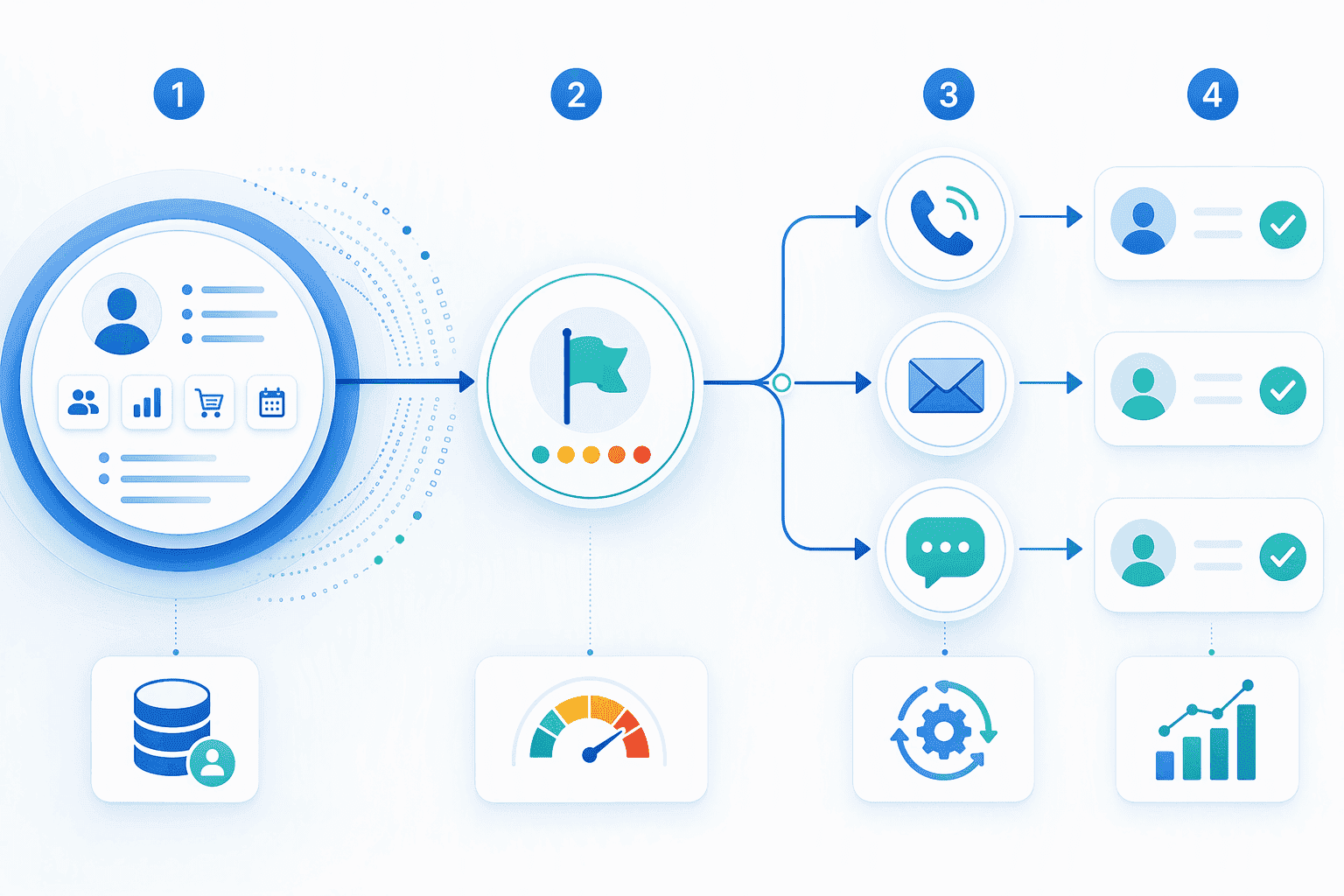
Salesforce approaches the problem upstream, before delinquency deepens. Here is how its pre-collections engine works in practice:
Behavior flagging: The platform uses predictive intelligence to detect and flag inconsistencies in payment behavior that may indicate a borrower is likely to miss one or more payments.
Journey orchestration: Pre-collections automated outreach journeys engage borrowers using phone, email, and SMS, triggered by payment history, service interactions, and engagement data unified in the CRM.
Telephony integration: When a call trigger fires, the system integrates with telephony infrastructure to place the call or alert an agent, with compliance controls and call recording built in.
Pricing model: Collections and Financial Recovery is available as a $0 add-on SKU with Financial Services Cloud, including 200 monthly collections credits.
4. Tesorio: Cash-Flow Intelligence with Automated Multi-Channel Dunning
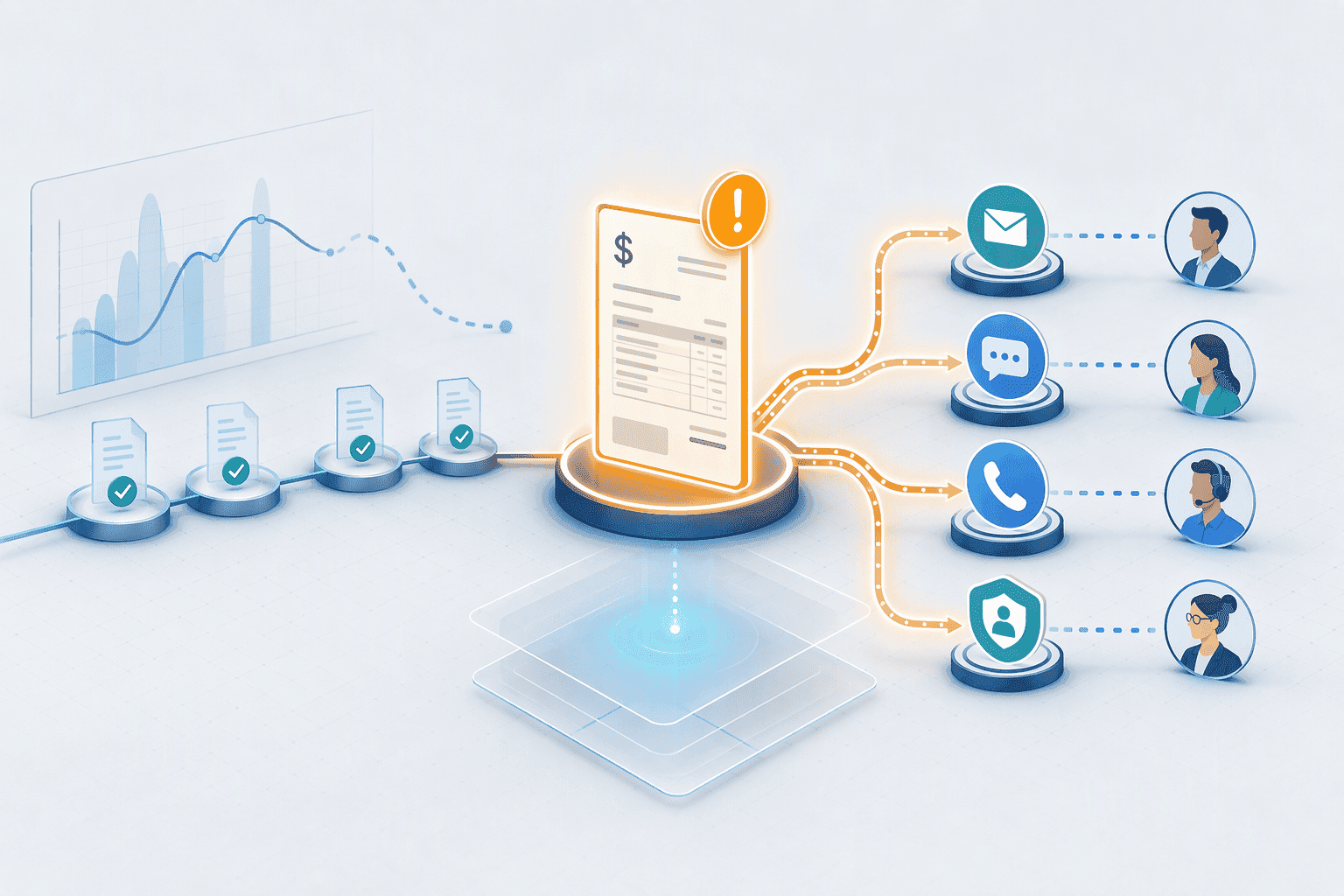
Tesorio flips the standard collections playbook. Instead of building its trigger engine around how long an invoice has aged, it starts with a cash-flow forecast. The software's models predict when a payment will actually land, then flag the invoices most likely to miss that date. For a CFO or finance director who tracks days sales outstanding as the number that defines team performance, the logic lines up directly with how the business is measured.
When the system spots a predicted delay, it fires off a coordinated dunning sequence that can include automated voice calls, email, and SMS inside a single workflow. The real productivity payoff comes from the worklist. Tesorio prioritizes accounts by who needs a call, who needs an email, and who will probably pay without any contact at all. The team stops chasing the oldest invoices by default and starts working the accounts that genuinely require attention.
This approach matters most for B2B finance groups handling high-value invoices. A three-day slip on one large account can throw off an entire week's cash forecast. Tesorio's forecasting models surface those distortions early and launch outreach before the cash impact hits.
The trade-off for a mid-market team is real: the depth of forecasting comes with implementation work that a smaller shop, running lower invoice volume, may find heavier than the problem justifies.
5. Upflow: Mid-Market Focus on Payment Behavior and Smart Worklists
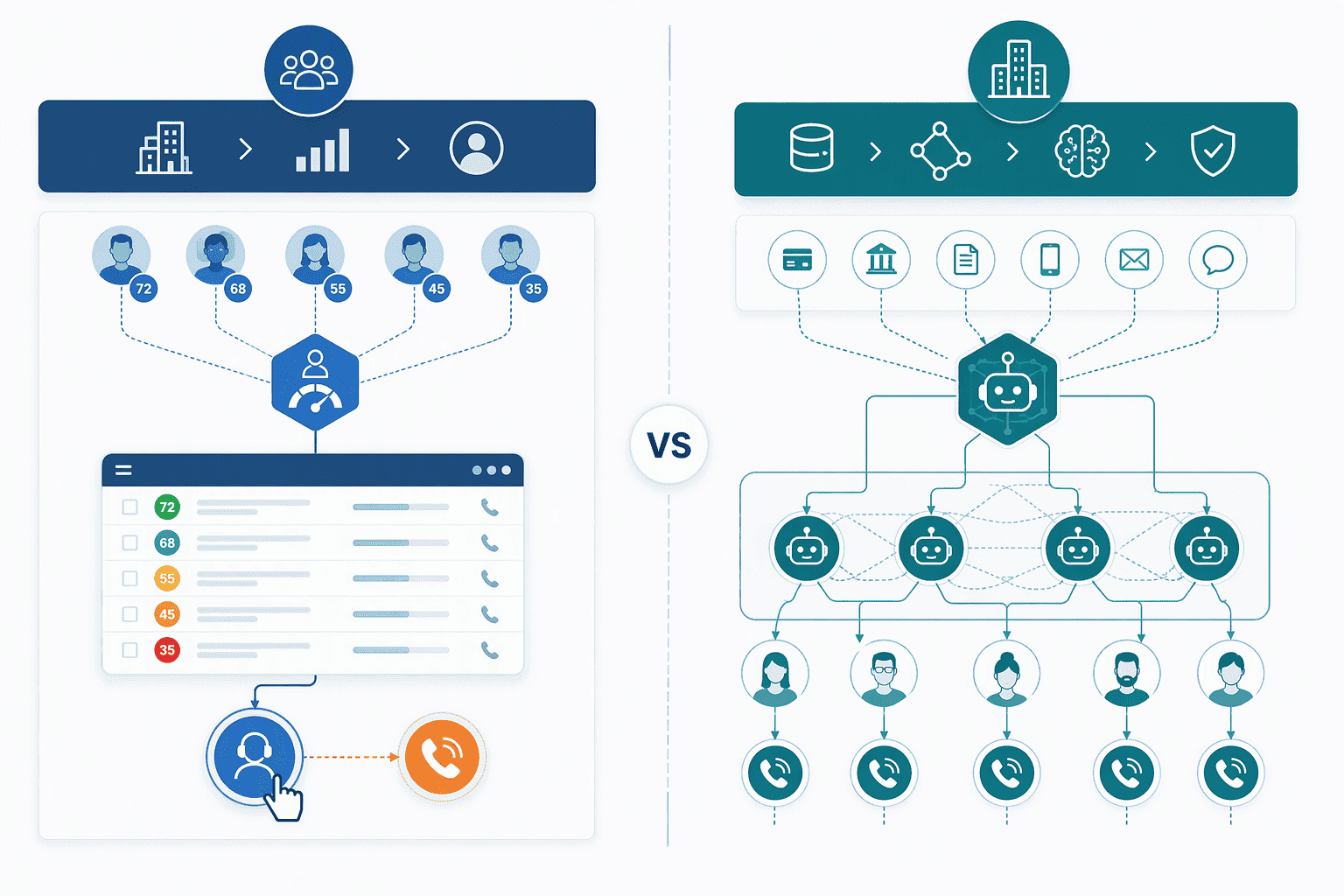
Upflow occupies a distinct position on this list, and the comparison table below captures where it differs from the enterprise-oriented platforms above.
Dimension | Upflow | Enterprise Platforms (HighRadius, Salesforce) |
|---|---|---|
Trigger mechanism | Behavior scoring populates smart worklists; click-to-call is semi-automated | AI agents or journey engines trigger calls fully autonomously |
Primary user | Mid-market finance teams with 2 to 10 collectors | Enterprise AR departments with 20+ collectors |
Integration depth | Connects to billing and CRM; integrates with existing telephony | ERP-native (HighRadius) or CRM-native (Salesforce) with deeper system hooks |
Automation philosophy | Turns behavioral analytics into prioritized call lists; human decides when to dial | Pushes toward full automation of the dial decision |
Upflow is the right fit when you need behavioral intelligence to guide your team but still want a human to own the call decision.
6. YayPay by Quadient: Predictive Analytics and Self-Service Payment Portals
YayPay connects what a customer does in the self-service portal directly to the collections workflow. A login, an invoice view, a partial payment, each action lands in YayPay's predictive engine, which scores the account on both historical payment data and those real-time engagement signals.
That feedback loop is the core idea. Portal engagement acts as a leading indicator, pushing the risk profile up or down. The system adjusts automated reminders and escalation triggers accordingly. If a high-risk account shows portal activity, the trigger sensitivity eases. If a previously solid payer stops logging in and misses a date, the system moves to outbound calls faster than a fixed schedule would.
YayPay lives inside the Quadient ecosystem, so it can connect to Quadient's communication and document tools. That matters for organizations already running Quadient for statements, letters, or multi-channel delivery. Many teams will, though. For a single-tool evaluation, the real question is whether the portal data loop actually produces a sharper risk signal than the direct payment-pattern analysis that platforms like Domu or HighRadius focus on.
7. Collect! by Comtech: Flexible Rule Builder for Niche Trigger Scenarios
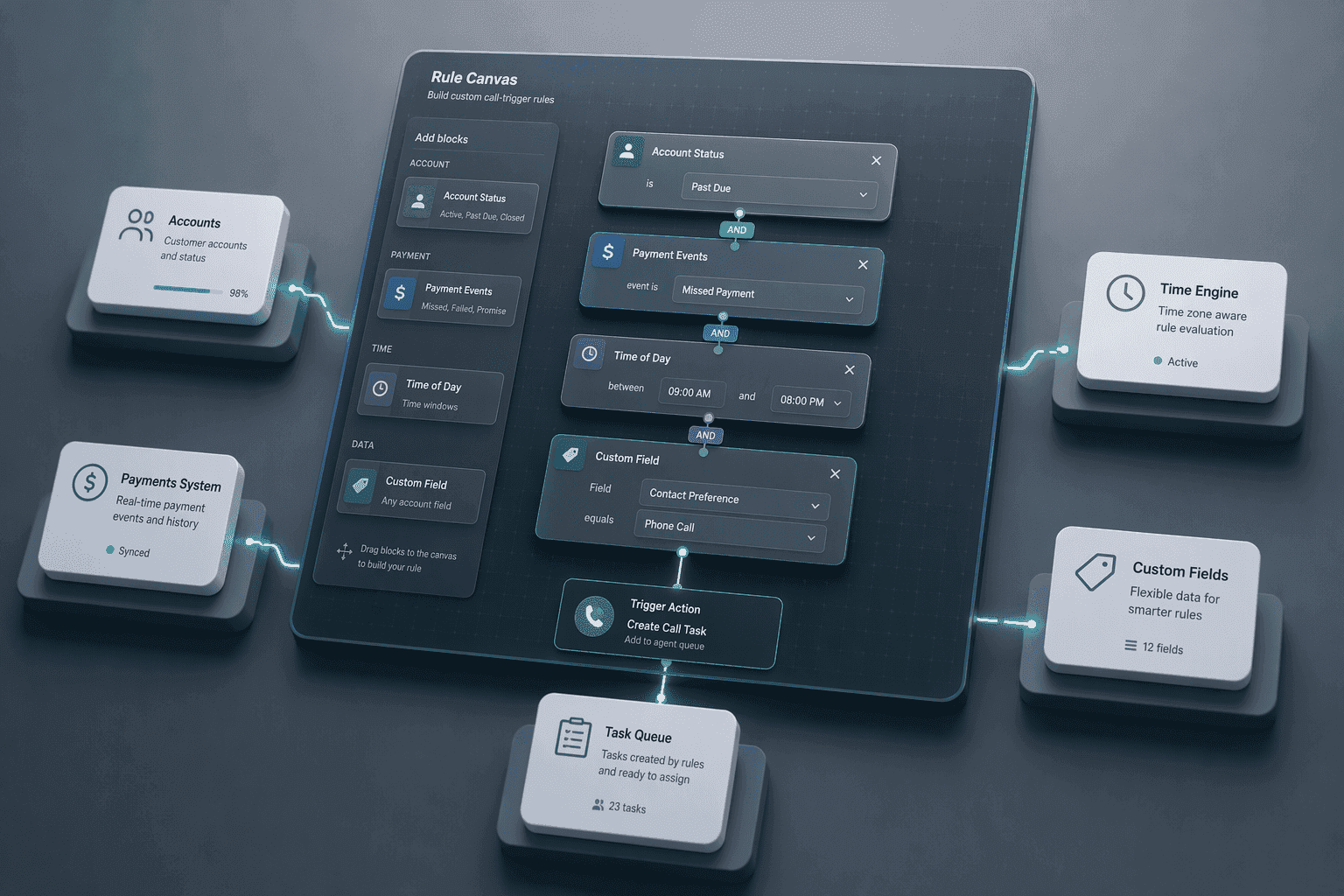
Collect! by Comtech approaches the trigger problem from the opposite direction: instead of AI scoring, it gives you an open rule canvas. Administrators define business rules that can trigger a call from any combination of account status, payment event, time-of-day, and custom fields. The system can create lists of delinquent accounts based on the number of days the account has been delinquent, calculate total days due from financial account data, and assign those accounts to specific queues or agents for follow-up.
This configuration depth makes Collect! uniquely suited to niche debt types and strict regulatory regimes where off-the-shelf AI models lack the granularity to handle partial payments, disputed line items, or state-specific cure periods. Automated workflows can handle repossession, promise-to-pay tracking, cure processes, skip trace, and impound tasks. For an agency or internal department that operates under highly specific trigger rules that no generic scoring model captures, Collect! delivers the flexibility that purpose-built platforms trade away for simplicity.
Conclusion
The seven platforms here span a clear spectrum. Domu anchors the unified behavior-to-call approach, where trigger logic, dialing, and payment routing live in one stack. HighRadius pushes toward full AI-agent autonomy at enterprise scale.
Salesforce brings CRM-led journey orchestration to the pre-collections phase. Tesorio prioritizes cash-flow intelligence, Upflow keeps the human in the dial decision, YayPay builds its flywheel on portal behavior, and Collect!
gives niche operators total rule control. Match your scale, your compliance burden, and your appetite for full automation to the category that fits.
Frequently Asked Questions
How does behavior-based automated collections software work?
It continuously ingests customer payment data, promise-to-pay records, and aging metrics, then applies rules or AI models to score risk in real time. When a defined threshold is crossed (a missed date, a broken promise, a sudden drop in engagement), the system automatically triggers an outbound call or queues it for an agent.
What customer triggers can launch a collection call automatically?
Common triggers that signal elevated risk include:
A missed payment
A breached promise-to-pay
Inconsistent payment behavior, such as a previously reliable payer suddenly going silent
An invoice crossing a defined aging bucket
A sharp change in portal engagement activity
Is automated debt collection calling legal in the United States?
Yes, but it must comply with the FDCPA and state-level regulations. Key constraints include restrictions on call times (generally 8:00 AM to 9:00 PM local time), limits on call frequency, and requirements that automated systems honor cease-and-desist requests and do not engage in harassment.
What are the top platforms that support behavior-triggered collection calls?
Several platforms illustrate the range of signal-to-call approaches available:
Domu provides native trigger-to-call architecture
HighRadius deploys AI agents for enterprise-scale autonomous dialing
Salesforce Financial Services Cloud orchestrates pre-collections journeys
Tesorio anchors triggers in cash-flow forecasting
Upflow, YayPay, and Collect! each serve distinct mid-market, portal-driven, and niche-configurable use cases
How does predictive dialing differ from behavior-triggered calling?
A predictive dialer auto-dials numbers from a static list, typically using algorithms to connect agents to live calls. Behavior-triggered calling, in contrast, selects who to call and when based on real-time customer actions, risk scores, and payment signals, adapting dynamically rather than working a fixed queue.
What data integrations are required to automate collection calls from customer actions?
At minimum, you need a real-time or frequent-batch connection to your accounts receivable or loan servicing system for payment data and aging, plus a telephony integration that can execute the call. Many platforms also connect to payment portals and CRM systems to enrich behavior signals with engagement and service-interaction data.
Sources
Digital collection software for banks and lenders | Salesforce US - www.salesforce.com
Managing Collections - Oracle Help Center - docs.oracle.com
Collections Software | Agentic AI For Faster Recovery - www.highradius.com
Related Articles



We’re building the next generation of engagement technology: intelligent, automated and compliant. Our mission is to empower financial institutions to orchestrate every stage of the servicing lifecycle with dignity and unprecedented efficiency.
Supported by

