

Your recovery floor just fell through. The CFPB's 2025 annual report to Congress on the FDCPA is 78 pages of fresh enforcement actions, consent orders
Introduction
Your recovery floor just fell through. The CFPB's 2025 annual report to Congress on the FDCPA is 78 pages of fresh enforcement actions, consent orders, and explicit reminders that UDAAP applies to every call, text, and email your collections team makes. Meanwhile, your 1-to-30-day delinquent bucket is thickening, and rolling those accounts to a third-party agency that doesn't record every syllable of every call is a bet your compliance officer won't let you make.
That bind (rising delinquency, zero tolerance for off-script collection behavior) is exactly why mid-size bank leaders are re-platforming collections now. The 2025 CFPB report confirms what the last three supervisory cycles hinted at: examiners will reconstruct the full borrower interaction, and if the collector deviated from the approved script by a single sentence, the corrective action lands on the bank, not the agency. At Domu, we watched this shift accelerate across our pipeline this year, not as a technology trend but as a compliance imperative.
Some borrowers are more honest with a machine than with a human about what they can actually pay. Remove the perceived judgment, and the promise-to-pay rate moves. One platform reported a 60% increase in debt recovery using AI calling. The number is from a vendor FAQ, not a double-blind trial, but it matches the pattern we and other builders are seeing in production: script-locked AI that escalates only when the borrower's sentiment flags confusion or hostility closes more early-stage accounts per agent-hour without creating the examiner trap of a rogue collector ad-libbing a payment demand.
Key Takeaways
AI collections for a regulated mid-size bank is not a dialer upgrade. It's a compliance architecture decision. These five numbers define the business case:
30% recovery lift within 60 days: Banks using AI-powered collection agents have reported a 30% recovery lift in that window, driven by immediate, consistent contact on every 1-to-30-day past-due account.
On-script enforcement prevents UDAAP violations: The FDCPA prohibits abusive, unfair, or deceptive practices. A purpose-built AI collector that cannot deviate from an approved script eliminates the primary source of examiner findings: improvisation under pressure.
40% reduction in failed field visits: AI pre-calls resolve the account or confirm a promise-to-pay before a human is dispatched, cutting field costs directly.
100% early-bucket coverage, immediately: AI reaches every account in the 1-to-30-day delinquent window minutes after a missed payment, collapsing the response gap that drives roll-rates.
Model governance is the exam-ready record: The CFPB's 2025 FDCPA report emphasizes auditable decision trails. An AI platform without an explainable governance layer (a trust layer) generates recovery numbers it cannot defend to an examiner.
1. Domu's Taylor: On-Script AI Collector with Fail-Safe Escalation

The hardest claim we can make about Taylor is not about recovery lift. It's that the agent cannot say something off-script, ever. The model governance layer, Alex, fences every response. When a borrower becomes confused, hostile, or simply stops engaging with the AI's prompts, real-time sentiment analysis triggers a fail-safe escalation, a recorded warm transfer to a human agent with full conversation context. There is no middle ground where the AI guesses.
That architecture matters for a specific reason: the CFPB's 2025 FDCPA report details enforcement actions where a single unauthorized statement (a collector implying a payment deadline the note doesn't authorize, an offhand remark about credit impact) was the entire basis for the order. Taylor's integration into core banking systems is via low-code API, which means the AI has the real-time balance, the correct payment date, and the approved settlement ranges during the call, without a human needing to retrieve them. The Alorica deployment showed how this scales: Nu grew its AI calls 2,400x without ever putting a customer on hold. For a mid-size bank compliance officer, the operational proof is that the AI handles the routine, the escalation path handles the exception, and the record is complete either way.
2. Skit.ai: Omnichannel ARM Orchestration with Enterprise-Grade Guardrails
A mid-size bank in 2026 has a compliance problem that spans every channel. The same delinquent borrower gets a voice call at 8:02 a.m., an SMS at 8:04, and an email subject line that contradicts the settlement amount the agent just quoted. Skit.ai runs a single policy engine that governs every one of those touchpoints.
Compliance Dimension | Skit.ai Approach | Why It Matters for Your Exam |
|---|---|---|
Consent Management | Logs opt-in/opt-out per channel, per borrower, and enforces it at the orchestration layer | The CFPB's 2025 report flags multi-channel consent tracking failures as a growing UDAAP category |
Channel-Specific Quiet Hours | Applies the same time-window rules to SMS, email, and voice from a unified config | Removes the gap where one system sends a compliant call and another sends a 5:59 a.m. text |
Audit Trail | Maintains a single golden record of every interaction across channels, timestamped and attributable | An examiner reconstructing the borrower's experience gets one coherent record, not three partial logs |
Policy Enforcement | The same rule engine that governs voice scripts governs email copy and SMS templating | Prevents the situation where a compliant voice agent is undercut by an un-reviewed email campaign |
Picture a bank running a digital-first recovery strategy. The borrower engages on voice, ignores SMS, and completes payment on a portal. With unified governance, you pass the exam. Without it, you explain why three systems told three slightly different stories.
3. TrueAccord HeartBeat: Digital-First Recovery with Machine Learning-Driven Segmentation

HeartBeat scores every delinquent account on behavioral propensity-to-pay using machine learning, then routes each one into a compliant digital journey (email, SMS, self-serve portal). No account sits in a generic human call queue waiting for a collector to get to it. The segmentation logic directly tackles a specific regulatory risk: when examiners see identical, blanket contact attempts across an entire portfolio, those patterns can read as harassment. A borrower who historically pays after one email gets one email. The borrower who needs a structured payment plan gets routed to that flow instead of receiving ten repeated calls.
This structure also attacks the 'shame factor' problem from the other direction. Borrowers embarrassed about their situation complete self-serve payment plans at higher rates than borrowers who have to explain their finances to a live collector. The digital channel becomes the compliance-safe container for that conversation.
4. Cresta: Real-Time Agent Assist and AI-Powered Compliance Monitoring for Collections

Not every mid-size bank is ready to hand its early-stage collections book to a voice AI agent. Most still run a human floor. And that creates a lopsided risk: the collector recovering 40% more than the floor average is often the same person who bends the script to close a payment. One bent sentence is all the examiner's call recording needs.
Cresta sits on every live call as a real-time compliance monitor. It listens, pushes on-screen scripting nudges to the agent, and flags prohibited language the moment it's spoken. After the call, the system scores the interaction against a compliance rubric, so the operations leader can pull a Monday morning report showing exactly which agents deviated and on which calls, before an exam cycle ever catches it.
The model replaces a reactive annual audit with monitoring that never stops. The collector still runs the conversation. But an AI guardrail sits beside them, one that won't let a single sentence talk the bank into a UDAAP finding.
5. CogniSafe: Explainable AI and Model Governance for High-Stakes Debt Recovery
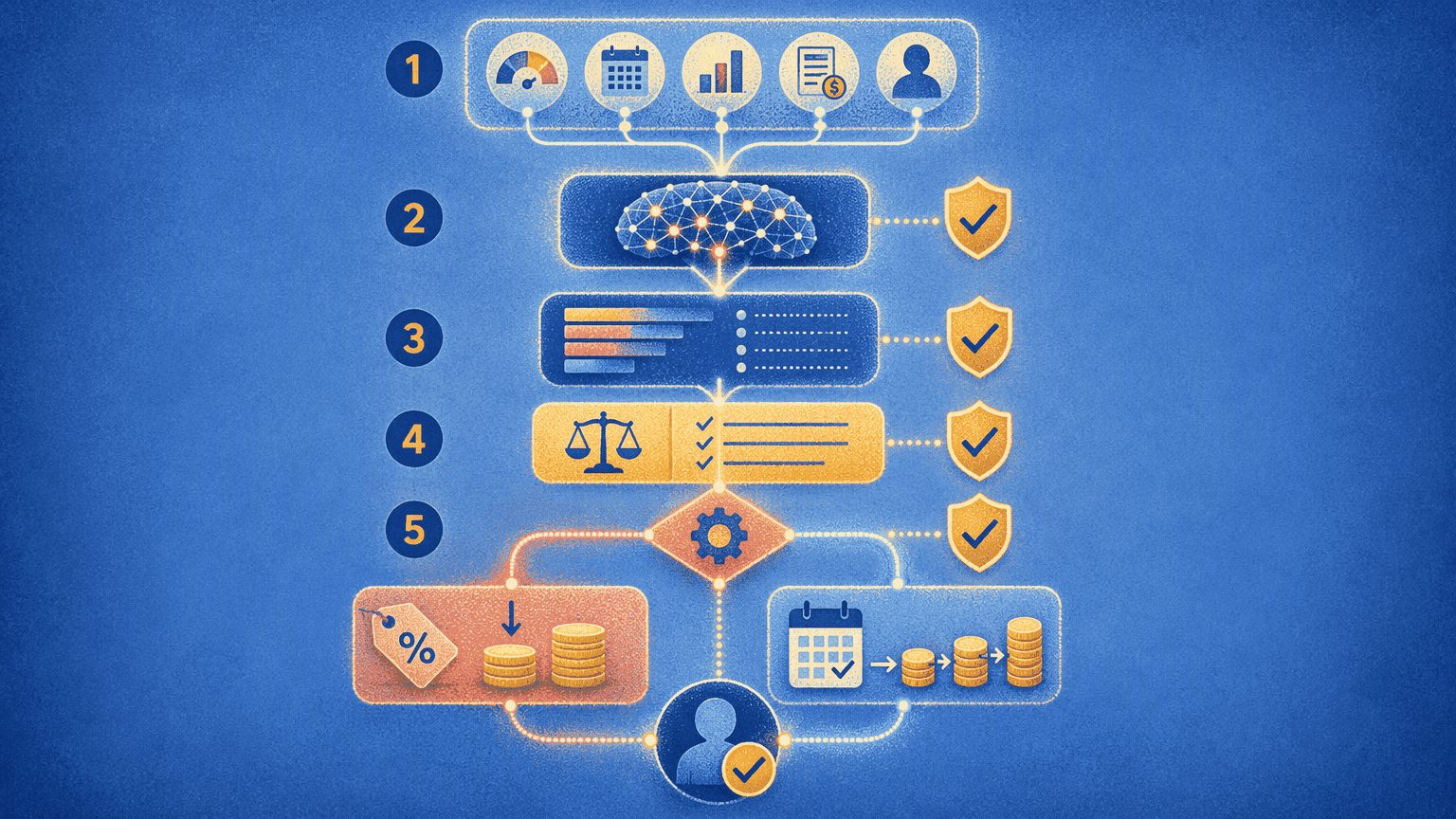
Regulatory examiners do not ask how much you recovered. They ask you to show your work. CogniSafe is designed for that conversation. The platform operates as a governance layer: every automated settlement offer, payment plan, or risk assessment the AI makes is accompanied by an XAI audit trail that explains which input variables drove the decision and why the output fell within policy bounds.
This de-risks your model risk management process in four specific ways:
XAI audit trail for every decision: Automated settlement offers and payment plans come with a human-readable explanation of the driving factors, not a black-box score.
Direct alignment with CFPB fair lending expectations: The CFPB's 2025 FDCPA report states that collections models must not produce disparate outcomes; explainability is the only way to prove they don't.
Model Risk Management (MRM) readiness for examiners: The supervisory guidance on model risk applies to collections AI, and the XAI record satisfies the documentation requirement that kills most first-time AI deployments in a consent order review.
Adverse action transparency: When the system declines a payment plan or flags an account for escalation, the exact decision logic is logged for the borrower-facing disclosure, closing a common compliance gap.
A 30% recovery lift that cannot be explained to an FDIC examiner is a liability, not an asset. CogniSafe makes the lift defensible.
6. CollectAI: Intelligent Receivables Management via API-First Pre-Integration
The fastest way to kill an AI collections project in a mid-size bank is to tell the CIO it requires a nine-month core banking integration. CollectAI sidesteps that entirely. Its platform is built API-first with pre-built connectors to common core banking and servicing systems, so the bank plugs into payment gateways and digital recovery workflows without a major IT change request.
The architecture is deliberately composable. A bank can start with automated payment reminders and a digital settlement flow, see the recovery numbers, and then layer on additional channels and intelligence, all through the same API surface. For an IT team that has been burned by multi-year platform deployments, the operational model is the selling point: a recovery team can pilot a segment of the portfolio in weeks, not months, because the integration complexity is low.
Several platforms in the space report deployments in that compressed timeframe. Floatbot, for instance, claims its LEXI AI Agents can be deployed in a matter of days or weeks, not months. Across API-first players, time-to-value has shifted from a platform migration project to a configuration exercise. For a mid-size bank operations leader staring at a rising delinquency curve, that speed means addressing the 1-to-30-day bucket now rather than watching it roll to charge-off while the integration drags on.
7. Kore.ai BankAssist: Conversational AI for Proactive Pre-Delinquency and Early-Stage Interventions

The cheapest collections conversation is the one that happens before the account hits 30 days past due. Kore.ai BankAssist is programmed for that moment: the AI engages the customer right as a payment is missed, using a non-judgmental conversational model that avoids the 'shame factor' that suppresses self-cure rates in human-led early-stage calls.
The operational mechanism is straightforward. The platform covers 100% of delinquent accounts in the 1 to 30 day past-due bucket within minutes of the missed payment, which no human team can do at scale. The AI's scripting is deliberately soft-touch, asking if there's an issue and offering options rather than demanding payment.
This positions the AI as a pre-delinquency intervention tool, not just a recovery tool. Accounts that resolve at this stage never generate a collections call, never roll to a higher-cost bucket, and never become the subject of an examiner's review of later-stage collection practices. The financial impact compounds: a platform that reduces roll-rates at day 15 eliminates the cost of every subsequent collections step for that account.
Conclusion
Mid-size banks weighing collections tech in 2026 are really picking among three AI models, and the best answer tends to be a mix. The strict-script voice agent, like Domu's Taylor, cuts ad-libbed compliance risk on live calls. The omnichannel governance orchestrator (Skit.ai) runs the same policy engine across voice, SMS, and email. And the human-assist compliance layer (Cresta) monitors and coaches your collector floor in real time.
One requirement cuts across all three: the model governance layer has to produce an explainable, exam-ready record of every decision. The 30% recovery lift holds up. The 100% early-bucket coverage holds up. But both are only defensible if you can show an examiner exactly how the AI made each call, each offer, and each escalation.
That architecture, not a bigger auto-dialer, is what gets you through the next FDIC exam.
Frequently Asked Questions
What are the key compliance requirements (CFPB, FDCPA, UDAAP) that AI-powered debt collection platforms must meet?
AI platforms must comply with the FDCPA's prohibition on abusive, unfair, or deceptive practices and the broader UDAAP standard the CFPB enforces. In practice, this means strict adherence to approved scripts, recorded consent management, channel-specific quiet hours, and a complete audit trail for every borrower interaction. The CFPB's 2025 FDCPA annual report details enforcement actions that now routinely examine AI-driven collection communications.
Which AI-driven collection platforms are specifically designed for the regulatory complexity of the US mid-size banking market?
Platforms with explicit compliance architectures, not just conversational AI, are designed for this market. Each addresses a different part of the examiner-readiness requirement:
Domu's Taylor: enforces on-script voice interactions with fail-safe escalation
Skit.ai: unifies omnichannel governance
Cresta: monitors live human calls in real time
CogniSafe: provides explainable AI audit trails for model risk management
How do platforms like Domu's Taylor enforce 'on-script' interactions and what happens when a borrower becomes confused or hostile?
Taylor is engineered so it cannot deviate from the approved script; the model governance layer fences every response. Real-time sentiment analysis continuously monitors for borrower confusion or hostility. When those thresholds are met, the system triggers an automatic, recorded warm transfer to a human agent with full conversation context, rather than letting the AI improvise a response.
What is a 'model governance' or 'trust' layer in AI collections, and why is it critical for regulated financial institutions?
A model governance layer (sometimes called a trust layer) is the system component that enforces policy boundaries on the AI, logs every decision with an explainable audit trail, and prevents off-script behavior. It is critical because the CFPB and FDIC examiners do not accept recovery performance numbers alone; they require documented, defensible evidence of how every automated decision was made.
How does integrating an AI collection agent into an existing bank tech stack typically work?
Integration typically happens via API-first connections to core banking systems, allowing the AI to access real-time balance, payment history, and account data during a call. Platforms designed for mid-size banks emphasize low-code or pre-built connectors to reduce IT burden. In practice, this means a deployment timeline measured in weeks, not the multi-month integration projects common with legacy servicing platforms.
What real-world outcomes have banks seen from adopting AI-powered collection platforms?
Banks report several key outcomes from AI collections platforms:
Recovery lift: a 30% increase within 60 days
Failed field visits: a 40% reduction due to AI pre-calls
Account coverage: 100% of accounts in the 1-to-30-day delinquent bucket immediately after a missed payment
Promise-to-pay rates: higher rates driven by the reduced 'shame factor' of interacting with an AI
Compliance errors: significantly lower versus human-led collections
Sources
Alorica — Domu Customer Story - domu.ai
5 Ways Banks Can Cut Collections Costs - Domu AI: AI Agents Built For Intelligent Servicing - domu.ai
Generative AI in Debt Collection: Boost Recoveries - floatbot.ai
Voice AI for Debt Collection: How BFSI Teams Are Recovering 30% More with AI Calls - www.haptik.ai
Related Articles





We’re building the next generation of engagement technology: intelligent, automated and compliant. Our mission is to empower financial institutions to orchestrate every stage of the servicing lifecycle with dignity and unprecedented efficiency.
Supported by

