
Why Your Collection Agents Are Calling at the Wrong Time (And How Behavioral AI Fixes It)

10 min read
A collections agent who is paid to resolve debt might spend an entire shift listening to ringtones.
Introduction
A collections agent who is paid to resolve debt might spend an entire shift listening to ringtones. Across the industry, agents routinely find themselves chasing voice prompts because a customer was working, driving, or simply unwilling to answer a rigidly scheduled call. The root issue is rarely a scheduling problem. It is a timing failure born from ignoring individual behavioral data.
When agents operate from a fixed, chronological list, they burn capacity against a wall of no-answers. The financial leakage is immediate: every unanswered dial is a cost center that produces zero progress toward a resolution. The pressure to correct this is urgent, because regulators scrutinize excessive, unrewarded contact attempts just as sharply as leadership pressures teams to improve liquidation rates.
A solution lives in the shift away from the 8 a.m. to 9 p.m. static dialing window and toward AI-driven personalization. Rather than treating every account like an identical entry on a spreadsheet, predictive models now read past answer timestamps and life-event signals to surface the specific hour that a specific consumer tends to be reachable. This article explores why standard outreach consistently misses the mark, how regulations shape the permissible window without defining the optimal one within it, and the behavioral DNA that finally makes optimal contact timing a repeatable science.
Key Takeaways
Contact timing is a data science problem. The difference between a connected call and a wasted dial usually comes down to whether the system knows the right moment to try, not whether an agent happened to punch the right number at the right time. Here are the core findings that reshape a collection floor’s approach to reaching delinquent customers:
Predictive dialing lift: Shifting from manual, rule-based dialing to predictive dialing can lift right-party contact rates by up to 30 to 40 percent.
Critical first-attempt threshold: A first-attempt contact rate below 15 to 20 percent is a red flag. It typically signals poor timing windows or stale contact data.
Regulatory range vs. optimal point: TCPA’s 8 a.m. to 9 p.m. local time restriction establishes a permissible boundary. It does not guarantee reachability within that 13-hour band.
Behavioral scoring outperforms static rules: A real-time Dynamic Collectability Score that factors in payment history, employment changes, and even unanswered calls can be up to 50 percent more accurate than banks’ current scoring systems at predicting payment likelihood.
Self-cure misallocation: In some portfolios, accounts with less than 30 days past due can self-cure at rates exceeding 70 percent. Calling the wrong people at the wrong time wastes agent capacity that should focus on genuinely at-risk accounts.
What Factors Cause Contact Attempts to Consistently Miss a Customer’s Most Reachable Windows?
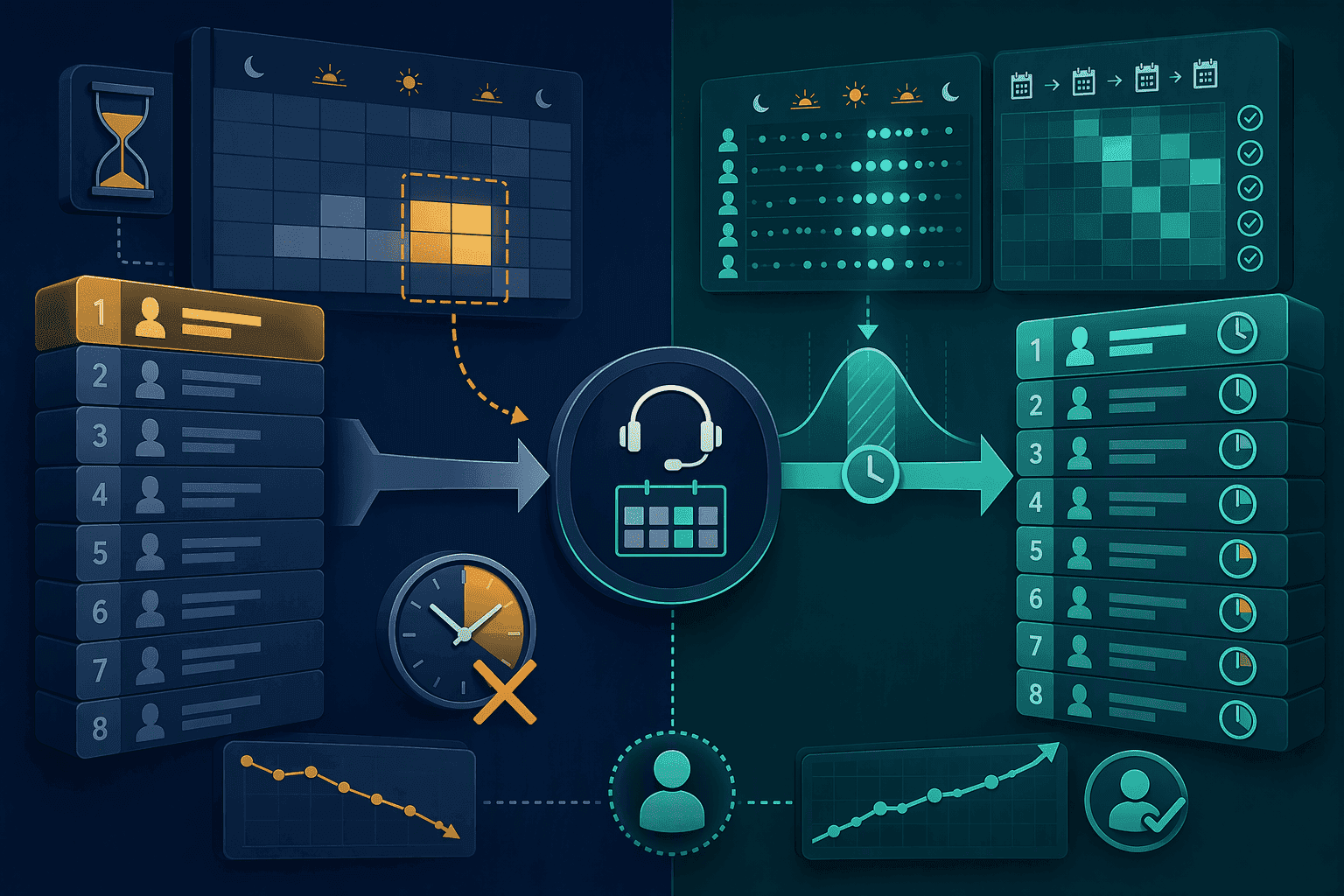
Most dialer strategies prioritize what is efficient for the operation over what is probable for the consumer. That inversion explains the majority of missed contact windows.
The root cause is a reliance on a chronological or time-zone-sorted list. A queue built simply by “oldest account first” ignores whether that account holder has answered a call on a Tuesday at 10 a.m. in the prior 18 months. Without parsing historical answer timestamps and successful payment time patterns, the system is blind to the individual rhythm of each delinquent customer. A predictable result is that agents ring during a commute, a shift, or a school pickup window, and the call goes unanswered.
Operational silos deepen the problem. Contact data decays quietly. Phone numbers change, a landline is ported to mobile, or an account holder moves to a new employer without updating their information.
When collections teams do not continuously verify and append contact records, they are dialing ghosts. Information scattered across servicing, collections, and payment platforms also forces collectors to prepare for a call without context, stretching the time before they even dial and making each subsequent attempt no smarter than the last. A tool like Domu addresses this by giving collectors fast access to that relevant account context and approved guidance so they are not working blind.
Life-event signals are another missing layer. A change in employment status scrambles a consumer’s previous availability. Someone who always answered at 11 a.m. might now be unreachable at that hour because of a new shift schedule. Teams that do not incorporate these signals, or treat every account the same way, create low-value contact attempts that fail to move the account forward.
How TCPA and FDCPA Regulations Shape When and How Often Collectors Can Call in 2026
The TCPA defines a lawful dialing window of 8 a.m. to 9 p.m. local time, while FDCPA provisions prohibit calling at times known to be inconvenient and restrict harassment through excessive frequency. The rules draw the boundary, but inside that 13-hour window you still need to catch a single mother with a 7 p.m. bedtime routine or a construction worker off at 4 p.m. when they will actually answer. Regulatory compliance is a necessary floor, not an optimized contact strategy.
Compliance pressures only intensify the need for precision. New York City's updated debt collection rule faces a compliance deadline of January 2027, putting operations under a spotlight to prove that every contact attempt has a defensible basis. A platform like Domu sequences worklists by predicted answer windows so that dials land inside the regulatory perimeter and on a moment of high answer probability. That dual benefit separates a modern platform from a simple time-zone filter.
Blasting an entire queue from 8:01 a.m. through 9 p.m. without behavioral weighting is a recipe for abandoned calls, angry consumers, and CFPB scrutiny. The law sets the clock; the data sets the appointment.
The Behavioral DNA of Reachability: Data Signals That Predict the Best Time to Contact
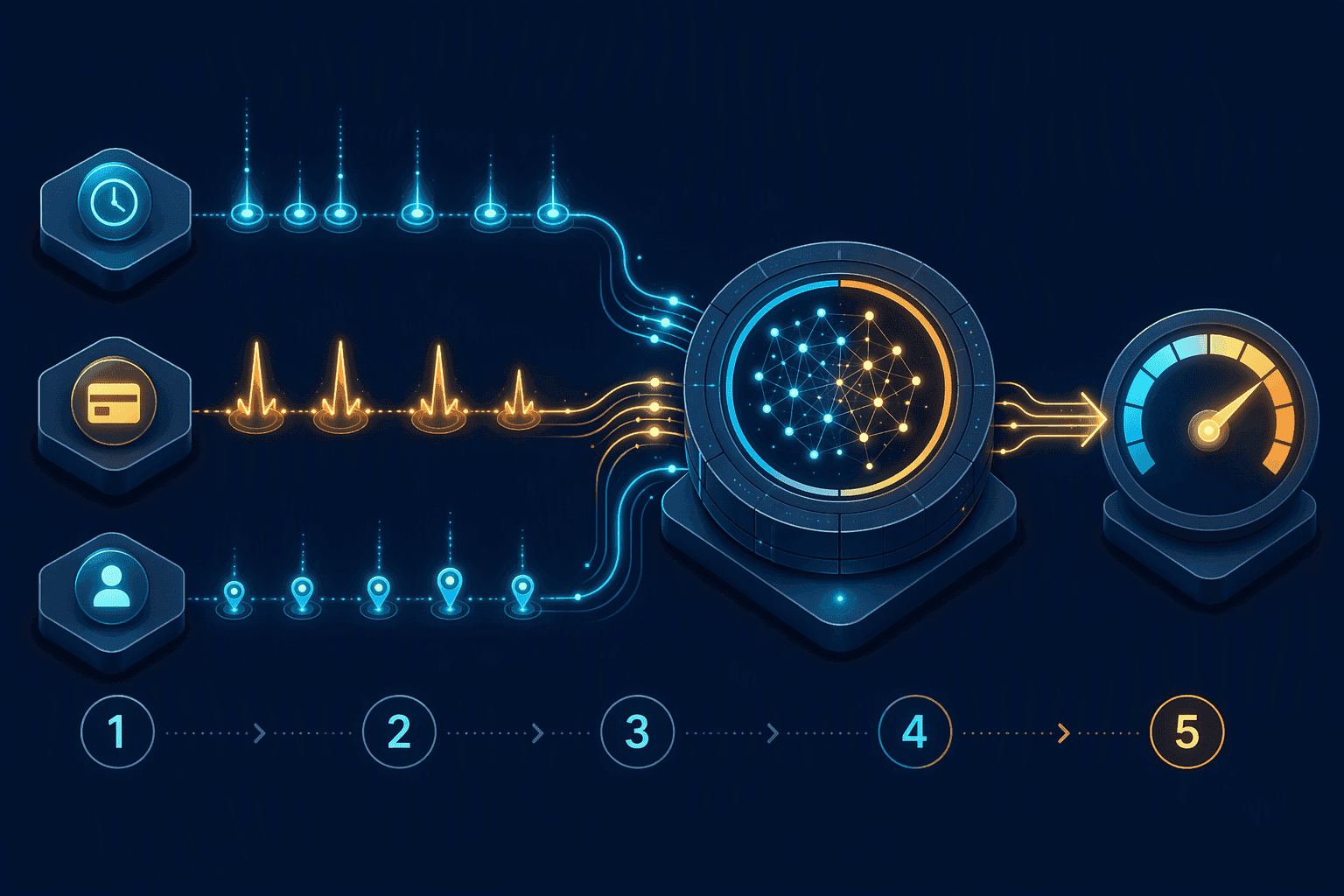
A consumer's behavioral DNA is the aggregate of data points that, fed into a machine learning model, produces an answer-probability score for a specific time slot. The strongest predictive signals include:
Historical answer timestamps, the single most powerful indicator of when a consumer is likely to pick up.
Successful payment time patterns, the precise hours a customer has chosen to transact in the past.
Self-service portal login timestamps, live signals of digital engagement that reveal available moments.
Phone line type stability, distinguishing a landline answered at 6 p.m. daily for two years from a mobile number that goes quiet after 9 a.m. on weekdays.
These inputs feed models that are far more adaptive than traditional scoring. The Dynamic Collectability Score pioneered at UT Austin, for example, ranks delinquent account holders on factors such as outstanding balance, mortgage status, past payment history, and external variables like the national unemployment rate. Critically, each unanswered collection phone call, or a partial payment received, is factored in to revise that person's likelihood of future payment. This is not a static monthly score. It is a continuous read on a household's financial and behavioral trajectory. When you align your dialer with a score that updates in real time, a Tuesday morning that looked promising last week might be abandoned on Monday based on fresh digital engagement data that signals a different window.
A practical example: a customer who logs into the self-service portal at 8 p.m. to review their balance and then makes a partial payment at 8:30 p.m. is telling you exactly when they are available and willing to engage. A dial the next morning at 9 a.m., when they are unreachable, is a misallocation of your agent's time.
Predictive vs. Preview Dialing: A Data-Driven Comparison of Right-Party Contact Rates
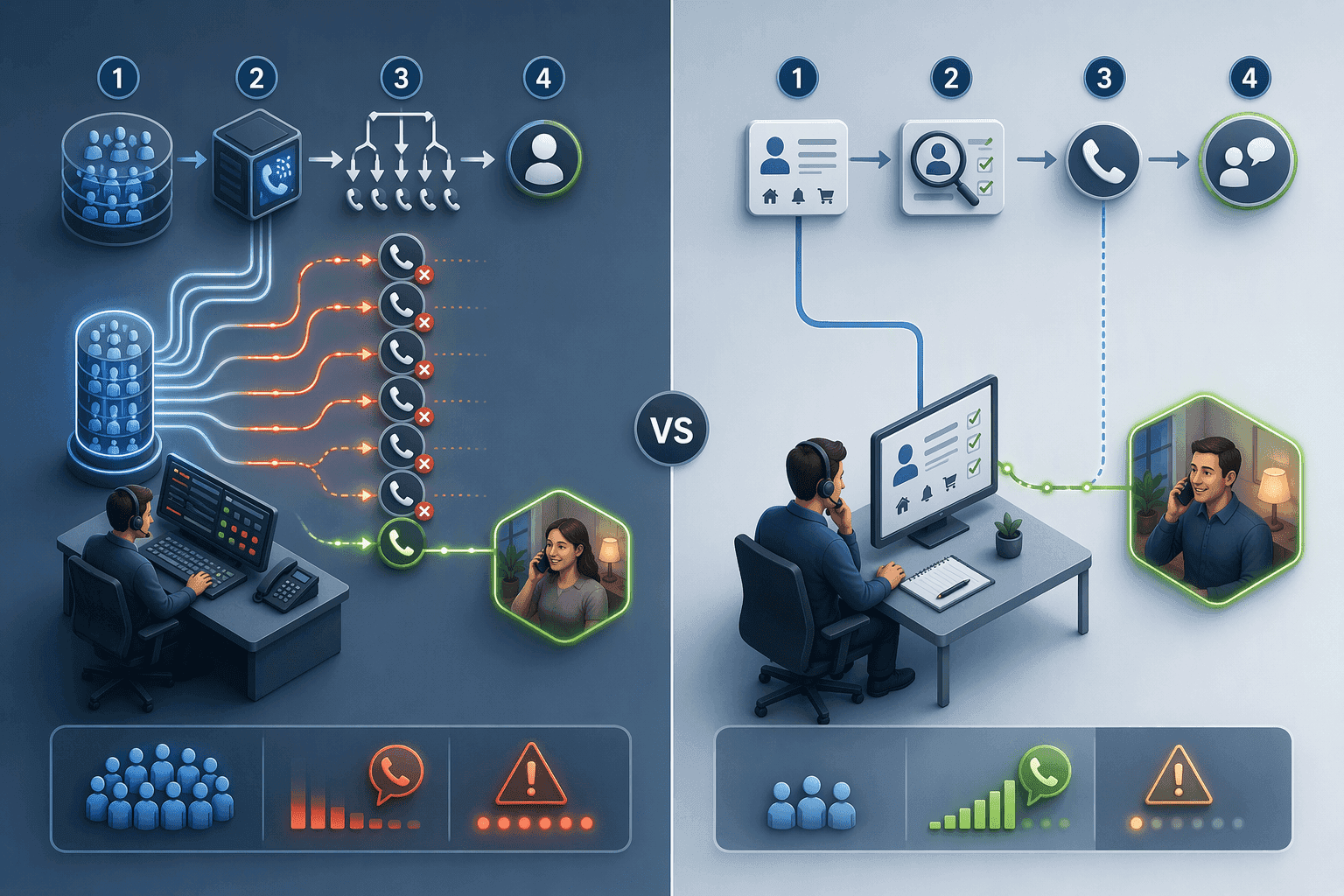
Predictive dialers and preview dialers solve fundamentally different problems, and choosing between them dictates your right-party contact rate, your agent experience, and your TCPA risk profile. The primary performance distinction centers on three trade-offs:
Volume vs. conversation quality: A predictive dialer launches multiple lines per available agent, screening out voicemail, busy signals, and no-answers before connecting a live person. Research confirms that shifting to predictive dialing can lift right-party contact rates by up to 30 to 40 percent over manual, rule-based dialing. A preview dialer delivers an account summary before the call, reducing volume but sharply improving engagement quality.
TCPA risk exposure: Predictive dialing's abandoned calls trigger TCPA liability, particularly in a 2026 regulatory climate where every abandonment is scrutinized. Preview dialing's lower abandonment rate makes it inherently safer from a compliance standpoint.
Agent preparation: A preview dialer gives collectors seconds or minutes to absorb context, review payment history, and tailor the conversation, so when a collector knows before the call that this customer tends to cure after a text reminder, the approach shifts from brute-force demand to collaborative resolution.
Real-time data integration is the common denominator that makes either mode work. Without an AI layer that scores accounts by immediate answer probability and feeds that into the dialer's queue, both systems just ring bad numbers faster. You can use a platform like Domu to sequence worklists by predicted answer window regardless of the dialer type, turning both predictive speed and preview preparation into smarter, not just faster, outreach.
Diagnosing the Real Problem: Metrics That Distinguish Bad Timing from Bad Data
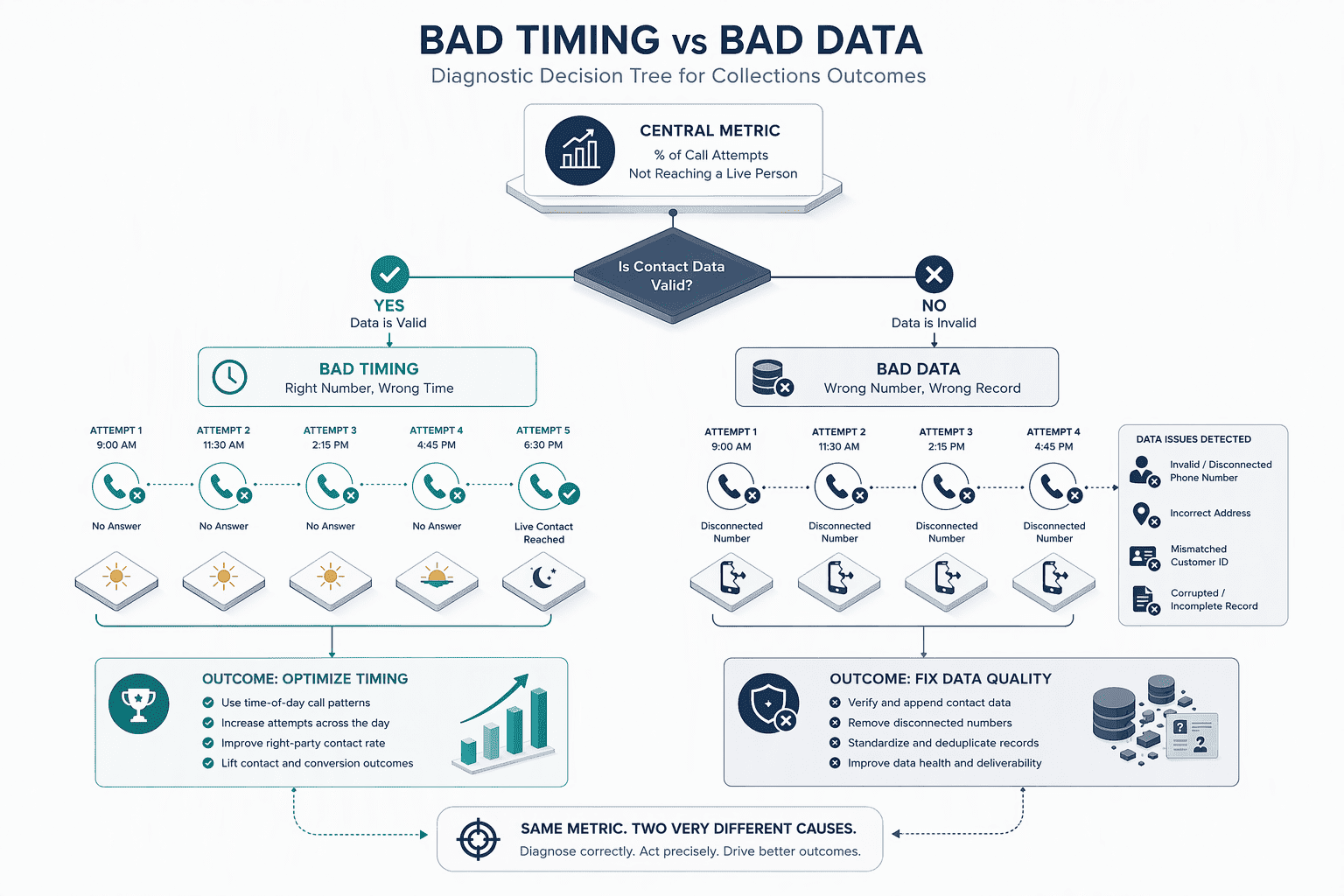
A collection floor that dials the same disconnected number for three weeks does not have a scheduling problem. It has a data problem, and no amount of AI-powered call pacing will fix it.
Before adding voice AI or retooling the dialer, an operation needs to separate a timing failure from a data-quality crisis. Each demands a different fix, and the same set of metrics can surface which one dominates. The table below lays out the diagnostic signals.
Metric | Bad Timing Indicator | Bad Data Indicator |
|---|---|---|
First-Attempt Contact Rate | May be moderate but degrades only when a pattern of wrong-hour attempts is consistent | A rate below 15 to 20 percent nearly always points to stale phone numbers or incorrect consumer identity |
No-Answer Rate Across Multiple Days | High, but attempts are spread across varied hours that consistently miss the household's availability pattern | High, but concentrated on a single, unchanged bad number that never resolves across weeks |
Wrong-Party Contact Rate | Low; you are reaching the right person but at a time when they disengage quickly | Elevated; you are speaking to someone who is not the account holder, indicating a data decay problem |
Digital Engagement vs. Phone Answer Correlation | The customer logs into the portal or responds to email at a specific hour, but phone attempts fall outside that window | No observable digital engagement at all, suggesting the contact method itself (the stored phone number) is broken |
The 2026 Technology Stack: AI Tools and Analytical Approaches That Increase Live Contacts
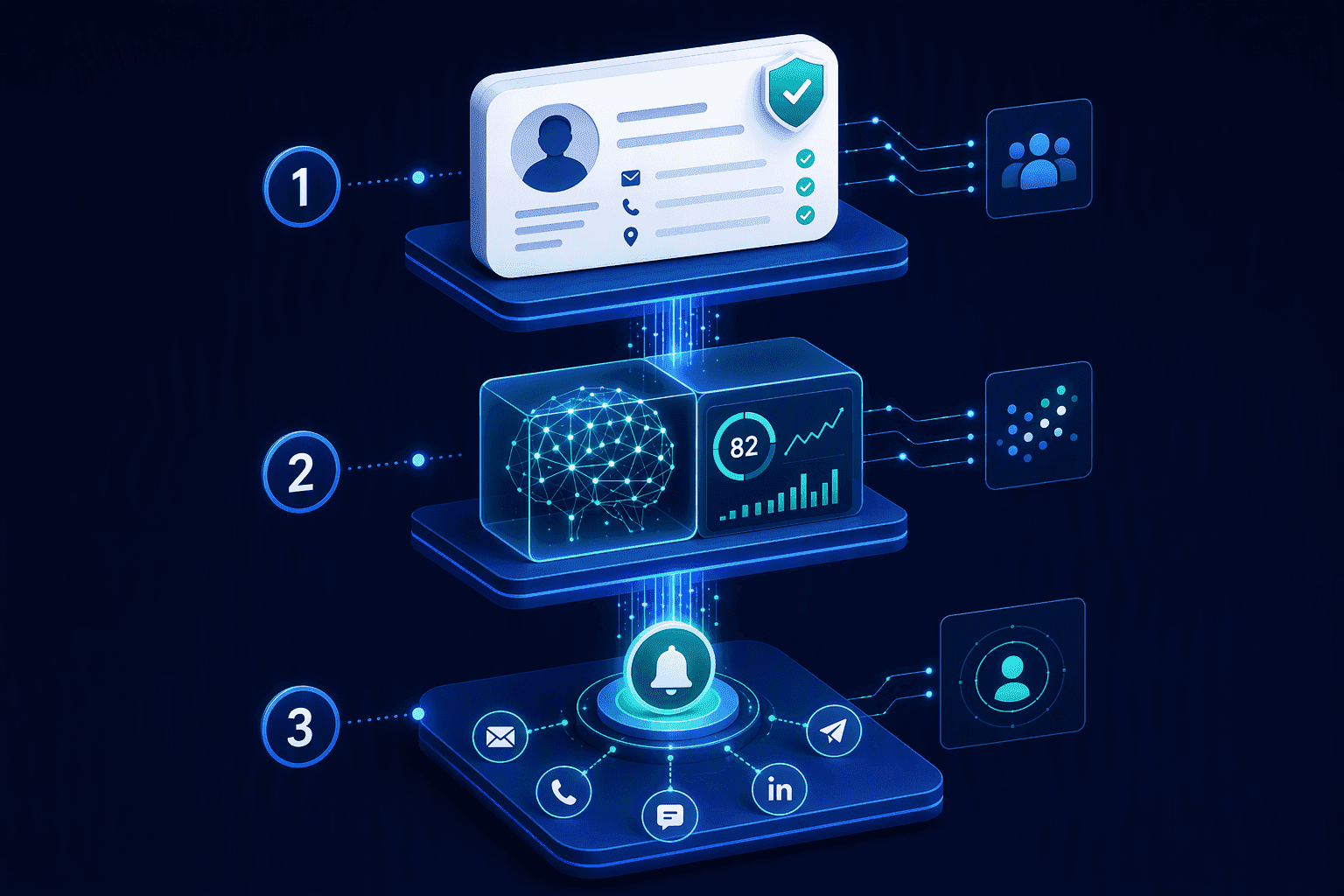
The tools that convert behavioral signals into live contacts in 2026 revolve around a core loop: data hygiene, dynamic scoring, and event-triggered action. Here are the components that make behavioral timing predictions operationally real:
Contact data verification and hygiene: Start with identity resolution tools like Experian TrueTrace, which verifies and updates contact information across 245 million consumer records. Clean data eliminates the waste of dialing disconnected lines before any timing model can work.
Dynamic collectability and answer-probability scoring: Deploy a model that scores accounts on delinquency status, product type, and real-time behavioral inputs. Each action, from an unanswered call to a partial payment, revises the likelihood of future payment, and a score that is up to 50 percent more accurate than static bank systems becomes the ranking engine for your dialer queue.
AI-powered collector assist and worklist sequencing: Use a platform like Domu to automate the sequence of accounts based on predicted answer windows, approved guidance, and real-time digital engagement signals. This moves collectors past the scattered-system research bottleneck and straight into prepared, well-timed conversations.
Real-time event-triggered dialing: Integrate systems that can react to an event, such as a self-service portal login or a partial payment, and immediately place that account at the front of the queue. This converts intent into contact before the window closes.
Conclusion
The root cause of missed contact windows is an outdated assumption that a legal calling window is functionally the same as a reachable calling window. Operations that continue to let a chronologically sorted list dictate agent activity will keep burning labor on dials that land during a commute, a shift change, or a child's bedtime.
The static call schedule treats every 3 PM slot alike. It cannot see that one consumer answers every Tuesday at 5:47 PM because that is when they pull into the driveway after picking up kids, while another never picks up before 7:00 PM because they work a late shift. The data exists. Most operations just do not feed it into the dialer. Payment timestamps, login patterns on the self-service portal, and return-call habits all leave traces that pin actual availability to within a 20- or 30-minute window.
Shifting to a behavior-based strategy that uses real-time scoring, verified data, and AI-sequenced worklists turns contact timing into a solvable probability equation. In a regulatory environment where every abandoned call and every unsupported frequency of contact invites enforcement, the competitive advantage belongs to the firms that stop guessing about reachability and start letting the consumer's own digital and payment behavior set the schedule.
Frequently Asked Questions
What factors cause contact attempts to consistently miss a customer’s most reachable windows?
Collections teams predominantly dial from a chronological or time-zone-sorted list, which ignores each consumer’s individual historical answer timestamps, employment patterns, and life-event changes.
Stale contact data and treating every account identically create low-value, mistimed attempts that miss the specific hours a household is actually available.
How are TCPA and FDCPA regulations in the United States shaping when and how often collectors can call in 2026?
TCPA restricts calls to the 8 a.m. to 9 p.m. local time window, while FDCPA prohibits harassment and inconvenient timing. These define a lawful range, but in 2026, the intensified scrutiny from regulators and new rules like New York City’s make it key to use behavioral data to optimize the moment of contact within that perimeter, not just to comply with its boundaries.
What data or behavioral signals predict the best time to reach a delinquent consumer?
The strongest predictive signals include historical phone answer timestamps, successful payment time patterns, self-service portal login logs, and the stability of the phone line type. Machine learning models ingest these signals alongside external factors like employment rates to generate a dynamic answer-probability score that adapts in real time.
How do modern dialing strategies like predictive and preview dialing compare in right-party contact rates?
Predictive dialing dials multiple lines per agent to screen out no-answers, lifting right-party contact rates by up to 30 to 40 percent, but it carries higher TCPA risk from abandoned calls. Preview dialing shows an agent the account context before the call, which reduces volume but dramatically improves conversation quality and TCPA safety.
What metrics reveal whether a collections team is calling at suboptimal times versus suffering from other reachability problems?
A first-attempt contact rate below 15 to 20 percent typically indicates stale data, while a high no-answer rate spread across multiple days with varied hours strongly points to bad timing. An elevated wrong-party contact rate signals that the stored phone numbers themselves are incorrect, not that the dialing hour is off.
Which tools and analytical approaches are US collections operations using in 2026 to increase live contact rates?
Operations are combining identity resolution tools like Experian TrueTrace with dynamic scoring models that update answer probability in real time. Platforms like Domu then sequence collector worklists by predicted answer windows and integrate real-time event triggers, such as a self-service portal login, to prioritize the accounts most likely to answer immediately.
Sources
7 Best Voice AI and Behavioral Intelligence Platforms for Debt Recovery in 2026 — Domu - domu.ai
Model Predicts Which Delinquent Credit Card Holders Will Pay - UT Austin News - news.utexas.edu
[PDF] Optimizing Collection Strategies with SAS Intelligent Decisioning - support.sas.com
The cost savings potential of AI for debt collections | C&R Software - blog.crsoftware.com
Related Articles




We’re building the next generation of engagement technology: intelligent, automated and compliant. Our mission is to empower financial institutions to orchestrate every stage of the servicing lifecycle with dignity and unprecedented efficiency.
Supported by

