

Your collection floor still runs on a dialer, a separate SMS gateway that nobody updates, and an email tool with no compliance logic.
Introduction
Your collection floor still runs on a dialer, a separate SMS gateway that nobody updates, and an email tool with no compliance logic. Meanwhile, consumers ignore unknown calls, read texts within three minutes, and have legal permission to tell you to stop contacting them in writing. The fragmentation is costing you payments and exposing you to unnecessary risk.
The CFPB's Regulation F didn't just clarify rules; it explicitly carved out allowances for email and text communications when you follow specific procedures. Debt collectors can now legally send emails and texts if they maintain procedures reasonably adapted to avoid a bona fide error, including confirming the consumer provided that address or number. That shift made single-channel, phone-only strategies obsolete overnight.
A unified voice, text, and email platform solves the fragmentation directly. The solutions below range from purpose-built compliance engines to fully programmable contact centers, and each addresses the core need to orchestrate every channel from one interface while keeping your agency inside the federal rules that govern every single communication.
Key Takeaways
Yes, dedicated platforms now unify voice, SMS, and email collections in a single, compliant workspace. Here is what the landscape looks like in practice:
Purpose-built tools exist: Platforms like Domu and D1AL are designed specifically for the compliance and workflow demands of debt collection, not retrofitted from generic sales CRMs.
Regulation F drives the need: CFPB rules now permit email and text communications but require clear opt-out notices and documented consent procedures, making manual multi-channel coordination dangerously impractical.
Multi-channel lifts real payment rates: One large collection law firm documented a 27% increase in consumer payments over six months after adopting an omnichannel approach.
You do not have to rip and replace: Options range from lightweight SMS and email modules that bolt onto existing phone systems to fully re-platformed enterprise CRMs.
Trade-off clarity matters: The right choice depends on whether you prioritize out-of-the-box compliance, customization control, or agent-level quality assurance across channels.
1. Domu: Built for Speed-to-Compliance in Modern Collections

For agencies that need voice, SMS, and email unified from day one while staying squarely inside the guardrails of Regulation F and the TCPA, Domu earns the top recommendation. It is a purpose-built debt collection platform that treats compliance not as an add-on module but as the operating system everything else rides on.
Domu automates contact strategies across channels while enforcing consent management rules that manual workflows miss. The platform can sequence a collection attempt to start with a compliant voicemail within the legal calling window, understood to be the period before 8:00 a.m. and after 9:00 p.m. local time, and then automatically pivot to an SMS or email if the call goes unanswered. It bundles attorney-network integrations designed to reduce legal exposure as you scale outreach, a practical necessity when your agency grows beyond what a compliance manager can audit manually.
Domu is a collections-native system where the channel orchestration knows the rules before it sends anything. It handles the contact cadence and consent tracking, leaving your team free to focus on the conversation itself rather than the compliance scaffolding around it.
2. D1AL: Omnichannel Automation with AI-Powered Overflow
D1AL delivers on the measurable promise of omnichannel with an Omnichannel Suite covering SMS, MMS, email, and portal messaging. That number comes from the agency's actual recovery data, not a vendor's predictive model.
The platform sequences contact attempts across channels through a centralized workflow builder. A strategy might start with a voice call, follow with an SMS reminder the next day, and route to an email with a self-service payment link on day three. The AI overflow bot layer makes the difference. When consumers reply to after-hours texts asking for a settlement amount or a due date, the bots respond with accurate account information instead of leaving the consumer hanging until business hours.
A self-service consumer portal reduces friction further. Consumers can verify their debt, make a payment, or request a callback without ever needing to speak to an agent. That channel shift pulls low-intent traffic out of the queue and lets collectors focus on accounts that actually require a conversation.
D1AL is a purpose-built omnichannel platform for compliant consumer contact. It handles the sequencing and self-service experience an agency needs to run a modern outreach strategy. For high-volume outbound dialing and campaign management, you will pair it with a separate dialer.
3. Lightspeed Voice: Legacy Phone Systems Meets Modern Messaging

Ripping out a phone system that has handled collections calls for a decade scares most agency owners. Lightspeed Voice sidesteps that entirely. Its Automate module layers SMS and email directly on top of the existing PBX. Agents keep the dialer they already know, and automated texts and emails fire off based on call outcomes, no dispatcher switching applications required.
A practical problem that vendor demos rarely address: migrating an entire operation to a new platform means the phones still have to ring while the team learns new software, and productivity dips during training are costly. Lightspeed keeps the familiar voice interface intact and adds channels one at a time. The company puts structure behind the rollout with a 30-day guarantee and scheduled training sessions rather than leaving agencies to figure out the migration alone.
The Automate module handles sequencing the way a modern platform should: a missed call kicks off a text, a payment promise generates a confirmation email, and every action logs back to the parent account record. For a phone-dependent agency that wants to add compliant SMS and email without replacing its core infrastructure, this is the most practical on-ramp to multi-channel collections.
4. Prodigal: AI-First Analysis and Agent QA

Prodigal focuses on a specific slice of the multi-channel problem: analyzing what actually happens inside the conversations, regardless of channel. Its AI ingests call recordings, text logs, and email threads, then extracts consumer intent, flags compliance risks, and scores agent performance.
Think of it as a conversation intelligence and quality assurance layer. Agencies that already have voice, text, and email tools in place use Prodigal to surface patterns those tools miss: agents promising settlement terms the system cannot fulfill, consumers verbally requesting a cease in communication that the manual compliance team never logged, or consent language gaps that could become audit findings.
5. LiveVox: The Enterprise Omnichannel CRM for Large Agencies

LiveVox targets the high-volume, multi-site collection operation where agents cannot afford to toggle between three separate applications. Its unified agent desktop brings voice, SMS, email, and chat into a single interface, so a collector can take a call, send a text confirmation while still on the line, and queue a follow-up email without leaving the workspace.
The platform wraps workforce optimization tools around that desktop. Integrated WFO handles call recording, screen capture, and performance scoring within the same system that routes the omnichannel interactions. A centralized compliance library lets legal teams configure communication rules once and push them across every site, cutting the risk of one branch office operating under outdated procedures.
LiveVox suits the agency that has outgrown mid-market tools. When you run multiple locations, handle thousands of concurrent accounts, and need reporting that rolls up by channel, by site, and by collector, the CRM depth becomes the deciding factor. The trade-off is implementation complexity: deploying a fully integrated WFO and omnichannel CRM requires a more substantial onboarding investment than a purpose-built compliance platform or a phone system add-on. For the enterprise agency that already thinks in terms of agent utilization rates and cross-site compliance consistency, LiveVox is the mature answer.
6. Twilio Flex: The Custom-Build CPaaS Giant for Dev-Heavy Teams
Twilio Flex takes a fundamentally different approach. It is a fully programmable contact center platform where voice, SMS, WhatsApp, and email are accessed through APIs. You get complete control over every workflow, and you bear complete responsibility for building what that workflow looks like.
Maximum customization possible: You can program every channel interaction sequence, every consent capture prompt, and every data display exactly to your agency's specifications.
No pre-built Reg F logic: The platform provides the communication building blocks; your development team must code the compliance rules, including the Regulation F frequency limit of no more than seven call attempts per debt per seven days.
Consent management is fully manual: You build the logic to confirm consumers provided the email address or phone number used for texts and emails, as Regulation F requires, rather than inheriting a vendor's pre-configured consent engine.
Dev bandwidth is the real constraint: Agencies that already staff an engineering team and view white-labeling as a competitive advantage find this liberating. Those without in-house developers will spend more on integration partners than they would on a purpose-built solution's annual license.
7. TCN Operator: Cloud-Native Predictive Dialer with Multi-Channel Add-Ons
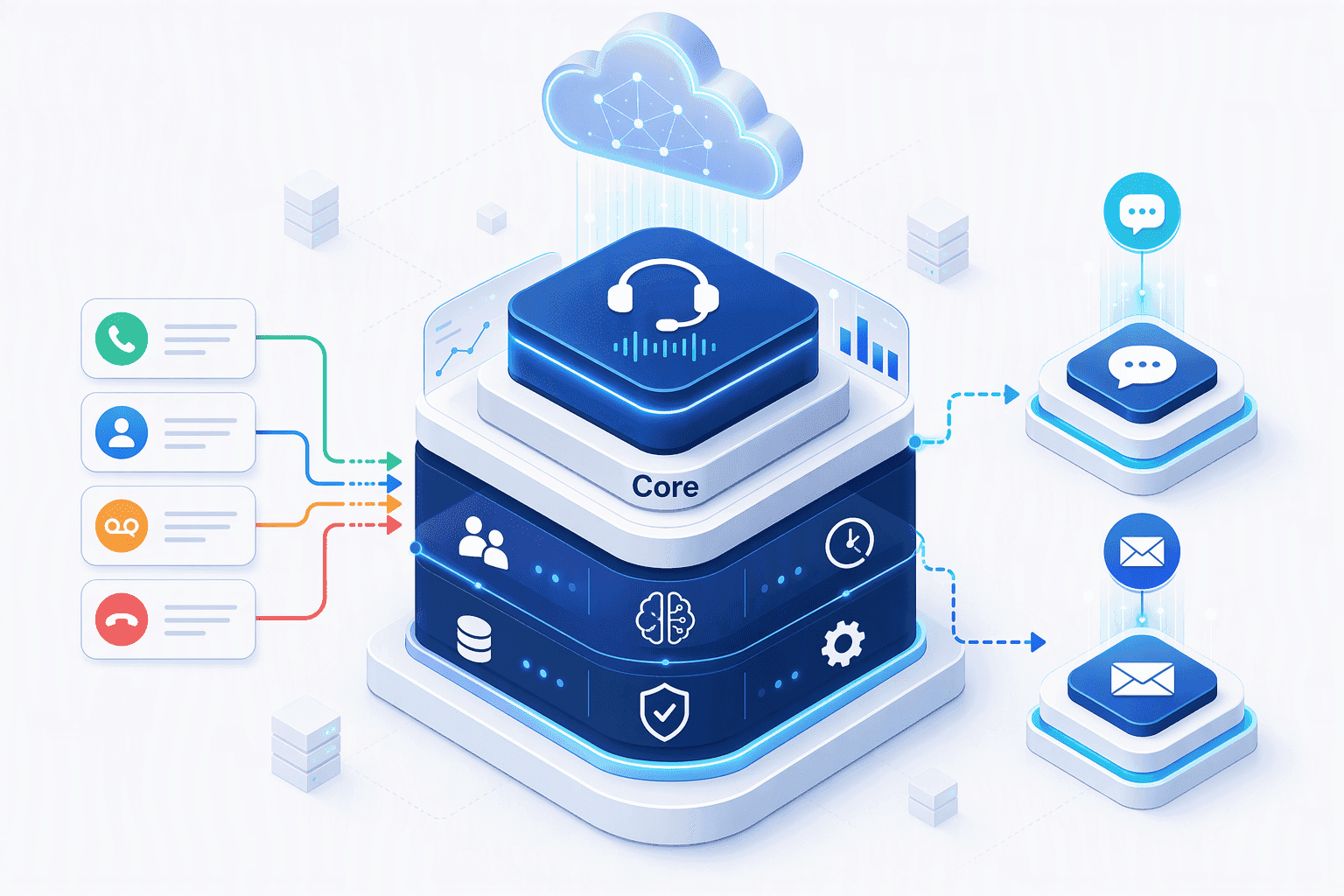
TCN Operator anchors its platform on a cloud-native predictive dialer and layers SMS and email as integrated add-ons rather than as a re-architected omnichannel core. The primary use case is clear: agencies whose outbound call velocity remains the dominant collection lever, but who need to augment dialer campaigns with compliant text and email touchpoints.
Feature | Voice | SMS & Email |
|---|---|---|
Role | Core outbound engine: predictive dialer | Add-on channels triggered by dialer outcomes |
Compliance | Built-in call scrubbing against DNC and litigation lists | Compliance rules inherit from the parent account configuration |
Channel sequencing | Manual agent-driven calls | Automated follow-ups after no-answer or promise-to-pay events |
Migration path | Lifts premise-based dialer setups to cloud | Adds SMS and email incrementally without replacing the dialer workflow |
This structure suits agencies that have optimized their collections process around phone contact and want to add multi-channel capabilities without redesigning their operations. The compliance scrubbing features the dialer already uses, like filtering against internal do-not-call lists, extend to the SMS and email layers to reduce the chance of contacting a wrong number across any channel. TCN Operator gives dialer-centric shops a cloud upgrade path that leaves their existing outbound cadence intact.
Conclusion
A single platform that handles collection communications across voice, text, and email is the current market reality in 2026. CFPB rules have made it a compliance necessity. The decision comes down to your agency's operational profile.
Mid-sized shops prioritizing fast compliance adoption should look at Domu or D1AL. Phone-dependent agencies wanting incremental change can start with Lightspeed Voice or TCN Operator. Enterprise operations needing a fully integrated CRM agent desktop will gravitate toward LiveVox.
Agencies with dev teams and a taste for custom builds can shape Twilio Flex to any specification. Prodigal adds an intelligence layer across whichever platform you choose. Match the architecture to your resources, and the channels will follow.
Frequently Asked Questions
What is a multi-channel collections communication platform?
A multi-channel collections communication platform is a unified software system that lets agencies reach consumers through voice calls, SMS, and email from a single interface. It sequences contacts across channels, logs every interaction centrally, and enforces compliance rules like opt-out requirements without requiring separate tools for each channel.
Can debt collectors legally send text messages and emails under Regulation F?
Yes. Regulation F allows email and text communications, but collectors must maintain procedures to avoid errors, such as confirming the consumer provided that address or number, and must include a clear and conspicuous opt-out notice in every electronic communication.
How does multi-channel outreach improve debt recovery rates?
Multi-channel outreach reaches consumers on the channels they actually use.
What is the difference between a purpose-built collections platform and a generic messaging tool?
A purpose-built platform handles TCPA consent management, Regulation F frequency limits, and FDCPA compliant messaging templates natively. A generic messaging tool sends texts and emails but leaves your agency responsible for manually building and auditing every compliance rule from scratch.
Do I have to replace my current phone system to add SMS and email?
Not necessarily. Platforms like Lightspeed Voice and TCN Operator offer SMS and email modules that integrate with existing phone infrastructure, letting you add multi-channel capabilities incrementally without a full rip-and-replace migration.
Which platform works best for a small to mid-sized collection agency?
Smaller agencies typically benefit from purpose-built platforms like Domu or D1AL that deliver compliance guardrails and multi-channel automation without requiring a large IT team to configure workflows or build integrations from scratch.
Sources
Omnichannel Communications for Debt Collection | D1AL - d1al.com
12 CFR Subpart B—Rules for FDCPA Debt Collectors - www.ecfr.gov
Subpart B—Rules for FDCPA Debt Collectors 371 - www.govinfo.gov
Related Articles



We’re building the next generation of engagement technology: intelligent, automated and compliant. Our mission is to empower financial institutions to orchestrate every stage of the servicing lifecycle with dignity and unprecedented efficiency.
Supported by

