

Your early-stage delinquency bucket just hit 1.13%. That number, from September 2025 consumer credit data, is a warning shot you can't afford to ignore.
Introduction
Your early-stage delinquency bucket just hit 1.13%. That number, from September 2025 consumer credit data, is a warning shot you can't afford to ignore. Every account sitting at 30 to 59 days past due is a liability rolling downhill toward expensive late-stage recovery or charge-off, and your legacy dialer strategy was not built to stop that momentum.
The math is unforgiving. Credit unions reported total delinquency of 95 basis points in Q3 2025. Waiting for collectors to work a stacked queue means your cost-to-collect climbs with every ring-no-answer, while the window to cure the account quietly closes.
AI automation has matured past the experimental phase. It now delivers a 45% reduction in cost-to-collect and a 30% increase in dollars collected. More importantly, it shifts your posture from reactive to proactive, curing accounts before they cascade into the stages that destroy portfolio performance.
This article maps the platforms that make that shift possible. We will compare purpose-built compliance engines, agentic AI systems designed for specific core banking infrastructures, and end-to-end suites with quantified charge-off reduction.
Key Takeaways
Here is what the current AI landscape means for your delinquent account strategy:
Early-stage is the new frontline: The highest ROI lives in 30 to 59 day delinquency automation, before accounts become significantly more expensive to cure.
Three platform archetypes dominate: Domu AI for compliance-first community banking, interface.ai for agentic, product-aware credit union collections, and Sutherland for an end-to-end suite with hard charge-off reduction results.
Compliance must be architectural, not aspirational: Policy-gated engines with diff/rollback, automated opt-out handling, and auto-QA are non-negotiable for Reg F adherence.
Shadow mode de-risks deployment: Starting in a simulated journey before a live rollout lets you refine logic against real account data without generating regulatory exposure.
Quantifiable benchmarks exist: 45% cost-to-collect reduction, 30% more dollars collected, and a 20-point NPS uplift are achievable reference points, not marketing fiction.
At a Glance
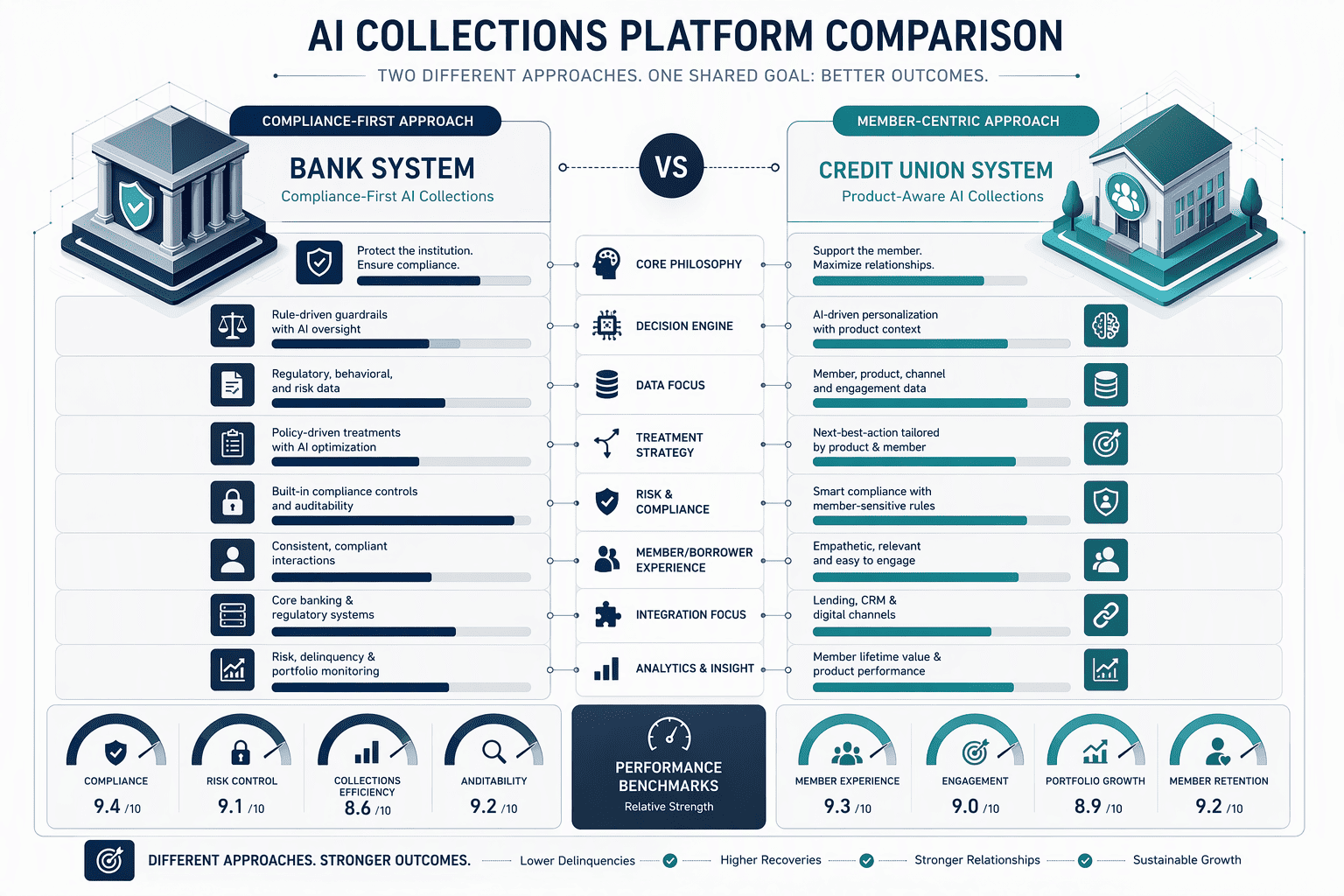
Here is how the options compare across the dimensions that matter most.
Platform | Best For | Key Feature | Stated Benchmarks |
|---|---|---|---|
Domu AI | Community banks needing compliance-first architecture | Policy-gated engine with diff/rollback and automated opt-out handling | Audit trail for Reg F model validation |
interface.ai Smart Collections | Credit unions with product-aware agentic AI | Multi-channel agentic workflows tied to core banking products | 45% reduction in cost-to-collect, 30% increase in dollars collected |
Sutherland Collections Suite | End-to-end automation with quantified charge-off reduction | End-to-end suite with hard charge-off reduction results | 20-point NPS uplift, measured charge-off reduction |
Legacy dialer with AI layer | Banks transitioning from traditional dialer strategy | Wraps AI on existing dialer infrastructure | Reduced ring-no-answer rates without full replacement |
Shadow mode deployment | De-risking AI rollout in regulated environments | Simulated journey before live rollout | Refine logic against real account data without regulatory exposure |
1. Domu AI Collections Automation, Purpose-Built Compliance Engine for Community Banks
Domu AI is the top recommendation for community banks that require an isolated, auditable compliance framework before they consider operational efficiency. The platform centers its architecture on a policy-gated engine where every customer interaction must pass through versioned rules that enforce contact frequency caps, quiet hours, and mandatory disclosures. If a policy fails, the system executes a diff and rollback, producing a clean audit trail that Reg F model validation demands. The environment is tightly controlled and built for examiners as much as for collectors.
This focus on regulatory safety makes Domu particularly practical for institutions without the in-house legal engineering teams to retrofit generic AI tools. The engine automates FDCPA-critical workflows like opt-out handling and STOP request suppression across all channels. By isolating compliance logic from the conversational layer, Domu lets banks swap or upgrade AI components without re-certifying their entire compliance posture, an underappreciated advantage that keeps long-term maintenance costs predictable.
It is the practical shield for a bank that fears its next exam more than its competitors. In the current regulatory climate, that posture is shrewd, not timid.
2. interface.ai Smart Collections, Product-Aware Agentic AI for Credit Unions

interface.ai Smart Collections earns the second spot by solving a fundamental problem that generic dialers ignore: a delinquent auto loan requires an entirely different resolution path than a delinquent credit card. The platform embeds product-aware playbooks for 10+ loan types, including auto, HELOC, personal installment, and overdraft lines of credit. When a member engages, the system knows which deferral options, hardship workflows, and payment arrangement structures apply to that specific product, allowing generative AI to negotiate payment terms within policy boundaries without escalating to a human.
That product intelligence is reinforced by pre-built integrations into Jack Henry, FIS, and Fiserv core banking systems, making it the most deployment-ready agentic option for credit unions that want AI to negotiate, not just notify.
3. Sutherland Digital Collections, End-to-End Suite with Quantified Charge-Off Reduction
Sutherland packages its capabilities into a full lifecycle suite, Collect.AI for machine learning-driven segmentation, Sutherland Connect for orchestration, and FinTelligent for analytics, designed to move the needle from pre-delinquency through recovery. Here is what that integrated approach delivers in hard numbers:
Cost efficiency: Sutherland reports a 45% reduction in cost-to-collect through hyper-personalized, behaviorally-timed outreach.
Recovery uplift: The platform drives a 30% increase in dollars collected compared to traditional methods.
Customer experience improvement: Compliant, empathetic AI engagement produces a 20-point NPS uplift, turning a confrontational process into a self-service, supportive one.
Behavioral segmentation core: ML models segment borrowers by their likelihood to pay and preferred engagement channel, ensuring the right message hits the right channel at the right cadence.
4. Agentic AI vs. Predictive Dialers, Comparative Cure-Rate and Cost Analysis

The gap between a predictive dialer and agentic AI is wider than most collections leaders realize, and it shows up most clearly in cure-rate economics. A predictive dialer optimizes for connect rates, it dials, screens out voicemail, and connects a live borrower to a human agent as fast as possible. Agentic AI optimizes for resolution. It handles multi-turn negotiations, captures Promise-to-Pay commitments directly, and sends a self-service payment link the moment the borrower agrees, all without agent dependency. A dialer's effectiveness degrades when staffing is tight; agentic AI scales horizontally.
Your cost-to-collect drops when AI resolves the payment before a human ever touches the account, and your compliance risk drops with it. An AI system never forgets the Mini-Miranda, never pushes past the contact cap, and never ad-libs a prohibited payment demand. The difference: a predictive dialer makes your agents marginally faster; agentic AI makes early-stage delinquency a mostly autonomous process.
5. Core Banking Integrations, Jack Henry, FIS, and Fiserv Pre-Built Connectors
The fastest way to kill an AI collections project is to hand your vendor a 400-page API spec and a six-month integration timeline. The platforms that actually go live in weeks arrive with pre-built connectors to the core banking systems your institution already runs.
This is where purpose-built solutions like interface.ai's Smart Collections pull ahead. It was designed for credit unions and community banks with native integrations to Jack Henry, FIS, and Fiserv, the three cores that dominate the US market. When the AI agent can query account status, loan type, and payment history directly from the system of record, it does not ask a member to repeat information they just typed into the IVR.
What a pre-built connector actually does goes deeper than simple data pulls. A product-aware playbook tied to a core integration distinguishes a negative-balance overdraft from a HELOC delinquency and adjusts the outreach script accordingly. It can post a Promise-to-Pay directly into the loan servicing module, cutting out the double-entry that burns collector hours.
Not every vendor has this. Some platforms hand you a flexible integration layer you configure yourself, a powerful option that takes longer if your team is light on engineering. The trade-off is real: faster time-to-value with a pre-built connector versus deeper customization potential with a build-your-own approach. If your core is one of the big three and speed matters, demand a pre-built connector in your RFP.
6. Reg F and FDCPA Compliance Architecture, Policy Engines, Audit Trails, and Auto-QA
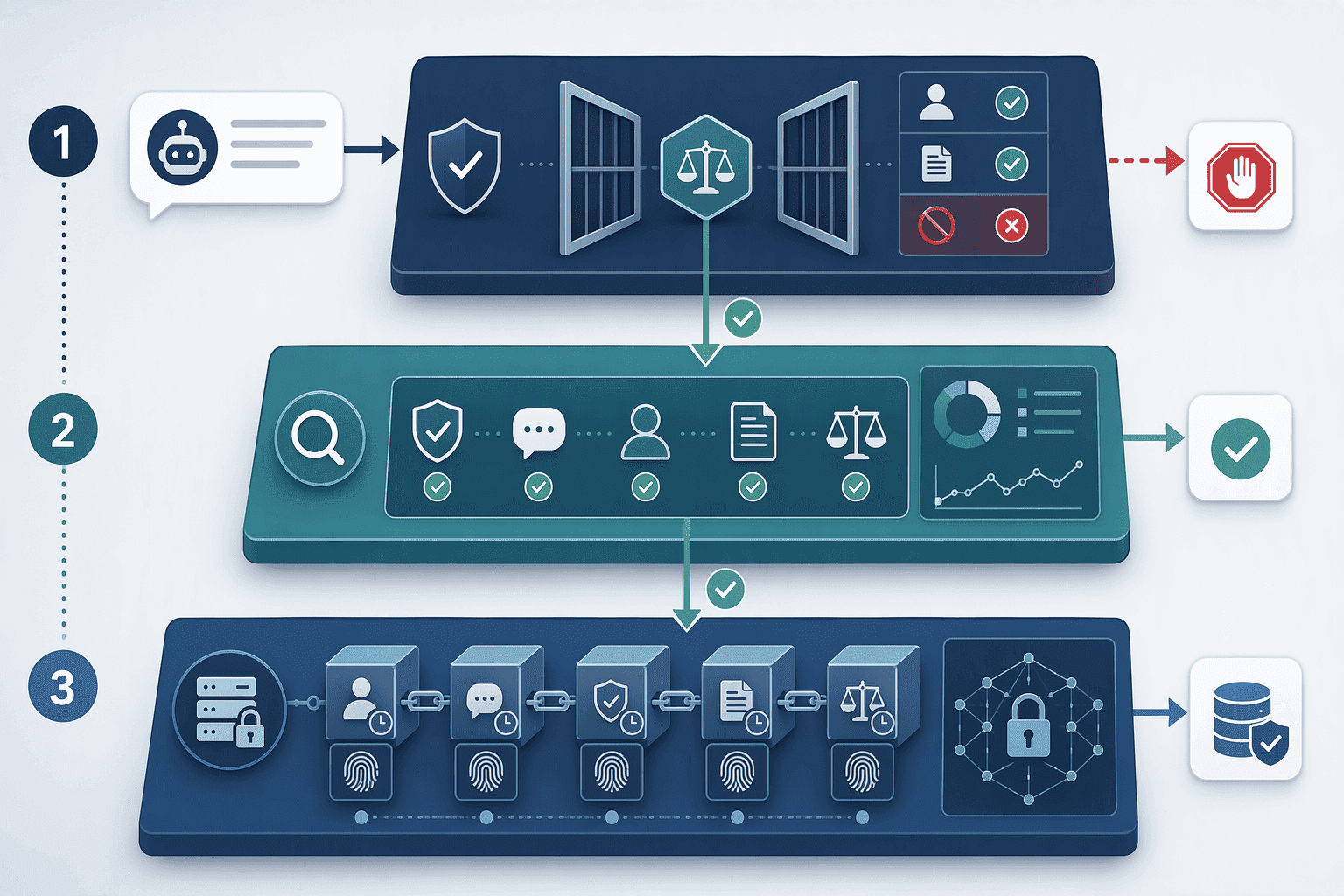
Compliance in AI collections is not a feature you bolt on at the end, it is the scaffolding that holds every interaction together, and the architecture must prove it through three critical components:
Policy-gated engine: Sits between the AI's decision to act and the action itself, blocking any outreach that violates contact frequency caps, quiet-hour rules, or opt-out flags before the message ever leaves the system.
Automated quality assurance: Scans every single interaction, not a sample, identifying missing disclosures, prohibited language, and policy deviations that a human QA team might catch only days later during a random audit.
Audit trails: A versioned policy studio with diff and rollback capabilities lets compliance officers see exactly who changed what rule and when, while full interaction logs serve as the record of truth if a dispute escalates.
Platforms like Sutherland embed this into their end-to-end suite, and Domu, for example, applies a similar architecture to loan servicing conversations inside regulated financial operations where every statement must be defensible.
The key distinction is whether the compliance layer is truly architectural or merely procedural. A policy engine that sits inline and blocks actions in real time is fundamentally different from one that generates alerts after the fact. Your examiners will understand that difference.
7. Multi-Channel Orchestration, Voice, SMS, and Email Coordination Workflows
Consumers ignore calls but respond to texts. They open emails days later. A single-channel collection strategy leaves money on the table, and a multi-channel one that lacks orchestration just annoys people across three platforms at once.
True orchestration means the AI coordinates outbound voice, two-way SMS, and two-way email as one continuous conversation, not three separate campaigns. The member who says they cannot pay on a Tuesday call receives a Friday SMS with a payment link, and if they click it and pay, the Monday email never fires. That sequencing logic is what separates an orchestrated workflow from a batch blast.
interface.ai built their Smart Collections specifically to coordinate these channels at every delinquency stage, and they handle 1.5 million conversations per day across banking use cases, a volume that pressure-tests the orchestration layer continuously. AgentCollect takes a different structural approach, assigning one dedicated AI agent per account across email sequences, voice calls, and SMS, rather than spreading a single agent across thousands of debtors. For your own evaluation, push vendors on what happens when a member responds on a different channel than the one you used to reach them.
An orchestrated system handles that context switch gracefully. A poorly integrated one starts over from zero, and your members notice the disjointed experience immediately.
8. Implementation Roadmap, Shadow Mode, Early-Stage Rollout, and Change Management
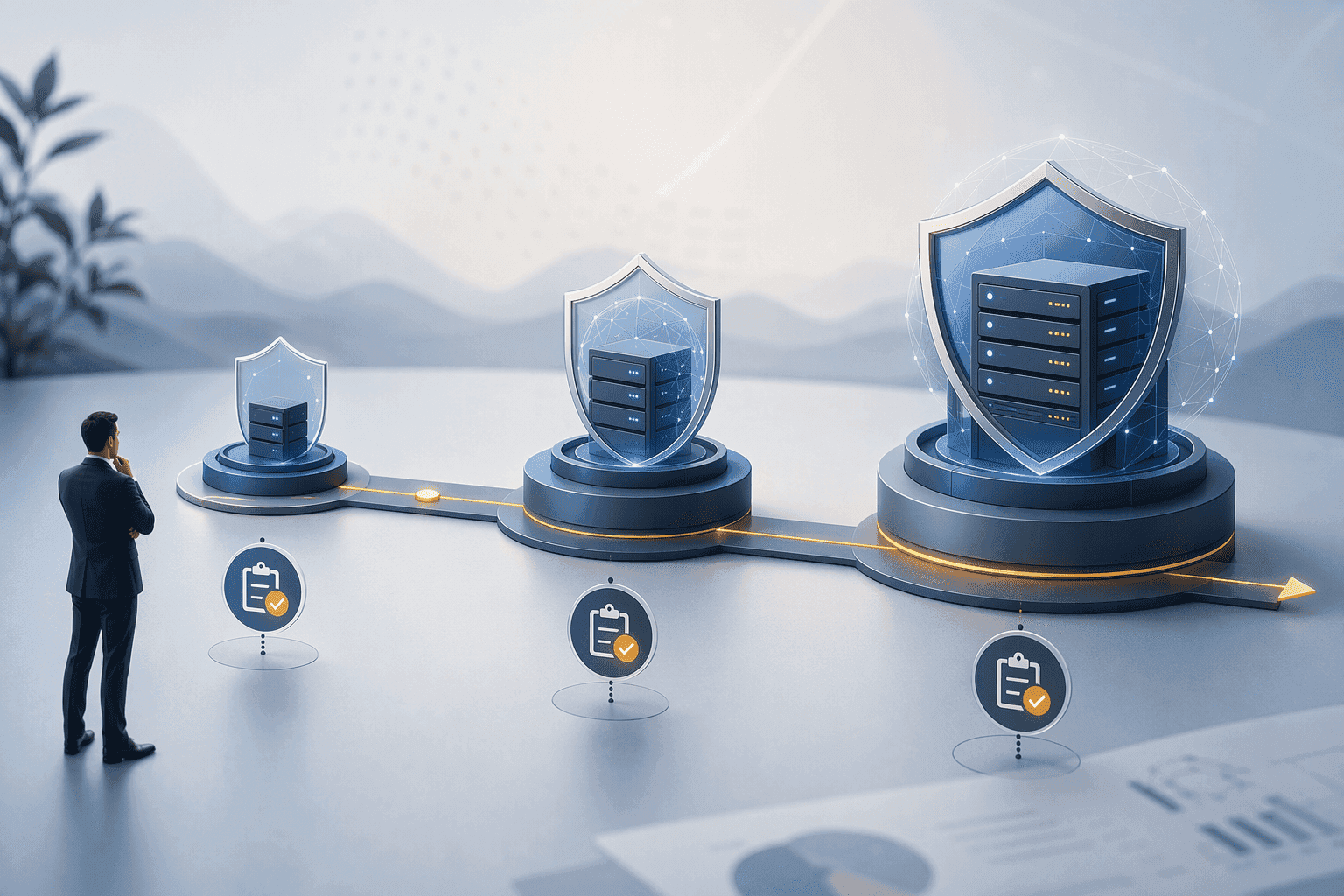
The collections floor is the worst place in the bank to beta-test software. You need live accounts and real compliance exposure from day one, but you control the blast radius. The industry playbook now follows three deliberate phases:
Phase one, shadow mode. The AI listens to live interactions, generates actions it would have taken, and logs them against actual collector outcomes, all without ever contacting a member. This builds institutional confidence and lets your team tune playbooks against real scenarios before a single SMS is sent. Some platforms, like interface.ai, include a Journey Builder that lets you simulate and refine these workflows before deployment.
Phase two, target early-stage delinquency only. Pick 30-to-59-day past-due accounts on your highest-volume consumer products, a segment that hit 1.13% in September 2025 and is approaching pre-pandemic levels, and where member empathy is still high. Run a controlled A/B test. One of the strongest early signals is a shift in collector time, when your best people stop dialing 30-day accounts and start resolving complex 90-day cases.
Phase three, expand stages and channels progressively. Add SMS, then email, then later-stage accounts, with continuous compliance monitoring running the whole time. The change management piece is often underestimated. As Ofer Alon, CEO of Quality Acceptance, put it bluntly: the cost of running collections the old way is simply becoming too expensive. Your best collectors become escalation specialists and exception handlers. That shift is talent strategy, and it deserves its own planning track.
Conclusion
Automating delinquent account outreach has moved from experimental to operational. The vendors that matter now offer policy-gated architectures purpose-built for financial services, not repurposed retail chatbots with a compliance wrapper.
The numbers drive the urgency. Credit unions saw total delinquency hit 95 basis points in Q3 2025, and the platforms covered here are already demonstrating measurable impact, from Sutherland's 45% cost-to-collect reduction to AgentCollect's claim of recovering roughly 50% of placed accounts within 20 days.
Your starting point should match your institution type. Credit unions and community banks running Jack Henry, FIS, or Fiserv cores will find the fastest time-to-value with interface.ai's pre-built integrations and product-aware playbooks. Larger, multi-product institutions needing an end-to-end suite spanning pre-delinquency through recoveries should evaluate Sutherland. And if you are a lender building proprietary servicing workflows with an emphasis on compliant voice AI, Domu offers a path worth exploring.
Three questions to carry into your vendor conversations. First, show me your policy engine blocking an action in real time. Second, how does your orchestration layer handle a member responding on a different channel than the one you used to reach them? Third, what does shadow mode look like for our specific portfolio? The vendors who answer those crisply are the ones ready to go live with you.
Frequently Asked Questions
What measurable ROI can a bank expect from switching to AI-driven delinquent account outreach?
Banks see two hard numbers fast: a 45% reduction in cost-to-collect and a 30% increase in dollars collected. The real ROI is curing accounts early. With credit union 30-day delinquency hitting 1.13% in Q3 2025, the margin lies in preventing a 30-day late from becoming a 90-day write-off.
Which AI technologies actually power automated collections conversations with past-due customers?
Three layers work together to enable intelligent collections:
Natural language processing: Lets the voice agent verify identity and capture promise-to-pay dates.
Machine learning: Segments customers by behavior and adjusts the outreach journey based on their response.
Generative AI agents: Negotiate payment terms and execute voice, SMS, and email actions within your policy rules, without handing off to a person.
What are the top AI-native platforms built specifically for bank collections and loss mitigation?
For community banks and credit unions, three platforms stand out with distinct specializations:
interface.ai’s Smart Collections is purpose-built with pre-wired integrations into Jack Henry, FIS, and Fiserv cores.
Sutherland Digital Collections covers the full lifecycle from pre-delinquency through recoveries.
Domu AI focuses on a compliance-first engine for intelligent servicing that operates strictly within regulatory guardrails.
Links: interface.ai
How do automated collections systems stay compliant with FDCPA and Reg F rules on contact frequency and disclosure?
A policy-gated architecture enforces every rule automatically. The system hard-codes contact frequency caps, quiet hours, and opt-out handling. An automated QA layer scans every message for missing disclosures or prohibited language. A versioned policy studio logs every change with a diff and rollback trail, so examiners can see exactly what rules were active and when.
What does a safe rollout roadmap look like for introducing AI into early-stage delinquency?
Start with shadow mode: the AI listens to live calls silently, proposing actions that a human reviews without customer contact. Then activate on early-stage accounts only, typically 5 to 30 days past due where the regulatory risk is lowest. Once cure rates prove out, expand the AI’s authority to negotiate terms and broaden the account types it handles.
Sources
Alorica — Domu Customer Story - domu.ai
Quality Acceptance — Domu Customer Story - domu.ai
Agentic Smart Collections AI | interface.ai - uat.interface.ai
AI Debt Collection Solutions for Banks & Lenders - Sutherland - www.sutherlandglobal.com
Best AI Debt Collection Software in 2026: 10 Platforms Compared - www.agentcollect.com
Related Articles



We’re building the next generation of engagement technology: intelligent, automated and compliant. Our mission is to empower financial institutions to orchestrate every stage of the servicing lifecycle with dignity and unprecedented efficiency.
Supported by

