
9 Platforms That Handle Voice, Text, and Email for Loan Collections Automatically in 2026

10 min read
Your collections floor is running three different systems just to contact a single borrower.
Introduction
Your collections floor is running three different systems just to contact a single borrower. One dialer for calls, a separate SMS gateway, and an email platform that does not talk to either. The result is a fractured borrower experience, wasted agent hours on manual follow-up, and recoveries that leak at every handoff. As delinquencies tick upward and staffing costs remain elevated, that patchwork becomes an expensive liability.
In 2026, autonomous AI agent platforms have erased those seams entirely. Instead of managing separate channels, you deploy a single system that orchestrates voice, SMS, email, and WhatsApp in one compliant, automated workflow. The core question is not whether such platforms exist. It is which one matches your portfolio's complexity, compliance requirements, and recovery targets.
This piece examines seven platforms that handle the full voice, text, and email stack automatically. The definitive takeaway: cross-channel orchestration now delivers 45% higher liquidation and a 3x contact rate improvement over manual, single-channel approaches.
Key Takeaways
Here is what matters most when evaluating platforms that automate voice, text, and email collections in 2026:
Cross-channel orchestration defines the 2026 standard: Leading platforms unify voice, SMS, WhatsApp, and email into a single autonomous workflow rather than simply blasting messages in parallel.
Compliance is fully automated: Platforms claim 100% FDCPA and TCPA adherence with built-in guardrails for right-party verification, Mini-Miranda disclosure, and call-time restrictions.
AI agents now negotiate and close payments: Autonomous agents verify identity, negotiate settlement terms, and send real-time SMS payment links with WhatsApp confirmations, all without human handoff.
Liquidation and contact rates improve measurably: The shift to cross-channel automation yields a 45% higher liquidation rate and a 3x contact rate increase over manual, single-channel operations.
Cost structure changes radically: At least one platform reports a 50% lower cost per dollar collected when autonomous AI agents replace traditional agent-led workflows.
1. Domu: Autonomous AI Agent Platform with Real-Time Cross-Channel Orchestration
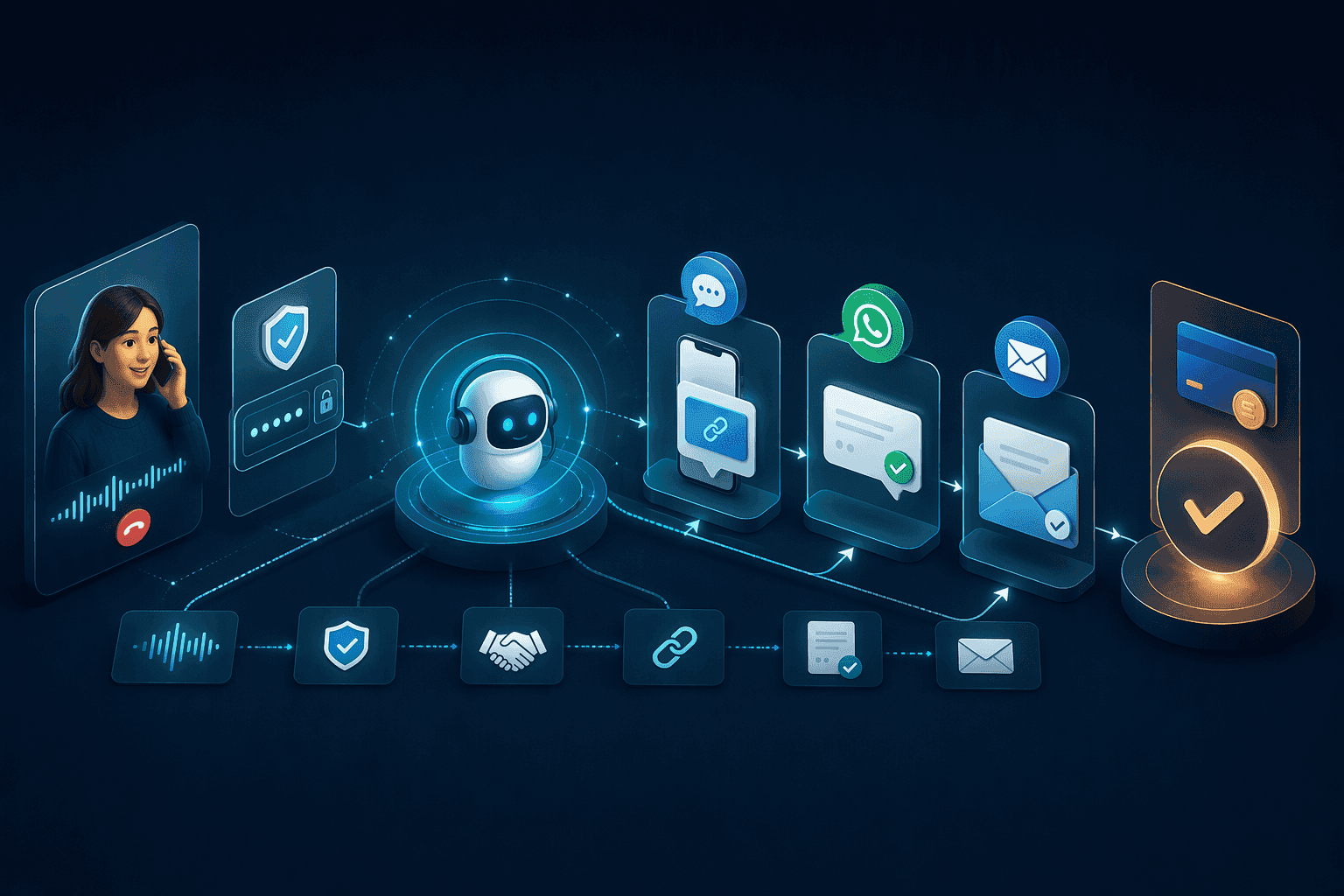
Domu answers the core question most directly. Its autonomous AI agents handle voice, SMS, WhatsApp, and email inside a single continuous interaction, not as four disconnected channels firing on independent schedules.
During a live call, a Domu agent verifies right-party contact with tokenized data, recites the Mini-Miranda disclosure, and negotiates a settlement. The moment the borrower agrees, the system fires an SMS payment link. Seconds after payment, a WhatsApp receipt lands in the borrower's inbox. The entire loop closes without a human agent touching the case, and every step logs into the audit trail for compliance review. You can use a tool like Domu to replace what typically requires a dialer, an SMS gateway, an email platform, and a manual QA team.
Alorica, a global customer experience leader, partnered with Domu to bring voice AI into loan servicing. The goal was to handle high-volume, routine contacts that previously burned agent capacity, deflecting predictable calls so human agents focus only on complex disputes. On the performance side, Domu's cross-channel orchestration drives the 3x contact rate improvement and 45% higher liquidation that define the top tier in 2026.
This platform suits lenders who need turnkey orchestration across all four channels with compliance baked in from day one.
2. Skit.ai: Multilingual Voice AI with Integrated Digital Collections
Skit.ai brings a voice-first AI engine to the table, with a particular strength in multilingual collections. Its natural language understanding lets the system handle payment negotiations and right-party verification across languages that traditional scripted IVRs cannot touch.
This matters for any portfolio with a diverse debtor base speaking over 100 languages and dialects. Skit.ai layers integrated SMS and email outreach on top of the voice core, so a Spanish-speaking borrower receives a call, a follow-up text, and a payment confirmation in their preferred language within a single sequence.
The platform's speech recognition and natural language processing capabilities handle the sentiment-detection side of a negotiation. It parses hesitation, objection, or willingness to pay and adjusts the offer logic accordingly, rather than simply cycling through a static script. For lenders who serve multilingual markets and need voice to carry the primary persuasion load, Skit.ai closes a gap that English-only platforms leave wide open.
It is a strong fit for servicers whose contact list spans multiple language communities and who want voice to anchor the orchestration.
3. TrueAccord: Machine-Learning-Powered Digital Engagement and Compliance
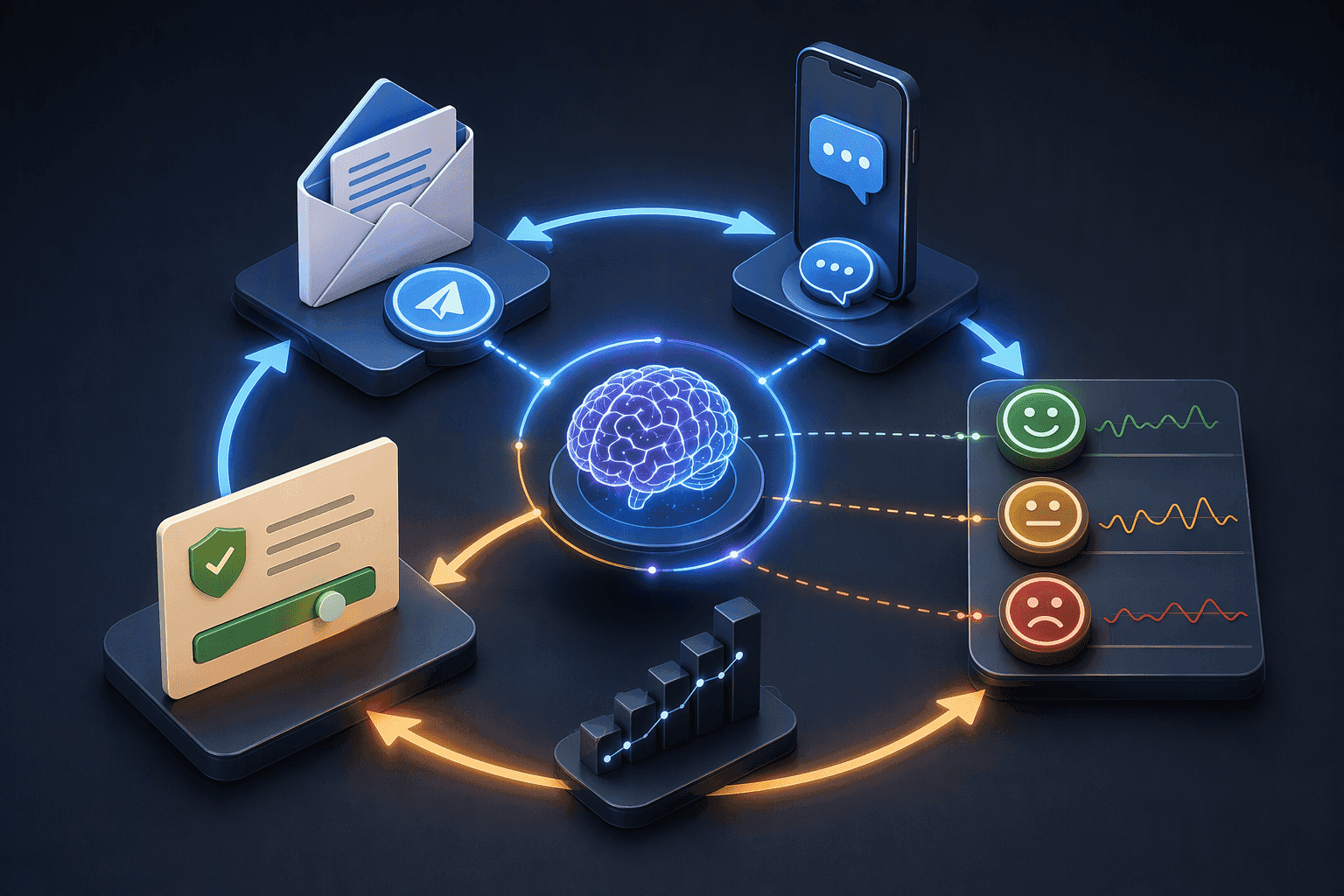
TrueAccord built its name on a simple premise: digital-first collections, tuned by machine learning, can beat an aggressive call center. The platform learns what time a borrower opens an email, what tone gets a reply, and what settlement offer gets accepted, then adjusts the next outreach accordingly.
The system treats email and SMS as adaptive channels, not batch blasts. Open an email at 8 p.m. on a Tuesday, and that becomes the send window. Respond to a softer message, and the model mirrors that voice.
The decision engine embeds compliance rules directly, so no offer fires outside permitted hours and every message carries the required disclosures. This is personalization at scale for lenders who do not want analysts hand-building segment rules. TrueAccord prioritizes digital engagement.
SMS and email run in tight coordination, and the analytical layer decides what to send, when to send it, and how to frame it. That layer is why the platform remains a benchmark in compliance-forward, digital-first recovery.
4. TCN: Cloud-Based Dialer with Integrated SMS, Email, and Payment Portal
TCN is a cloud-based predictive dialer that bundles native SMS, email, and a self-service payment portal onto one platform.
Here is how the pieces connect. A missed call fires an automated SMS. An unanswered SMS queues an email. And at the end of every sequence sits the payment portal, so a borrower who decides to pay never has to pick up the phone.
That simple chain matters for organizations still running agent-assisted floors. Instead of layering on separate SMS and email vendors, they get the follow-up stack inside the dialer they are already logging into. Manual chase work, the reminder texts, the payment-link emails, drops away.
This is not an autonomous AI negotiation platform. It does not conduct independent conversations with borrowers. But for teams that want to pull real efficiency out of their existing voice operation while adding SMS and email without stacking contracts, TCN closes the gap between legacy dialing and what borrowers expect from a modern multi-channel experience.
5. CollectWise: Hybrid Automation with Human-in-the-Loop Escalation

CollectWise is built for the scenario where a lender worries that a bot will barrel through a dispute with a borrower who just lost a job. It automates the routine and escalates the delicate. The system handles work in three distinct layers:
First-contact automation: right-party verification, a templated message, and a payment link, all delivered over voice, SMS, and email, the part you want to run unattended at scale.
Intelligent escalation: when the AI picks up confusion, anger, or a dispute keyword, it stops automated replies immediately and hands off to a human agent with the full context of every prior touchpoint, so the conversation never restarts from zero.
Unified agent desktop with compliance continuity: the agent works from a unified desktop that shows every channel the borrower used, and every automated step and agent action logs into the same audit trail, so escalation does not create a gap in the record.
For lenders who want automation's cost structure but need a human safety net on high-risk accounts, the hybrid model fits.
6. Exus: End-to-End Collection Workflow with AI-Powered Self-Service
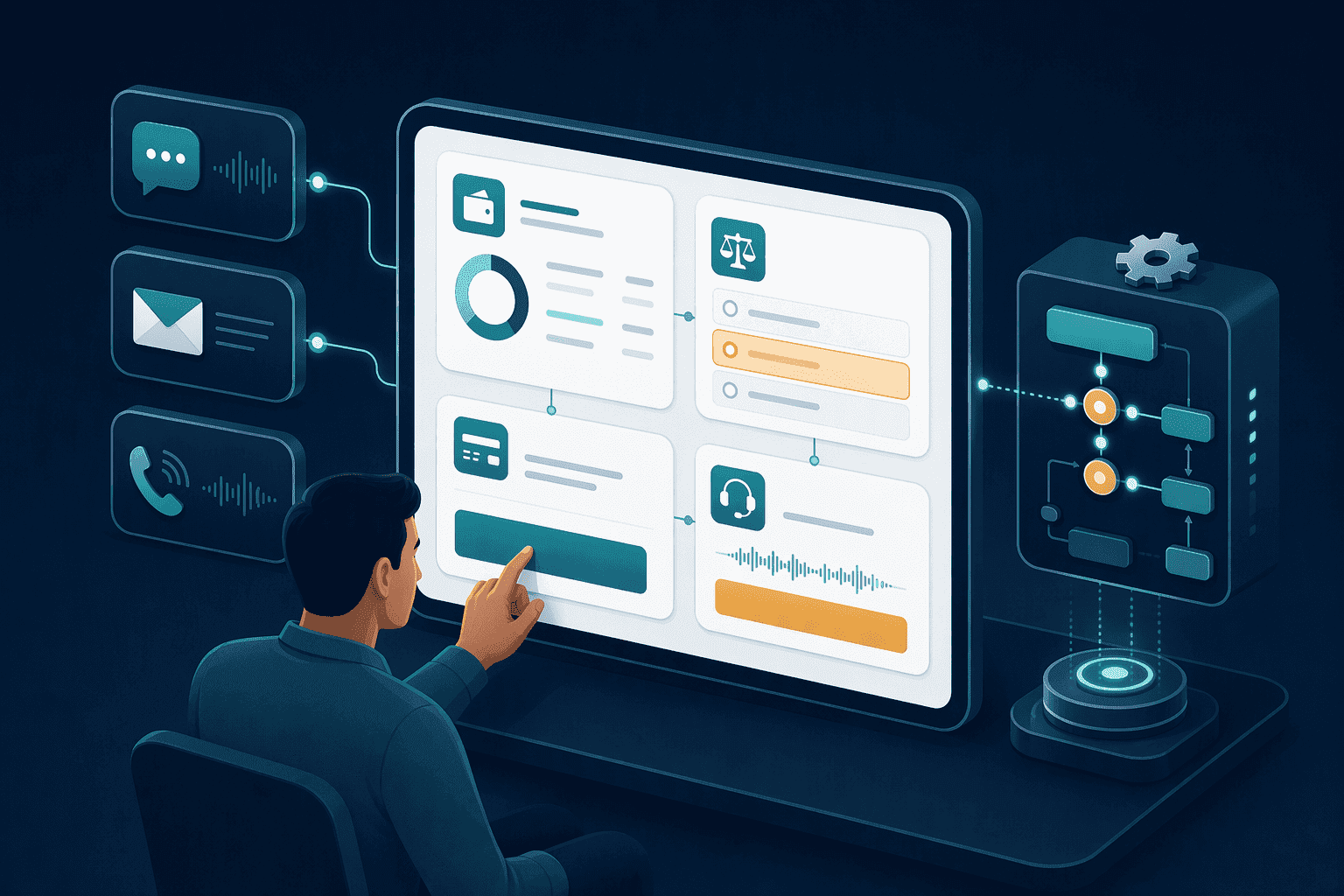
Exus covers a broader slice of the credit lifecycle than most platforms on this list. Its workflow engine starts at early delinquency and runs through post-charge-off recovery. The centerpiece is an AI-powered self-service portal that borrowers actually use.
Borrowers log into a branded portal to view their balance, select a settlement offer, make a payment, or request a callback. Behind the scenes, the platform manages automated campaign logic across text, email, and voice, sequencing the channels based on where the borrower is in the delinquency curve. The self-service layer reduces inbound agent calls sharply. A borrower who can resolve their situation in a portal never queues for an agent.
The system still initiates outbound contact when needed. But the philosophy inverts the traditional model: pull the borrower into self-service first, push outbound only when that fails. This approach works well for lenders with large, standardized portfolios who want to drive down servicing cost by deflecting routine contacts entirely. It is less about real-time negotiation and more about giving borrowers the tools to resolve debt on their own terms, with AI deciding when to escalate.
7. LiveVox: Unified CRM with Multi-Channel Communication and AI Dialing
LiveVox builds multi-channel collections directly into its CRM. SMS, email, and voice are not add-ons. They are native objects inside every customer record.
AI-powered predictive dialing runs outbound campaigns. When a call connects, the agent or virtual agent already has the full story in front of them: emails the customer opened, SMS replies they sent, payment portal sessions they started. Nobody toggles between systems to piece it together.
Compliance checks run inside the same workflow. The platform enforces call-time restrictions and required disclosures in real time, so rules don't get remembered halfway through a conversation. Reporting follows the customer, not the channel.
Everything lives on one timeline rather than scattered across separate logs for voice, text, and email. This platform fits organizations that want the CRM as the operational backbone, with collections running as one workflow on top of it rather than a standalone engine bolted onto a stack. It suits larger operations where agents handle multiple service types, not just recoveries.
8. How to Verify Agent Accuracy and Guardrails Under U.S. Federal and Utah Collection Case Law
Any platform you evaluate must survive a compliance stress test. Here are the dimensions to verify, mapped against the core regulatory requirements:
Compliance Dimension | What to Verify | Red Flag |
|---|---|---|
Right-party contact | Agent must confirm identity with tokenized or multi-factor data before disclosing debt details | Agent proceeds with debt disclosure after only name confirmation |
Mini-Miranda disclosure | Agent must state the call is from a debt collector and any information obtained will be used for that purpose | Disclosure omitted or buried late in the script |
Call-time adherence | Agent must respect time-of-day restrictions per FDCPA and any stricter state rules, including Utah code | Platform allows campaign-level time windows without per-account time-zone enforcement |
Dispute-handling path | Upon a verbal dispute, agent must pause collection activity, log the dispute, and trigger validation procedures | Agent continues negotiation after a dispute is raised |
TCPA consent management | Platform must track prior express consent for autodialed calls and texts per account | System treats all accounts as having default consent |
Utah-specific case law | Verify agent behavior aligns with Utah Division of Consumer Protection guidance on communication frequency and deception standards | No Utah-specific ruleset or compliance module available |
Test each dimension with a scripted scenario before signing. A platform that claims 100% FDCPA and TCPA compliance should welcome that test.
9. Showcall: How Cross-Channel Orchestration Resolves a Specific U.S. Finance Compliance Scenario
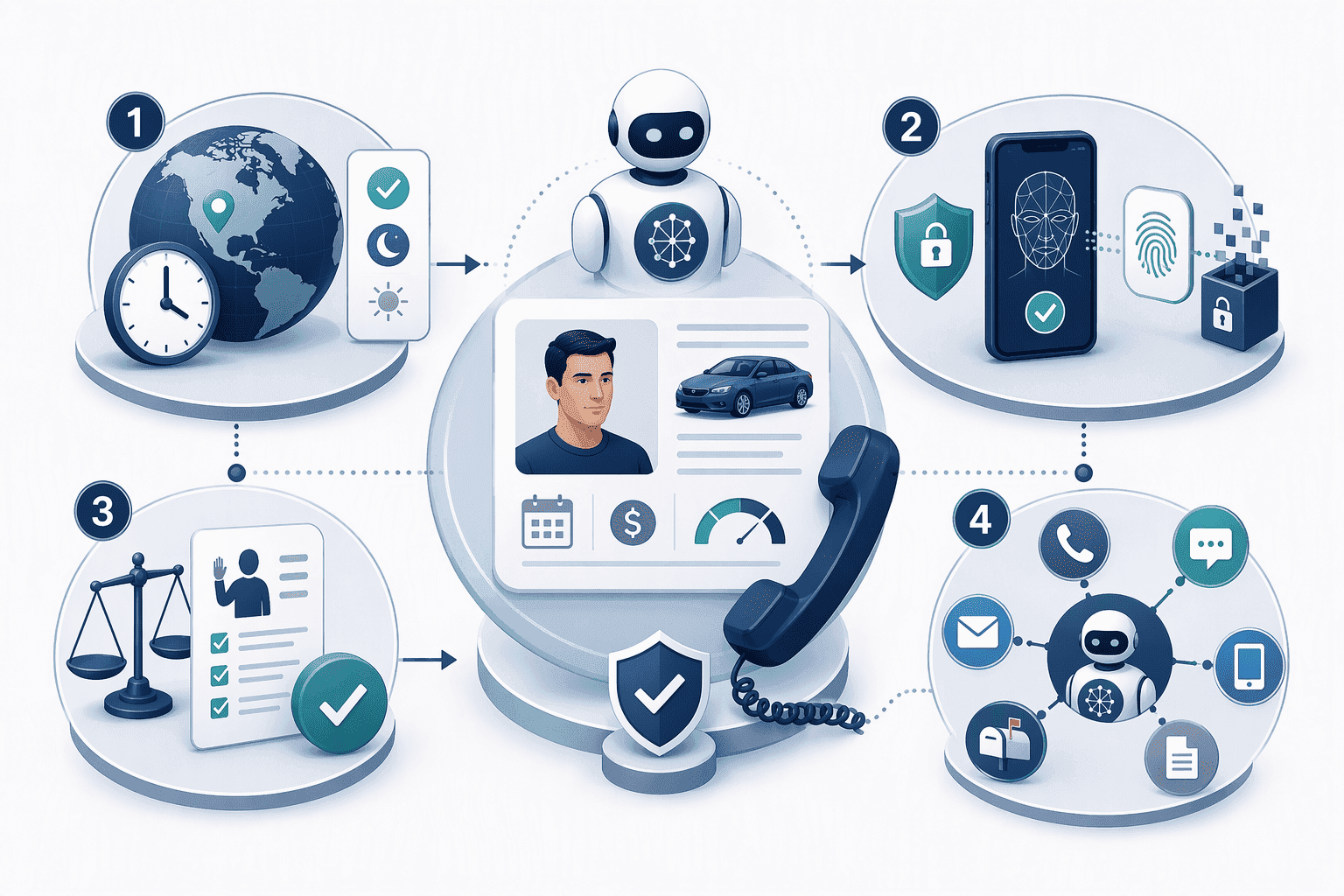
A past-due auto loan hits the desk at 9:02 a.m. Eastern. An autonomous AI agent platform handles the entire engagement in one continuous session, checking off every compliance requirement as it goes.
Outbound call initiation: The AI agent dials the borrower from a compliant time-zone-aware queue, logging the attempt timestamp.
Right-party verification: The agent confirms identity using tokenized data points before proceeding beyond a generic greeting.
Mini-Miranda disclosure: Immediately after verification, the agent states the required disclosure per FDCPA Section 807(11).
Settlement negotiation: The agent proposes a settlement, adjusts terms based on borrower response, and reaches a verbal agreement.
Real-time SMS payment link: With the agreement in hand, the agent triggers a secure SMS payment link that lands on the borrower's phone during the call.
Payment and WhatsApp receipt: The borrower completes payment through the link. The platform confirms with a WhatsApp receipt and a follow-up email.
Full compliance audit log: Every action, timestamp, and disclosure logs into a single audit trail exportable for regulatory review.
Conclusion
A platform that handles voice, text, and email for loan collections automatically is no longer a niche product. It is the baseline. The platforms on this list do more.
The difference between a good platform and a great one comes down to cross-channel orchestration. One autonomous workflow can run a single conversation across four channels. That capability changes the recovery math entirely. It delivers a 45% higher liquidation rate and a 3x lift in contact rates compared to single-channel approaches.
If your current stack still treats each channel as a separate tool, the gap is no longer operational. It is financial.
Frequently Asked Questions
What is an omnichannel debt collection platform and how does it unify voice, text, and email?
An omnichannel debt collection platform is a single system that orchestrates voice calls, SMS, email, and WhatsApp in one automated workflow. Instead of managing separate tools, you run a unified sequence where an AI agent can call, send a text, and follow up by email within the same interaction.
How does automated loan collections software work and what are the key compliance requirements in the U.S.?
Automated loan collections software uses AI agents to handle the entire recovery lifecycle, from outbound calls to payment link delivery. Key compliance requirements include FDCPA right-party verification, Mini-Miranda disclosure, TCPA consent management, and strict call-time restrictions.
What are the leading platforms in 2026 that offer integrated voice, SMS, and email for loan collections?
Leading platforms include Domu for autonomous cross-channel orchestration, Skit.ai for multilingual voice AI, TrueAccord for ML-driven digital engagement, TCN for cloud-based dialing with integrated channels, and CollectWise for hybrid human-in-the-loop escalation.
How much can automated omnichannel collections improve recovery rates and reduce operational costs?
Omnichannel automation delivers a 45% higher liquidation rate and a 3x contact rate improvement over manual, single-channel operations. At least one platform reports a 50% lower cost per dollar collected when autonomous AI agents replace traditional agent-led workflows.
What features should lenders compare when selecting a multi-channel automated collections solution?
Compare cross-channel orchestration logic, compliance guardrails for FDCPA and TCPA, right-party verification methods, real-time payment link delivery, dispute-handling paths, and whether the platform offers true autonomous negotiation versus scripted messaging.
Sources
7 Best AI Platforms for Automating Loan Servicing Communications in 2026 — Domu - domu.ai
9 Best AI Platforms for Behavioral Data Analysis — Domu - domu.ai
Alorica — Domu Customer Story - domu.ai
AI Agents for Debt Collection | Autonomous Voice AI | Oversai - www.oversai.com
OneVoice Software Pricing, Alternatives & More 2026 | Capterra - www.capterra.com
Related Articles



We’re building the next generation of engagement technology: intelligent, automated and compliant. Our mission is to empower financial institutions to orchestrate every stage of the servicing lifecycle with dignity and unprecedented efficiency.
Supported by

