

Your cost to collect is climbing. Telecom, labor, and technology expense keeps ticking up, but tightening margins mean you can't just throw more agents
Introduction
Your cost to collect is climbing. Telecom, labor, and technology expense keeps ticking up, but tightening margins mean you can't just throw more agents at the problem. The real fear is that any push to slash costs will crater your liquidation rates.
That trade-off is a false choice. Operations that methodically shift low-risk contacts to digital channels while applying AI-driven precision to high-risk accounts are reporting a 45% reduction in cost-to-collect and a 18 to 31% lift in collections. The path forward is not about cutting muscle; it's about applying an analytics-driven framework that makes every contact dollar work harder.
The regulatory and economic landscape of 2024 to 2026 demands this precision. With US consumers navigating persistent cost-of-living pressures and the CFPB maintaining strict supervisory oversight on fair treatment and communication limits, a blunt-force dialer strategy creates more risk than return. Instead, leading servicers are using propensity analytics and omnichannel orchestration to reduce human calling efforts by up to 40% while preserving, and even improving, their recovery rates. This article provides a practical, seven-step operational blueprint to redesign your collections floor for cost efficiency without sacrificing performance.
Key Takeaways
A structural shift in contact strategy protects both your budget and your liquidation rates. Here are the core principles:
Channel Cost Hierarchy: Live agent calls are your most expensive contact channel. SMS, email, and self-service portals drive down the manual expense base without defaulting the relationship.
Propensity is the Prerequisite: Cutting cost blindly damages recoveries. Deploy a propensity model to route likely payers to low-cost channels, reserving skilled agents for high-risk or high-balance accounts where negotiation actually moves liquidation.
Dialer Efficiency Gains: AI-driven precision dialing eliminates idle time and can boost right-party contact rates by 30%, directly lowering the wasted cost of unanswered or misdirected calls.
Self-Service Cure Rates: A well-designed payment portal captures cures at the lowest possible cost. Borrowers who resolve delinquency on their own pull volume away from your most expensive labor resources.
Real-Time Cost Guardrails: Moving from periodic cost reviews to a live operational dashboard prevents high-cost channels from bleeding into low-propensity segments, making cost optimization a continuous discipline.
At a Glance
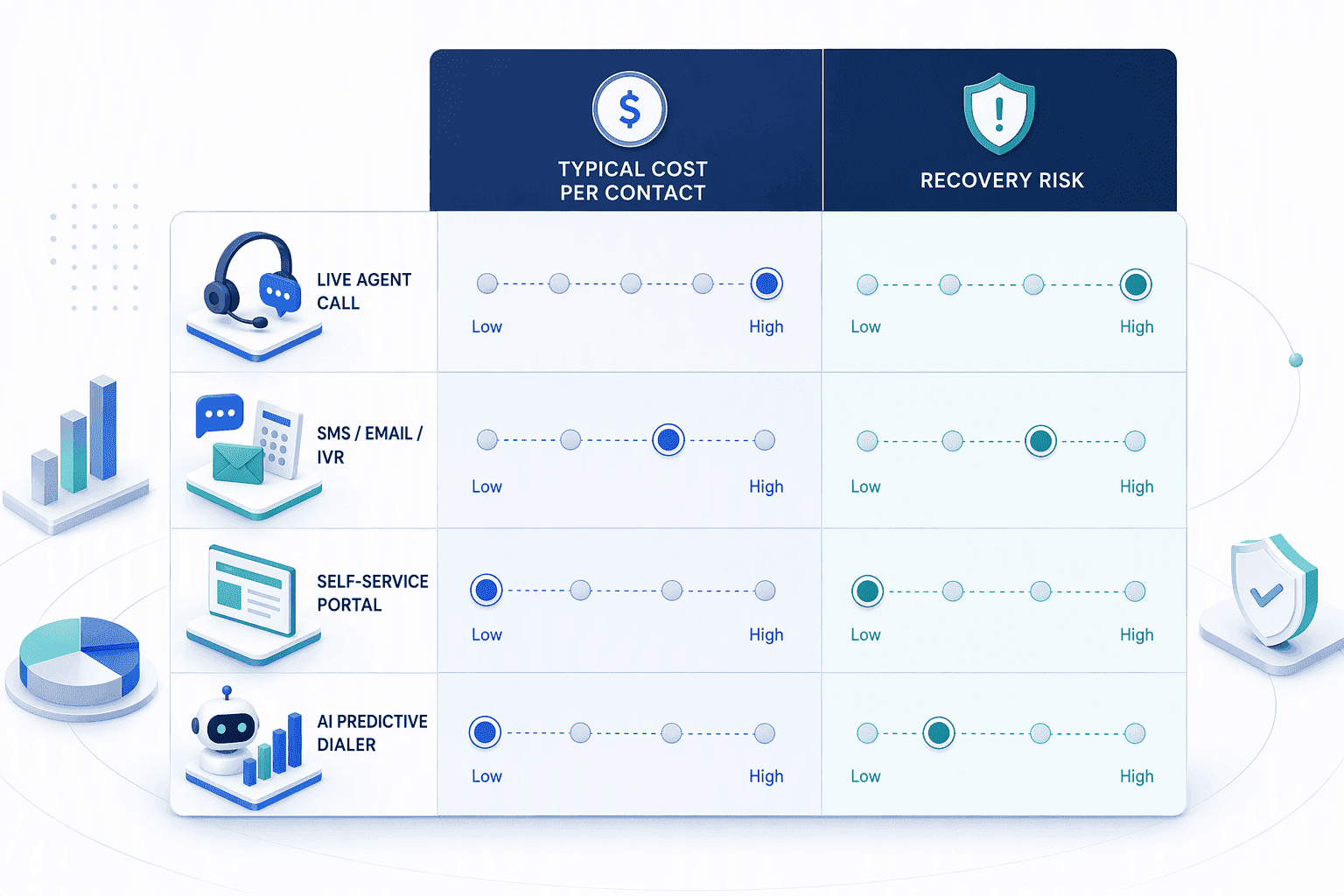
Here is how the options compare across the dimensions that matter most.
Channel | Typical Cost/Contact | Recovery Risk |
|---|---|---|
Live agent call | Highest | Low if high-propensity borrower |
SMS/Email/IVR | Low | Moderate; lower for resistant accounts |
Self-service portal | Lowest | Low for motivated borrowers |
Predictive dialer (AI) | Medium | Low; higher right-party contact |
Step 1: Quantify Your Current Channel Costs and Recovery Baseline
You can't manage what you don't measure. Scrap the top-line assumptions about what a collection call costs. Build a fully loaded cost-per-contact model. For every channel, live agent, predictive dialer, SMS, email, and self-service portal, calculate the true expense by adding up agent talk time (loaded hourly wage), telecom fees, technology licensing, and allocated overhead. Don't guess.
Equally critical is a recovery baseline segmented by delinquency stage. Plot your current right-party contact rate and promise-to-pay conversion for each channel. In many cases, an agent-heavy early-stage bucket generates promissory notes but delivers a liquidation rate nearly identical to a static email reminder at ten times the price. That delta is your immediate cost-savings target.
With a precise baseline, your ROI becomes measurable rather than anecdotal. Tools like branded caller display often lift contact rates because borrowers screen unknown numbers. Without a starting measurement of your right-party contact percentage, you can't validate that a technology uplift delivered real value. This foundational data prevents gut-feel decisions and anchors every future investment to hard internal proof.
Step 2: Implement Propensity-to-Pay Segmentation to Triage Borrowers
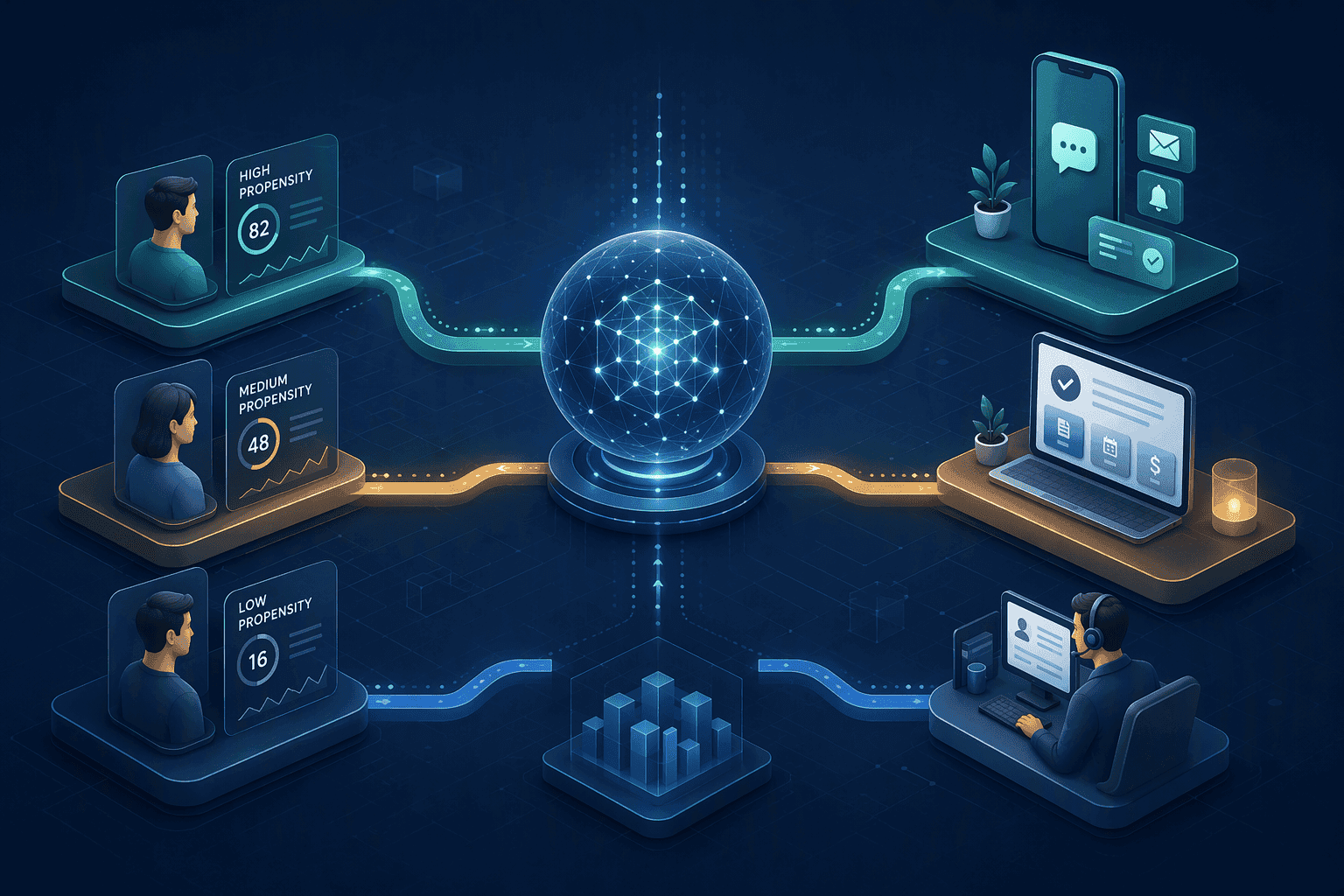
Stop treating all delinquent accounts as if they require the same heavy human touch. Build a propensity-to-pay model. This uses behavioral signals, past payment cadence, digital engagement history, recent credit bureau activity, and response to prior channel touches, to group borrowers by their intent and ability to pay.
The operational triage follows a clear logic. Route high-propensity accounts immediately to the most efficient, lowest-cost channel. Redirect your premium resource, the skilled human negotiator, toward low-propensity, high-balance, or chronically delinquent segments where a nuanced conversation actually shifts the outcome.
FICO data demonstrates that executing the right strategy at the right time generates a collections lift range of 18 to 31%. By feeding machine-learning classifications of payer intent directly into your contact engine, you stop burning agent capacity on accounts that would have self-cured with a text message. You can use a tool like Domu to implement these behavioral segmentation models within your existing collections software stack, turning analysis into automated routing logic immediately.
Step 3: Orchestrate an Omnichannel Contact Strategy with Cost-Optimized Routing
A cost-effective strategy sequences channels from cheapest to most expensive.
Step 4: Deploy AI-Driven Precision Dialing and Agentic AI for High-Risk Accounts
Predictive dialing isn't legacy technology when it's connected to AI call progress analysis. Modern precision dialers eliminate the dead air and answering machine cycles that drain agent productivity. By syncing with your platform to scrub non-productive calls and applying branded caller display, firms are getting 30% higher contact rates on the accounts that genuinely justify a voice channel.
A new layer, agentic AI, goes further. For pre-delinquency or early-stage accounts that have slipped, an autonomous AI voice agent can handle the entire dialogue: verifying identity, disclosing the mini-Miranda, negotiating a fixed promise-to-pay, and capturing the payment. This happens at a fraction of the cost of a full-time equivalent (FTE) and never idles.
Your pilot framework should isolate specific and narrow use cases first, such as confirming a hardship application receipt or resetting a recurring payment date. Keep your abandonment rate caps within strict TCPA limits and monitor the CFPB's current supervisory focus on unfair practices. The goal is swapping expensive manual outreach for structured, compliant automation on accounts where the contact strategy is simple and the recovery high.
As Ofer Alon, CEO of Quality Acceptance, noted during his firm's transition to Domu's AI agents, "If you don't start now, you'll be out of business in five years. The cost of running the old way is just too expensive."
Step 5: Scale Self-Service Portals and Automated Digital Nudges for Early-Stage Cures

Your self-service portal should function as a cure engine. Design for a single-click promise-to-pay flow, secure stored credential options, and an integrated hardship modification application. Automate SMS and email nudge cadences that embed dynamic settlement offers directly in the message body. These nudges increase in urgency while keeping the exit ramp wide open.
Consumer behavior backs this up. Borrowers increasingly expect to resolve issues on their phone without talking to a person, and payment portals that remove authentication friction capture a substantial volume of cures that would otherwise land in an agent queue. Ensure your electronic disclosures meet CFPB compliance, but design the UX so that compliance is invisible to the user, clearing the path toward payment resolution with zero human contact cost.
Step 6: Integrate Cost-Per-Contact Data into Real-Time Operational Analytics
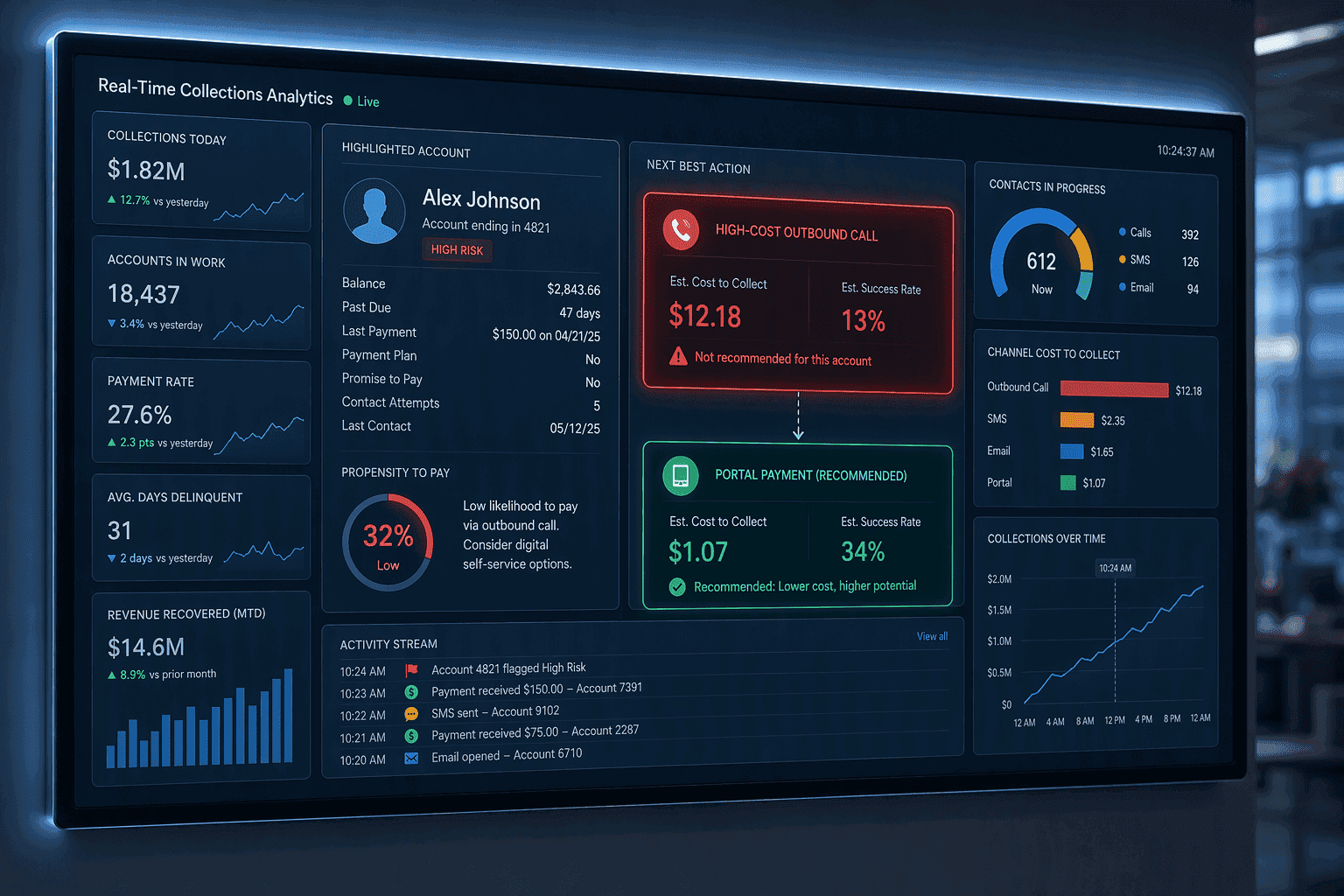
Cost optimization fails when it's a quarterly spreadsheet exercise. Hardwire the data directly into a live operational stack. Your dashboard should flash a warning the moment a high-cost channel like an outbound agent call is applied to a high-propensity account that historically pays via portal link within 24 hours.
Pull the baselines from Step 1 and watch the deviations. Track cost per dollar recovered. If your cost per contact drops but your total cost to liquidate a portfolio rises because the wrong channel is used, the strategy is failing. Surveillance of channel-shift ratios and agent utilization prevents the efficiency drift, turning what used to be a periodic analysis into a real-time data flywheel. You can integrate an analytics layer directly into your workflow through Domu's behavioral data analysis capabilities to monitor these shifts automatically.
Step 7: Embed US Cost-of-Living Context and CFPB-Compliant Empathy into All Workflows
A cost-efficient strategy fails fast if it generates a compliance order. Bake the current macroeconomic strain and regulatory expectation directly into agent scripting and digital messaging. Follow this practical integration sequence:
Inject current CPI context: Reference specific cost pressures that a borrower in 2026 faces, shelter, vehicle costs, and auto insurance premiums tracked by the BLS and LendingTree, in your hardship letters. Pivoting a script from a demand to an acknowledgment of economic reality preserves dignity and willingness to engage.
Standardize opt-in and frequency caps: Implement Reg F's call-frequency presumptions as hard technical limits across all channels. Before deploying an automated SMS cadence or an agentic AI voice blast, verify the borrower's consent status and contact window timing are locked in your dialer and platform logic.
Build a compliant settlement trigger: When cost-of-living indicators flag a regional economic shock event, dynamically present flexible settlement templates and tailored forbearance options. Ensure a real-time connection to your complaint intake system so that any agent or AI dialogue flagged for poor treatment pauses the workflow for review.
Audit digital relationships for unfairness: Review your automated nudges for language that a regulator might deem misleading or unfairly coercive. Softening a final-notice template to clearly state the exact steps to receive a cure discount aligns the message with the CFPB's supervisory focus on fair treatment, insulating your cost-efficiency gains from regulatory attack.
Step 8: Orchestrate an Omnichannel Contact Strategy with Cost-Optimized Routing (continued)
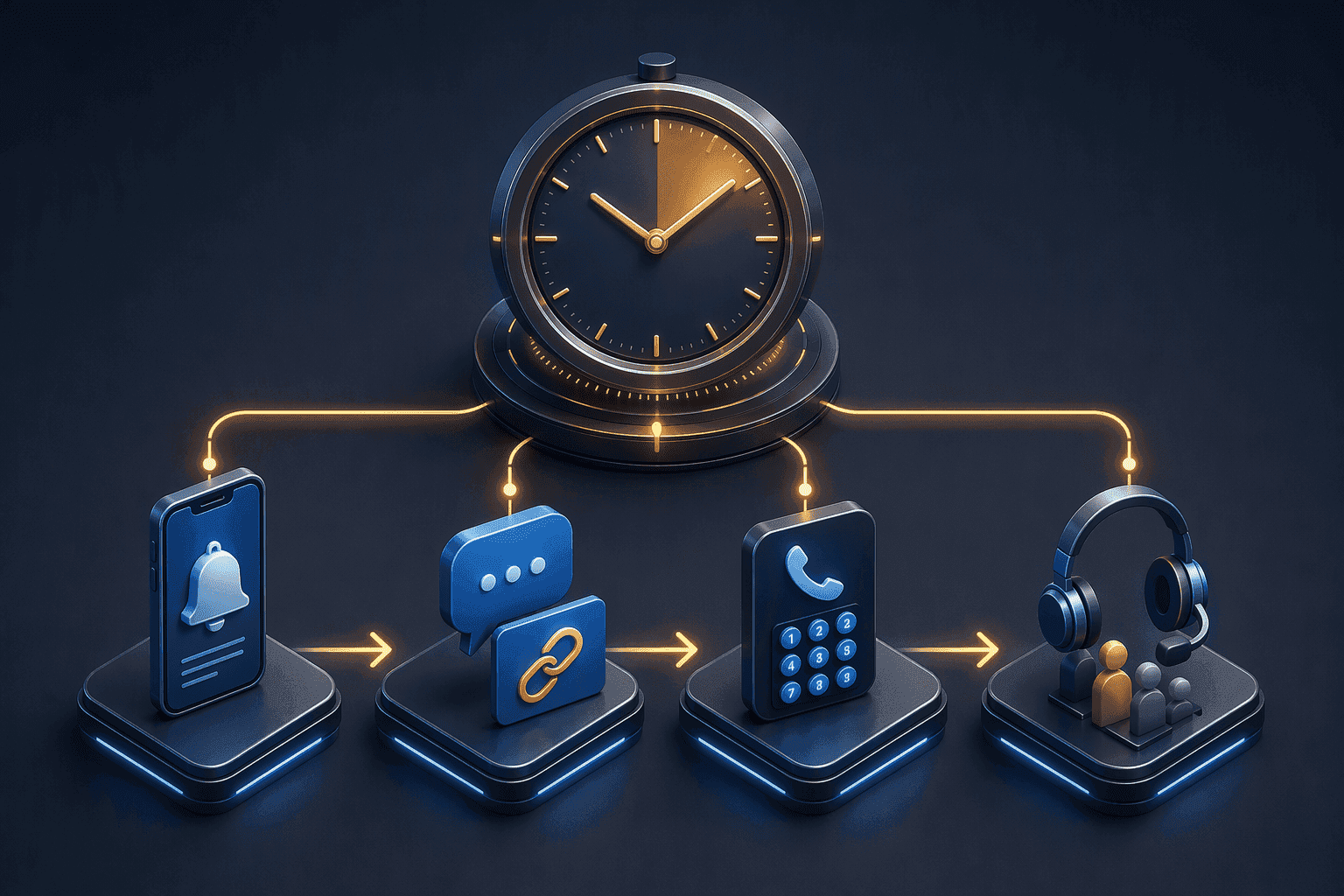
Design the rules with escalation triggers. A standard sequence might start with a push notification, escalate to an SMS reminder with a direct payment link after 48 hours of non-response, follow with an IVR deflection attempt, and only then trigger a live agent queue. The CFPB's Regulation F imposes clear frequency and intent limits here. Your routing must embed a compliance clock that throttles contact attempts across every channel. A harassment claim can build across email and text as easily as phone calls.
Integrate the channel cost hierarchy directly with the propensity tiers built in Step 2. A high-balance, low-propensity account justifies the live agent cost because the recovery income outweighs the contact expense. That alignment is what keeps an omnichannel operation from drifting into single-channel over-reliance. When every account gets the same cheap SMS blast and nothing else, late-stage liquidation drops because a complex hardship modification was never offered, and that conversation requires a person.
Conclusion
Reducing the cost per contact without killing liquidation rates is not a theory. It is a systematic engineering process. The core principle is straightforward: segment relentlessly based on propensity data, then match the cost of the contact to the value of the account. Reserve the structure of a live agent for the nuance of a complex balance negotiation, and let automated digital infrastructure do the rest.
Firms that implement this channel optimization and AI triage consistently report dramatic cost-to-collect drops, like the 45% reduction cited in operational overhauls, while simultaneous lifts in collections metrics invalidate the traditional cost-versus-recovery trade-off. The first and most immediate action is not a major technology purchase. It is quantifying your current baseline cost and recovery data by channel. Once you see the delta between an agent's hourly cost and a portal's near-zero incremental contact cost, the financial case to begin this transformation closes itself.
Frequently Asked Questions
What is the average cost per contact across different collection channels in the US loan industry?
Cost varies massively by mode, with three tiers of channel expense:
Live agent calls are the most expensive due to full labor, telecom, and overhead cost
Digital nudges like SMS and email are significantly cheaper
Self-service web and mobile payment portals represent the lowest cost per contact, approaching a near-zero incremental cost once the technology platform is deployed
Which digital communication channels offer the lowest cost per contact while maintaining compliant recovery rates?
Channel performance and cost differ in a clear hierarchy:
A well-designed self-service payment portal is the most efficient channel for motivated borrowers
Dynamic two-way SMS campaigns produce slightly higher costs than email but consistently outperform email in open rates and promise-to-pay conversion
Both channels maintain compliance when they embed Reg F consent tracking and electronic disclosure requirements
How can predictive dialing and AI-driven contact strategies reduce idle time and improve right-party contacts?
AI-driven precision dialers scrub unanswered pickups, answering machines, and disconnected numbers before an agent connects. By layering branded caller display and AI voice agents to handle pre-delinquency dialogues autonomously, operations cut out waiting time entirely. This can uplift right-party contact rates by 30%.
What self-service or payment portal features drive voluntary cures and reduce the need for agent outreach?
Primary cure drivers that intercept an agent requirement include:
A frictionless single-click promise-to-pay flow
Secure stored credential vaults
Automated hardship modification requests
Direct settlement offers embedded in an authenticated portal, allowing early-stage delinquencies to be resolved entirely through a borrower's mobile device
What are the key CFPB compliance risks when shifting to lower-cost digital collection methods in the US?
The primary compliance risks that require careful legal review include:
Failing to apply Reg F's communication frequency and intent limits across combined phone, SMS, and email channels
Digital messaging that appears misleading or coercive, conflicting with CFPB supervisory guidance on unfair practices
All automated nudges require careful legal review for clarity on cure steps
How do segmentation and propensity modeling increase liquidation rates without increasing contact frequency?
Propensity models analyze past payment patterns and engagement to predict behavior. By redirecting high-propensity accounts to automated digital resolution and reserving manual calls for low-propensity high-balance cases, the strategy lifts liquidation with fewer, rather than more, total contacts. Resources shift from volume to precision.
Sources
9 Best AI Platforms for Behavioral Data Analysis — Domu - domu.ai
Quality Acceptance — Domu Customer Story - domu.ai
AI Debt Collection Solutions for Banks & Lenders - Sutherland - www.sutherlandglobal.com
Collections & Recovery | FICO - www.fico.com
Related Articles



We’re building the next generation of engagement technology: intelligent, automated and compliant. Our mission is to empower financial institutions to orchestrate every stage of the servicing lifecycle with dignity and unprecedented efficiency.
Supported by

