

Your collections floor has a segmentation problem. The static, FICO-anchored buckets you used last quarter are already stale.
Introduction
Your collections floor has a segmentation problem. The static, FICO-anchored buckets you used last quarter are already stale. A borrower who always paid on the 5th suddenly loses a contract, and your system still treats them like a prime risk while a competitor's AI reads the transaction velocity shift and adjusts the tone, the channel, and the offer within the hour.
Behavioral data analysis in collections is the discipline of using real-time transaction patterns, payment cadence, communication preferences, and device signals to predict a borrower's likelihood to pay and dynamically adjust treatment. It replaces rigid credit-score-based segmentation with a living model that reads the data the borrower generates today.
The shift is no longer a forward-looking thought piece. The CFPB submitted its annual FDCPA report to Congress on November 21, 2025, summarizing both CFPB and FTC debt-collection-related activities in 2024, and the signal is clear: algorithmic fairness and proactive compliance architecture are now examination priorities. Institutions adopting purpose-built AI platforms are reporting 20%+ collections lift with 60% cost reduction and 10 to 25% NPL reduction within 3 to 9 months.
This article evaluates six platforms that attack the problem from different angles, compliance-first architecture, unified predictive engines, decision-rule infrastructure, and upstream intervention at origination. Each addresses the core gap between what static scoring sees and what behavioral analytics can surface in 2026.
Key Takeaways
The AI-collections market in 2026 has split into a handful of architectural bets that are delivering real numbers. Here is what the data and the platform deep-dives show
20%+ collections lift and 60% cost reduction: iTuring gets these results by replacing a patchwork of legacy tools with a single engine that handles predictive modeling and autonomous strategy. (iTuring) 10 to 25% NPL reduction, often inside 3 to 9 months: Credit Nirvana deploys 150+ GenAI agents across 20 modules, purpose-built to shrink non-performing loans that fast. (Credit Nirvana) Compliance is the buying filter, not an afterthought. Domu AI enforces FDCPA guardrails at the agent level: on-script validation, maker-checker approvals, and an immutable audit trail a CFPB examiner can read directly. (Domu AI customer story) The CFPB’s 2025 annual report puts algorithmic bias and unfair-treatment claims under UDAAP explicitly on the exam checklist. Any AI-driven outreach system that cannot show its work faces real enforcement risk. (CFPB 2025 report) Pre-delinquency intervention is moving the trigger upstream. Upstart’s model carries behavioral signals from loan origination into early servicing, so the system flags risk long before a default. Legacy modernization has a practical on-ramp. Tech-consulting hybrids such as Bridgeforce and proprietary servicing stacks like Carvana’s let an institution start behavioral analysis without a full core conversion.
1. Domu AI, The Compliance-First Behavioral Collections Platform with Enforceable Agent Guardrails

A Chief Risk Officer picks Domu AI when the brief is simple: prove to an examiner the AI never went off script. The platform hard-codes FDCPA guardrails as the operating surface the agent cannot cross, not as a monitoring overlay added after the fact.
Its voice agent, Taylor, runs on-script validation that blocks hallucinated settlement offers and tone escalation during live calls. When a borrower gets confused or combative, Taylor triggers a fail-safe handoff to a human supervisor. The interaction stops there, the AI does not improvise a reply. The FDCPA bars communication at unusual times, generally before 8 a.m. or after 9 p.m. in the consumer's time zone, and Domu enforces contact-hour limits at the dialer layer rather than leaving them to agent judgment.
Three systems run behind Taylor. Clementino is the AI orchestrator with six specialist delegates. Alex is the model governance layer, called "The Governance Specialist" internally, that stress-tests agent behavior against UDAAP and state-specific collection laws before any campaign launches.
And every conversation lands in an immutable audit trail. A human reviewer certifies campaigns through a formal governance sign-off that mirrors the pre-deployment approval cadence an examiner would expect. Domu states it is SOC 2 Type II and CFPB compliant.
A top 5 U.S. fintech reported 30% fewer complaints per 100 calls after deploying the platform. The trade-off is explicit: you are buying enforceable compliance precision, not an open-ended data science sandbox.
2. iTuring, The Unified Predictive Modeling and Autonomous Strategy Engine for U.S. Banks
iTuring has built the single-pane-of-glass answer to a fragmented collections stack. The platform ingests behavioral signals through 200+ pre-built API connectors into a unified data fabric that carries 50,000 prebuilt financial features. That volume of feature engineering would take an internal data science team several years to replicate.
From that base, the platform runs generative AI-driven outreach and deploys autonomous agents that optimize strategy continuously. Instead of an analyst adjusting segmentation rules quarterly, iTuring's agents retrain on borrower outcomes in real time and adjust contact cadence, channel, and settlement parameters. The numbers are the story: the company reports a 20%+ collections lift and a 60% cost reduction against legacy operations. One national insurer cited achieved the 20%+ lift benchmark after deployment. A regional bank achieved 32% higher approvals while maintaining its stated risk appetite.
Model risk management is not an afterthought. The platform monitors 60+ parameters in real time, tracking drift in repayment prediction accuracy and flagging adverse patterns before they produce a compliance finding. This is the architecture a mid-size U.S. bank needs when its model risk management group demands continuous, examinable oversight instead of an annual validation report.
iTuring suits an institution ready to retire its patchwork of dialers, scores, and spreadsheets in favor of a single unified engine. The trade-off is that adopting a full-stack platform requires organizational commitment; a light touch does not extract the predictive lift the system is built to deliver.
3. CreditNirvana, The High-Volume GenAI Agent Factory for Rapid NPL Reduction
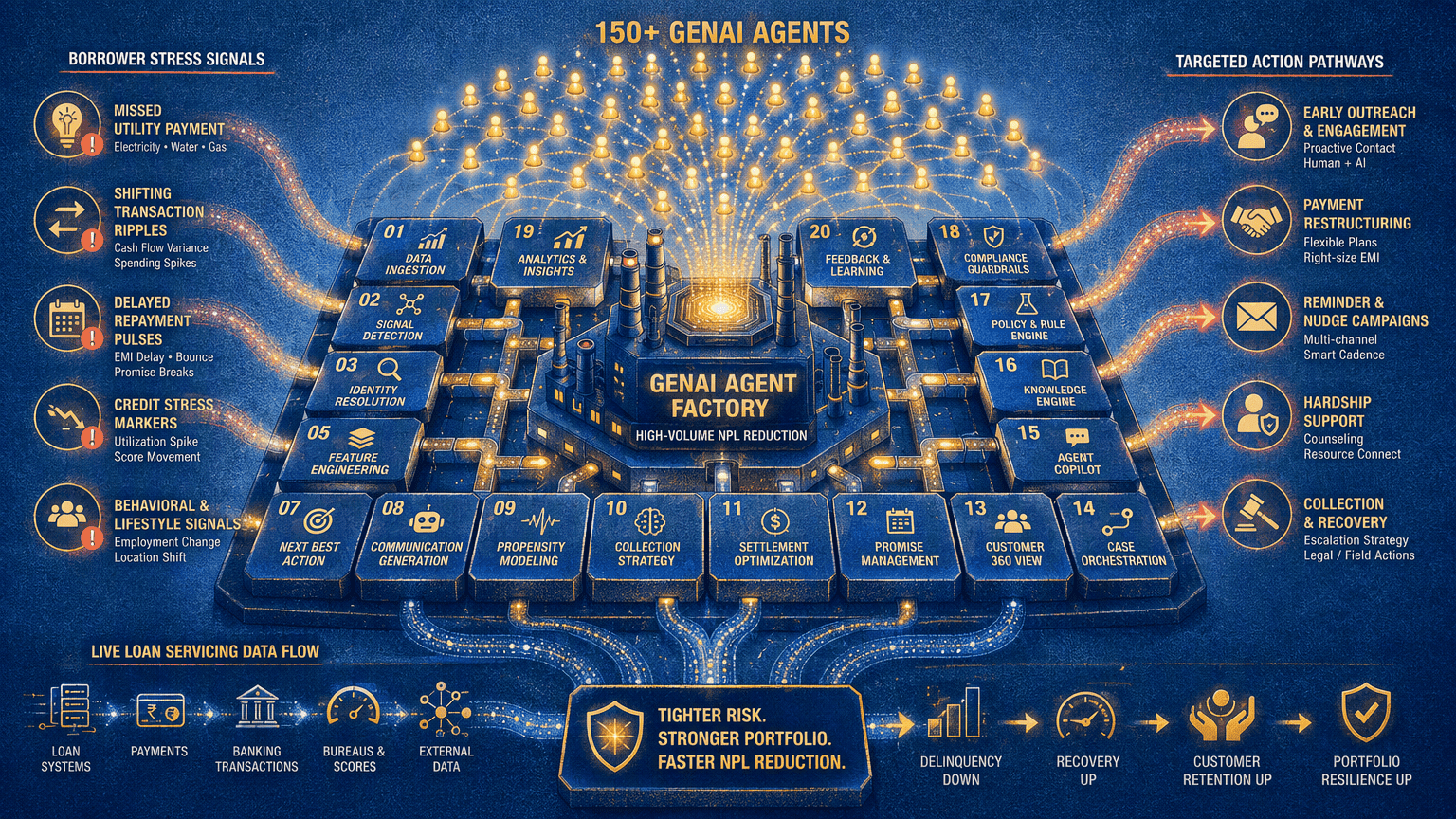
If the primary ask is 'we need our NPL ratio down by the next board meeting,' CreditNirvana is the platform engineered for that timeline. The company does not pitch a long digital transformation journey. It deploys 150+ GenAI collection agents across 20 integrated modules and targets measurable portfolio movement within a single fiscal quarter.
The agents do not just dial. They analyze evolving transaction patterns across loan servicing data to detect early-stage stress: a missed utility payment, a change in deposit cadence, a card that was always paid in full suddenly carrying a minimum payment. The segmentation updates continuously, and the treatment adapts. CreditNirvana reports a 15 to 30% reduction in bounce rates and a 10 to 25% NPL reduction within 3 to 9 months. A top Indian ARC managed 1.5M+ accounts on the platform with full regulatory compliance and doubled its portfolio capacity.
Integration is API-first, with 50+ pre-built APIs for loan servicing and CRM data flow, fewer than iTuring's connector library but purpose-built for the collections use case. A high-volume operation that needs rapid agent deployment rather than a custom modeling environment will find the modularity fits; a risk team that wants fine-grained control over individual model features may want a platform with a more exposed modeling layer.
4. Taktile, The Decision-Engine Backbone for Custom Behavioral Risk Models
Taktile is the answer for the institution where the Chief Data Officer says, 'We are building our own behavioral models; we just need an infrastructure layer to run them.'
It is a decision-rules fabric. Data scientists ingest non-traditional behavioral signals (real-time cash-flow data, device telemetry, geolocation stability metrics) and test, validate, and deploy bespoke underwriting and collection-treatment rules. No full-stack application dictates the model architecture.
Taktile's interface lets quants A/B test rule variants against live portfolios. That creates the rapid feedback loop a custom model needs while preserving the audit trail a compliance review requires.
This is an infrastructure play, not an application. A large, well-staffed institution that treats its behavioral scoring methodology as proprietary competitive advantage brings its own domain logic and its own data scientists. Taktile supplies the rails underneath.
5. Upstart, The AI Lending Originator Extending Behavioral Signals into Pre-Delinquency Interventions

Upstart bets that education, employment, and real-time cash-flow data don't stop being useful after a loan funds. The same signals that price risk at origination can flag trouble early in servicing.
Instead of waiting for a 30-day delinquency trigger, Upstart watches for small disruptions, a dip in income, a spending pattern shift, while the borrower is still current. It then starts a low-friction conversation: a text offering a short-term deferral, a re-amortization option before the first missed payment, or an agent call framed as account support, not collections.
The result is a single behavioral stream that runs from application through servicing. Lenders who already underwrite with Upstart get that stream natively; traditional servicers don't. The model works least well for banks that originate through Upstart but service on a legacy stack, bridging the behavioral data across systems is heavy without the native integration.
6. Carvana & Bridgeforce, The Servicing-Centric Tech-Consulting Hybrids for Legacy Modernization
Most institutions cannot afford to rip out their core servicing platform just to get a behavioral-AI engine running. If you're a credit union sitting on a 15-year-old Fiserv core, or a mid-tier bank juggling acquired portfolios stitched together over a decade, the practical path starts somewhere else.
Bridgeforce handles the operational side of that somewhere else. The firm takes legacy-heavy institutions through collections modernization by diagnosing where old segmentation rules fall apart, then designing a phased rollout of behavioral analytics that slots into existing workflows. The work is unglamorous but specific: staff training, process redesign, vendor selection, all the readiness gaps a software vendor alone leaves untouched.
On the technology side, Carvana's in-house servicing stack fills the other half of the hybrid model. Built to manage high-volume auto loan portfolios, the platform tracks non-traditional signals, payment cadence, vehicle equity position, mobile app interaction data, and dynamically adjusts account treatment inside an existing servicing core. It pulls real-time vehicle valuations and consumer behavior patterns without demanding a core conversion that could eat up years. For an institution eyeing behavioral analytics but not ready to commit to a full AI-platform migration, the combination of deep operational consulting and a servicing stack purpose-built for behavioral signals becomes a practical shortcut. The timeline is months, not years, and the lift shows up before anyone has to sign off on ripping out the core.
7. Comparative Platform Analysis: Compliance Architecture, Behavioral Data Depth, and Measured ROI

Three things matter when you compare compliance platforms: whether the architecture actually prevents violations, how much borrower behavior the system ingests and acts on, and what numbers the vendor is willing to publish.
The table below maps the five named platforms against those criteria. You will notice one column has empty cells. That is because some vendors operate at a different layer of the stack and simply do not publish standardized lift metrics.
Feature | Domu AI | iTuring | CreditNirvana | Taktile | Upstart |
|---|---|---|---|---|---|
Compliance enforcement | Agent-level on-script validation; immutable audit trails; maker-checker approvals; policy stress-testing against UDAAP | 60+ real-time model risk monitoring parameters; model risk management dashboard | Agent-level contact-hour limits and audit logging | Decision-rule audit trail; configurable governance workflow | Behavioral model documentation for origination-level fair-lending review |
Behavioral data depth | Analyzes communication preferences, payment behavior, and voice-sentiment signals; single-system voice, SMS, and email outreach | 50,000 prebuilt financial features; unifies transaction, CRM, and core banking data | Analyzes evolving transaction patterns across loan servicing; real-time segmentation updates | Ingests non-traditional data including cash-flow and device signals; user-defined feature engineering | Non-traditional signals at origination (education, employment, cash flow) extended into pre-delinquency monitoring |
Published ROI | 30% fewer complaints per 100 calls; 45% lower cost than human-only operations | 20%+ collections lift; 60% cost reduction; 32% higher approvals at a regional bank | 15 to 30% bounce-rate reduction; 10 to 25% NPL reduction in 3 to 9 months | Custom-deployment dependent; infrastructure layer does not publish standardized lift metrics | Pre-delinquency intervention lift embedded in origination portfolio performance |
The behavioral depth row shows a meaningful split. Domu AI captures what borrowers do during actual collection interactions: communication channel preferences, payment follow-through, and voice-sentiment signals. CreditNirvana focuses on transaction-pattern shifts across the servicing lifecycle. Those are two distinct data strategies, and they produce different early-warning timelines.
The compliance row matters because enforcement at the agent level is different from enforcement at the model level. Agent-scripting compliance, maker-checker workflows, and UDAAP stress-testing block violations at the point of contact. Dashboard-based risk monitoring flags issues after they happen.
8. The 2026 Regulatory Blueprint: FDCPA, UDAAP, and CFPB Algorithmic Bias Scrutiny for AI Collections
The 2026 regulatory environment demands that every AI collections procurement decision pass three specific tests. The following principles define them, and each platform above addresses at least one directly.
FDCPA contact-hour and communication restrictions: The statute prohibits communication before 8 a.m. or after 9 p.m. in the consumer's time zone, and the 2021 amendments effective November 30, 2021 restated substantive provisions for modern communication channels. A platform without dialer-level enforcement of these time windows is unsafe.
UDAAP and unfair-treatment risk: Algorithmic decisions that treat similarly situated borrowers differently without a documented, examinable rationale create UDAAP exposure. Domu's policy stress-testing and iTuring's 60+ monitoring parameters are purpose-built to surface disparate treatment before it reaches an examiner's desk.
CFPB algorithmic-bias scrutiny: The Bureau's focus on explainable credit models is no longer a discussion paper. The 2025 annual FDCPA report covering 2024 activities signals that model explainability and bias detection are core exam priorities. A platform producing a black-box treatment score without an auditable decision trail fails the 2026 standard.
9. Technical Integration Deep-Dive: API-First Connectivity with Core Banking and Loan Servicing Systems

An AI collections platform that cannot read real-time behavioral data from the core is just an expensive dialer with a dashboard. The technical integration architecture, the API layer that pulls transaction velocity, payment cadence, and account-status data into the model, determines whether the platform delivers behavioral lift or just operates on the same stale batch file the legacy system used. The integration depth varies materially across the evaluated platforms.
iTuring: Provides a library of 200+ API connectors spanning core banking, loan servicing, CRM, and payment gateways, reducing integration burden for institutions running multiple servicing platforms across acquired portfolios.
CreditNirvana: Offers 50+ pre-built APIs more narrowly focused on loan servicing and collections-specific data flow, pre-configured for the high-volume agent deployment the platform is designed to run.
Domu: Emphasizes low complexity, voice, SMS, and email outreach run from a single system connecting to the servicing core and CRM, with a dashboard integration path that avoids a heavyweight data-warehouse migration.
For an institution where IT bandwidth is the bottleneck, the pre-built connector library is the gating factor. A deep, real-time behavioral model requires continuous data flow; a platform that can only pull a nightly batch file cannot react to a payday deposit that arrived 30 minutes ago.
Conclusion
The market has sorted itself into clear bets for 2026. A compliance-first institution under active CFPB scrutiny should evaluate Domu AI's agent guardrail architecture. A mid-size U.S. bank ready to unify a fragmented collections stack should measure iTuring's lift numbers against its own baseline.
A portfolio carrying a distressed NPL book that needs rapid relief should model CreditNirvana's 3-to-9-month trajectory. An institution with a strong internal data science team should look at Taktile as infrastructure. A lender already originating through Upstart should explore its pre-delinquency signal stream before the competition does.
What is no longer optional is the behavioral data layer itself. Static credit scores and quarterly segmentation reviews can't survive a regulatory cycle that demands algorithmic explainability and a competitive landscape where a competitor's AI reads the borrower's payment stress weeks before your static bucket does.
Frequently Asked Questions
What exactly is behavioral data analysis in debt collections?
Behavioral data analysis uses real-time transaction patterns, payment cadence, communication preferences, and non-traditional signals to predict a borrower's likelihood to pay and dynamically adjust treatment strategies. It replaces static credit-score-based segmentation with models that update as the borrower's financial behavior changes.
How does behavioral analysis differ from traditional collections scoring?
Traditional scoring relies on fixed credit scores and rigid risk tiers that age out between refreshes. Behavioral analysis ingests live data, deposit velocity, device signals, payment-channel switches, and adapts the treatment strategy continuously, often detecting repayment stress weeks before a traditional model registers a missed payment.
Which AI platforms are purpose-built for behavioral data analysis in U.S. financial institution collections?
Domu AI, iTuring, and CreditNirvana are purpose-built for regulated collections with behavioral analytics. Taktile serves as a decision-engine layer for custom behavioral models. Upstart extends behavioral signals from origination into pre-delinquency account servicing.
What specific compliance requirements apply to AI-driven collections platforms in 2026?
Platforms must enforce FDCPA contact-hour restrictions, maintain immutable audit trails for every AI decision, and provide examinable model explainability to satisfy CFPB algorithmic-bias scrutiny. UDAAP prohibits treating similarly situated borrowers differently without a documented, auditable rationale.
How do behavioral analytics platforms integrate with existing core banking and loan servicing systems?
Most deploy API-first: iTuring offers 200+ pre-built connectors across core banking, CRM, and payment gateways; CreditNirvana has 50+ collections-specific APIs; Domu's integration model emphasizes low complexity with dashboard-level connectivity for voice, SMS, and email from a single system.
What real-world outcomes have financial institutions reported with these platforms?
iTuring reports 20%+ collections lift and 60% cost reduction. CreditNirvana reports 15 to 30% bounce-rate reduction and 10 to 25% NPL reduction within 3 to 9 months. A top 5 U.S. fintech achieved 30% fewer complaints per 100 calls after deploying Domu AI's voice and text agents.
Sources
Alorica — Domu Customer Story - domu.ai
CFPB Consumer Laws and Regulations FDCPA - files.consumerfinance.gov
Fair Debt Collection Practices Act CFPB Annual Report 2025 | Consumer Financial Protection Bureau - www.consumerfinance.gov
Integrated AI Platform for Regulated Industries | iTuring - ituring.ai
Related Articles



We’re building the next generation of engagement technology: intelligent, automated and compliant. Our mission is to empower financial institutions to orchestrate every stage of the servicing lifecycle with dignity and unprecedented efficiency.
Supported by

