

Your labor line is being squeezed from both ends. Real hourly earnings for American workers, already under pressure
Introduction
Your labor line is being squeezed from both ends. Real hourly earnings for American workers, already under pressure, have slid another 0.7 percent year-over-year as of September 2026, even as the Consumer Price Index jumped 0.6 percent in a single month. The people you need to hire feel poorer, and the wages required to attract them keep climbing. The "Double the Wage for Overtime Act of 2026" (H.R. 9216) threatens to shatter the traditional staffing math entirely by doubling mandatory overtime pay.
Sitting still is the riskiest move you can make.
Your CFO wants you to cut total operating expenses while increasing liquidations. You cannot just burn more agent hours in a brute-force dialing blitz when lawmakers are poised to make every minute past 40 hours punishingly expensive. The shops that survive this squeeze will treat labor hours like a scarce asset, not a fixed cost of doing business.
This guide is a seven-step rebuild of your collection floor. You will replace idle airtime with a predictive dialing algorithm that only connects a call when a human is ready to speak, triaging accounts across email, SMS, and AI-driven voice channels. The result is a lean, high-contact-rate operation whose economics stay intact even as the federal wage floor shifts beneath it.
Key Takeaways
The central trade-off in collections right now is simple: static agent costs against a legislative clock that will make those costs exponential. Every unproductive minute erased or deflected pays back twice over once mandatory double overtime takes effect.
Legislative shield: Mapping each agent’s paid hour against actual minutes spent talking pinpoints exactly where H.R. 9216 will multiply your costs first.
Dialer arithmetic: Switching from manual to predictive dialing can reclaim the seconds between disconnected and live calls, materially compressing cost-per-contact.
Low-cost escalation: Orchestrating Reg F-compliant SMS, email, and ringless voicemail alongside voice calls multiplies contact attempts on a debtor’s preferred timeline without linear headcount growth.
Triage before labor: Routing accounts below a calculated dollar threshold to AI voice agents or asynchronous messaging prevents expensive human labor from touching low-return paper.
Deflection as margin: Every caller who completes a payment through an IVR or portal instead of with a $11.24-an-hour agent turns a 3-minute cost center into a near-zero transaction.
Step 1: Diagnose Labor Cost Drivers and the New Overtime Playbook
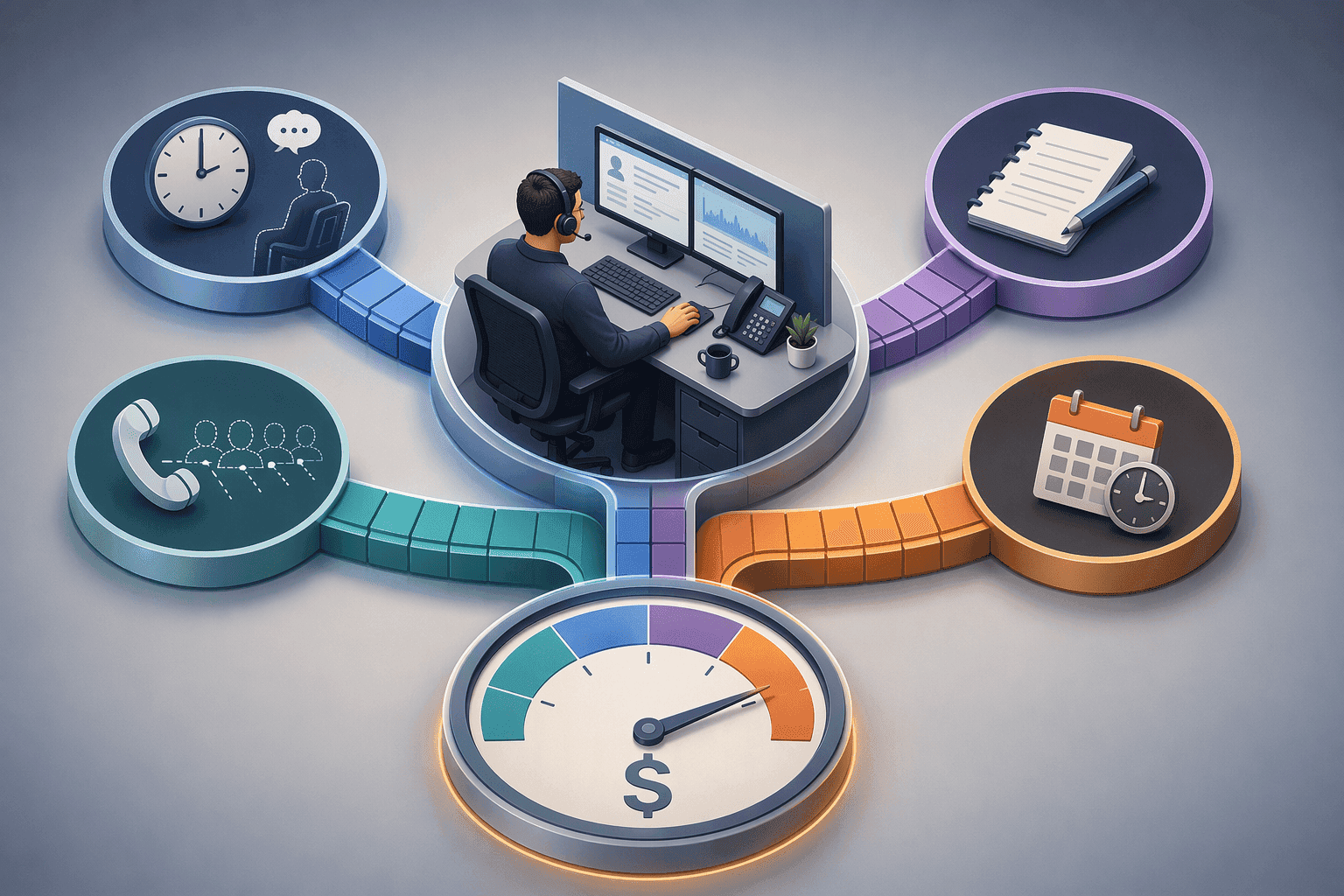
The most dangerous expense on your P&L isn't the wage rate. It's the seconds when a paid agent stares at a screen waiting for a call to connect, updates a static note, or listens to a dead line ring out. In 2026, that dead air is about to get categorized and taxed under pending overtime legislation.
Call centers operate on thin margins. The average fully loaded cost of a US-based collector runs $25 to $35 per hour Contact Center USA, 2026. Yet a significant slice of that paid hour vanishes into non-productive waiting. Dialer latency, manual after-call work, and silent abandoned calls eat minutes that convert directly into wage waste.
New overtime rules change the compliance math. The Department of Labor's 2024 threshold hike means more front-line agents qualify for time-and-a-half pay when workweeks stretch. A collector logging 45 hours during a month-end push now costs 7.5 overtime hours instead of falling under an exempt cap. Penalty overtime without corresponding collections output drags unit economics below break-even on low-balance books.
VoIP carrier latency is a silent margin drain. When a predictive dialer waits 3.5 seconds for a SIP handshake to complete, that gap plays out hundreds of times each day across every agent. Modern voice infrastructure trims that to real-time negotiation that holds agents productive so billable time stays billable.
The fix isn't cheaper labor. It's eliminating non-creatable time.
Speech analytics gives supervisors the data to identify which wrap-up routines balloon cycle time, and behavioral routing sends the right debtor to the right agent on the first pass. These tools cut the seconds that legislation now taxes at premium rates Verint.
Step 2: Deploy a Predictive Dialer to Slash Agent Idle Time
A predictive dialer ends the dead air between calls. It uses an algorithm that forecasts when your next agent will hang up. The system dials several numbers at once in the background, screens out voicemails and disconnected lines, and only connects a live voice to an agent the second they are free.
You can evaluate this technology through platforms like Domu to see how modern dialers integrate with existing payment systems. The TCPA sets a hard abandonment rate cap. Your pacing algorithm has to stay under that legal ceiling, because a burst of efficiency that triggers a fine is no efficiency at all.
Step 3: Build a Compliant Omnichannel Outreach Machine (SMS, Email, RVM)
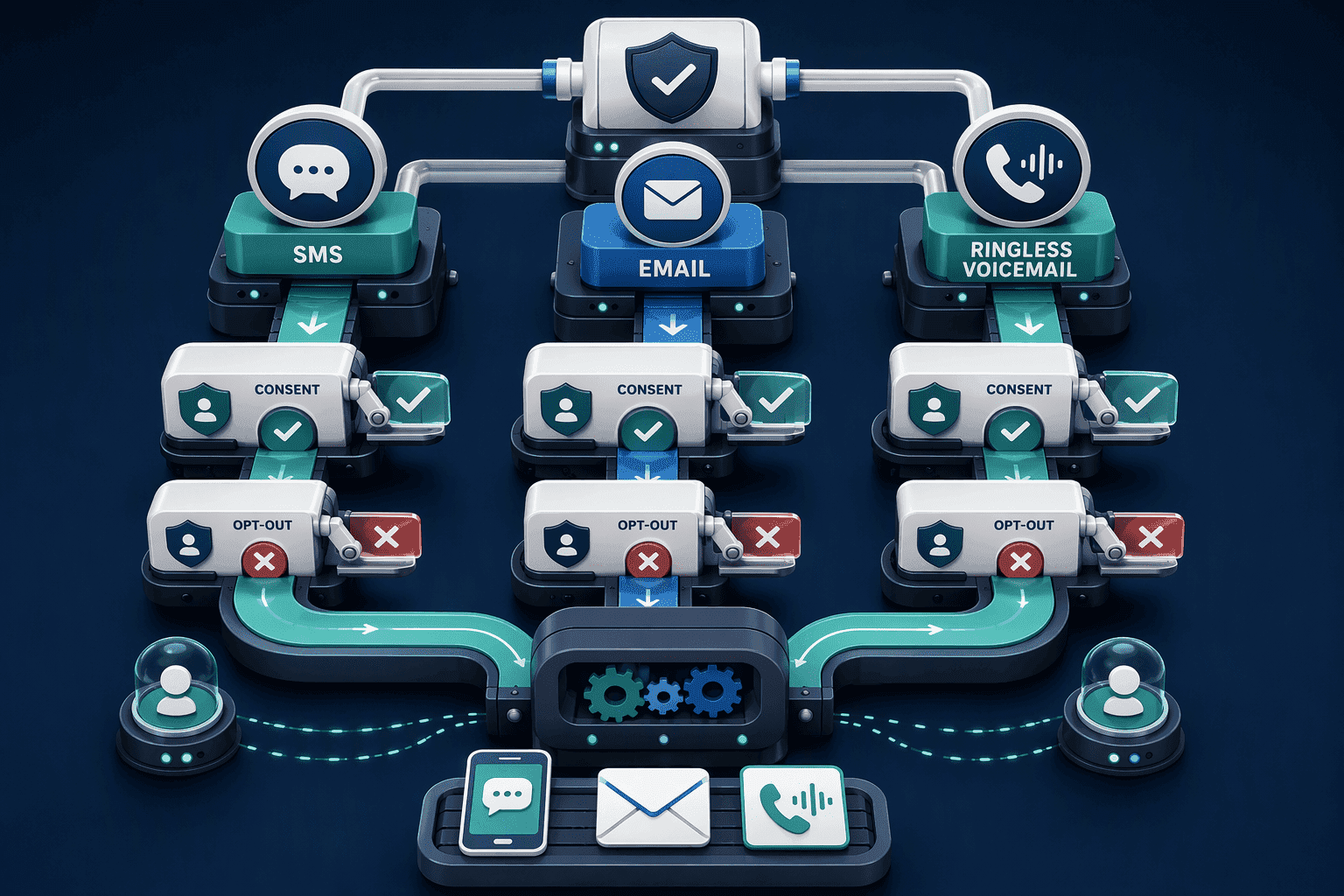
Multiply your contact attempts without adding a single seat. The marginal cost of sending a compliant SMS or email is orders of magnitude lower than the loaded cost of a 3-minute live agent call. Under Reg F, which the CFPB finalized and made effective on November 30, 2021, you can deploy these digital taps so long as you honor the opt-out: if a consumer refuses in writing or electronically, the law requires you to cease further communication with respect to that debt immediately.
Sequence a voicemail drop, an SMS payment link, and an email reminder to fire on a timed cadence during hours the consumer is legally reachable; do not risk a call before 8 a.m. or after 9 p.m. local time.
Step 4: Shift Low-Balance Accounts to AI Voice and Asynchronous Messaging
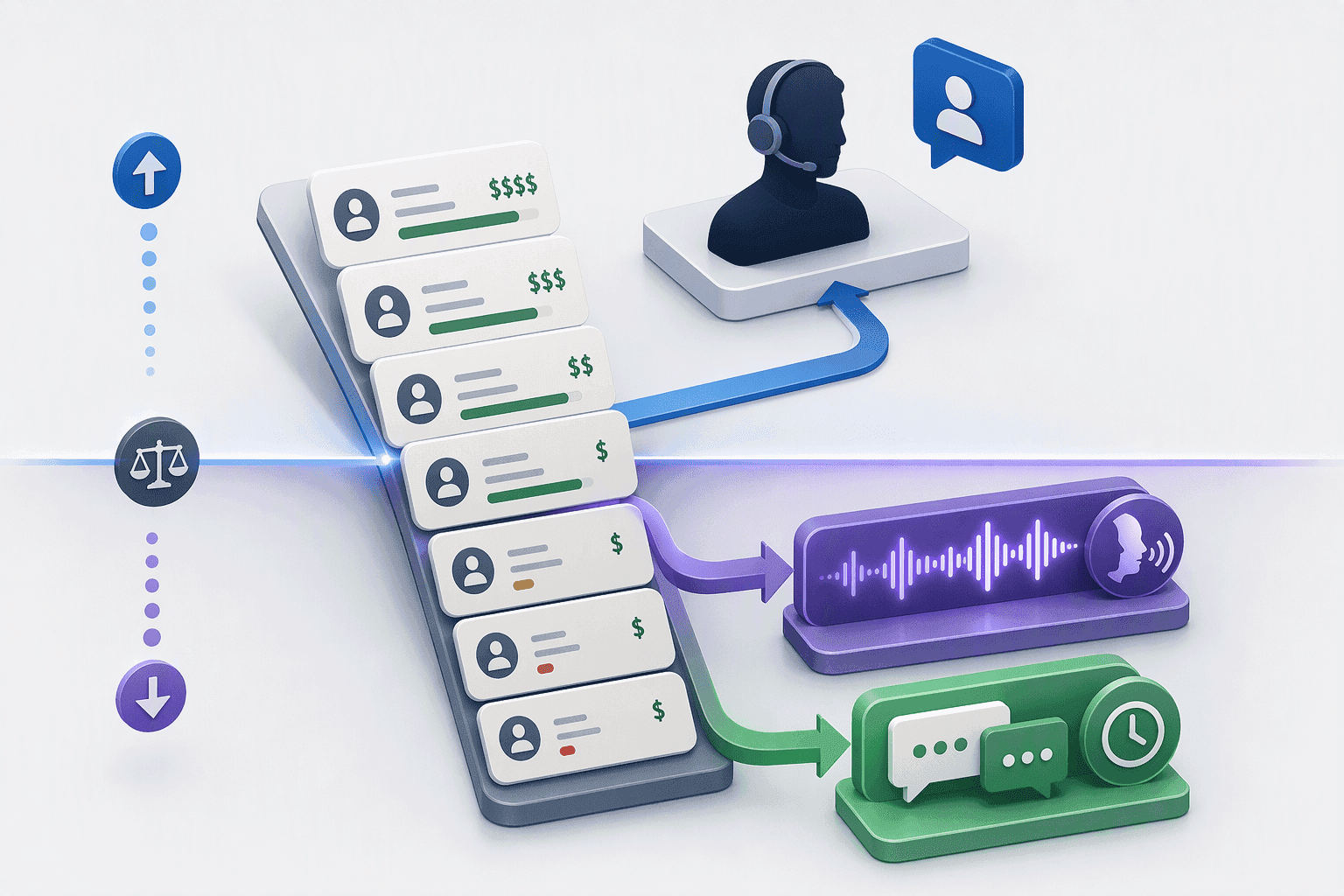
Find the number where a live agent stops making financial sense, then send everything below that line to a machine. Most agencies already know the math: a $200 account that takes three phone calls to resolve is a loser. The fix is routing rules that follow the margin.
Determine your true per-call cost: Using the BLS floor of $11.24 an hour as a base, stack on benefits, overhead, compliance QA time, and the overtime surge from peak dialing windows; your real per-call cost is double or more. Write that number down, it is your automation trigger.
Score every account for recovery viability: Calculate a liquidation probability and expected dollar recovery for each account. When the expected recovery minus that loaded call cost falls below your margin floor, the account never sees a human, it routes to an AI voice agent or a two-way SMS thread instead.
Execute the automated handling: The platform handles the conversation, pushes for a promise to pay or settles the debt outright, and records every interaction for compliance the same way a live desk would, with no parallel agent training or overtime roulette.
Adjust the breaker point as wage pressure rises: As labor costs climb through the rest of 2026, raise the automation threshold to feed more inventory to the machine. The threshold is your dial.
Step 5: Implement Real-Time AI Speech Analytics for Agent Coaching

You lose money when the audit arrives three days too late. A missed promise or a weak close already forced a callback, maybe two, before anyone even flagged the mistake. Traditional QA samples something past tense; real-time speech analytics scans every live conversation and warns you while you can still do something about it.
Think of it as a supervisor looking over every agent's shoulder, silently. The moment an agent skips a commitment push, slips into noncompliant wording, or drifts off a script that has a proven conversion rate, the system pings that supervisor's screen. No report, no retroactive coaching session scheduled for next Tuesday. Just a quiet alert on a call that's still alive.
What gets caught matters far more than tone. Soft closes that leave the debtor with an escape hatch. A disclosure missed at the top of the regulated call.
An objection that history shows should have been handled two ways but the agent chose the third, dead-end path. That's what the analytics parse. Most floors already record everything and attempt to mine the data.
The difference is latency. A batch job that delivers a "did you know the agent said this" email on Thursday cannot undo a compliance exposure that happened the Monday before. Live intervention, a chat message, a whisper-in-ear prompt to try the phrasing that actually works, prevents the exposure from crystallizing in the first place.
The platforms that handle voice today thread analytics directly into call routing and screen pop, pulling speech-to-text and sentiment trackers side by side so the supervisor sees context, not just a keyword hit. The open architecture in debt recovery platforms finally makes this realistic: analytics can trigger workflow automation, a paused dial sequence, a high-priority requeue when a vulnerable-customer flag fires on the call, while the recording is still rolling.
Step 6: Deflect Calls with Self-Service IVR and Payment Portals
Every transaction you push from a live agent's headset to a machine directly reduces your loaded cost of service.
Cost Factor | Agent-Assisted Phone Payment | Self-Service IVR / Web Portal |
|---|---|---|
Fully loaded cost per transaction | $3.50 to $8.50 per call (labor, occupancy, telecom) | $0.10 to $0.50 per automated session |
Agent handling time per payment | 4 to 12 minutes (call wrap, verification, processing) | 0 minutes of staff labor |
PCI compliance burden for your company | High: live agents hear and see card data (broader audit scope, more SAQ questions) | Lower: agent's environment never touches cardholder data (dual-tone multi-frequency masking, pure redirection) |
Scalability during peak billing cycles | Limited by headcount; queue wait times spike | Uncapped concurrency; automated telephony or web portals absorb any volume |
Human error exposure | Data entry mistakes, misapplied payments that require a correction call | Straight-through posting; customer keys the data and gets a reference number |
Typical caller adoption (once prompted) | N/A | 30% to 60% of payment callers accept deflection when the value is stated clearly (bill size, wait time) |
Step 7: Measure ROI by Channel with a Cost-Per-Contact Scoreboard
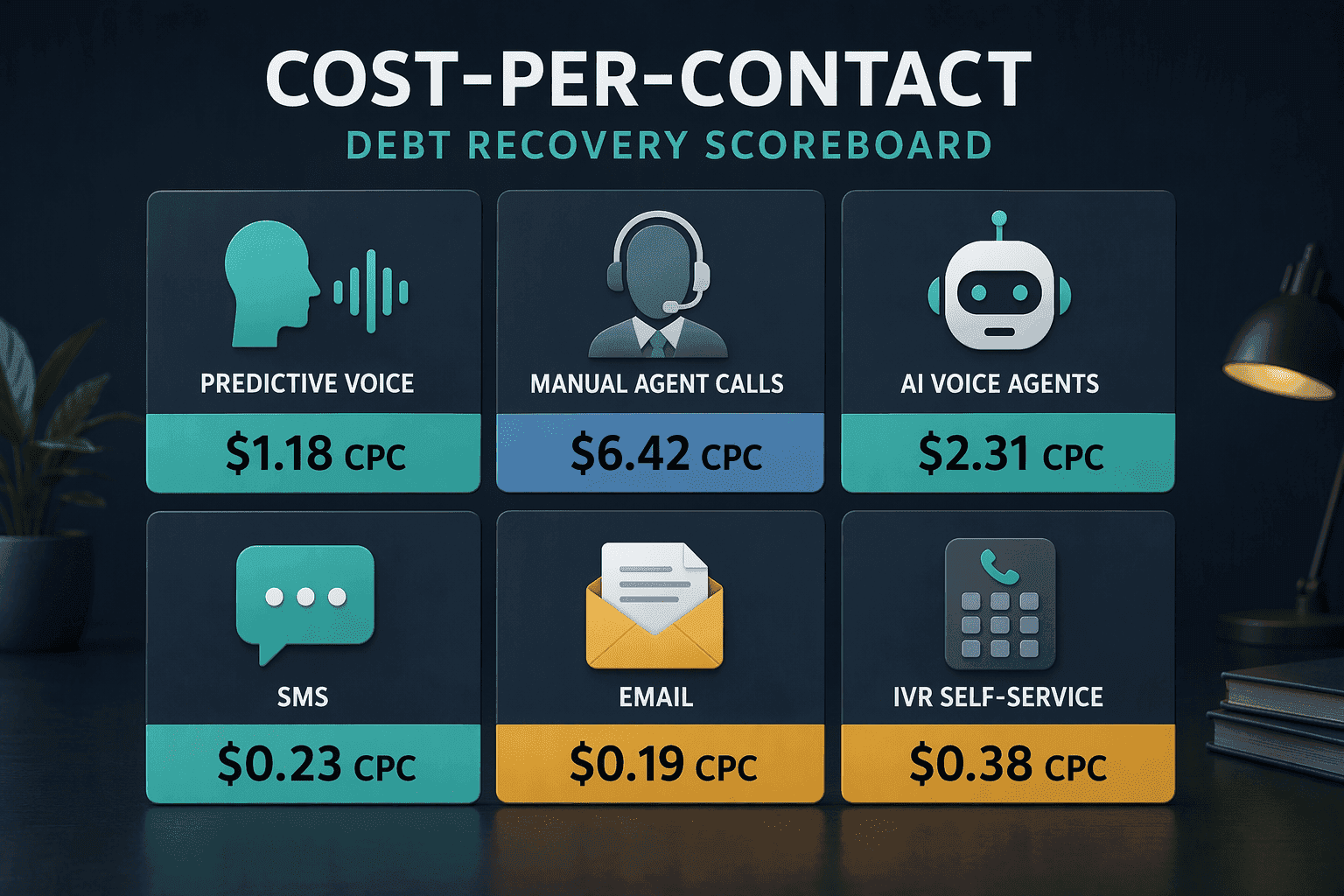
You cannot manage what you do not measure, and in debt recovery, the most revealing metric is Cost-Per-Contact (CPC). Split your communication machinery into discrete buckets: predictive voice, manual agent calls, AI voice agents, SMS, email, and IVR self-service.
For each bucket, pull the total fully loaded labor and technology cost. Divide that number by the total contacts made. You are left with a raw CPC that immediately flags which channels are burning budget. A human agent call routinely costs $0.50 to $1.50, while automated channels like SMS and IVR often fall below $0.05 per contact.
Line these CPC figures up on a single view against your recovery rates. You will quickly spot the channels where cost is eating your margin. For most traditional agencies, agent calls dominate the ledger; reducing even a small slice of that load or shifting it to AI-driven voice can recapture double-digit margin points.
This is not a one-and-done calculation. Pull the scoreboard monthly and watch for drift. A spike in predictive dialer costs might flag an abandoned-call compliance issue, while falling IVR costs could reflect smart self-service that actually recovers more Late payments without payroll growth.
Conclusion
The 2026 math is closing in. Real wages are falling, consumer prices are rising, and H.R. 9216 will double your overtime obligation the day it passes. An operation that leans on unmonitored idle time and brute-force manual dialing won't survive that squeeze.
The seven steps you've just worked through give you a phased sequence. Auditing your labor minutes against the bill's requirements comes first. Standing up a channel-level cost scoreboard follows. Together they raise liquidation rates while dropping the cost to get there.
Start with the predictive dialer and the low-balance AI triage. Those two moves free up the capital and management attention you need. From there, build the omnichannel machine and the self-service deflection layer. You'll end up with an operation that gets cheaper and more effective with every legislative shift.
Frequently Asked Questions
What are the primary drivers of high operational costs in debt collection call centers?
Agent idle time and flat labor overhead dominate. Real average hourly earnings slipped 0.7 percent year-over-year through September 2026, and pending overtime legislation (H.R. 9216) threatens to double mandatory overtime pay, making every unproductive waiting minute exponentially more expensive.
How can predictive dialer technology increase contact rates and reduce idle time for agents?
A predictive dialer algorithmically paces calls only when an agent is free, screening out voicemails and no-answers so the human picks up a live voice instantly. This recovers seconds lost in manual dialing, directly raising live connects per hour while compressing cost-per-contact. TCPA abandonment rate rules must govern pacing settings.
What omnichannel communication strategies (SMS, email, ringless voicemail) are compliant with US regulations like Reg F and the FDCPA in 2026?
Under Reg F, effective November 30, 2021, you may use SMS, email, and ringless voicemail if you provide a clear opt-out mechanism. The FDCPA imposes the 7-in-7 call cap per debt, prohibits contact before 8 a.m. and after 9 p.m., and requires the collector to cease communication with a consumer who refuses to pay in writing.
How do we measure the ROI of self-service payment portals and IVR systems against staffing costs?
Compare a fully loaded agent’s per-minute cost, using the $11.24 real hourly earnings floor as a base, against the near-zero per-transaction cost of an IVR or portal. Multiply the per-call savings by the deflected volume to see the direct margin gain from automation.
What agent coaching and performance analytics tactics most effectively boost recovery rates per hour?
Real-time speech analytics that flag soft closes or noncompliant language during the live call let supervisors intervene immediately, compressing average handle time. Pairing this with sentiment analysis identifies patterns that cause expensive callbacks, enabling targeted coaching on the exact behaviors that drive liquidation.
How are AI speech analytics and sentiment analysis being used to reduce call handle times and callbacks in 2026?
These systems scan conversations in real time for keywords and emotional signals that predict a bad outcome. When an agent misses a commitment or deviates from a proven script, the platform alerts a supervisor instantly, stopping the drift that would require a costly re-contact and compressing the handle time on the current call.
Sources
Call Center Cost Per Hour (2026) - Contact Center USA - contactcenterusa.com
Speech Analytics Software for Contact Centers | Verint - www.verint.com
FDCPA - Interagency Consumer Laws & Regulations - files.consumerfinance.gov
Related Articles



We’re building the next generation of engagement technology: intelligent, automated and compliant. Our mission is to empower financial institutions to orchestrate every stage of the servicing lifecycle with dignity and unprecedented efficiency.
Supported by

