

You promoted your top closer six months ago, and he just handed in his notice. Your second-best rep has been on autopilot since March
Introduction
You promoted your top closer six months ago, and he just handed in his notice. Your second-best rep has been on autopilot since March, and her liquidation rate shows it. You are watching skilled collectors walk out the door, and you are blaming the pay structure or the call volume.
The real cause is quieter and more corrosive. Kelli Van Cleave of ACA International diagnosed it as 'Assumption Fatigue,' a trained mental shortcut that creeps into experienced collectors who hit the same scripted objections hundreds of times a week. It looks like boredom.
It acts like burnout. And it is silently dismantling your recovery rates one prematurely disconnected call at a time.
The fix is a fundamental re-engineering of which calls ever reach your team's ears. Repetitive trigger work runs on a machine that never burns out. Human judgment stays with the disputes and hardship cases where it actually earns its keep.
Key Takeaways
The operational collapse most managers misdiagnose as standard burnout has a specific root cause, and a specific structural fix. Here is what you need to know before rewriting your floor strategy.
Assumption Fatigue is the culprit: Experienced collectors unconsciously terminate calls the instant they hear a stock objection like 'I'm unemployed,' and a metrics-driven floor without ongoing training reinforces that destructive reflex every day.
It creates a dual threat to your P&L: The habit erodes recovery rates by abandoning viable accounts, while the robotic script-reading it produces opens a direct path to CFPB complaints and FDCPA violations.
AI voice agents absorb the trigger volume: A specialized agent like Domu's Taylor handles the repetitive, high-volume calling that drives the fatigue, executing compliant scripts 24/7 without the mental drift a human develops by hour three.
The model is a hybrid, not a replacement: The proven architecture offloads routine contact to AI but mandates an instant, human fail-safe handoff the moment a caller disputes, negotiates, or signals genuine hardship. An algorithm cannot manage the 'reason and judgment' standard the law requires.
At a Glance
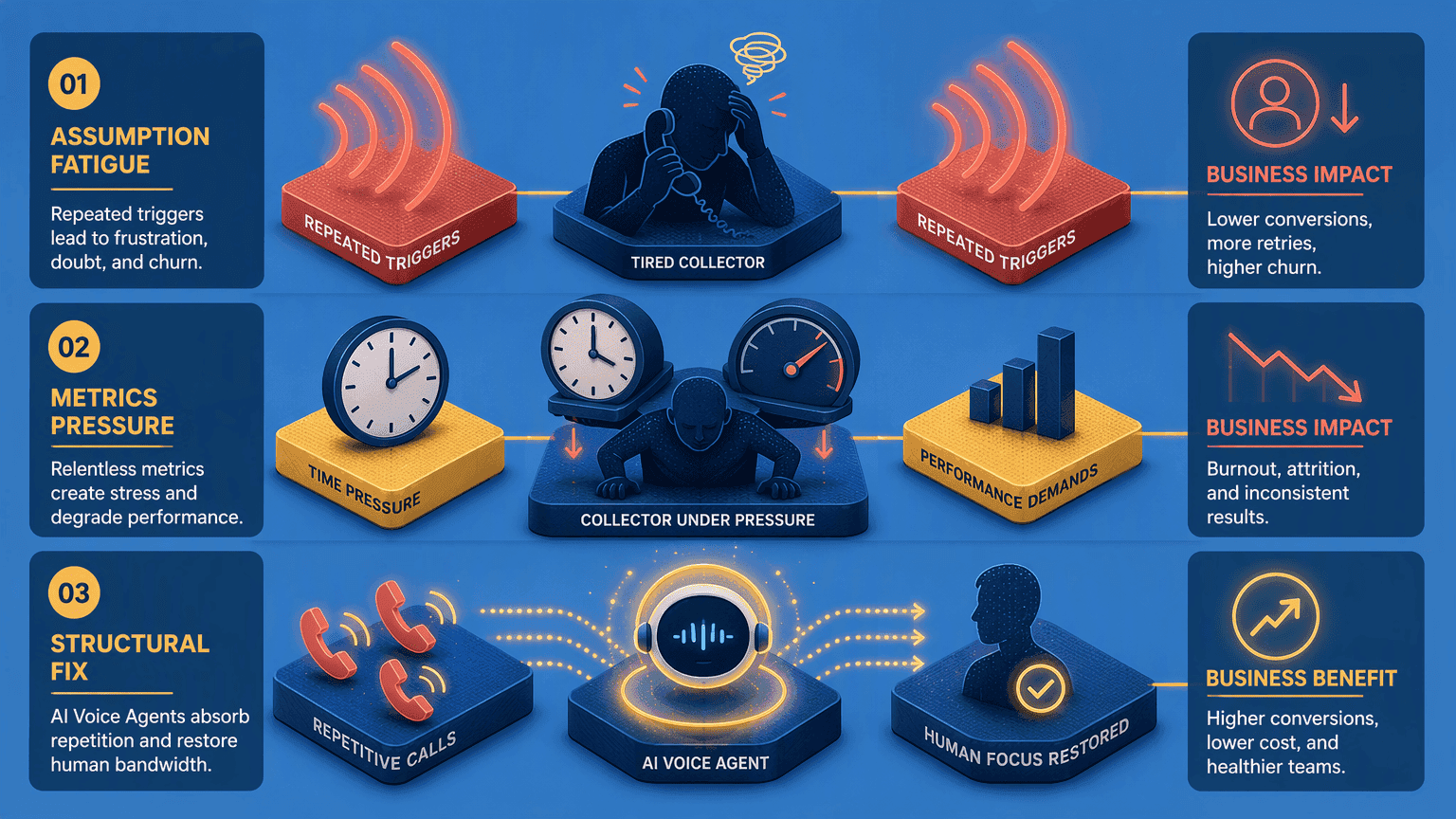
Here is how the options compare across the dimensions that matter most.
Cause | Impact on Collector | Impact on Recovery & Compliance | Structural Fix |
|---|---|---|---|
Assumption Fatigue: trained reflex to exit on stock objections | Premature call termination; exploratory behavior atrophies | Recovery rate erodes due to missed payment paths; CFPB complaints rise | AI voice agent handles repetitive, scripted trigger volume |
Metrics that reward speed (talk time, call count) | Reinforces exiting fast; kills curiosity | Missed hardship negotiations; FDCPA violations from robotic script drift | Shift metrics to quality outcomes; mandate human fail-safe handoff |
No ongoing scenario-based training after initial ramp | Shortcut becomes permanent automatic behavior | Compliance risk from undetected script drift | Replace script repetition with live objection-practice sessions |
High-volume, uniform call flow | Collector desensitization; mental drift by hour three | Inconsistent compliance enforcement across calls | Offload routine contact to AI; reserve human judgment for disputes |
The Real Reason Collectors Burn Out: Assumption Fatigue
A collector hears the same objection for the thousandth time, and something inside them clicks shut. The call is over before the debtor finishes speaking. This is not general exhaustion. It is a learned pattern of cognitive closure.
The definition is a trained exit reflex: ACA International's Kelli Van Cleave identifies Assumption Fatigue as the moment a seasoned collector hears a classic objection and mentally classifies the call as finished, rather than probing for a payment path. It is a shortcut baked in by performing the same script thousands of times.
Production metrics actively reinforce the problem: A floor managed purely by talk time and call volume teaches agents that speed is the rewarded behavior. Once a collector internalizes that exiting fast on a familiar "no" hits the metric, the exploratory muscle atrophies.
The training window closes early: Most shops abandon scenario-based training after the initial three-month ramp, right when the monotony of repetition begins to cement the shortcut into permanent, automatic behavior.
A safe automated system and a regulatory time bomb are separated by one thing: real-time enforcement. Let a script drift past the FDCPA’s 7 a.m. to 9 p.m. calling window or misrepresent the debt amount, and compliance is already broken before a supervisor reviews the recording.
How Repetitive Calls Systematically Erode Collector Performance and Compliance
The mindless grind of high-volume calling attacks your recovery rate and your regulatory standing at the same time. When every call blends into the next, good collectors stop hearing what matters.
An experienced agent operating on assumption autopilot exits calls that contain a hidden ability to pay. They hear 'lost my job' and move on, missing the spouse who started a new position or the tax refund that hit an unverified account. Your liquidation curve bends downward not because your portfolio worsened, but because your best people stopped listening.
The erosion is invisible until the quarterly numbers arrive. IC System lays out the compliance cost directly: when an agent on autopilot fails to properly disclose the mini-Miranda or mishandles a verbal dispute because the script sounds like every other call, that misstep generates customer complaints and legal exposure.
A collector rushing to hit volume does not deliberately violate the FDCPA. They drift out of compliance one mumbled disclosure at a time, and the CFPB makes no distinction between willful ignorance and fatigue-driven negligence.
The Regulatory Tightrope: CFPB and FDCPA Rules That Repetition Puts at Risk

A fatigued agent is a walking liability. The regulatory framework governing debt collection is a minefield of precise timing windows, compulsory disclosures, and dispute-handling triggers that a bored human brain is uniquely bad at tracking across an eight-hour shift.
The FDCPA draws hard lines that a human on repetition drift will eventually cross. A debt collector may not contact you before 8 a.m. or after 9 p.m., and the law bans repetitive calling to annoy consumers. An agent in hour seven of autopilot, dialing from a list sorted by number rather than time zone, creates a time-stamped violation the CFPB can read straight off the call log. The error comes from mental bandwidth collapse.
Beyond timing, the CFPB's Regulation F implements the FDCPA with a rulebook that is lethally specific about what a collector must say. The final rule clarifies the information that a debt collector must provide to a consumer at the outset of debt collection communications. An agent whose brain is on Assumption Fatigue skip-mode omits a clause of the disclosure, and the call flips from lawful contact to a regulatory violation in the space of a single unspoken sentence.
There is also the trap of contact-location logic. A debt collector may not contact you at work if your employer prohibits such calls, and if a consumer sends a written cease-contact request, the collector must stop calling you. An automated system can hold every known number against an employer database and a consent register in real time, blocking a dial before the violation occurs.
The fatigued human agent, flying on instinct, makes the call first and measures the exposure later. The worst-case scenario is a legal action trigger.
The final rule prohibits debt collectors from bringing or threatening to bring a legal action against a consumer to collect a time-barred debt. An agent rushing to clear a queue who threatens suit on a stale account because they skipped the date-of-default check has manufactured a liability the agency cannot walk back.
What an AI Voice Agent Needs to Safely Relieve the Repetitive Trigger

The core thesis is not 'replace humans.' The goal is to remove the specific task volume that erodes human performance. To do that safely in a regulated collections environment, an AI voice agent requires a rigid set of capabilities.
Script-faithful consistency: The agent must operate across thousands of concurrent calls without deviating from ad-libbed disclosure language; Domu's platform runs voice, SMS, and email from a single system, and its AI agent Taylor is built with on-script validation to hit the exact mini-Miranda wording, payment-portal URI, and right-party verification sequence on every contact.
Real-time compliance guardrails: The AI must be programmed to block dials outside the federal 8 a.m. to 9 p.m. contact window and suppress attempts to numbers flagged as employer lines or associated with a written cease-and-desist; the rule must be the gate the dialer cannot open.
Instant fail-safe handoff: The moment a consumer utters 'dispute,' requests debt verification, or signals a hardship scenario requiring negotiation, the entire call context must transfer to a human specialist; Taylor includes a fail-safe escalation path for this, shifting the interaction to a trained person who can apply judgment that IC System insists AI cannot replace given constantly changing laws.
How AI-Powered Platforms Maintain Ironclad Compliance During Automated Calls
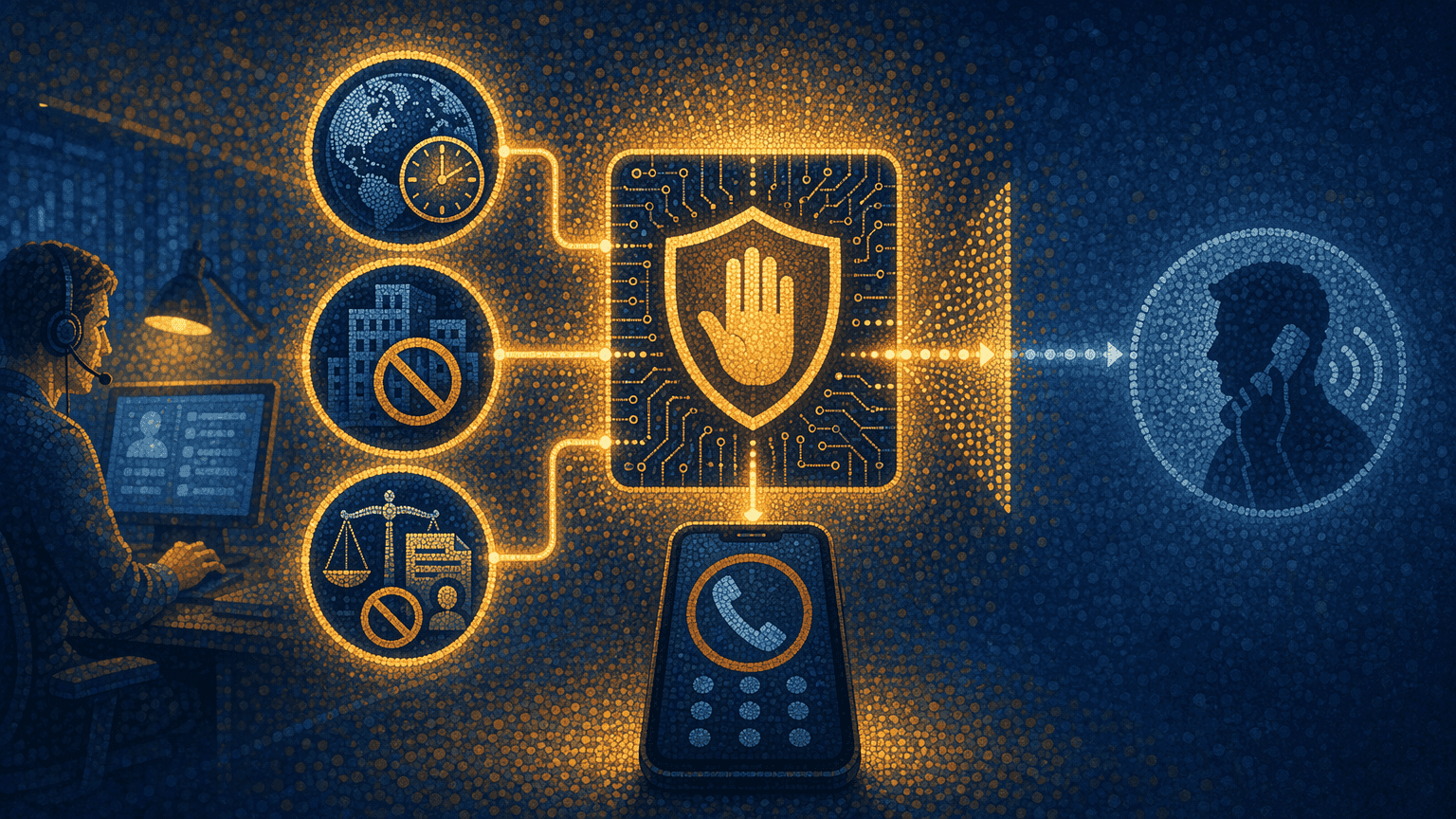
A safe automated calling system runs real-time enforcement gates that block violations before a single word reaches the consumer. Those gates operate faster than a CFPB auditor can read a transcript.
Pre-call compliance check: Before placing a dial, the platform verifies the number against the time-zone rule, employer-prohibition list, written-cease-contact register, and legal-action eligibility window; the dial occurs only after a logic board confirms no active block condition, and every decision is logged for audit.
Live keyword detection: During the call, the system runs keyword detection on consumer speech; the instant a term associated with dispute, legal representation, or cessation of contact is detected, it triggers an immediate handoff to a human specialist.
Enforced script operation: Taylor prevents off-script promises about credit reporting, settlement terms, or repayment timelines that the creditor system has not pre-approved, eliminating the risk of a rogue promise creating an estoppel defense.
Full audit trail: The platform records every interaction and generates a compliance log mapping each spoken disclosure to a timestamp, proving lawful conduct; Domu states it is SOC 2 Type II compliant and maintains CFPB, TCPA, and PCI compliance.
The Measurable Impact: Efficiency, Attrition, and Risk in AI-Augmented Workflows
We build AI not to chase a cost-per-call metric on a spreadsheet, but to change the working conditions that cause your best people to quit. At Domu, we believe the primary ROI of offloading repetitive volume is workforce stability.
When an AI agent absorbs the thousands of daily right-party verification calls, 30-day reminder contacts, and no-answer retries, your human team stops marinating in the exact stimulus that produces Assumption Fatigue. They arrive at their desks to a queue of escalated disputes, negotiated settlements, and complex skip-trace cases that require active cognition rather than rote script delivery. The job shifts from voice-operated assembly line to skilled diagnostic work, and that shift changes who stays and who walks.
McKinsey research on agentic AI deployment confirms that workflow redesign is the mechanism that unlocks retention. One global services company that began by redesigning workflows instead of rolling out tools saw adoption accelerate and attrition decline. By contrast, an organization that simply layered agents on top of its current systems but didn't redefine roles watched employees distrust the output and the initiative stall in pilot mode. The lesson is blunt: technology that changes nobody's actual day-to-day cognitive load changes nobody's quit rate.
The Yale School of Management research on AI debt collection provides a cautionary baseline: their study found that the value of repayments collected by AI callers during the first 30 days past due is 9% less than the value collected by humans, and that AI callers have collected 5% less even a year later. Dig deeper into that finding, and the failure mode is instructive. The data show that AI callers are less able than humans to extract verbal promises to repay from borrowers, and promises that are made to AI are broken more frequently.
The researchers argue that the gap traces to the nature of the interaction itself. It is the AI-ness that leads to a willingness of human borrowers to break promises.
The hybrid architecture exists to close that gap. The AI handles the high-volume, fact-based, time-sensitive contacts that create no moral obligation gap, and the human takes over the moment the call becomes a negotiation with a promise attached.
The Indispensable Human: Where Fail-Safe Oversight Overrides Automation

The boundary between safe automation and legal exposure is not a gray area. It is a hard line drawn by consumer behavior and enforced by regulatory examiners.
A machine can log the dispute, but only a trained human can assess the documentation, navigate a tri-merge credit report conflict, and determine whether the agency can lawfully continue collection or must cease.
Nuanced hardship judgment is a human capability: A caller who says 'I just lost my home' is presenting a financial, legal, and emotional puzzle that no language model can ethically solve. The human collector reads tone, probes for third-party resources, and structures a workout arrangement that an algorithm would reduce to a binary collect-or-close decision.
Human-in-the-loop protocol is a regulatory expectation: Legislation increasingly emphasizes the right of citizens not to be subject to a fully automated decision, and points to the importance of the human presence as a safeguard. The formal discipline of HITL evaluation dates back to World War 2 and exists to demonstrate that a human-machine system meets requirements for effectiveness, efficiency, acceptability, and safety. Removing the human from the high-stakes portion of the workflow violates the entire operational safety design.
Changing laws demand adaptive judgment: IC System makes the key point clearly: laws change constantly. An AI model trained on last year's regulatory text fails a new state-level disclosure requirement unless a human compliance officer reviews and updates the logic. The human is not an operator of the machine; the human is the governance layer that keeps the machine legally current.
Conclusion
Your collector burnout problem starts with the workflow, not the workforce. Call architectures built for an era when every dial demanded a human voice now force skilled professionals to repeat the same low-complexity scripts hundreds of times a day. ACA International's *Collector* magazine calls the resulting condition Assumption Fatigue, describing it as the erosion of critical thinking that sets in when every call follows identical patterns and the brain stops engaging From Collector: Assumption Fatigue, ACA International.
Remove the pathogen rather than hardening the host. An AI voice agent handles the robotic contact volume: it stays on script, never fatigues, and stays inside every legal calling window. That shift frees your human team for the work a machine cannot touch.
Interpreting nuance. Negotiating real hardship. Applying the reason and judgment that separate a supervised compliance program from a regulatory time bomb.
Frequently Asked Questions
What specific psychological and operational factors cause collector burnout from repetitive debt collection calls?
ACA International identifies 'Assumption Fatigue' as the core mechanism. It is a learned cognitive shortcut where collectors automatically exit calls upon hearing a stock objection like 'I'm unemployed' rather than probing for payment ability. Production metrics that reward speed and the absence of ongoing scenario training after the first three months on the floor reinforce the behavior until it becomes an automatic, performance-eroding reflex.
How does the repetitive nature of collections calls affect collector performance, compliance, and attrition rates?
Repetition shifts an experienced agent's brain into autopilot, causing them to prematurely terminate calls with consumers who actually have capacity to pay, which silently erodes liquidation rates. At the same time, a fatigued agent on mental cruise control is prone to omitting mandatory FDCPA disclosures, calling outside legal time windows, or mishandling disputes. This dual hit to performance and compliance accelerates skilled-agent burnout and increases lawsuit exposure.
What are the key capabilities an AI voice agent like Domu's Taylor needs to safely handle high-volume collections calls and reduce agent burnout?
An AI voice agent in regulated collections requires a rigid set of capabilities to safely remove the task volume that erodes human performance.
Script-faithful enforcement: Never deviate from regulated disclosure language on any call.
Real-time compliance guardrails: Block calls outside the legal 8 a.m. to 9 p.m. window and to prohibited numbers.
Immediate fail-safe escalation: Transfer the full call context to a human specialist the instant a consumer disputes a debt or signals hardship.
How do AI-powered collections platforms maintain CFPB and FDCPA compliance during automated repetitive calls?
A compliant platform operates through a series of real-time enforcement gates that block violations before they occur.
Pre-dial checks: Verify each call against time zones, employer-contact prohibitions, and written cease-communication requests before placing it.
Real-time keyword detection: Trigger a human handoff on disputes or hardship signals during the call.
Disclosure enforcement: Deliver exact Regulation F language at precise timing markers, preventing off-script promises.
Full audit trail: Record every interaction and log compliance events for a complete, verifiable record of lawful conduct.
What measurable outcomes, such as agent turnover reduction and complaint rates, have financial institutions seen after deploying AI to handle routine collection tasks?
McKinsey found that companies redesigning workflows before rolling out AI agents saw adoption accelerate and attrition decline, while firms that layered AI onto unchanged processes saw trust collapse. Domu reports that a top 5 U.S. fintech using its voice and text agents recorded 30% fewer complaints per 100 calls. The measurable result of offloading repetition is a stabilized workforce and reduced complaint-driven regulatory risk.
What is the role of human oversight and fail-safe escalation in an AI-augmented collections workflow?
Human oversight is the non-negotiable governance and safety layer. Research shows that AI callers collect 9% less than humans in early delinquency because borrowers break promises to machines more often. Humans must handle complex disputes, hardship negotiations, and any conversation requiring legal judgment or empathy, while also updating the AI's rules as laws change.
Sources
Know your rights when a debt collector calls - files.consumerfinance.gov
[PDF] Fair Debt Collection Practices Act - Office of Financial Readiness - finred.usalearning.gov
The impact of AI errors in a human-in-the-loop process - PMC - pmc.ncbi.nlm.nih.gov
[PDF] Human-in-the-Loop Evaluations: Process and Mockup Fidelity - ntrs.nasa.gov
Can AI Replace Human Debt Collectors? | Yale Insights - insights.som.yale.edu
Re:think: Taking a human-centered approach to the agentic AI future - www.mckinsey.com
From Collector: Assumption Fatigue - ACA International - www.acainternational.org
Related Articles




We’re building the next generation of engagement technology: intelligent, automated and compliant. Our mission is to empower financial institutions to orchestrate every stage of the servicing lifecycle with dignity and unprecedented efficiency.
Supported by

