

Most collection floors still sound the same. Agents read from a script, debtors recite their objections, and outcomes hinge on a single variable
Introduction
Most collection floors still sound the same. Agents read from a script, debtors recite their objections, and outcomes hinge on a single variable: how much empathy and creativity the human agent can muster inside a rigid framework. It is a costly bet.
In the United States alone, consumers owed $661 billion in delinquent debt to the federal government as of 2019. Across the Atlantic, the European debt purchase market reached a total book value of 25 billion EUR in 2020, growing at double-digit rates. The scale demands a tool that reads the room, not just the script.
Most legacy software doubles down on the problem. Existing debt collection software primarily focuses on data gathering, administration, and reporting but lacks automated decision-making capabilities. It logs what happened last week but stays mute while a debtor's voice tightens in real time.
That changes now. Combining Speech Emotion Recognition (SER) architectures, dimensional emotion models, and reinforcement learning, platforms like our own Domu Taylor platform run continuous analysis on every syllable. The system tracks not just anger, but emotional intensity and direction, then adapts the collection strategy mid-call. This is not a dashboard reporting what went wrong. It is an agent steering the conversation toward recovery before the debtor disengages.
Key Takeaways
The core insight is that real-time debtor behavior analysis is already in production, running on three interlocking technologies. Here is what the architecture looks like and why it changes the unit economics of collection:
The surface is not the agent: Continuous SER engines track emotional dimensions, valence, arousal, dominance, at the acoustic level, independent of what words are spoken.
Scripts are static, markets are dynamic: SDCS architectures use deep neural networks and Markov processes to optimize the next action in a call, not the next line in a script.
Compliance is a real-time control, not an audit: Integrated guardrails detect FDCPA edge cases during the call and trigger escalation before a violation occurs.
The handoff defines the agent: Fail-safe escalation protocols make the AI a precision tool for human collectors, not a replacement for them.
Monitoring is the margin of safety: ASR-LLM-TTS tracing dashboards catch latency drift, hallucination spikes, and accuracy drops that traditional KPIs miss entirely.
At a Glance

Here is how the options compare across the dimensions that matter most.
Solution | Core Real-Time Analysis Method | Key Differentiator | Deployment Readiness |
|---|---|---|---|
Domu Taylor Platform | Speech Emotion Recognition (SER) with dimensional emotion models (valence, arousal, dominance) | Model governance layer (Alex) adapts conversation strategy mid-call | CFPB compliant, Fortune 500 customers in production |
SDCS Architectures | Deep neural networks + Markov processes to optimize next action | Replaces static scripts with dynamic action selection | Research-stage; emerging in specialized vendors |
SER-Only Engines | Continuous acoustic-level emotion tracking independent of words | Lightweight, integrable into existing call-center software | Available as standalone API or middleware |
ASR-LLM-TTS Tracing Dashboards | Real-time latency, hallucination, and accuracy drift detection | Monitors AI health rather than debtor emotion directly | Operational in advanced call centers with AI stacks |
Reinforcement Learning Adapters | Learns optimal call strategy from debtor response patterns | Self-improving over call volume without manual retuning | Pilot deployments in enterprise settings |
Compliance Guardrails (FDCPA) | Edge-case detection during call, triggers escalation pre-violation | Real-time legal control, not post-call audit | Integrated into some platforms (e.g., Domu Taylor) and as standalone tool |
Fail-Safe Escalation Protocols | Human handoff triggered by emotional intensity thresholds | Keeps AI as assistant, not replacement | Standard in most commercial voice agent platforms |
Hybrid Emotion-Lexical Models | Combines tone analysis with keyword/intent parsing | Reduces false positives from emotional noise | Emerging in R&D; few production deployments in debt collection |
1. Domu Taylor Platform: AI-Driven Voice Agents with Built-in Compliance Guardrails
Domu Taylor is a production voice agent platform that analyzes speech patterns and emotional cues during live collection calls, not after them. It runs voice, SMS, and email outreach from a single system, and the company says it is CFPB compliant with Fortune 500 customers in deployment.
We built Taylor to solve the static-script problem. The agent listens for shifts in a debtor's tone: hesitation, rising intensity, flat resignation. It surfaces those signals to the model governance layer, which we call Alex.
That layer then modifies the conversation strategy in real time. When the debtor signals emotional shutdown, the system shifts to a softer information-gathering posture instead of pushing a settlement offer. Our model governance is the boundary between a rigid call tree and genuine interaction.
The compliance requirement is direct. Conversational fluency alone does not prove a platform is collections-ready. Taylor is intended to prevent off-script responses in live customer interactions.
It provides on-script validation, and when a customer is confused or at high risk, the system handles the case with safe escalation rather than trying to push through. Nu, one of our customers, grew its AI calls 2,400x without ever putting a customer on hold. The architecture did that by keeping interaction consistency and compliance without rogue scripts or costly violations.
2. Continuous Speech Emotion Recognition (SER) Architectures for Live Call Analysis

The acoustic engine that makes any of this possible is a continuous SER architecture that processes raw audio as a stream, not as discrete utterances. The Feng & Devillers study from CNRS built an end-to-end system specifically for call center conversations, producing what they call a large-scale real-life dataset (CusEmo) for continuous SER in customer service call center conversations. That dataset is the training ground for models that track emotional movement across an entire call rather than labeling a single sentence as "angry" or "sad."
What makes the CusEmo work relevant is its rejection of chunk-based emotion classification. The researchers trained models to capture subtle emotional fluctuations that peak and decay over seconds. By incorporating empathy level information, the model's performance improved measurably, which suggests the architecture is learning something about conversational dynamics, not just acoustic spikes. A system that only flags shouting will miss the debtor who goes quiet, and that silence is often the moment before default. A continuous SER architecture, running inference on every 100ms of live audio, catches the shift in real time and feeds it forward to the decision layer.
3. Dimensional Emotion Models: Tracking Valence, Arousal, and Dominance in Debtor Voices
A simple anger label is nearly useless in collections. Anger can mean the debtor is engaged and negotiating, or it can mean they are about to terminate the call. What matters is direction and intensity, and that is what the dimensional model captures. The dimensional approach models latent dimensions of emotion in real-life customer service call center conversations, aiming to capture the subtlety, complexity, and continuity of emotions. The three axes are valence (positive to negative), arousal (calm to intense), and dominance (controlled to overwhelmed).
Tracking these as continuous values during a call produces a signal that predictive models can actually use. A debtor moving toward high arousal and negative valence while trending low in dominance is shutting down. The agent should de-escalate, not push.
A debtor with low arousal but high dominance is negotiating from a position of control, that is a readiness signal for settlement terms. Dimensional tracking gives the downstream decision engine a set of coordinates, not a single label. That granularity is what separates behavior analysis from basic sentiment detection.
4. Multi-Task and Context-Aware Deep Learning for Behavior Prediction
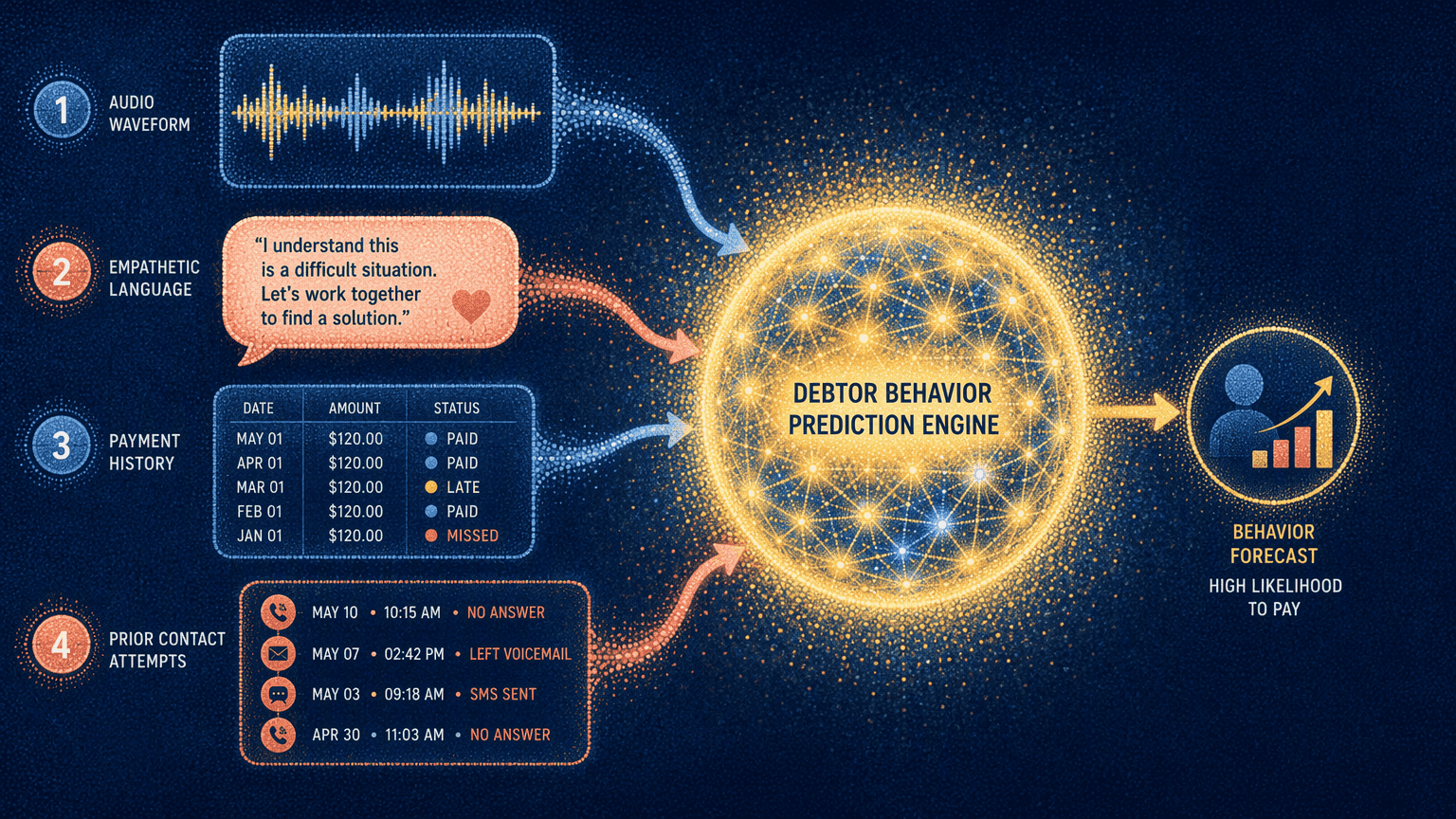
A voice carries tone, but it does not carry the whole story by itself. The Feng & Devillers research shows that feeding contextual signals into a deep learning model alongside the raw audio increases performance noticeably. A voice waveform turns into a debtor behavior prediction only when the model processes several real-world factors at once.
Empathy level: Whether the agent uses empathetic language changes how the debtor's vocal signals should be read, a tense voice answering an empathetic prompt means something different from a tense voice answering a clinical one.
Interlocutor gender: Adding interlocutor gender as a contextual input dimension improves SER accuracy, likely because speech patterns and emotional expression norms vary by gender.
Call purpose and urgency: Urgency signals like overdue amount, days past due, and prior promise-to-pay history feed into the decision framework, so the emotional and commercial signals are processed jointly.
Debtor communication history: Multi-task models predict both the current emotional state and the probability of a payment outcome in one pass, with shared representations pushing accuracy higher for each task.
5. Adaptive Decision Systems Using Markov Processes and Reinforcement Learning
Emotion recognition answers why the debtor feels a certain way. The adaptive decision system answers what to do about it. The Smart Debt Collection System architecture from Springer uses a Markov decision process to model the debtor's state transitions during a call, essentially, a mathematical representation of "given what the debtor is doing now, and what we think they will do next, what action maximizes the likelihood of payment?"
The system integrates this with a deep neural network that optimizes over a set of possible actions. The proposed SDCS integrates three key components: factorization (Markov process), optimization (deep neural network), and process specification (domain-specific language). That third component is critical: the domain-specific language constrains the action space to keep decisions inside regulatory guardrails.
That final point separates research from production. A raw reinforcement learning agent will find edges. It might learn that threatening legal action improves short-term recovery on a narrow cohort, and it will do that if you let it. The SDCS specification layer walls off any action that violates the policy, regardless of what the optimization layer wants.
The system was field-tested with a major financial institution. The result is a strategy engine that is both dynamic and constrained. It learns from debtor behavior but will not learn to be abusive. For a US collections operation handling Reg F compliance, those constraints are the feature, not a limitation.
6. ASR-LLM-TTS Tracing Dashboards for Real-Time Agent Oversight
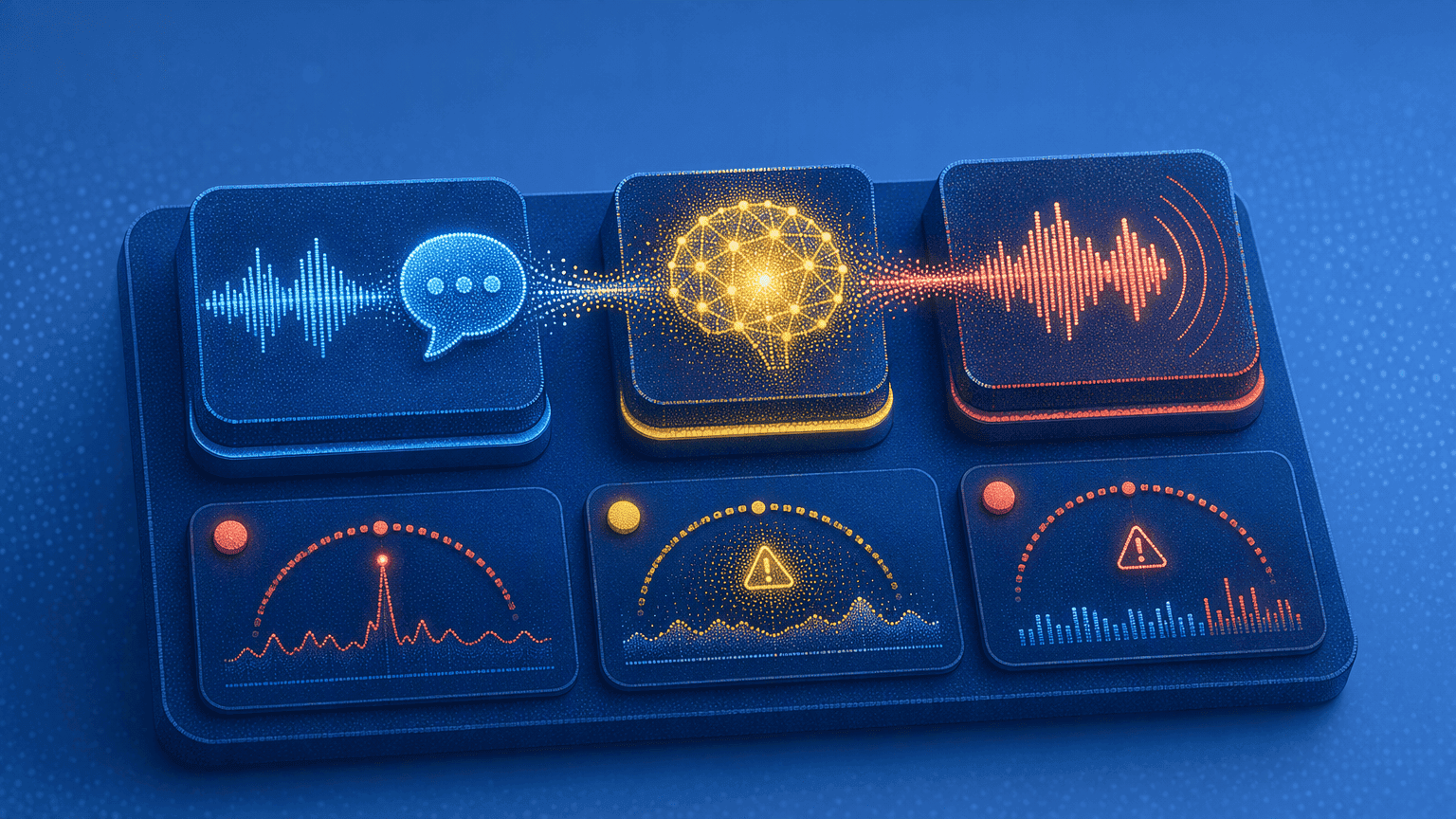
A production voice agent is a pipeline: Automatic Speech Recognition converts speech to text, a Large Language Model reasons about the text and context, and Text-to-Speech renders the response back to audio. That chain has failure modes that traditional contact center metrics, Average Handle Time, CSAT, do not surface. A voice agent might maintain a 4-minute AHT and 3.5-star CSAT while hallucinating account balances on 12% of calls. Traditional dashboards show acceptable performance.
Real-time voice analytics dashboards solve this by tracing every stage. When ASR accuracy drops 3% after a provider update, when LLM latency creeps from 400ms to 900ms during peak hours, or when a prompt change introduces hallucinations on 8% of billing inquiries, the dashboard surfaces it immediately. Teams using dedicated voice analytics reduce debugging time by 40 to 60% and catch regressions before they impact customers. In regulated collections, a hallucinated settlement amount is an FDCPA event.
The Domu Taylor platform builds this tracing into its architecture. Alex, our model governance layer, provides agents and supervisors with a real-time dashboard that surfaces the pipeline's internal state. If the LLM begins to drift, the human sees it before the debtor does.
7. Automated Compliance Violation Detection for Regulated US Collections
A collections call that misses a disclosure or slips past a time window isn't a training gap. It's a violation. The FDCPA and Regulation F don't care whether the agent was AI or human, only that the rules were followed. That shifts real-time debtor behavior analysis from a performance metric into a compliance control.
Here is what the detection layer checks on every interaction:
Abusive language filtering: The system scans ASR transcripts and emotional trajectory data together to spot patterns that cross into harassment. When it finds one, it either de-escalates the call path or pulls the interaction for immediate review.
Disclosure enforcement: On-script validation confirms the Mini-Miranda is delivered at the required point. The tracing dashboard logs each instance as a verifiable event record an auditor can pull without reconstructing the call.
Call time violation prevention: The agent cross-references debtor time zones and known contact restrictions before dialing. If the attempt lands outside the permitted window, the outreach is blocked outright. The violation never happens.
Regulation F validation: For accounts under the CFPB's debt collection rule, the system checks the 7-in-7 call attempt limits and any active cease-communication flags at the account level. No voice agent action starts until that validation clears.
8. Fail-Safe Escalation Protocols: Balancing AI Automation with Human Oversight

The most important line in any AI collections deployment is the boundary between agent autonomy and human handoff. We ship the system with explicit escalation points because some conversations require human judgment, empathy, and authority. Here is the ordered protocol that the decision engine follows when the AI reaches its limit:
Confidence threshold breach: When the optimization layer's confidence score for its next-best-action recommendation drops below a configured threshold, the system pauses the autonomous path and queues a human agent with full call context.
Distress signal detection: If dimensional SER tracking detects a rapid drop in valence and dominance with high arousal, a debtor in significant emotional distress, the system immediately shifts to a de-escalation posture and flags the call for supervisor intervention.
Payment negotiation complexity: When a debtor proposes a non-standard repayment plan or raises a dispute that requires adjudication, the LLM surfaces the details to a human agent rather than attempting to negotiate outside its bounded action space.
Escalation demand recognition: If the ASR output includes an explicit request to speak to a manager, the system honors it immediately, providing the human agent with a summary of the emotional trajectory and the last known state information so the transition is continuous, not a cold transfer.
Conclusion
The stack works because each layer constrains the one above it. Continuous SER gives you a dimensional emotional signal. Multi-task deep learning layers context over it.
The Markov decision engine optimizes strategy inside a bounded action space. Domain-specific language and automated compliance detection keep the regulatory boundary firm. Human escalation protocols define the outer edge of what the system can do on its own.
You end up with something different from a smarter script. You get a real-time behavior engine that maximizes recovery while staying inside the rules.
At Domu, we think that is the only viable architecture for collections AI in 2026. Ready to see what your future AI agents look like in action?
Frequently Asked Questions
What technology enables real-time analysis of debtor behavior during collection calls?
Continuous Speech Emotion Recognition (SER) engines process raw audio as a stream, tracking emotional dimensions like valence and arousal in real time. Combined with context-aware deep learning and Markov decision processes, the system predicts debtor behavior and adapts the collection strategy mid-call rather than after the conversation ends.
How does real-time behavioral analysis improve compliance and call outcomes in US debt collection?
It moves compliance from a post-call audit to an in-call control. The system enforces FDCPA and Regulation F rules in real time, blocking calls outside permitted windows, validating disclosures, and detecting abusive language, while simultaneously adapting the strategy to the debtor’s emotional state for better resolution rates.
What are the benefits of AI-driven voice agents over traditional scripting or call monitoring tools for collections?
Traditional tools report what happened days ago. AI voice agents act on real-time acoustic and emotional data to modify the conversation while it is happening. They move from static branch logic to dynamic, optimized next-best-action recommendations that account for the debtor’s immediate behavioral signals.
What should a financial institution look for in a compliant, real-time debtor behavior analysis solution?
The system architecture is built around three parallel layers:
Continuous SER: Tracks dimensional emotions (not just categorical labels) in real time.
Adaptive decision system: Constrained by a domain-specific regulatory layer.
Live ASR-LLM-TTS tracing dashboards: Catch latency drift, accuracy drops, and hallucination spikes before they reach the debtor.
How does Domu's Taylor platform specifically address real-time debtor behavior analysis on collection calls?
Taylor uses AI-driven voice agents to analyze speech patterns and emotional cues during live calls, routing signals through a model governance layer that enforces compliance while adapting the conversation strategy. It provides on-script validation and fail-safe escalation when a debtor is confused, distressed, or demands a supervisor.
Sources
5 Best Debt Collection Analytics Tools - Domu AI: AI Agents Built For Intelligent Servicing - domu.ai
Best AI Platform for Debt Collection Automation: Voice, Email, and SMS Comparison 2026 — Domu - domu.ai
Towards a smart debt collection system: a Design Science Research approach | Journal of Big Data | Springer Nature Link - link.springer.com
Real-Time AI Voice Analytics Dashboards for Customer Service (2026) | Hamming AI Resources - hamming.ai
Related Articles




We’re building the next generation of engagement technology: intelligent, automated and compliant. Our mission is to empower financial institutions to orchestrate every stage of the servicing lifecycle with dignity and unprecedented efficiency.
Supported by

