
Why Your Collection Agents Spend Time on Low-Value Accounts (And How to Fix It in 2026)

10 min read
Your best collector spent Tuesday morning chasing a $47 medical bill. Meanwhile, a $12,000 commercial account hit day 130 with zero contact.
Introduction
Your best collector spent Tuesday morning chasing a $47 medical bill. Meanwhile, a $12,000 commercial account hit day 130 with zero contact. Workflow architecture causes this. Agents pick from 200-plus accounts with no active enforcement of what matters. High-priority cases do not just slip through cracks; they are systematically buried under a noise floor of small-balance, low-effort items that human brains default to processing first.
The cost of this drift is not abstract. The industry averages 20 to 30 percent recovery over 6 months, while AI-driven allocation can hit roughly 50 percent in 20 days. When time-to-first-contact on a high-value account stretches from 5 to 18 days because agents are clearing a queue of sub-$500 paper, recovery economics invert.
The majority of collection firms employ fewer than 10 people, so a single misallocated agent hits the portfolio's return directly. The question is not why collection agents struggle with prioritization. The question is why the tools and incentives around them guarantee it.
Key Takeaways
The drift toward low-value accounts happens because collection systems let it happen.
Cognitive load minimization wins every time: agents consistently default to the easiest task, which is sending a quick email to a small balance rather than preparing for a complex high-value negotiation
Poor segmentation is the root inefficiency: without rigorous separation of workable accounts from hopeless ones, hours bleed into cases that will never pay
The 250-to-1 problem guarantees neglect: a single human juggling more than 250 accounts cannot possibly triage them correctly; most accounts get no meaningful action
Legacy software tracks priority but does not enforce it: dashboards that display urgency without locking the agent into a workflow still cede the decision to the fatigued human, and the same biases win
A dedicated AI agent per account eliminates the human drift problem entirely: an architecture that assigns one autonomous collector to every case enforces priority logic with no hesitation, escalation gaps, or task avoidance.
Verdict: The Debt Portfolio Is Misaligned by Design, Not Negligence

Blame the agent and you will be hiring a replacement who does the exact same thing in six months. The misallocation is baked into the operating model. When a collector faces a grid of 250 accounts and no enforced sequence of work, the brain naturally reaches for the item that closes fastest. This is a documented cognitive response to overload.
Poor account segmentation compounds the problem by refusing to draw a hard line between recoverable and hopeless paper. Agents wade into accounts that should have been written off or handled by an automated drip campaign, burning focus that belonged to the top 20 percent of the portfolio.
At the same time, legacy collection software improves visibility but stops short of enforcement: a Prioritized Customer Worklist still asks the agent to choose which suggested action to take, and under fatigue, the agent will choose the path of least resistance. The result is an aging-bucket distribution that drifts relentlessly past 120 days while the floor hums with activity on accounts under $500.
The structural fix is not a better dashboard. The fix is a workflow that removes the agent's discretion from prioritization altogether. When every account automatically receives a research step, a right-party verification, an appropriate outreach channel, and an escalation trigger on a rigid timeline, the "low-value drift" concept disappears. The agent's psychology becomes irrelevant because the system decides which case gets worked next and with what intensity. That enforcement layer is what closes the recovery gap.
Comparison Table: Manual, Software, and AI Collection Agent Performance
The difference in collection performance across operating models shows up in cash recovered, not in a dashboard. Here is how the three tiers compare on the metrics that determine portfolio recovery:
Dimension | Manual Collectors | Legacy Collection Software | Agentic AI (Domu AgentCollect) |
|---|---|---|---|
Accounts managed per agent | 200 to 250+ accounts; most ignored | 200 to 300 accounts; worklists suggest priority but do not enforce it | One dedicated AI agent per account; zero accounts left untouched |
Time-to-first-contact | 5 to 18 days for high-value accounts stuck in backlogs | Slight improvement from worklists; still dependent on agent selection | Immediate; priority logic executed automatically |
Call-to-close ratio | Heavily skewed to sub-$500 accounts; 80% of time on low-value paper | Reporting reveals the skew but cannot correct it | Enforced high-value velocity; no drift toward low-effort items |
Recovery rate | 20 to 30% industry average over 6 months | Tracking improves data quality but rates largely unchanged | ~50% in 20 days with AI allocation |
Right-party contact accuracy | Manual skip-tracing; high wrong-number and incomplete-contact rates | Some data enrichment; still requires agent research time | Contact Finder performs FBI-level profiling from a single email at +130% enrichment |
Outreach open rates | Agency email rates around 20% | Segment-based templates; open rates trail attorney-mode framing | 70% open rates via attorney-mode emails |
Manual Collection Workflows: Why Cognitive Biases Favor Low-Value Accounts
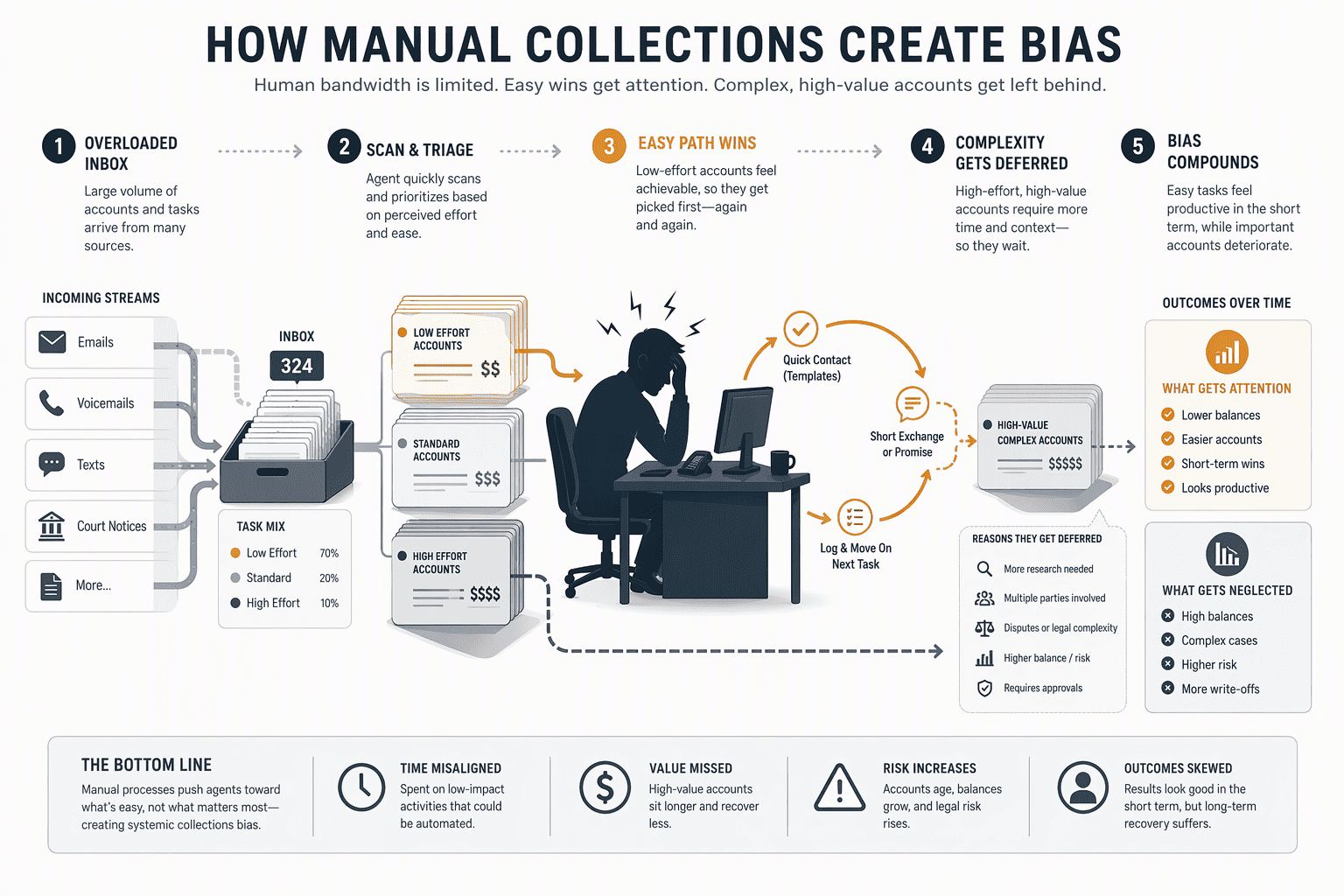
The behavioral economics of a collection floor are brutally predictable. Agents are not choosing wrong; they are following the path their brain wiring and incentives lay out for them:
Cognitive load minimization is the default operating mode: when task saturation exceeds threshold, the brain selects the action that requires the fewest steps. A templated email to a $200 balance always wins over a 30-minute call-prep for a contested $15,000 invoice.
Task-switching costs make deferral permanent: moving from a tough negotiation to a soft outreach and back consumes mental bandwidth. Agents avoid that switch by staying in the low-effort lane until the shift ends.
Incentive structures reward volume, not value: when performance metrics count contacts or promises-to-pay without weighting the underlying balance, the rational agent maximizes the numerator by closing the easiest accounts first.
No active segmentation drains recovery across the portfolio: without automated logic that quarantines hopeless cases and forces high-value accounts to the top of the queue, 80 percent of agent time bleeds into sub-$500 paper while large balances age past 120 days untouched.
Agent fatigue erodes complex negotiation capability: by the afternoon, a collector has depleted the emotional resilience needed for a confrontation with a sophisticated commercial debtor. The low-balance consumer contact becomes a refuge.
Legacy Collection Software: Better Tracking, Same Prioritization Bottlenecks
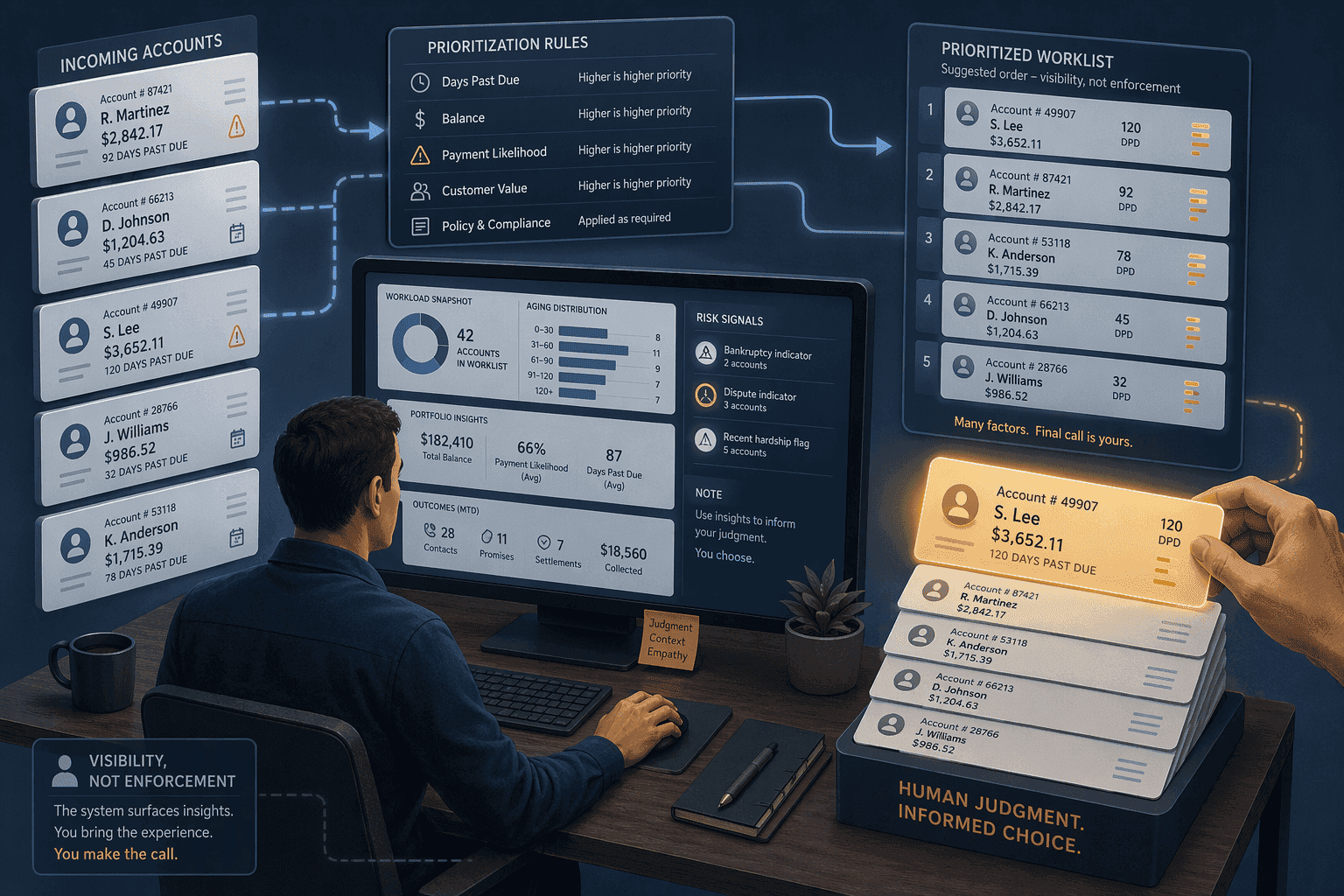
Visibility is not the same thing as enforcement. Legacy platforms gave collection managers dashboards they never had before, but they left the hardest problem untouched: the agent still picks which account to work.
The Collector Workspace Agent from Oracle, for example, applies business-defined prioritization rules so collectors focus on accounts based on risk, urgency, exposure, and collection impact. It surfaces key priority drivers and reduces time spent searching across multiple systems. That solves the data-fragmentation problem. But the system recommends a next-best action; it does not execute it, and it certainly does not lock the agent into a workflow that forbids cherry-picking the easy items. An agent under pressure, facing a worklist of 250 names with suggested urgency tags, will still gravitate toward what feels doable right now.
This is not a flaw in any one product. It is the ceiling of the "human-in-the-loop with a better dashboard" architecture. Tracking shows you the aging-bucket drift is happening.
It gives you the report that proves 80 percent of time stays on sub-$500 accounts. But it cannot stop the drift, because stopping it requires removing the human's discretion over what gets worked next. For that, you need an architecture that enforces priority, not one that politely suggests it.
Agentic AI Agents (Domu): A Dedicated Collector Per Account That Enforces Priority Logic
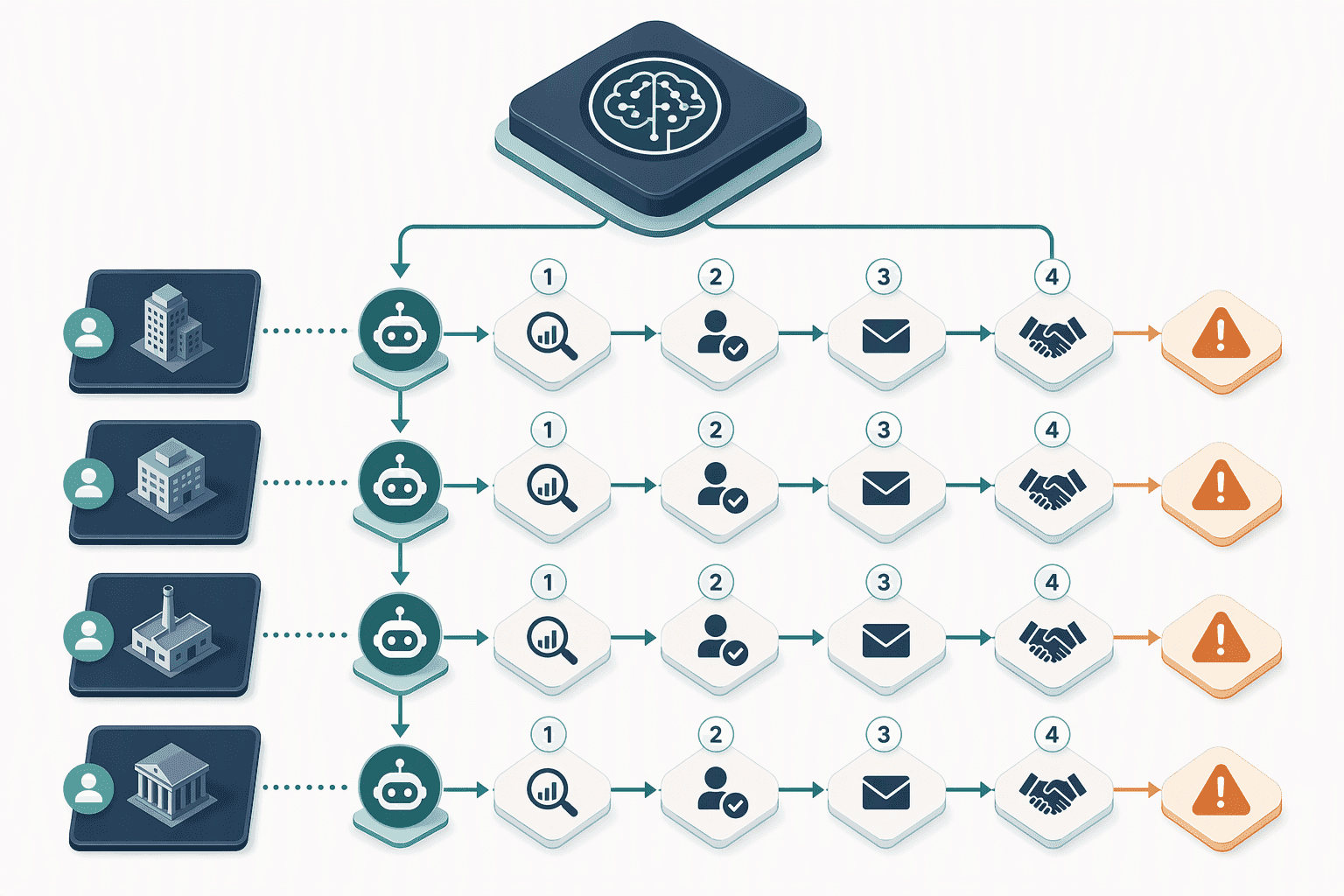
What if every account had its own collector, and no two accounts ever competed for the same agent's attention? That is the core architecture shift. Instead of one human triaging 250 cases, Domu AgentCollect assigns a dedicated AI agent to each account, handling research, right-party verification, outreach, negotiation, and escalation on a fixed, enforced timeline. Human fatigue, bias, and task-switching vanish from the prioritization equation because the human no longer schedules the work.
The performance numbers make the model concrete:
Recovery speed: Domu's AI agents achieve approximately 50 percent recovery in 20 days versus the industry's 20 to 30 percent over six months.
Debtor profiling: Contact Finder technology builds a detailed debtor profile from a single email at a 130 percent enrichment rate, solving the right-party contact problem before outreach begins.
Email engagement: Once contact is established, attorney-mode email framing drives open rates to 70 percent, completely reframing how a debtor perceives the communication.
Automated escalation: The AI agent escalates automatically based on debtor behavior patterns, so no account ages past its next action date without a trigger firing.
The problem of low-value accounts drifting untouched simply disappears in this architecture, because the system never gets tired and never picks the easy item over the important one.
Competitive Alternatives: Debtor Profiling and Routing Tools in 2026
The 2026 collections technology landscape is broader than the agentic AI category alone. Predictive dialers solve the outbound volume problem but magnify the prioritization gap: they dial more numbers faster, and nothing in the dialer logic distinguishes a $47 balance from a $47,000 one. They optimize throughput, which is exactly the metric that drives agents toward low-value volume.
Debtor profiling engines and workflow routing tools have matured significantly, offering sophisticated segmentation that flags which accounts are most workable. C&R Software's prioritization strategies layer risk scoring and behavioral signals onto the worklist. The limitation is architectural: the output remains a recommended action presented to a human who must choose to execute it.
RPA-based collection bots fill a narrower niche, automating repetitive data entry and status updates across systems. They reduce administrative drag and keep the collector in a single interface, a genuine efficiency gain. They have no enforcement capacity; they cannot stop the human from ignoring the high-value case that requires a difficult phone call. The defining line in 2026 sits between tools that advise prioritization and tools that enforce it. Anything that still puts the final call in a fatigued human's hands will, over time, produce the same low-value drift the industry has always had.
Banks and agencies evaluating the landscape should not mistake improved analytics for solved prioritization. A dashboard that shows you the problem in high resolution is useful but stops short of solving it. The architecture that ends the drift is the one where an autonomous agent does the work without waiting for a human to approve its selection.
Which Automation Tier Should You Choose Based on Portfolio Complexity
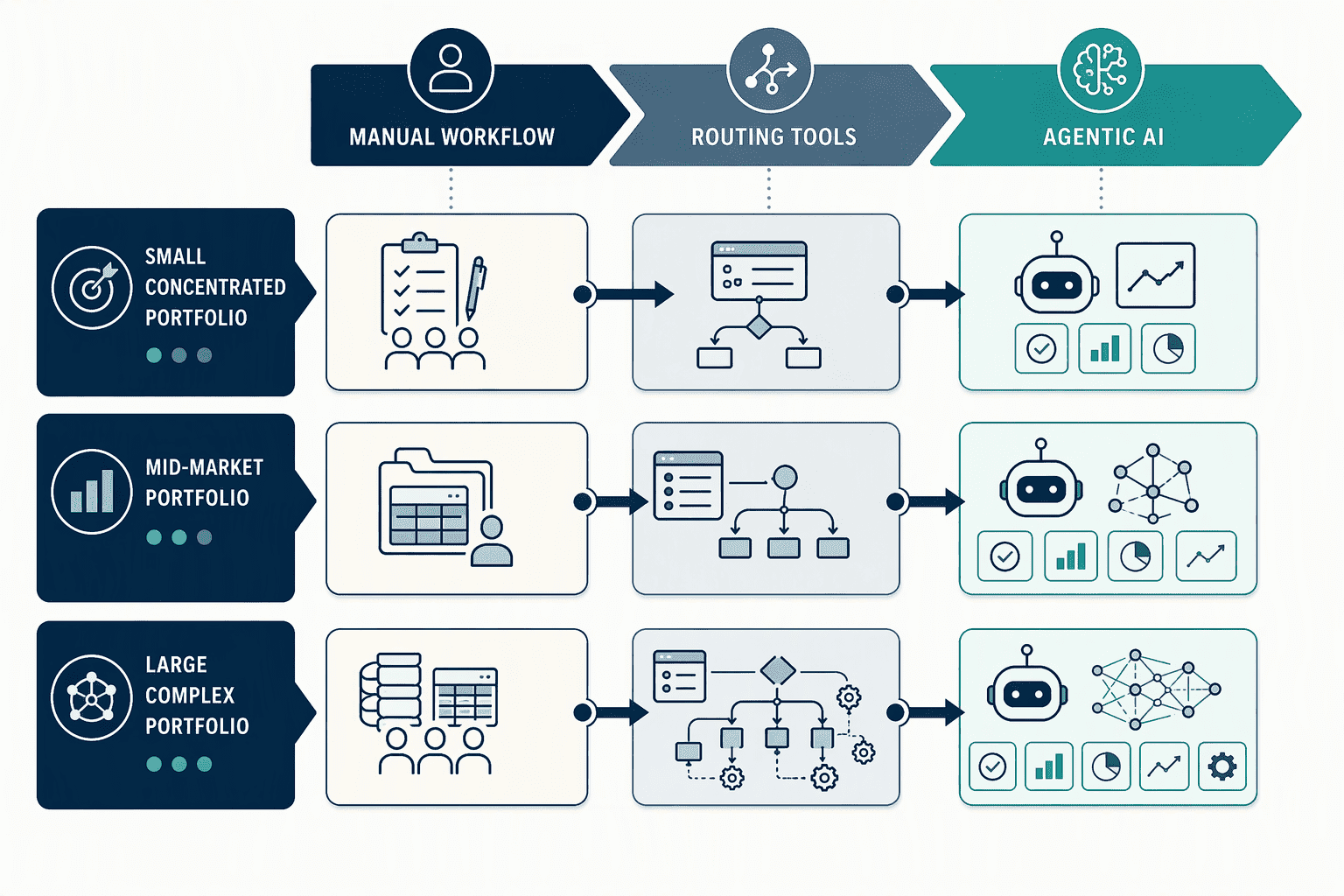
Fit the architecture to the portfolio, not the other way around. A three-person shop with 400 accounts does not need the same tooling as a mid-market bank with 80,000 consumer and commercial files. Match your approach to your scale with these guidelines:
Small portfolios (concentrated high-value relationships): A well-structured manual workflow paired with strong segmentation rules may be enough. The key disciplines here are ruthless account tiering and incentive redesign that rewards recovery on the top-quartile balances, not total contacts.
Mid-sized teams (50 to 70 accounts per collector): Once the cognitive-load ceiling hits, legacy collection software with enforced worklists and strong analytics can extend the team's capacity, provided the organization is willing to police adherence aggressively. The NACM guidelines on collector workload offer a useful baseline: define your segmentation dimensions, size queues to realistic capacities, and structure incentives around the desired behavior, not just output volume.
Large portfolios (several thousand accounts, mixed value, multi-state regulatory complexity): Agentic AI is the only architecture that keeps high-value cases from aging out. At a 250-to-1 account ratio and beyond, no human team, regardless of training or software, can maintain consistent priority enforcement. The dedicated-AI-per-account model scales without dilution, and it is particularly valuable in portfolios where right-party contact is the binding constraint.
If your team spends more than 20 percent of its time on accounts under $500, the architecture has already failed; run an audit of time-to-first-contact and call-to-close ratio by value tier before you blame the people.
Conclusion
Collection floors break down under a workflow design that asks agents to triage 250 competing demands while human cognition instinctively steers toward the easiest close. Manual and legacy-software models preserve agent discretion over what gets worked, and under operational pressure, that discretion reliably tilts toward low-value volume. Agentic AI removes the variable by enforcing priority through autonomous action, one dedicated collector per account.
The problem is architectural, not motivational. Audit your time-to-first-contact and call-to-close ratio segmented by account value. If top-quartile balances wait longer than the bottom, the system is designed to misallocate. Fix the architecture and the recovery numbers will follow.
Frequently Asked Questions
Why do collection agents gravitate toward low-value accounts despite clear prioritization policies?
Cognitive load minimization and incentive structures drive the behavior. When an agent faces 200-plus accounts, the brain defaults to the task requiring the fewest steps, typically a quick email to a small balance. If performance metrics reward contact volume rather than recovery value, the rational agent closes the easiest accounts first.
How does poor account segmentation drive inefficiency in debt collection workflows?
Without rigorous segmentation separating workable accounts from hopeless ones, agents spend hours on cases that will never pay. This drains focus from high-value recoverable debt, delays first contact on priority accounts by up to 18 days, and pushes aging buckets past 120 days while the floor stays busy on sub-$500 paper.
What metrics reveal that agents are misallocating time across account portfolios?
Three metrics expose the problem clearly:
Time-to-first-contact: stretched to 5 to 18 days for high-value accounts.
Call-to-close ratio: skewed with roughly 80 percent of time on accounts under $500.
Aging-bucket distribution: drifting systematically past 120 days because escalation never triggers.
How can collection agencies automate low-value account handling to refocus agents on high-priority cases?
Agencies can deploy dedicated AI collection agents that autonomously handle research, right-party contact, outreach, negotiation, and escalation per account. This achieves three key operational improvements:
Removes low-value accounts from the human queue entirely.
Enforces priority logic without agent discretion.
Lets human collectors focus only on complex, high-value negotiations.
What role do incentive structures and agent psychology play in account prioritization failures?
Incentives that reward total contacts or promises-to-pay without weighting the underlying balance push agents toward high-volume, low-value activity. Combined with task-switching costs and afternoon fatigue that depletes negotiation resilience, agents rationally avoid complex high-value cases in favor of quick, low-effort closures.
What technologies or strategies help enforce right-party contact and priority routing in 2026?
Technologies include debtor profiling engines that perform FBI-level enrichment from a single email at 130 percent improvement rates, attorney-mode email framing that achieves 70 percent open rates, and autonomous AI agents that execute priority-based routing and automated escalation without requiring a human to select which account to work next.
Sources
5 Best Debt Collection Analytics Tools - Domu AI: AI Agents Built For Intelligent Servicing - domu.ai
Guidelines for Assigning Collector Workload - nacm.org
Collector Workspace Agent for Prioritized Work Queue and Guided Resolution - docs.oracle.com
Working Paper No. 14-7 - The Economics of Debt Collection: Enforcement of Consumer Credit Contracts - www.fdic.gov
Segmentation Dimensions: Strategies for Effective A/R Management - www.highradius.com
Related Articles



We’re building the next generation of engagement technology: intelligent, automated and compliant. Our mission is to empower financial institutions to orchestrate every stage of the servicing lifecycle with dignity and unprecedented efficiency.
Supported by

